By Olasunkanmi Adeniyi, Chief AI Writer & Researcher for AI Discoveries
Word Count: ~3,500 words
Reading Level: Beginner
Last Updated: April 2026
Table of Contents
- What is AI? (Simple Definition)
- A Brief History of Artificial Intelligence
- How Does AI Actually Work?
- The 3 Main Types of AI
- Key AI Technologies Explained
- Real-World Examples of AI in 2026
- Benefits of Artificial Intelligence
- Risks and Limitations of AI
- AI vs. Human Intelligence: Key Differences
- The Future of AI: What’s Next?
- Frequently Asked Questions About AI
- Key Takeaways
1. What is AI? (Simple Definition)
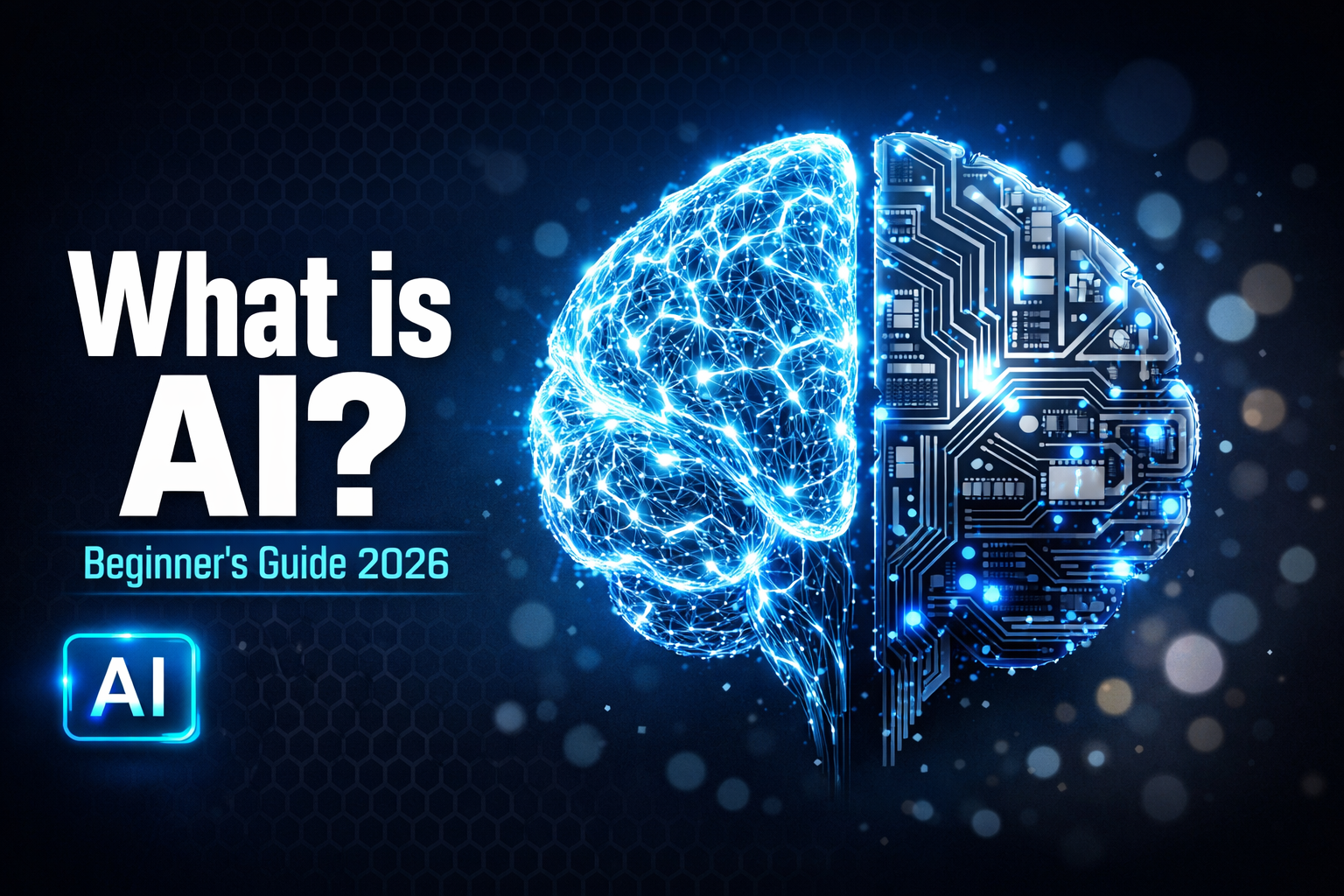
Artificial Intelligence (AI) is the ability of a computer or machine to perform tasks that would normally require human intelligence — things like understanding language, recognizing images, making decisions, and solving complex problems.
Think of AI as a very powerful pattern-recognition engine. Just as a child learns to identify a cat by seeing hundreds of cats, an AI system learns to identify patterns by processing millions — sometimes billions — of examples.
Read Also: AI Lead Generation Prompts for Claude and ChatGPT (2026 Edition) – AI Discoveries
Simple analogy: If a traditional computer program is a recipe (a fixed set of steps), then AI is a chef who has tasted thousands of dishes and can improvise a new one from scratch.
The term “Artificial Intelligence” was coined in 1956 by computer scientist John McCarthy, but in 2026, AI has moved from academic curiosity to a technology that shapes nearly every aspect of daily life — from the search results you see to the medicines your doctor recommends.
What AI is NOT
Before going deeper, it helps to clear up a few common misconceptions:
- AI is not magic. It is mathematics — specifically statistics, linear algebra, and calculus applied at enormous scale.
- AI is not a single technology. It is an umbrella term for dozens of techniques: machine learning, deep learning, natural language processing, computer vision, and more.
- AI is not (yet) conscious. Current AI systems do not think, feel, or have awareness. They process inputs and generate outputs based on patterns learned from data.
- AI is not infallible. AI systems make mistakes, inherit biases from training data, and can be confidently wrong.
2. A Brief History of Artificial Intelligence
Understanding where AI came from helps explain where it is today.
| Era | Milestone |
|---|---|
| 1950 | Alan Turing proposes the “Turing Test” — a benchmark for machine intelligence |
| 1956 | John McCarthy coins the term “Artificial Intelligence” at the Dartmouth Conference |
| 1966 | ELIZA, the first chatbot, is created at MIT |
| 1997 | IBM’s Deep Blue defeats world chess champion Garry Kasparov |
| 2012 | Deep learning revolution begins; AlexNet wins ImageNet competition |
| 2016 | Google’s AlphaGo defeats the world Go champion |
| 2017 | Google researchers publish the “Attention Is All You Need” paper, inventing the Transformer architecture that powers modern AI |
| 2022 | ChatGPT launches, bringing conversational AI to 100 million users in 2 months |
| 2024–2026 | Multimodal AI (text, image, audio, video) becomes mainstream; AI agents begin autonomously completing multi-step tasks |
The most important leap came in 2017 with the invention of the Transformer architecture, which enabled today’s large language models (LLMs) like GPT, Claude, and Gemini. This architecture allowed AI to process language in context — understanding not just words, but meaning, tone, and nuance.
3. How Does AI Actually Work?
At its core, AI works through a process called machine learning: instead of being programmed with explicit rules, an AI system is trained on large amounts of data and learns to find patterns.
Here is the simplified three-step process:
Step 1: Data Collection
AI systems need data — lots of it. A facial recognition model needs millions of labeled photos. A language model needs billions of words of text. A medical diagnostic AI needs thousands of X-rays with confirmed diagnoses. The quality and diversity of this data directly determines how good the AI becomes.
Step 2: Training
During training, the AI model processes the data repeatedly, adjusting its internal parameters (called “weights”) to minimize errors. This is done through an algorithm called backpropagation and an optimization technique called gradient descent.
Think of it like a student studying for an exam: each time they get a question wrong, they learn from the mistake and adjust their understanding. An AI model does this millions of times per second.
Step 3: Inference
Once trained, the model is deployed. When it receives a new input (a question, an image, a data point), it uses the patterns it learned during training to generate an output — a prediction, a classification, a generated response.
The Role of Neural Networks
Most modern AI is built on artificial neural networks — mathematical systems loosely inspired by the structure of the human brain. A neural network consists of:
- Input layer — receives raw data (pixels, words, numbers)
- Hidden layers — extract increasingly abstract features (edges → shapes → objects → concepts)
- Output layer — produces the final result (a label, a prediction, a generated token)
“Deep learning” simply means using neural networks with many hidden layers — sometimes hundreds — allowing the model to learn extremely complex representations.
Read Also: 50 ChatGPT Prompt Templates You Can Use Right Now (Free Download)
4. The 3 Main Types of AI
AI researchers broadly classify artificial intelligence into three categories based on capability:
Type 1: Narrow AI (Artificial Narrow Intelligence / ANI)
Also called “Weak AI”, this is the only type of AI that exists today. Narrow AI is designed to perform one specific task — and often performs it better than any human.
Examples:
- Spotify’s recommendation algorithm (music recommendations only)
- Tesla Autopilot (driving assistance only)
- DeepMind’s AlphaFold (protein structure prediction only)
- ChatGPT / Claude (language tasks only)
Despite the word “narrow,” modern narrow AI systems are extraordinarily powerful within their domain.
Type 2: General AI (Artificial General Intelligence / AGI)
AGI refers to an AI system with human-level intelligence across all domains — the ability to reason, learn, and apply knowledge to any task, just as a human can.
AGI does not yet exist. As of 2026, it remains one of the most debated topics in the field. Some researchers believe it is decades away; others argue we may be closer than expected. Anthropic, OpenAI, Google DeepMind, and others are all actively pursuing this goal while debating how to ensure it remains safe.
Type 3: Super AI (Artificial Superintelligence / ASI)
ASI is a hypothetical future AI that surpasses human intelligence in every domain — creativity, emotional understanding, scientific reasoning, social skills, and everything else.
ASI is purely theoretical at this point. It is the subject of both extraordinary excitement (it could solve cancer, climate change, and poverty) and existential concern (its goals may not align with humanity’s). Organizations like Anthropic were founded specifically to research how to ensure advanced AI systems remain safe and beneficial.
5. Key AI Technologies Explained
The field of AI encompasses many sub-disciplines. Here are the most important ones, explained plainly:
Machine Learning (ML)
The foundational technique that allows computers to learn from data without being explicitly programmed. All modern AI applications are built on machine learning.
Deep Learning
A subset of machine learning that uses multi-layered neural networks. Deep learning is responsible for breakthroughs in image recognition, speech recognition, and natural language processing.
Natural Language Processing (NLP)
The branch of AI that enables computers to understand, interpret, and generate human language. NLP powers chatbots, translation tools, search engines, and AI writing assistants.
Computer Vision
AI’s ability to interpret and understand visual information from images and video. Used in medical imaging, autonomous vehicles, facial recognition, quality control in manufacturing, and more.
Large Language Models (LLMs)
The technology behind tools like ChatGPT, Claude, and Gemini. LLMs are trained on enormous text datasets and can generate human-like text, answer questions, write code, analyze documents, and more. As of 2026, the most capable LLMs can handle text, images, audio, and video simultaneously — these are called multimodal models.
Generative AI
AI that can create new content — text, images, audio, video, 3D models, and code. Generative AI exploded into mainstream awareness in 2022–2023 and continues to advance rapidly. Key tools include ChatGPT, Claude, Midjourney, Sora, and Stable Diffusion.
Reinforcement Learning (RL)
A type of machine learning where an AI agent learns by trial and error, receiving rewards for good actions and penalties for bad ones. Used to train game-playing AI (like AlphaGo) and increasingly to improve language models through “Reinforcement Learning from Human Feedback” (RLHF).
AI Agents
One of the fastest-growing areas of AI in 2026. An AI agent is a system that can autonomously complete multi-step tasks by using tools, browsing the web, writing and executing code, and interacting with external services — with minimal human supervision.
6. Real-World Examples of AI in 2026
AI is no longer a future technology. It is present in virtually every industry. Here are concrete, real-world examples:
Healthcare
- Disease diagnosis: AI models analyze medical scans to detect cancers, eye diseases, and cardiac abnormalities, often with accuracy matching or exceeding specialist physicians.
- Drug discovery: AI dramatically accelerates the identification of new drug candidates. DeepMind’s AlphaFold solved a 50-year-old protein-folding problem and is now used by millions of researchers.
- Personalized medicine: AI analyzes a patient’s genetic data, lifestyle, and medical history to recommend tailored treatments.
Education
- Personalized tutoring: AI tutors adapt in real time to each student’s learning pace, identifying knowledge gaps and adjusting content accordingly.
- Automated grading: AI can assess essays, provide feedback on writing, and grade standardized tests at scale.
- Language learning: Apps like Duolingo use AI to personalize lessons and simulate natural conversations.
Business and Finance
- Fraud detection: Banks use AI to flag suspicious transactions in milliseconds, far faster than any human analyst.
- Algorithmic trading: AI systems execute trades based on real-time analysis of market data, news, and sentiment.
- Customer service: AI-powered chatbots handle millions of customer inquiries simultaneously, 24/7.
Transportation
- Autonomous vehicles: Companies like Waymo operate fully driverless robotaxi services in multiple U.S. cities.
- Traffic optimization: AI systems in cities like Singapore manage traffic light timing in real time to reduce congestion.
- Predictive maintenance: Airlines and rail operators use AI to predict equipment failures before they occur.
Creative Industries
- Content creation: Journalists, marketers, and authors use AI writing tools to draft articles, summarize research, and overcome writer’s block.
- Image and video generation: Filmmakers use AI to generate visual effects, create concept art, and even produce entire scenes.
- Music composition: AI tools generate original music in specific styles, moods, and genres.
Science and Research
- Climate modeling: AI processes vast climate datasets to produce more accurate weather and climate projections.
- Materials discovery: AI accelerates the discovery of new materials for batteries, semiconductors, and solar panels.
- Astronomy: AI systems analyze telescope data to identify new exoplanets, galaxies, and astronomical phenomena.
7. Benefits of Artificial Intelligence
Productivity and Efficiency
AI automates repetitive, time-consuming tasks, freeing humans to focus on creative, strategic, and interpersonal work. A task that takes a human analyst a week can sometimes be completed by AI in minutes.
Accuracy and Consistency
Unlike humans, AI does not get tired, distracted, or emotional. In domains like quality control, medical imaging analysis, and data processing, AI often achieves higher consistency than human operators.
Accessibility
AI is democratizing expertise. Tools that once required expensive consultants — legal research, financial analysis, medical information, software development — are now accessible to anyone with a smartphone.
Scientific Discovery
AI is accelerating the pace of science in ways that were simply impossible before. AlphaFold alone is estimated to have saved thousands of years of collective scientific labor.
Personalization
AI enables products and services to adapt to individual users at scale — from personalized education and healthcare to entertainment recommendations tailored to your exact tastes.
8. Risks and Limitations of AI
AI is a powerful technology with real risks that deserve honest discussion.
Bias and Fairness
AI systems learn from historical data, which often reflects historical biases. A hiring AI trained on past hires at a company may perpetuate gender or racial biases. A facial recognition system trained mostly on lighter-skinned faces may perform poorly on darker skin tones. Addressing AI bias is one of the central challenges of the field.
Misinformation and Deepfakes
Generative AI can create convincing fake images, videos, audio recordings, and written content. This creates serious risks for elections, public trust, journalism, and personal reputation.
Privacy
AI systems that process personal data — health records, location data, communication history — raise significant privacy concerns. Who owns this data? How is it secured? Who can access the insights derived from it?
Job Displacement
AI automation will eliminate some jobs and transform many others. The economic impact of this transition, and society’s responsibility to those affected, is a major policy debate in 2026.
Hallucinations
Current AI language models sometimes “hallucinate” — generating confident-sounding but factually incorrect information. Users must always critically evaluate AI outputs, especially for high-stakes decisions.
Safety and Alignment
As AI systems become more powerful, ensuring that they behave in ways that are aligned with human values and intentions becomes increasingly important — and increasingly difficult. This is the focus of AI safety research at organizations like Anthropic, DeepMind’s safety team, and academic institutions worldwide.
Concentration of Power
The most capable AI systems require enormous computational resources, concentrating power in the hands of a small number of companies and governments. This raises questions about competition, access, and democratic accountability.
9. AI vs. Human Intelligence: Key Differences
| Attribute | AI | Human |
|---|---|---|
| Speed | Processes data millions of times faster | Slower, but context-aware |
| Memory | Virtually unlimited storage | Limited working memory |
| Learning | Requires massive labeled datasets | Learns from few examples |
| Creativity | Recombines patterns from training data | Can generate genuinely novel ideas |
| Common sense | Struggles with basic real-world reasoning | Intuitive and automatic |
| Emotion | None (simulated output only) | Integral to decision-making |
| Adaptability | Limited outside training distribution | Highly flexible across new domains |
| Cost | High upfront training; cheap at scale | Expensive at scale |
| Explainability | Often a “black box” | Humans can articulate reasoning |
| Consciousness | No evidence of subjective experience | Self-aware |
The key insight: AI and human intelligence are not in direct competition — they are complementary. AI excels at speed, scale, and consistency. Humans excel at judgment, creativity, ethics, and navigating novel, ambiguous situations.
10. The Future of AI: What’s Next?
As of 2026, these are the most significant trends shaping the near future of AI:
Agentic AI
The shift from AI as a conversational tool to AI as an autonomous agent is accelerating. AI agents that can plan, use tools, browse the web, write code, and complete multi-step projects with minimal human oversight are becoming commercially viable. This will transform knowledge work dramatically over the next 2–5 years.
Multimodal AI
The next generation of AI models seamlessly processes and generates text, images, audio, and video — moving closer to how humans naturally perceive and interact with the world.
AI in Science
The application of AI to fundamental scientific problems — physics, biology, chemistry, materials science — may produce breakthroughs that rival anything in human history. Some researchers believe AI-assisted science may be approaching moments comparable to the invention of the scientific method itself.
AI Governance and Regulation
Governments worldwide are developing regulatory frameworks for AI. The EU’s AI Act (in force since 2024) is the most comprehensive law to date. The U.S., UK, China, and international bodies are all developing their own approaches. How regulation shapes AI development over the next decade is one of the most important questions in technology policy.
The Road to AGI
Whether or not AGI arrives in the next decade, AI capabilities will continue to expand. The question of how to ensure this expansion benefits everyone — and does not concentrate power or cause harm — is the defining challenge of our time.
11. Frequently Asked Questions About AI
Q: Is AI the same as a robot?
No. Robots are physical machines; AI is software. Some robots use AI to perceive and navigate their environment, but most AI runs as software in data centers with no physical body at all.
Q: Can AI think for itself?
Current AI systems do not “think” in any meaningful sense. They process inputs according to patterns learned during training. They have no goals, desires, or autonomous will. Ongoing research explores whether this might change with more advanced systems.
Q: Will AI take my job?
AI will automate specific tasks within many jobs, but historically technology has created more jobs than it has eliminated over the long run. The realistic near-term picture is that AI will transform most jobs — changing what tasks are required — rather than simply eliminating them wholesale. Jobs requiring deep human judgment, interpersonal skills, creativity, and physical dexterity are most resilient.
Q: Is AI dangerous?
Like any powerful technology, AI carries risks. Current risks include misinformation, bias, privacy violations, and misuse. Longer-term risks related to advanced AI systems are the focus of serious academic and industry research. AI is a tool — its impact depends heavily on how it is designed, deployed, and governed.
Q: How is AI different from traditional software?
Traditional software follows rules explicitly coded by a programmer: “if X, do Y.” AI software learns rules from data: “I’ve seen thousands of examples of X and Y — here is the pattern I’ve identified.” This is why AI can perform tasks that are too complex or ambiguous for traditional rule-based programming.
Q: What is the difference between AI and machine learning?
AI is the broad field; machine learning is a specific approach within it. All machine learning is AI, but not all AI is machine learning. Early AI systems used hand-coded rules; modern AI almost universally uses machine learning.
Q: What is generative AI?
Generative AI refers to AI models that create new content — text, images, audio, video, or code — rather than simply classifying or analyzing existing content. Tools like ChatGPT, Claude, Midjourney, and Sora are examples of generative AI.
Q: Who are the leading AI companies in 2026?
The leading AI companies include Anthropic (Claude), OpenAI (ChatGPT, GPT series), Google DeepMind (Gemini), Meta AI (Llama), Microsoft (Copilot), xAI (Grok), and Mistral AI. In hardware, NVIDIA dominates the GPU market that powers AI training.
Q: How can I start learning AI?
Great starting points include: fast.ai (practical deep learning course), Coursera’s Machine Learning Specialization by Andrew Ng, Google’s AI Essentials, and Anthropic’s Claude documentation. No prior programming experience is needed for introductory courses.
12. Key Takeaways {#key-takeaways}
- Artificial Intelligence is the ability of computer systems to perform tasks that would normally require human intelligence, such as understanding language, recognizing images, and making decisions.
- AI is not magic or science fiction — it is applied mathematics (statistics, calculus, linear algebra) running on specialized hardware.
- Three types of AI exist in theory: Narrow AI (today’s AI — task-specific), General AI (human-level, not yet achieved), and Superintelligence (hypothetical).
- Modern AI works through machine learning: the system learns patterns from large datasets rather than following explicitly programmed rules.
- Deep learning and Transformers are the architectural breakthroughs that enabled today’s most powerful AI systems.
- AI is already transforming healthcare, education, finance, transportation, science, and creative industries.
- Key risks include bias and fairness, misinformation, privacy, job displacement, hallucination, and long-term alignment challenges.
- AI and human intelligence are complementary, not competitors — AI excels at speed and scale; humans excel at judgment, creativity, and ethics.
- The most important AI trend in 2026 is the move toward autonomous AI agents that can complete complex, multi-step tasks with minimal human supervision.
Sources and Further Reading
- Turing, A. (1950). “Computing Machinery and Intelligence.” Mind, 59(236), 433–460.
- McCarthy, J. et al. (1955). A Proposal for the Dartmouth Summer Research Project on Artificial Intelligence.
- Vaswani, A. et al. (2017). “Attention Is All You Need.” Advances in Neural Information Processing Systems.
- Jumper, J. et al. (2021). “Highly accurate protein structure prediction with AlphaFold.” Nature, 596, 583–589.
- LeCun, Y., Bengio, Y., & Hinton, G. (2015). “Deep learning.” Nature, 521, 436–444.
- European Union (2024). EU Artificial Intelligence Act.
- Anthropic (2023). Claude’s Model Card and Safety Evaluations.
This guide was last updated in April 2026. The field of AI evolves rapidly — check back for updates.



Leave a Reply