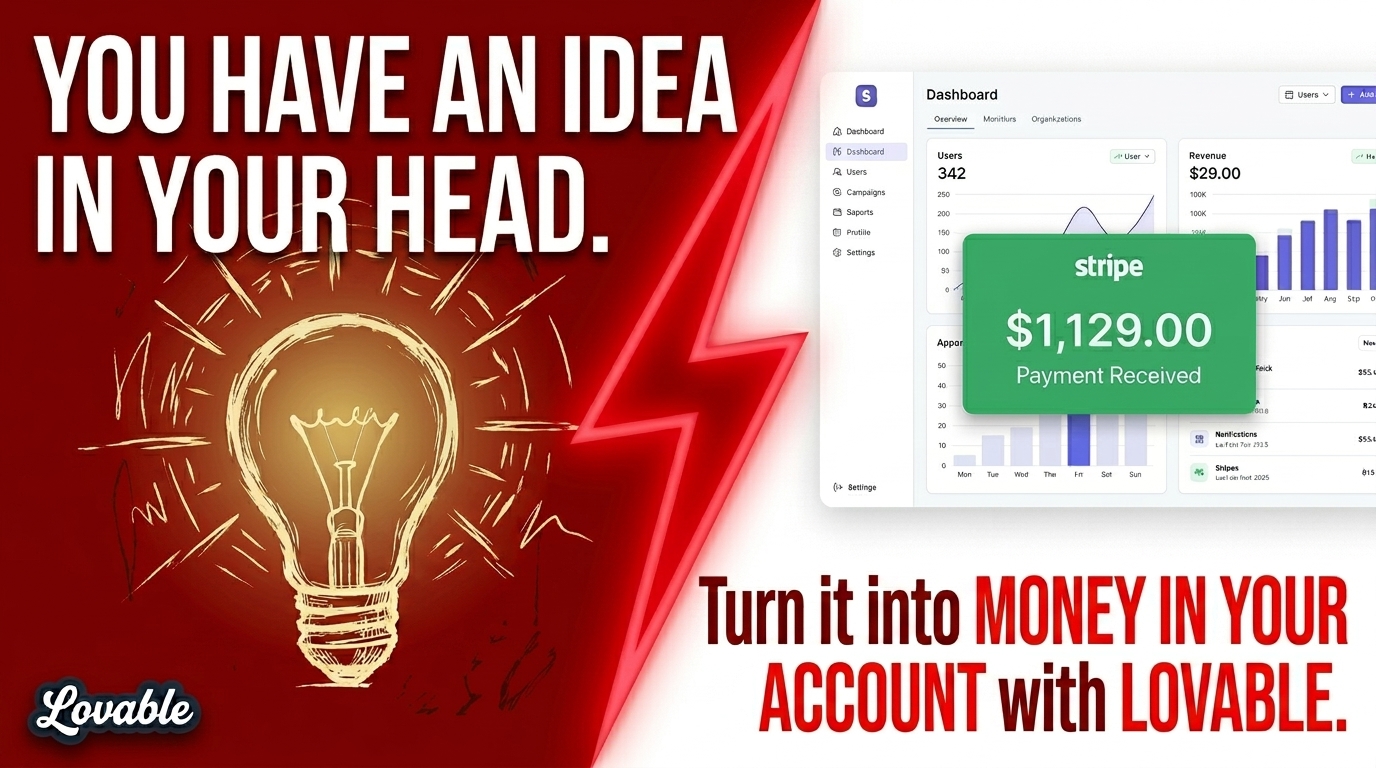
You have an idea. It has been sitting in your head for weeks, maybe months. A tool, an app, a SaaS product, a marketplace, a directory. You know it could make money. You just don’t know how to build it.
That was the problem before Lovable existed.
Lovable is an AI-powered app builder that lets anyone, regardless of coding experience, turn a product idea into a fully functional, deployable web application in hours, not months. No developers. No agency fees. No six-figure runway required.
This guide walks you through every step, from the raw idea in your head to your first paying customer, using Lovable.
WHAT IS LOVABLE AND WHY IT MATTERS IN 2025
Lovable (formerly GPT Engineer) is a full-stack AI development platform that generates real, production-ready code from plain English prompts. Unlike no-code tools that lock you into rigid templates, Lovable produces actual React and TypeScript code you own and can export. It connects to Supabase for your database and authentication, integrates with Stripe for payments, and can be deployed to the web in one click.
In plain terms: you describe what you want to build, and Lovable builds it. You iterate with follow-up prompts. You publish. You sell.
The reason this matters is simple. The gap between having an idea and having a product used to require a technical co-founder, a freelance developer costing $5,000 to $50,000, or years of learning to code yourself. Lovable collapses that gap to a weekend.
WHO THIS GUIDE IS FOR
This guide is for anyone who has a product idea but no technical background. Consultants who want to productize their expertise. Freelancers who want recurring revenue. Entrepreneurs validating a concept before raising money. Side-hustlers who want to ship something real. Content creators who want to sell tools to their audience.
If you can describe what your product should do in plain language, you can build it with Lovable.
STEP 1: CLARIFY AND VALIDATE THE IDEA BEFORE YOU BUILD ANYTHING
The most expensive mistake you can make is building something nobody wants. Lovable is fast, but fast in the wrong direction is still wasted effort.
Before you open Lovable, spend thirty minutes answering these four questions honestly.
What specific problem does your product solve? Be brutally specific. “It helps people with productivity” is not a problem. “It helps freelancers automatically generate invoices from their time-tracking data” is a problem.
Who has this problem badly enough to pay for a solution? Name them. Solo consultants. E-commerce store owners. HR managers at startups. The tighter you define your customer, the easier your marketing becomes.
What does a basic version of the solution look like? Strip away every nice-to-have. What is the absolute minimum that would solve the problem well enough for someone to pay for it? This is your Minimum Viable Product, or MVP.
Is there evidence people want this? Search Reddit, Facebook Groups, Twitter, and forums in your niche. Are people asking for this? Are they complaining about the problem it solves? Are there competitors charging money for something similar? Competitors are validation, not discouragement.
If you can answer all four questions, you are ready to build.
STEP 2: WRITE YOUR LOVABLE PROMPT LIKE A PRODUCT BRIEF, NOT A WISH LIST
The quality of what Lovable builds depends heavily on how you describe it. Most beginners write prompts that are too vague. They type something like “build me an app for freelancers” and then wonder why the result doesn’t match their vision.
Write your initial prompt as a mini product brief. Structure it like this:
Start with the product name and what it does. State who it is for. List the core features of the MVP only. Describe the key user flow, meaning what the user does when they open the app. Mention any integrations you need, such as user login, a database, or Stripe payments.
Here is an example of a weak prompt: “Build me a tool for freelancers to manage their clients.”
Here is an example of a strong prompt: “Build a web app called ClientPulse for freelance designers and developers. Users can log in, add clients, log hours worked per client, and generate a PDF invoice automatically based on those hours with their hourly rate. The app should have a clean dashboard showing total hours and earnings per client this month. Use Supabase for authentication and data storage.”
The second prompt gives Lovable everything it needs to make real decisions. The result will be dramatically better.
STEP 3: BUILD YOUR MVP IN LOVABLE
Go to lovable.dev and create a new project. Paste your product brief prompt into the editor and submit it.
Lovable will generate the full application: the user interface, the logic, the database schema, the authentication flow. This typically takes between one and three minutes.
When it finishes, you will see a live preview of your app on the right side of the screen. Use it. Click through it as if you are a real user. Note everything that is missing, broken, or confusing.
Now iterate with follow-up prompts. Treat each follow-up prompt as a small, specific instruction. Do not try to change ten things in one prompt. Change one thing at a time. This gives you control and makes it easier to reverse changes you don’t like.
Examples of good follow-up prompts: “Add a button on the invoice page that lets the user download the invoice as a PDF.” “Change the dashboard to show a bar chart of earnings per month.” “When a user signs up, send them a welcome email with their login link.”
Continue this cycle, preview and iterate, until the core user flow works end to end. You do not need it to be perfect. You need it to work well enough for a real person to pay for it.
STEP 4: CONNECT YOUR DATABASE AND AUTHENTICATION WITH SUPABASE
Lovable has native integration with Supabase, which is a free open-source backend that gives your app a real database, user authentication, file storage, and security rules.
Inside your Lovable project, click the Supabase integration button and connect your Supabase account. Lovable will automatically create the necessary tables and relationships in your database based on what your app needs.
This is the step that makes your app real. Before connecting Supabase, your app is a prototype. After connecting it, it can store real data, support real users logging in, and persist information between sessions.
If your app involves user accounts, and most money-making products do, you must complete this step before launching.
STEP 5: ADD PAYMENTS WITH STRIPE
An app that cannot take money is a hobby project, not a product. Lovable supports Stripe integration, which means you can add subscriptions, one-time payments, or usage-based billing directly into your app.
Decide on your pricing model first. The three most common for indie products are a flat monthly subscription, a one-time payment for lifetime access, and a freemium model where the base is free and premium features cost money.
For a first product, a simple flat monthly subscription is the easiest to build and maintain. Price it based on the value the customer gets, not the time it took you to build it.
In Lovable, prompt it to add Stripe checkout to your app. For example: “Add a Stripe checkout button on the pricing page. When clicked, it redirects the user to a Stripe payment page for a monthly subscription at $29 per month. After successful payment, mark the user as a paid subscriber in Supabase and unlock the premium features.”
Connect your Stripe account, set up your products and prices inside the Stripe dashboard, and then copy the price IDs back into your Lovable prompts. Test the entire payment flow using Stripe’s test mode before going live.
STEP 6: DESIGN FOR TRUST, NOT FOR ART
Most first-time builders spend too much time on visual design and not enough time on the experience of trust. When a stranger visits your app, they are unconsciously asking: Is this real? Will this work? Can I trust this person with my money?
You build trust through a few specific elements. A clear headline on your landing page that states exactly who the product is for and what it does. Real social proof, even if it is just two or three testimonials from beta users you gave free access to. A simple pricing page with no confusing tiers. An FAQ that addresses the most obvious objections. A way to contact you, even just an email address.
Ask Lovable to build a landing page for your product. Give it your headline, your key benefits, your pricing, and a call to action button. A strong landing page prompt looks like this: “Build a marketing landing page for ClientPulse. The headline is: The Invoice Tool Built for Freelancers Who Hate Admin. Include a features section with three benefits, a pricing section showing one plan at $29 per month, three placeholder testimonials, and a sign-up button that links to the app.”
STEP 7: DEPLOY YOUR APP TO A REAL DOMAIN
Lovable lets you publish your app instantly with one click using their built-in hosting. Your app gets a Lovable subdomain, which is fine for testing, but you should connect a custom domain before you start selling.
Buy a domain from Namecheap or Cloudflare. Something short, memorable, and relevant to the problem you solve. Then go into your Lovable project settings, find the custom domain option, and follow the instructions to point your domain to your Lovable deployment.
This step takes about ten minutes and adds significant credibility. A product living at clientpulse.io converts far better than one living at clientpulse.lovable.app.
STEP 8: GET YOUR FIRST TEN CUSTOMERS MANUALLY
This is where most builders go wrong. They launch and wait. They post once on Twitter and check their Stripe dashboard obsessively. Nothing happens and they conclude their product failed.
Your first ten customers will not find you organically. You will find them.
Go back to the communities where you validated your idea in Step 1. Reddit threads. Facebook groups. LinkedIn. Twitter or X. Discord servers. Find the people who are experiencing the exact problem your product solves. Talk to them directly. Not with a sales pitch, but with a genuine offer to help.
Tell them you built something that solves the problem they have been complaining about. Offer them free access for a week. Ask for their honest feedback. If your product genuinely helps them, ask if they would pay for it. When they say yes, send them your Stripe payment link.
Your first ten customers will teach you more about your product than any amount of design thinking. They will tell you what is confusing, what is missing, and what they love. Use that to improve the product.
STEP 9: TURN FEEDBACK INTO IMPROVEMENTS WITH LOVABLE
This is where the speed of Lovable becomes your competitive advantage. Traditional development makes changes slow and expensive. With Lovable, you can take a piece of feedback in the morning and ship the improvement by afternoon.
Create a simple feedback system. This can be as basic as a Google Form linked from your app, or a short Typeform survey you email to users. Ask two questions: What is the one thing you wish this app did that it currently doesn’t? Is there anything in the app that confuses you?
Collect that feedback, turn it into Lovable prompts, and iterate. Each improvement cycle makes your product more valuable and your customer retention stronger.
STEP 10: PRODUCTIZE YOUR DISTRIBUTION
Once you have confirmed that real people will pay for your product, the question shifts from can I build this to how do I reach more customers.
The channels that work best for indie products built with tools like Lovable tend to be content-driven. Write about the problem your product solves. Create short video tutorials showing how your app works. Share your building journey on Twitter or LinkedIn. Answer questions on Reddit and Quora that your product addresses, and mention your tool when it is genuinely relevant.
SEO is a long-term channel worth investing in early. Write blog posts targeting keywords your potential customers are searching for. If you built an invoice tool for freelancers, write articles like “how to send an invoice as a freelancer,” “best invoice apps for designers,” and “how to track billable hours.” Each piece of content you publish is a permanent asset that can drive traffic to your product for years.
Product Hunt is worth a launch if your product is polished. It gives you a burst of early adopters and social proof that helps with conversion.
COMMON MISTAKES TO AVOID WHEN BUILDING WITH LOVABLE
Building too much before talking to customers. The temptation when building is free and fast is to keep adding features. Resist it. Validation comes from customers, not features.
Ignoring the prompt quality. Vague prompts produce vague products. Invest time in writing clear, specific, well-structured prompts. It saves hours of back-and-forth.
Skipping the payment integration. A product with a waitlist is not a product. A product with paying customers is. Connect Stripe as early as possible. Getting that first payment notification is the moment everything becomes real.
Setting the price too low. Founders consistently underprice their first product. If your product saves a freelancer two hours per week and they bill at $75 per hour, your product is worth at least $50 per month to them. Price based on value delivered.
Building for everyone. The narrower your target customer in the early days, the better your conversion will be. A tool for freelance graphic designers will outsell a tool for all freelancers every time, because the messaging is more relevant.
HOW LONG DOES THIS ACTUALLY TAKE
A realistic timeline for a first product built with Lovable looks like this. Day one: validate the idea and write your product brief. Day two: build the MVP in Lovable, connect Supabase and Stripe, deploy to a custom domain. Days three through five: manually reach out to potential customers, get three to five people using it for free. Day seven: follow up, ask for paid conversions, use feedback to make improvements.
That is one week from idea to first revenue. Not one year. Not one month. One week.
THE BOTTOM LINE
The only thing standing between the idea in your head and your first money-making product is the decision to start building. Lovable removes every technical barrier that used to stop non-developers from shipping real software products.
You do not need to know how to code. You do not need a co-founder. You do not need to raise money. You need a clear problem, a specific customer, a focused MVP, and the willingness to put something imperfect in front of real people and improve it based on what you learn.
The best time to build your first product was a year ago. The second best time is today.
Go to lovable.dev, open a new project, and write that first prompt



Leave a Reply