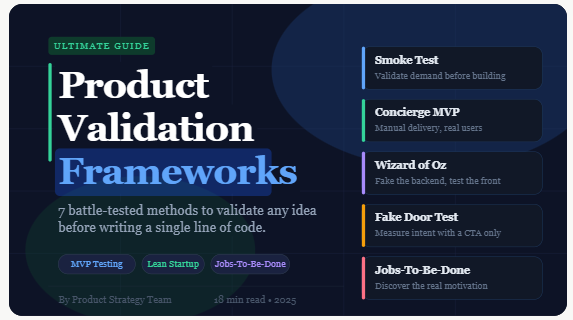
Discover the 7 most effective product validation frameworks used by top product teams at Airbnb, Dropbox, and beyond. Stop wasting months building the wrong thing.
Reading time: 18 minutes Last updated: 2026
Table of Contents
- What Is Product Validation? (And Why Most Teams Skip It)
- The Cost of Skipping Validation
- The 7 Core Product Validation Frameworks
- 1. The Smoke Test
- 2. Concierge MVP
- 3. Wizard of Oz Testing
- 4. Fake Door (Painted Door) Test
- 5. Jobs-To-Be-Done (JTBD) Framework
- 6. Problem Interview Framework
- 7. The Riskiest Assumption Test (RAT)
- How to Choose the Right Validation Framework
- The Validation Stack: Combining Frameworks
- Common Validation Mistakes (And How to Avoid Them)
- Frequently Asked Questions
1. What Is Product Validation? (And Why Most Teams Skip It)
Product validation is the process of testing whether a product idea solves a real problem for a real audience before committing significant time, money, or engineering resources to building it.
Read Also: How to Turn Your Idea Into a Money-Making Product With Lovable (Step-by-Step Guide for Non-Coders)
It sounds obvious. It rarely happens.
Most product teams skip validation for three predictable reasons:
- Confirmation bias: The team already believes in the idea and doesn’t want data that contradicts it.
- Speed pressure: Stakeholders want to ship, not research. Validation feels like delay.
- Misplaced confidence: “We know our users.” (They usually don’t.)
The result is the same every time: teams spend months building something users don’t actually want, then wonder why adoption is flat.
Product validation frameworks provide a structured, repeatable method for testing assumptions cheaply and quickly — before a single line of production code is written.
Key definition: A product validation framework is a structured approach for testing whether a proposed product, feature, or business model is desirable (do people want it?), feasible (can we build it?), and viable (can we sustain a business around it?) — using the minimum amount of resources possible.
2. The Cost of Skipping Validation
According to CB Insights’ post-mortem analysis of startup failures, 42% of startups fail because there was no market need for their product. Not because of poor engineering, not because of bad marketing — because nobody wanted the thing they built.
In enterprise product teams, the number is no better. McKinsey estimates that 50–75% of new product launches fail to meet their business objectives within the first year.
The mathematics of this are brutal:
- A typical product development cycle costs $250,000–$2M in engineering time alone
- The average time to ship a new product feature is 4–12 months
- A validation sprint, by contrast, costs $5,000–$20,000 and takes 2–4 weeks
You do not need to build to learn. Validation frameworks let you learn without building.
3. The 7 Core Product Validation Frameworks
Framework 1: The Smoke Test
Best for: Validating demand before any product exists
What it is
A smoke test (also called a landing page test) involves presenting your product as if it already exists to measure whether real users will take a meaningful action — typically signing up, pre-ordering, or clicking a call-to-action. If people engage, you have signal. If they don’t, you have an equally valuable signal.
The name comes from electronics: before you fully assemble a circuit board, you “apply smoke” to see if anything burns. In product terms, you’re checking whether the idea catches fire before you wire up the full system.
How it works
- Build a minimal landing page describing the product’s core value proposition.
- Include a clear CTA — sign up, pre-order, join waitlist, download.
- Drive targeted traffic via paid ads, social posts, or email campaigns.
- Measure conversion rate against a pre-defined success threshold.
- Do not build the product until you hit the threshold.
Real-world example
Dropbox’s famous 2007 explainer video is the canonical smoke test. Drew Houston published a demo video of software that didn’t exist and generated 75,000 signups overnight. The waiting list itself validated the product before a single line of production code was committed.
Key metrics to track
- Landing page conversion rate (industry benchmark: 2–5% is weak, 10%+ is strong signal)
- Cost per lead (CPL) from paid traffic
- Email open and click rates if using a waitlist
When to use it
Use the smoke test at the very earliest stage of idea formation — before you’ve committed to a roadmap, before you’ve briefed engineering, before you’ve written a product spec. It is the fastest and cheapest form of market validation available.
Limitations
Expressing interest is not the same as paying. A smoke test validates intent, not willingness to exchange money or long-term behaviour. Follow up with a concierge MVP or fake door test to validate purchase intent.
Framework 2: The Concierge MVP
Best for: Validating that your solution actually solves the problem (not just that the problem exists)
What it is
A concierge MVP involves delivering the value proposition of your product entirely manually — by humans, without automation or technology — to a small number of real users. You act as the product. You perform the service yourself.
This is the direct opposite of scalable. That’s the point. Scalability is an engineering problem you solve after you’ve confirmed the model works. Before that, it’s noise.
How it works
- Identify 5–10 target users who have the problem your product claims to solve.
- Offer to solve their problem for free (or at cost) using entirely manual processes — spreadsheets, email, phone calls, white-glove service.
- Observe every friction point, every workaround, every moment of confusion.
- Measure whether users actually experience the value you promised.
- Iterate on the manual process until the model reliably works. Then, and only then, begin automating it.
Real-world example
Airbnb’s founders personally photographed properties, wrote listings, and coordinated bookings manually in the early days. Food on the Table, a meal-planning startup, had its founder personally shop for groceries and deliver meal plans. Both discovered critical insights about user needs that no prototype or mockup would have revealed.
Key signals to watch for
- Do users complete the full workflow or abandon partway through?
- Which steps require the most hand-holding?
- Are users willing to pay once they’ve experienced the value?
- What are users doing that you didn’t expect?
When to use it
The concierge MVP is most effective when you’re validating a service-oriented product, a two-sided marketplace, or any workflow-heavy solution where user behaviour is unpredictable. It’s also invaluable when your product category is new and users have no mental model for what “using it” looks like.
Framework 3: The Wizard of Oz Test
Best for: Products where building the real technology is expensive or technically complex
What it is
In a Wizard of Oz test, users interact with what appears to be a fully functional product, but the “intelligence” or automation behind it is actually a human operator performing those functions in real time, hidden from the user.
Like the wizard behind the curtain, the mechanics are concealed. Users believe they’re using a real product. You’re watching what they actually do with it.
How it works
- Build a frontend interface that looks and feels like a real product.
- Connect it to human operators (the “wizards”) who manually perform what the product would eventually automate.
- Recruit users and have them complete real tasks using the interface.
- Document their behaviour, confusion, delight, and abandonment points.
- Use the findings to validate the core mechanic before investing in the backend.
Real-world example
Zappos founder Nick Swinmurn photographed shoes at local stores and posted them online. When orders came in, he went back to the store, bought the shoes at retail, and shipped them to customers. He wasn’t operating a supply chain — he was operating a Wizard of Oz test to validate that people would buy shoes online.
When to use it
Use this framework when your product depends on AI, complex algorithms, or backend infrastructure that would be expensive to build upfront. If you’re building an AI-powered product, this is particularly relevant: have humans provide the “AI responses” manually while you observe how users interact with and react to the interface.
Cost vs. concierge MVP
The distinction from a concierge MVP is that in a Wizard of Oz test, users believe the automation is real. In a concierge MVP, the manual delivery is usually transparent to the user. Both are valid; which to use depends on whether transparency would bias user behaviour.
Framework 4: The Fake Door (Painted Door) Test
Best for: Validating interest in specific features within an existing product
What it is
A fake door test involves adding a button, menu item, or CTA for a feature that doesn’t yet exist. When users click it, they are shown a message explaining the feature is coming soon, or they’re redirected to a waiting list. You measure click rate to gauge demand.
How it works
- Identify a feature hypothesis: “Users want X.”
- Add a button or navigation element for that feature in your existing product.
- Instrument the button with click tracking.
- When clicked, display a “Coming soon — join the waitlist” screen or a brief explanation.
- Measure click-through rate. Set a threshold before you run the test (e.g., if fewer than 5% of users click within 30 days, we will not build this).
Key metrics
- Click rate on the fake door element (normalised against exposure)
- Waitlist sign-up conversion rate
- User comments or support tickets following the click
When to use it
The fake door test is ideal for product teams with an existing user base who want to prioritise features without running full usability studies. It is among the most data-efficient validation tools available because it captures real intent — users who click a button are more serious than users who say they want something in a survey.
Ethics and transparency
Some teams worry about deceiving users. The solution is to be transparent in the messaging after the click: “This feature doesn’t exist yet — we’re testing interest. Thank you for helping us prioritise.” Most users respond positively to being part of the process.
Framework 5: The Jobs-To-Be-Done (JTBD) Framework
Best for: Understanding the deep motivation behind why users adopt or avoid products
What it is
Jobs-To-Be-Done is a demand-side theory of innovation developed by Clayton Christensen. The central insight: people don’t buy products — they hire products to do a job. The “job” is the progress a person is trying to make in a specific circumstance.
Understanding the job lets you design validation experiments that test the actual motivation, not the surface-level behaviour.
The JTBD structure
Every job has three components:
- Functional dimension: The practical task the user is trying to accomplish.
- Emotional dimension: How the user wants to feel while doing it or as a result.
- Social dimension: How the user wants to be perceived by others.
A complete job statement follows the structure: “When [situation], I want to [motivation], so I can [expected outcome].”
How to apply it for validation
- Recruit 8–12 users who have recently switched to or from a competing product in your space.
- Conduct switch interviews (developed by Bob Moesta): ask them to walk you through the exact moment they decided to look for a new solution, what they tried first, why it didn’t work, and what ultimately made them switch.
- Map the forces that shaped the decision: push (dissatisfaction with the current solution), pull (attraction to the new solution), anxiety (fear of switching), and habit (inertia).
- Identify the core job your product is being hired to do. Validate that your product actually does that job better than the existing alternative.
Real-world example
Snickers famously repositioned as a hunger solution (“You’re not you when you’re hungry”) after JTBD analysis revealed that the job wasn’t “I want a chocolate bar” but rather “When I’m irritable and can’t focus because I haven’t eaten, I want something filling and satisfying so I can get back to normal.” That insight informed product positioning, not engineering — but it’s equally applicable to product validation.
When to use it
Use JTBD interviews early in the discovery phase, especially when you’re entering a crowded market or when users say they want your product but don’t convert. It’s also powerful when usage data shows people using your product in unexpected ways.
Framework 6: The Problem Interview Framework
Best for: Validating that a problem is real, frequent, and worth solving
What it is
Developed by Ash Maurya (of Lean Canvas fame), the problem interview is a structured qualitative research method for confirming that the problem you intend to solve is genuinely experienced by your target users — and is painful enough that they’d pay for a solution.
Many ideas die here. They die because the “problem” turned out to be a minor inconvenience, something users had already solved well enough with existing tools, or something only the founders experienced.
The interview structure
A well-run problem interview follows five stages:
- Welcome (2 min): Set context. Explain you’re learning, not selling. Ensure the user knows this is not a product demo.
- Collect demographics (2 min): Understand who this person is in the context of the problem domain. This anchors their perspective.
- Tell a story (4 min): Describe the problem in neutral, jargon-free language. Ask if they’ve experienced it. If yes, ask them to describe the last time it happened.
- Problem ranking (5 min): Present your top 3 problem hypotheses. Ask users to rank them by pain. Listen for what they add, subtract, or reframe.
- Explore the existing solution (5 min): Ask how they currently solve the problem. What do they use? How much do they spend? How painful is the current solution?
What you’re testing
- Is this problem real? (Do users confirm it unprompted?)
- Is it frequent? (Is it a daily/weekly frustration or a once-a-year event?)
- Is it important? (Do users rank it high among their problems?)
- Is the current solution inadequate? (Are they actively looking for something better?)
Success criteria
If 7 out of 10 users confirm the problem, rank it as important, and describe the current solution as inadequate, you have validated the problem. If fewer than 5 confirm it, pivot your hypothesis before spending another hour on solution design.
Framework 7: The Riskiest Assumption Test (RAT)
Best for: De-risking complex products with multiple interdependent assumptions
What it is
The Riskiest Assumption Test is a systematic approach to identifying and isolating the single assumption that, if wrong, would invalidate the entire business model — then testing that assumption with the smallest possible experiment.
The RAT is a meta-framework. It doesn’t prescribe a specific research method; it tells you what to test first. It pairs with any of the six frameworks above.
How it works
- List every assumption your product model depends on. Include desirability assumptions (“users will want this”), feasibility assumptions (“we can build this”), and viability assumptions (“we can monetise this”).
- Rate each assumption on two dimensions:
- How critical is this assumption? (1–10: if this is wrong, how badly does the model fail?)
- How confident are we that it’s true? (1–10: based on existing evidence)
- The riskiest assumption is the one with the highest criticality and the lowest confidence. This is what you test first.
- Design the smallest possible experiment to test that assumption. This could be a smoke test, a concierge MVP, a problem interview, or a single data query from your analytics platform.
- Run the experiment, update your confidence score, then move to the next riskiest assumption.
The RAT vs. the MVP
The RAT is often contrasted with the Minimum Viable Product. The MVP builds a complete, shippable (if minimal) product. The RAT builds nothing — it isolates one assumption and tests only that. The RAT is faster and cheaper. The MVP provides broader signal and begins building product equity. In early-stage validation, the RAT comes first.
Example assumption mapping
For a B2B SaaS product designed to automate procurement approvals:
| Assumption | Criticality | Confidence | Priority |
|---|---|---|---|
| Finance teams spend 3+ hours/week on approvals | 9 | 4 | Test first |
| Companies will integrate our tool with their ERP | 8 | 5 | Test second |
| Procurement managers have authority to buy tools | 7 | 6 | Test third |
| $299/mo is within budget | 6 | 5 | Test fourth |
Run a problem interview to test Assumption 1 before building anything else.
4. How to Choose the Right Validation Framework
Different frameworks are suited to different stages and questions. Use this decision logic:
At the idea stage (zero users, zero product): Start with problem interviews and the JTBD framework to confirm the problem is real and understand the motivation. Then run a smoke test to measure demand.
At the concept stage (defined solution, no product): Use a fake door test if you have an existing user base, or a landing page smoke test if you don’t. The goal is to test the value proposition, not the product.
At the prototype stage (basic product exists, not shipped): A concierge MVP or Wizard of Oz test lets real users interact with the workflow and uncovers behaviour you couldn’t have anticipated in user stories.
At the growth stage (product ships, features are added): Fake door tests and the Riskiest Assumption Test help prioritise the roadmap based on observed demand rather than stakeholder opinion.
The shortest framework selection checklist:
- Do I know if the problem is real? → Problem Interview
- Do I know why people switch products in this space? → JTBD
- Do I know if people want my specific solution? → Smoke Test
- Do I know if the solution actually works? → Concierge MVP or Wizard of Oz
- Do I know if users will engage with a specific feature? → Fake Door
- Do I know what to test first? → RAT
5. The Validation Stack: Combining Frameworks
The highest-performing product teams don’t choose one framework — they use a validation stack. Each layer reduces a different category of risk.
Layer 1 — Discovery (reduce problem risk) Tools: Problem Interview, JTBD Output: Confirmed problem statement with demand evidence
Layer 2 — Concept (reduce solution risk) Tools: Smoke Test, Fake Door, Landing Page Test Output: Validated value proposition with intent metrics
Layer 3 — Delivery (reduce execution risk) Tools: Concierge MVP, Wizard of Oz Output: Validated workflow with behavioural evidence
Layer 4 — Scale (reduce growth risk) Tools: A/B tests, cohort analysis, RAT applied to growth assumptions Output: Validated acquisition and retention model
Move through the layers in sequence. Do not jump to Layer 3 without evidence from Layers 1 and 2.
6. Common Validation Mistakes (And How to Avoid Them)
Mistake 1: Asking people what they would do, not what they have done
Survey responses and hypothetical questions are unreliable predictors of actual behaviour. Replace “Would you use a product that…” with “Tell me about the last time you tried to solve [problem].” Past behaviour is the only reliable indicator of future behaviour.
Mistake 2: Validating with friends and family
Your network will be polite. Polite feedback is the enemy of accurate validation. Recruit strangers who match your target demographic. If you can’t get strangers interested, that’s the most important finding you’ll ever produce.
Mistake 3: Running one experiment and declaring victory
A single smoke test with 100 visitors is a data point, not a verdict. Triangulate: run two or three different validation methods and look for convergent evidence before committing to build.
Mistake 4: Treating validation as a one-time event
Validation doesn’t end at launch. Markets shift, user needs evolve, and competing products change the landscape. Continuous discovery — small, ongoing validation cycles — is the practice of the best product teams.
Mistake 5: Setting thresholds after seeing the data
Decide what success looks like before you run the experiment. A 7% landing page conversion rate means something very different if you set 8% as the threshold beforehand versus if you set your threshold after seeing the result.
Mistake 6: Confusing product validation with usability testing
Usability testing tells you whether users can operate your product. Validation tells you whether they want to. Both matter. Neither replaces the other.
7. Frequently Asked Questions
What is the fastest product validation framework?
The smoke test is typically the fastest. A minimal landing page can be built in a day using tools like Carrd, Webflow, or Framer, traffic can be driven via a paid social campaign within 24 hours, and meaningful click data is usually available within 7 days.
What is the difference between a product validation framework and a product discovery process?
Product discovery is the broader practice of continuously learning about your users, their needs, and the opportunity space. Product validation frameworks are specific tools within that broader practice, focused on confirming or disconfirming specific hypotheses about desirability, feasibility, or viability.
Can product validation frameworks be used in B2B SaaS?
Yes, and they are often more critical in B2B contexts because sales cycles are longer and the cost of building a product nobody buys is higher. Problem interviews and JTBD interviews are particularly valuable in B2B because enterprise buyers are usually willing to speak candidly about their problems. Fake door tests and smoke tests can be adapted for B2B using LinkedIn-targeted paid campaigns or outbound email.
How many users do I need for meaningful validation?
For qualitative methods (problem interviews, JTBD), 8–12 users is typically sufficient to reach saturation — the point where you’re no longer hearing new insights. For quantitative methods (smoke tests, fake door tests), statistical significance depends on your baseline conversion rate, but 200–500 unique visitors is a practical minimum for a landing page test.
When should I stop validating and start building?
When you have evidence from at least two independent methods that confirms: (1) the problem is real and painful for a defined audience; (2) your proposed solution is meaningfully better than existing alternatives; and (3) users are willing to exchange something of value (money, data, time) to access the solution. If any of these three conditions is unconfirmed, run another experiment.
Conclusion
Product validation frameworks are not bureaucratic overhead — they are the most direct path from idea to evidence. The best teams in the world are not building less; they are learning faster.
The seven frameworks in this guide — smoke test, concierge MVP, Wizard of Oz, fake door, Jobs-To-Be-Done, problem interview, and the Riskiest Assumption Test — collectively cover every major category of product risk. Used in sequence, as a validation stack, they represent a systematic approach to eliminating the single most common cause of product failure: building something nobody wants.
Start with a problem interview. End with a committed customer. Build only what the evidence demands.
References & Further Reading
- Ries, E. (2011). The Lean Startup. Crown Business.
- Christensen, C. (2016). Competing Against Luck: The Story of Innovation and Customer Choice. Harper Business.
- Maurya, A. (2012). Running Lean: Iterate from Plan A to a Plan That Works. O’Reilly Media.
- Torres, T. (2021). Continuous Discovery Habits. Product Talk LLC.
- Moesta, B. (2020). Demand-Side Sales 101. Lioncrest Publishing.
- CB Insights. (2023). The Top Reasons Startups Fail. CB Insights Research.
Last updated: 20256 | Category: Product Strategy | Reading time: 18 minutes


Leave a Reply