Claude Fable 5.1 is here, and Anthropic is positioning it as its most capable generally available model for coding, knowledge work, and long-running AI tasks.
Released on September 1, 2026, Claude Fable 5.1 builds on Fable 5 with stronger agentic coding, deeper research capabilities, improved computer use, better document and spreadsheet work, and significantly cheaper cache reads. Anthropic says the model can reduce typical token-based costs by about 25%, with savings of up to approximately 45% for highly agentic workloads.
Read Also: 20 New Ways to Make Money With AI as a Beginner in 2026: A Complete Guide
But the most interesting part of this release is not simply that Fable 5.1 scores higher on benchmarks.
It is what Anthropic is trying to make possible with it.
AI is moving from answering individual prompts toward completing complex projects that can run for hours, use multiple tools, work across applications, and require very little supervision.
Claude Fable 5.1 is designed for exactly that.
What is Claude Fable 5.1?
Claude Fable 5.1 is Anthropic’s latest frontier AI model for demanding reasoning, coding, research, and long-horizon agentic work.
Anthropic describes Fable 5.1 as its most capable generally available Claude model. It is designed for ambitious projects where the model needs to plan, reason, use tools, verify its work, recover from failures, and continue working across multiple steps.
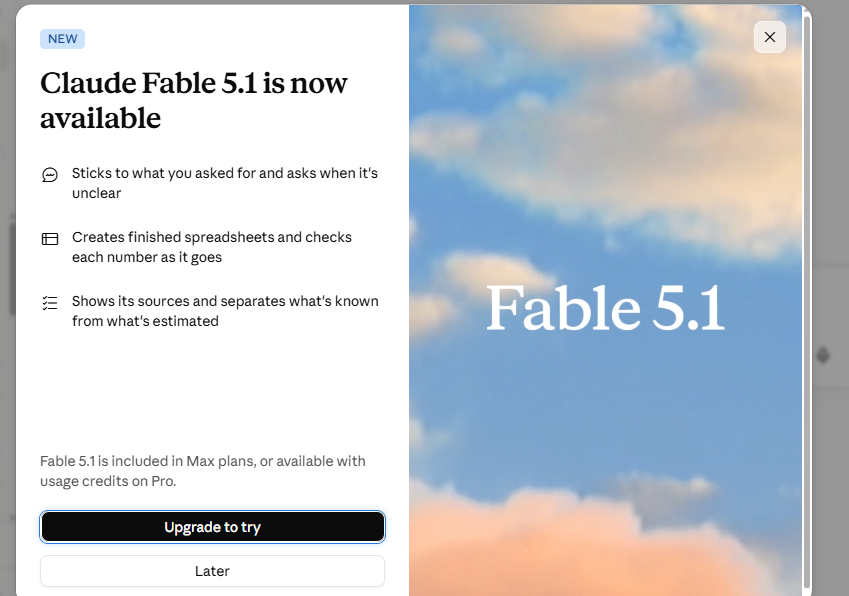
The model is available through Claude and the Claude API, as well as platforms including Amazon Web Services, Google Cloud, and Microsoft Foundry.
It also has a 1 million token context window and can generate up to 128,000 tokens in a single response.
That combination makes Fable 5.1 particularly interesting for developers, researchers, enterprise teams, product managers, analysts, and anyone working on projects that cannot be completed with a single short prompt.
Claude Fable 5.1 vs Fable 5: What changed?
The easiest way to understand Fable 5.1 is to look at the areas Anthropic focused on.
Fable 5.1 brings improvements in:
• Long-running agentic tasks
• Software engineering
• Scientific and technical research
• Knowledge work
• Computer use
• Document analysis
• Spreadsheets and presentations
• Root-cause analysis
• Self-verification
• Cost efficiency
• Safety safeguards
The model also introduces improvements to how developers can control and monitor agentic workflows.
That is an important distinction.
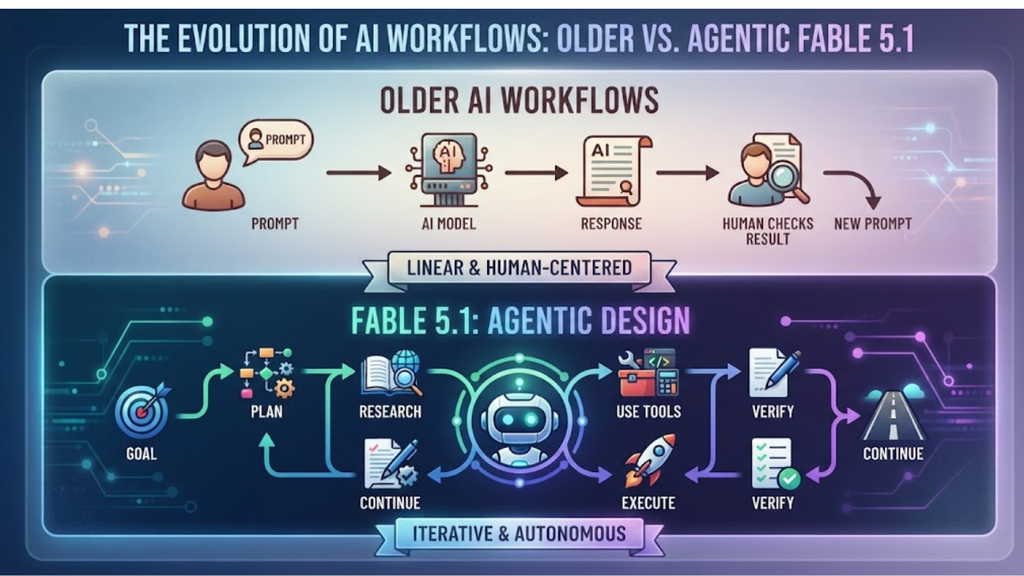
Older AI workflows often looked like this:
Prompt → Response → Human checks result → New prompt
Fable 5.1 is increasingly designed for:
Goal → Plan → Research → Use tools → Execute → Verify → Correct → Continue
That shift could have a much bigger impact on businesses than another small improvement in chatbot quality.
Claude Fable 5.1 benchmark results
Anthropic reports substantial gains over Fable 5 across several evaluations.
One of the most striking examples is Terminal-Bench-Science 0.1, which measures agentic scientific research.
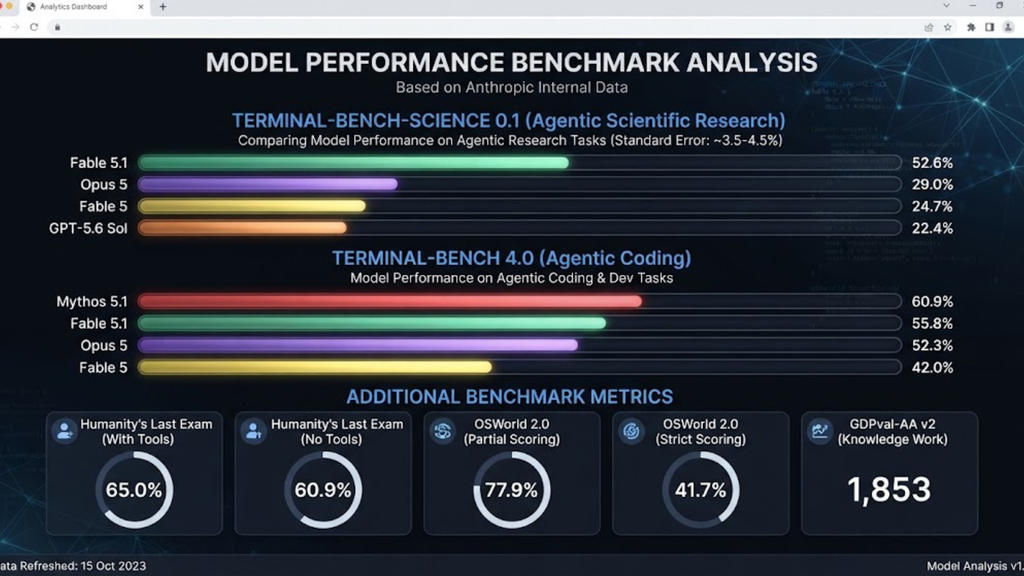
Fable 5.1 scored 52.6%, compared with 24.7% for Fable 5 and 29.0% for Opus 5 in Anthropic’s setup. GPT-5.6 Sol scored 22.4% on the same comparison. Anthropic notes that the benchmark has a standard error of approximately 3.5 to 4.5 percentage points per model.
On Terminal-Bench 4.0, which focuses on agentic coding, Fable 5.1 scored 55.8%, compared with 42.0% for Fable 5 and 52.3% for Opus 5. Anthropic reports 60.9% for Mythos 5.1, which uses the same underlying model with different safeguards.
The model also recorded:
• 1,853 on GDPval-AA v2 for knowledge work
• 77.9% on the partial scoring of OSWorld 2.0
• 41.7% on the strict scoring of OSWorld 2.0
• 60.9% on Humanity’s Last Exam without tools
• 65.0% on Humanity’s Last Exam with tools
These numbers should be treated as benchmark results rather than guarantees of real-world performance. Anthropic also notes that production safety safeguards were enabled during its evaluations, which affected some results.
The biggest upgrade may be agentic coding
If you are a software developer, this is one of the most important parts of the release.
Fable 5.1 is designed to handle coding projects that span entire codebases rather than isolated snippets.
Anthropic says the model can work on:
• Features that touch multiple parts of a codebase
• Code reviews
• Performance optimization
• Multi-day autonomous coding sessions
• Testing and verification
• Design implementation
• Debugging
• Root-cause analysis
The model can also use vision to compare what it builds against the intended design.
That matters because software development is increasingly becoming an agent problem.
The difficult part is rarely writing one function.
The difficult part is understanding the existing system, identifying dependencies, changing multiple files without breaking something, testing the changes, investigating failures, and knowing when the work is actually finished.
Fable 5.1 is designed around that broader workflow.
Anthropic shared an example from Millennium, where Fable 5.1 reportedly identified the cause of an extremely rare software crash that had remained unexplained for several years.
Fable 5.1 is built for long-running AI agents
This may be the release’s most important strategic change.
Anthropic is clearly targeting workflows that take hours rather than seconds.
Fable 5.1 can operate across multiple applications, use external tools, maintain progress, recover from failures, and continue working without constant human intervention.
Imagine giving an AI agent a task such as:
“Analyze our customer support backlog, identify the biggest recurring problems, review the relevant product documentation, compare them against recent customer complaints, and prepare a prioritized product improvement report.”
A traditional chatbot might help with individual parts of that task.
A long-horizon agent is expected to coordinate the entire workflow.
That difference is where the economic value of frontier AI could become much larger.
Read Also: How to Learn AI for FREE from Harvard, Stanford, MIT & Google
Claude Fable 5.1 pricing
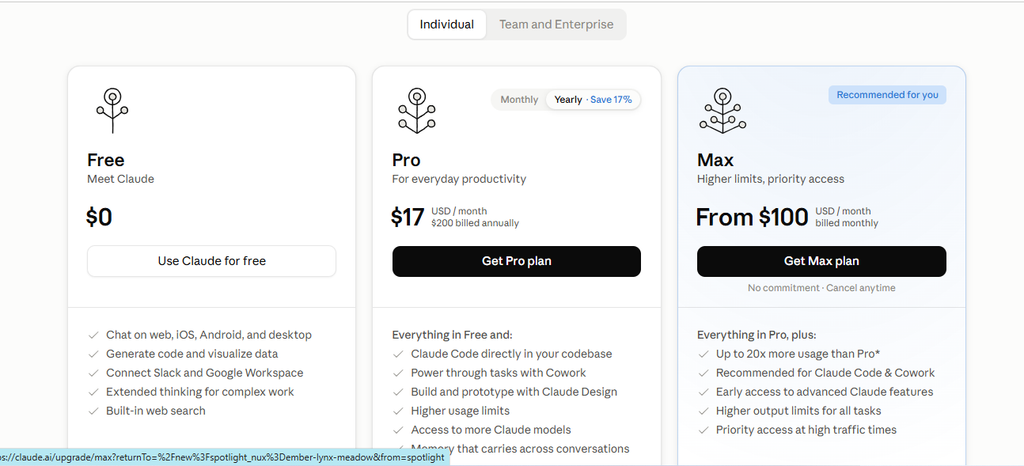
Fable 5.1 costs:
Input: $10 per million tokens
Output: $50 per million tokens
Cache reads: $0.25 per million tokens
Anthropic has kept the standard input and output pricing at the same level as Fable 5 while dramatically reducing cache-read costs. Cache reads are now 75% cheaper than they were for Fable 5.
Anthropic estimates that typical workloads will cost around 25% less.
For highly agentic workloads, savings can reach approximately 45%.
This is strategically important.
AI agents repeatedly interact with the same context.
They may read the same codebase, documentation, instructions, or project information across many steps.
Reducing the cost of cached information makes long-running agents more economically practical.
1 million token context window
Fable 5.1 retains a 1 million token context window.
Its maximum output is 128,000 tokens.
For businesses, this opens up useful workflows involving large amounts of information.
For example:
• Analyze a large software repository
• Review lengthy contracts
• Study large research collections
• Analyze financial documents
• Work with extensive product documentation
• Process large spreadsheets
• Compare multiple reports
• Maintain context across long agentic workflows
A large context window does not automatically mean perfect reasoning.
But it gives the model considerably more room to work with complex information without constantly rebuilding context.
Fable 5.1 for research and scientific discovery
Anthropic is also positioning Fable 5.1 and its restricted counterpart, Mythos 5.1, as models capable of contributing to scientific research.
The company tested the models across scientific domains and reported examples involving molecular design and other research workflows.
The scientific angle is significant because research involves many tasks that are naturally suited to AI agents:
Research → collect evidence → analyze → generate hypotheses → use tools → test → revise → document findings
That is much closer to the type of workflow Fable 5.1 is designed to perform than a simple question-and-answer interaction.
Anthropic is careful to distinguish Fable 5.1 from Mythos 5.1, however.
They share the same underlying model, but Mythos has different safeguards and is currently restricted to trusted access programs, particularly for advanced cybersecurity and life sciences work.
Better computer use
Fable 5.1 also improves AI’s ability to interact with computers.
Anthropic reports a 77.9% partial score and 41.7% strict score on OSWorld 2.0. Fable 5 scored 72.9% and 36.1%, respectively, under the reported evaluation setup.
Computer-use capabilities matter because many business processes live inside software that does not have a convenient API.
An AI agent that can understand a screen, navigate applications, manipulate files, and complete multi-step tasks could automate workflows that previously required a human to operate several different tools.
Better work with documents, spreadsheets and presentations
Fable 5.1 is not only a coding model.
Anthropic says it is designed for complex enterprise knowledge work, including research, analysis, documents, spreadsheets, and slides.
Its vision capabilities also allow it to understand diagrams, charts, and tables inside files and PDFs.
That makes it potentially useful for:
• Financial analysis
• Business research
• Product analysis
• Legal document review
• Market research
• Data analysis
• Presentation creation
• Executive reporting
The important change is that these tasks can become part of a larger workflow instead of isolated prompts.
Fable 5.1 gets smarter about verification
One of the most useful characteristics of Fable 5.1 is its emphasis on checking its own work.
Anthropic says the model can create tests to validate code, use verification loops, and use vision to compare outputs with the original goal.
That matters because one of the biggest weaknesses of AI agents is not their ability to generate an answer.
It is knowing whether the answer is actually correct.
A stronger agent needs to:
- Understand the objective.
- Create a plan.
- Execute the plan.
- Test the result.
- Identify failures.
- Correct them.
- Verify the final result.
Fable 5.1 is designed to perform more of this loop autonomously.
New safety and security safeguards
More capable AI creates a difficult problem.
The same capabilities that make an AI useful for cybersecurity and biology can also make it more dangerous if misused.
Anthropic says Fable 5.1 has improved safeguards designed to reduce unnecessary restrictions while still limiting high-risk capabilities.
In cybersecurity, Anthropic says the new safeguards produce 60% fewer false positives than the previous system.
Fable 5.1 can also identify software vulnerabilities, although Anthropic says it cannot use those capabilities to develop exploits.
For some flagged cybersecurity and biology requests, Claude can route the request to another model rather than simply refusing it.
This is an important direction for AI safety.
The goal is becoming more precise control rather than simply making the model less capable.
Enterprise privacy is getting a major upgrade
Anthropic also announced Enterprise Frontier Safeguards, or EFS.
The system is designed to allow eligible enterprise customers to store data in cloud infrastructure controlled entirely by the customer rather than Anthropic. Anthropic says this can provide privacy equivalent to a zero-data-retention policy while maintaining safeguards against adversarial use.
Anthropic plans to roll EFS out to enterprise customers in phases beginning later in fall 2026.
Until then, eligible customers can use Fable 5.1 with zero data retention.
For companies handling sensitive business information, this could be as important as the model’s benchmark improvements.
Who should use Claude Fable 5.1?
Fable 5.1 makes the most sense for users who have complex work rather than simple questions.
You should consider it if you are:
Software developer:
Use it for large codebases, debugging, code reviews, architecture, testing, and autonomous development.
Product manager:
Use it for customer research, product specifications, competitive analysis, documentation, and complex product workflows.
Researcher:
Use it for literature analysis, evidence gathering, data interpretation, and multi-step research.
Founder:
Use it to automate research, build prototypes, analyze markets, and execute operational workflows.
Enterprise team:
Use it for document-heavy analysis, reporting, financial workflows, knowledge management, and internal automation.
AI developer:
Use it when building agents that need strong reasoning and long-running tool use.
For simple tasks such as rewriting an email, summarizing a short document, or answering straightforward questions, a cheaper and faster Claude model may be a better choice.
Claude Fable 5.1 vs Claude Opus 5
One interesting question is whether everyone should immediately switch to Fable 5.1.
The answer is no.
Anthropic’s own documentation recommends using Opus 5 for most workloads and Fable 5.1 when you need demanding reasoning and long-horizon agentic work, especially when higher-effort Opus 5 still falls short.
Here is the basic positioning:
Fable 5.1:
Best for maximum capability, complex reasoning, long-running agents, and ambitious coding.
Opus 5:
Better fit for many demanding workloads where speed and cost matter more.
Sonnet 5:
Better fit for fast, high-volume work.
Haiku 4.5:
Better fit when speed and lower cost are the priority.
The smartest approach is to match the model to the job rather than automatically choosing the most powerful model.
Claude Fable 5.1 availability
Claude Fable 5.1 became generally available on September 1, 2026.
It is available to Pro, Max, Team, and Enterprise users.
Developers can access it through the Claude API and supported cloud platforms, including Amazon Web Services, Google Cloud, and Microsoft Foundry.
The API model ID is:
claude-fable-5-1
Anthropic’s documentation lists the model as active, with a release date of September 1, 2026.
Is Claude Fable 5.1 better than GPT-5.6 Sol?
There is no single benchmark that can answer this question.
Anthropic’s published comparison shows Fable 5.1 ahead of GPT-5.6 Sol on several of the benchmarks it reports.
For example:
Terminal-Bench-Science 0.1:
Fable 5.1: 52.6%
GPT-5.6 Sol: 22.4%
Terminal-Bench 4.0:
Fable 5.1: 55.8%
GPT-5.6 Sol: 37.3%
GDPval-AA v2:
Fable 5.1: 1,853
GPT-5.6 Sol: 1,711
But benchmark leadership does not automatically translate into universal superiority.
The better question is:
Which model performs best on your actual workflow?
If you are building a coding agent, run your coding evaluations.
If you are doing research, test research accuracy.
If you are automating business operations, measure task completion, cost, latency, and failure rates.
Your own evaluation matters more than a leaderboard.
Why Claude Fable 5.1 matters
The biggest story behind Fable 5.1 is not another chatbot getting better at answering questions.
It is the continued movement toward AI that can own larger pieces of work.
The unit of AI productivity is changing.
It used to be:
One prompt.
Then:
One task.
Now:
One workflow.
And increasingly:
One project.
Fable 5.1 is designed for that fourth category.
A developer can delegate a multi-day engineering task.
A researcher can delegate a complex research workflow.
A business can delegate document-heavy analysis.
A product team can delegate a large research and planning project.
The human increasingly becomes the person who defines the objective, sets constraints, reviews important decisions, and manages exceptions.
That is a much bigger shift than simply getting better chatbot answers.
Final verdict: Should you try Claude Fable 5.1?
If your work involves complex coding, deep research, large documents, multi-step analysis, or autonomous AI agents, Claude Fable 5.1 deserves serious testing.
Its biggest improvements are concentrated in exactly the areas where frontier AI is heading:
Stronger reasoning.
Better long-running agents.
More capable coding.
Better tool use.
Improved verification.
Lower cache costs.
More precise safeguards.
Better enterprise privacy options.
The 52.6% Terminal-Bench-Science result is particularly notable, but the broader story is more important. Anthropic is building Fable 5.1 around AI systems that can take responsibility for longer and more complicated workflows.
That is where the next major productivity gains from AI are likely to come from.
The question is no longer simply, “Which AI chatbot gives me the best answer?”
It is becoming:
“What work can I safely hand to an AI agent and trust it to finish?”
Claude Fable 5.1 is Anthropic’s latest answer to that question.
Frequently Asked Questions
What is Claude Fable 5.1?
Claude Fable 5.1 is Anthropic’s latest generally available frontier model for demanding reasoning, coding, knowledge work, research, and long-running agentic tasks.
When was Claude Fable 5.1 released?
Anthropic released Claude Fable 5.1 on September 1, 2026.
How much does Claude Fable 5.1 cost?
The API price is $10 per million input tokens and $50 per million output tokens. Cache reads cost $0.25 per million tokens.
Does Claude Fable 5.1 have a 1 million token context window?
Yes. Claude Fable 5.1 has a 1 million token context window and a maximum output of 128,000 tokens.
Is Claude Fable 5.1 better than Fable 5?
Anthropic reports significant improvements across coding, scientific research, knowledge work, computer use, and long-running tasks. On Terminal-Bench-Science 0.1, Fable 5.1 scored 52.6%, compared with 24.7% for Fable 5 in Anthropic’s evaluation.
Is Claude Fable 5.1 available to everyone?
Fable 5.1 is generally available to eligible Claude users and developers. Claude Mythos 5.1, which shares the same underlying model but has different safeguards, remains restricted to trusted access programs.
What is Claude Fable 5.1 best at?
Its strongest use cases include complex software engineering, long-running AI agents, deep research, knowledge work, document analysis, computer use, and multi-step business workflows.
✍️ About the Author
Olasunkanmi Adeniyi is a solo founder, product builder, AI practitioner, no-code and low-code developer, and SEO/content strategist. He builds websites, SaaS products, digital tools, and content systems using AI and modern development tools.
Rather than writing about AI from theory alone, Olasunkanmi focuses on testing, building, experimenting, and documenting what actually works. His work explores AI-powered workflows, product development, automation, SEO, content strategy, online business, and the practical use of emerging technologies.
Through AI Discoveries, he publishes practical tutorials, in-depth guides, experiments, and real-world use cases designed to help entrepreneurs, professionals, creators, and businesses understand and apply AI more effectively.
His goal is simple: make AI practical, understandable, and actionable—so readers can move from learning about what AI can do to actually using it to build, work, and grow.
Learn more and explore his latest work at www.aidiscoveries.io.





Leave a Reply