Why Most People Get Weak Results From ChatGPT
If you have ever typed a vague question into ChatGPT and received a bland, generic response, you are not alone. The truth is, the quality of your output is almost entirely determined by the quality of your input. That input is called a prompt.
Read Also: The Complete Beginner’s Guide to Using AI in Nigeria (2026 Edition) – AI Discoveries
A well-crafted prompt is the difference between getting a five-sentence fluff answer and getting a detailed, actionable, publication-ready response in seconds. Whether you are a marketer, entrepreneur, student, developer, or content creator, the right prompt template can save you hours every single week.
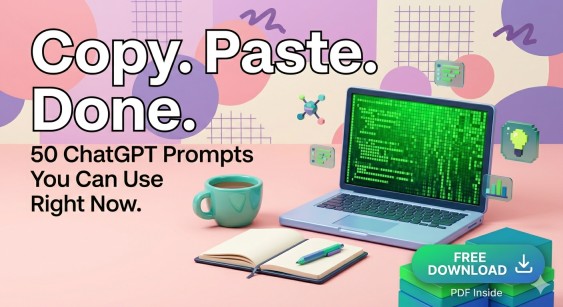
In this post, you will find 50 battle-tested ChatGPT prompt templates organised by category, ready to copy and use right now. You can also download all 50 as a free PDF at the end of this article.
Let us get into it.
What Is a ChatGPT Prompt Template?
A ChatGPT prompt template is a pre-written, structured instruction designed to consistently produce high-quality output from an AI language model like ChatGPT, Claude, or Gemini. Instead of starting from scratch every time, a template gives you a proven framework with placeholder variables you simply swap out for your specific needs.
A basic template looks like this:
“Write a [type of content] about [topic] for [target audience] in a [tone] tone. Include [specific elements]. Keep it under [word count] words.”
Templates save time, reduce trial and error, and make AI tools accessible to everyone, not just prompt engineers.
How to Use These Prompt Templates
Each template below uses square brackets like [this] to mark the parts you need to customise. Simply replace the bracketed text with your specific details and paste the result into ChatGPT, Claude, or any other large language model.
Pro tips for better results:
- Be as specific as possible when filling in the variables.
- Add context about your audience, industry, or goal.
- If the first result is not right, type “Try again but make it more [concise / detailed / formal / casual].”
- Stack prompts: use the output from one prompt as the input for another.
The 50 Best ChatGPT Prompt Templates (By Category)
CATEGORY 1: Content Writing and Blogging (Prompts 1 to 10)
Prompt 1 — SEO Blog Post “Write a 1,500-word SEO-optimised blog post on the topic ‘[your topic]’. The target keyword is ‘[keyword]’. Include an engaging introduction, at least four H2 subheadings, a bullet-point list, a FAQ section with five questions, and a compelling call to action at the end. The tone should be [professional / conversational / friendly]. Write for [your target audience].“
Prompt 2 — Blog Post Outline “Create a detailed blog post outline for the topic ‘[your topic]’. Include a working title, meta description, introduction hook, five to seven main sections with sub-points, a conclusion angle, and three internal linking suggestions.“
Prompt 3 — Listicle Article “Write a listicle article titled ‘[your title]’. Include [number] items. For each item, write a two-to-three sentence explanation of why it matters. Keep the tone [casual / informative / authoritative]. The audience is [describe your audience].“
Prompt 4 — Rewrite and Improve Existing Content “Rewrite the following content to make it more engaging, SEO-friendly, and clear. Improve the sentence structure, add transition words, remove fluff, and strengthen the conclusion. Here is the original text: [paste your content].“
Prompt 5 — Content Repurposing “Take the following blog post and repurpose it into: (1) a Twitter/X thread of 10 tweets, (2) a LinkedIn post of 200 words, (3) a YouTube video script outline, and (4) five Instagram caption ideas. Here is the blog post: [paste content].”
Prompt 6 — Opinion / Thought Leadership Article “Write a 900-word thought leadership article arguing that [your position on a topic]. Support the argument with three logical reasons, at least one real-world example or analogy, and address one common counterargument. The tone should be confident but not arrogant.”
Prompt 7 — How-To Guide “Write a step-by-step how-to guide explaining how to [task or goal]. The guide should have a brief introduction, numbered steps with clear action verbs, helpful tips or warnings where relevant, and a short conclusion with next steps. The reader is a [beginner / intermediate / advanced] in this area.”
Prompt 8 — Product Review Article “Write a balanced product review article for [product name]. Include an overview, key features, pros and cons, who it is best for, a comparison with one alternative, and a final verdict. Tone: honest, helpful, and unbiased. Word count: 800 words.”
Prompt 9 — Newsletter Issue “Write a weekly email newsletter issue for [brand name] on the theme of [topic]. Include a short personal introduction, three to five curated insights or tips, one featured resource or tool, and a closing call to action. Tone: [warm / professional / witty]. Audience: [describe subscribers].”
Prompt 10 — Pillar Page Content “Create a comprehensive pillar page on the topic ‘[main keyword / topic]’. Structure it with an introduction, ten to twelve detailed subtopics written in full paragraphs, a FAQ section with seven questions, internal link opportunities, and a summary. This should serve as the definitive resource on this topic for [target audience].”
CATEGORY 2: Marketing and Copywriting (Prompts 11 to 20)
Prompt 11 — Facebook or Instagram Ad Copy “Write three variations of a Facebook ad for [product or service]. Each variation should have a hook line, two to three sentences of body copy, and a clear call to action. Target audience: [describe audience]. Key benefit: [main benefit]. Tone: [urgent / friendly / witty].”
Prompt 12 — Google Ad Headlines and Descriptions “Write 10 Google Search ad headlines (max 30 characters each) and four ad descriptions (max 90 characters each) for [product or service]. Focus on the keyword ‘[keyword]’, highlight the unique selling point ‘[USP]’, and include a call to action.”
Prompt 13 — Email Subject Lines “Generate 20 email subject lines for an email about [topic or offer]. Make five of them curiosity-driven, five benefit-focused, five urgency-based, and five personalised. Aim for open rates above average by avoiding spam trigger words.”
Prompt 14 — Sales Page Copy “Write a long-form sales page for [product or service name]. Include: a headline and subheadline, an empathy-driven opening, a clear problem statement, the solution and its benefits (use bullet points), social proof placeholder, a breakdown of what is included, objection handling, a guarantee statement, pricing section placeholder, and a strong call to action. Tone: persuasive but not pushy.”
Prompt 15 — Cold Email Sequence “Write a five-email cold outreach sequence to [target prospect type] pitching [your offer]. Email 1: initial intro and value proposition. Email 2: a follow-up with a case study or result. Email 3: address a common objection. Email 4: a soft close with a low-commitment ask. Email 5: a final breakup email. Keep each email under 150 words.”
Prompt 16 — Product Description “Write a compelling product description for [product name]. Highlight the top three features and turn each into a customer benefit. Include sensory language, a line about who it is perfect for, and end with an urgency or scarcity element. Tone: [premium / playful / minimalist].”
Prompt 17 — Brand Tagline Options “Generate 20 tagline options for a [type of business] called [brand name]. The brand values are [values]. The target audience is [audience]. Mix different styles: some clever, some direct, some emotional, some action-oriented.”
Prompt 18 — Social Media Content Calendar “Create a 30-day social media content calendar for [brand name] in the [industry] niche. For each day include: the platform, content type (reel, carousel, static post, story), topic, and a one-sentence caption idea. Mix educational, entertaining, inspirational, and promotional content in a 70-20-10 ratio.”
Prompt 19 — Video Script (Short-Form) “Write a 60-second video script for [platform: TikTok / Instagram Reels / YouTube Shorts] on the topic ‘[topic]’. Start with a hook in the first three seconds that stops the scroll. Include a main value point, a quick story or example, and end with a strong call to action or punchline.”
Prompt 20 — Case Study “Write a customer case study for [company or client name]. Structure it as: client background, the challenge they faced, the solution we provided, the implementation process, the measurable results achieved, and a closing client quote placeholder. Tone: professional, factual, and results-focused.”
CATEGORY 3: Business and Productivity (Prompts 21 to 30)
Prompt 21 — Business Plan Executive Summary “Write an executive summary for a business plan for [business name], a [type of business] that [what it does]. Include the business overview, problem being solved, target market, revenue model, competitive advantage, and funding requirement. Keep it under 500 words and make it investor-ready.”
Prompt 22 — Meeting Agenda “Create a detailed meeting agenda for a [type of meeting] lasting [duration]. The meeting is with [attendees]. The main goals are [goals]. Include time allocations for each section, an owner for each agenda item, and a section for action items at the end.”
Prompt 23 — SWOT Analysis “Conduct a detailed SWOT analysis for [company name or business idea] in the [industry] industry. Under each category (Strengths, Weaknesses, Opportunities, Threats), provide five specific, realistic points. Follow the analysis with three strategic recommendations based on your findings.”
Prompt 24 — Job Description “Write a compelling job description for the role of [job title] at [company name], a [type of company]. Include: a two-paragraph company overview, a role summary, five to seven key responsibilities, required qualifications, preferred qualifications, what makes this role exciting, and a brief note on company culture. Tone: professional but human.”
Read Also: AI Tools for Nigerian Professionals & Businesses (2026 Complete Guide) – AI Discoveries
Prompt 25 — Performance Review “Write a mid-year performance review for an employee named [name] who works as a [job title]. Their key achievements this period include [achievements]. Areas needing improvement are [areas]. The tone should be constructive, specific, and encouraging. Include SMART goals for the next review period.”
Prompt 26 — Project Proposal “Write a professional project proposal for [project name]. Include: executive summary, project background and problem statement, proposed solution, scope of work, timeline with milestones, budget estimate, expected outcomes, and a call to action for approval. Audience: [internal stakeholders / external client].”
Prompt 27 — SOP (Standard Operating Procedure) “Create a standard operating procedure document for [process or task]. Include: purpose, scope, roles and responsibilities, equipment or tools needed, step-by-step instructions, quality checks, common issues and troubleshooting, and a revision history section. Write it clearly enough for a new team member to follow without supervision.”
Prompt 28 — Investor Pitch Deck Script “Write a script for a 10-slide investor pitch deck for [startup name]. Cover: problem, solution, market size, business model, traction, competitive landscape, team, financial projections, use of funds, and closing ask. Keep each slide script to 60 to 90 spoken words. Tone: confident, concise, and compelling.”
Prompt 29 — OKR Framework “Create a set of OKRs (Objectives and Key Results) for [team or department] at [company name] for the upcoming quarter. Include three to four objectives, each with two to four measurable key results. Align them with the broader company goal of [company goal].”
Prompt 30 — Competitive Analysis “Write a competitive analysis comparing [your company or product] against three main competitors: [Competitor 1], [Competitor 2], and [Competitor 3]. Analyse each across pricing, features, target audience, marketing positioning, strengths, and weaknesses. Conclude with a strategic opportunity for [your company].”
CATEGORY 4: Education and Learning (Prompts 31 to 38)
Prompt 31 — Study Guide “Create a comprehensive study guide on the topic ‘[topic]’ for a [level: high school / undergraduate / professional] student. Include key concepts, definitions, important dates or figures if applicable, a summary of main ideas, practice questions with answers, and memory tips or mnemonics.”
Prompt 32 — Lesson Plan “Design a one-hour lesson plan for teaching [topic] to [age group or grade level] students. Include learning objectives, materials needed, a five-minute warm-up activity, the main teaching segment with activities, a group exercise, a five-minute wrap-up, and an assessment method.”
Prompt 33 — Explain Like I am Five “Explain [complex topic or concept] as if you are talking to a 10-year-old with no prior knowledge. Use simple words, a real-life analogy, and a short story or scenario to make it memorable. Then give a slightly more advanced one-paragraph explanation for curious learners.”
Prompt 34 — Quiz Creator “Create a 15-question quiz on the topic ‘[topic]’. Include five multiple-choice questions, five true or false questions, and five short-answer questions. Provide an answer key at the end. The difficulty level should be [beginner / intermediate / advanced].”
Prompt 35 — Book Summary “Write a detailed summary of the book ‘[book title]’ by [author name]. Include the main thesis, key ideas from each chapter or section, the most important takeaways, any criticisms or limitations of the book, and how the ideas can be applied practically. Format: clear headings for each section.”
Prompt 36 — Research Paper Outline “Create a detailed research paper outline on the topic ‘[topic]’. Include a working thesis statement, an introduction section, four to six body sections with sub-arguments and evidence types needed, a counterargument section, a conclusion direction, and a suggested list of source types to consult.”
Prompt 37 — Language Learning Flashcards “Create 20 vocabulary flashcard pairs for learning [language] at a [beginner / intermediate / advanced] level, focused on the theme of [theme: travel / business / food / daily life]. Format each as: [Target Language Word] — [English Translation] — [Example Sentence in Target Language].”
Prompt 38 — Debate Preparation “I need to argue [your position] on the topic ‘[debate topic]’. Help me prepare by: providing five strong arguments in favour of my position, anticipating five counterarguments the opposing side might raise, giving me a rebuttal for each counterargument, and suggesting an opening statement of 100 words.”
CATEGORY 5: Coding and Technical (Prompts 39 to 44)
Prompt 39 — Code Generator “Write a [language: Python / JavaScript / SQL / etc.] script that [describe what the code should do]. Include comments explaining each major section. The code should handle [edge case or error]. Optimise for [readability / performance / simplicity].”
Prompt 40 — Code Review and Debugging “Review the following [language] code and identify any bugs, inefficiencies, security vulnerabilities, or areas for improvement. Explain each issue clearly and provide a corrected version of the code. Here is the code: [paste code].”
Prompt 41 — API Documentation “Write clear API documentation for the following endpoint. Include: endpoint URL, HTTP method, description, request parameters with data types and whether they are required or optional, example request, example response, and possible error codes. Endpoint details: [describe your endpoint].”
Prompt 42 — README File “Write a professional README.md file for a GitHub repository called ‘[project name]’. Include: project description, features list, installation instructions, usage examples, configuration options, contribution guidelines, license information, and contact details. Use proper markdown formatting.”
Prompt 43 — SQL Query “Write a SQL query that [describe what the query needs to do]. The database has the following tables and columns: [describe schema]. Optimise the query for performance. Add inline comments to explain any complex logic.”
Prompt 44 — Tech Stack Recommendation “I am building a [type of application] that needs to [describe functionality]. Expected user scale: [number]. Budget: [budget level]. Team size: [team size]. Recommend the best tech stack for this project, explaining why you chose each layer (frontend, backend, database, hosting, and any third-party services).”
CATEGORY 6: Personal Use and Creativity (Prompts 45 to 50)
Prompt 45 — Cover Letter “Write a compelling cover letter for the role of [job title] at [company name]. I have experience in [your background]. My top three relevant achievements are: [achievement 1], [achievement 2], [achievement 3]. The company values [company values]. Make the letter confident, specific, and no longer than 350 words. Avoid clichés.”
Prompt 46 — Personal Bio “Write three versions of a personal bio for [your name], a [your profession] who [brief background]. Version 1: 50 words for social media. Version 2: 150 words for a website About page. Version 3: 300 words for a speaking event introduction. Tone: [professional / warm / bold].”
Prompt 47 — Short Story “Write a 600-word short story in the [genre: thriller / romance / sci-fi / literary fiction] genre. The main character is [describe character]. The setting is [describe setting]. The central conflict is [describe conflict]. End with a twist or an emotionally resonant final line.”
Prompt 48 — Travel Itinerary “Create a detailed [number]-day travel itinerary for [destination]. I am travelling with [who: solo / couple / family with kids]. My budget is [budget level]. I am interested in [interests: history / food / adventure / art]. Include daily activities, recommended restaurants, transport tips, accommodation suggestions, and one hidden gem per day.”
Prompt 49 — Personal Development Plan “Create a 90-day personal development plan for someone who wants to improve in [skill or area of life]. Include weekly goals, specific actions to take each week, resources to use (books, courses, habits), milestones to celebrate, and how to track progress. The starting level is [current level].”
Prompt 50 — Speech or Presentation Script “Write a [duration]-minute speech on the topic ‘[topic]’ for [type of event: graduation / company all-hands / wedding / conference]. The audience is [describe audience]. The tone should be [inspiring / humorous / informative / heartfelt]. Include a memorable opening, three to four core points with stories or data, and a powerful closing line.”
How to Get Better Results: 5 Advanced Prompt Tips
1. Assign a Role Start your prompt with “You are an expert [role]…” to prime the AI to respond from a specific perspective. For example: “You are an expert email marketer with 15 years of experience in SaaS.”
2. Specify the Format Tell the AI exactly how you want the output. Say: “Format your response as a numbered list / a table / bullet points / a five-paragraph essay.”
3. Set Constraints Word limits, tone instructions, and audience specifications dramatically improve output quality. Never leave these details out.
4. Use Chain Prompting Use the output of one prompt as the input for the next. For example, first generate a blog outline, then ask it to write each section one by one.
5. Ask for Multiple Options Instead of accepting the first output, ask: “Give me five different versions of this and rate each one out of 10.” Then pick the best.
Free Download: All 50 ChatGPT Prompt Templates as a PDF
To make these templates even easier to use, you can download all 50 as a clean, formatted PDF. Keep it bookmarked, share it with your team, or print it out for your desk.
[INSERT DOWNLOAD BUTTON OR LINK HERE — e.g., link to a landing page or Google Drive PDF]
The download is completely free. No email required. Just click, save, and start prompting.
Frequently Asked Questions
Q1: Can I use these ChatGPT prompt templates with other AI tools like Claude or Gemini? Yes. These prompt templates are model-agnostic. They work with ChatGPT (GPT-4o), Anthropic’s Claude, Google Gemini, Microsoft Copilot, and other large language models. The principles of clear, structured prompting apply across all AI tools.
Q2: Do I need a paid ChatGPT plan to use these prompts? No. All 50 prompts work with the free version of ChatGPT. However, if you are using prompts that require long outputs, a paid plan (ChatGPT Plus or Team) with GPT-4o will give you significantly better results, longer responses, and access to advanced features.
Q3: How do I make these prompts work for my specific industry? Simply add your industry context to the prompt. For example, instead of “target audience: general consumers,” specify “target audience: B2B SaaS founders in the healthcare compliance space.” The more specific your variables, the more relevant the output.
Q4: What is the best ChatGPT prompt format for SEO content? The most effective SEO prompts include: the target keyword, a word count, a defined audience, specific structural elements (headings, FAQ, CTA), and a tone instruction. Prompt 1 in this article is specifically designed for SEO blog posts.
Q5: How often should I update my prompt templates? AI models are updated frequently, and what works best can shift over time. Review and test your templates every three to six months. Pay attention to changes in output quality and adjust your instructions accordingly.
Q6: Are these prompts safe to use for professional or commercial work? Yes, but always review AI-generated content before publishing or sending. Use these templates as a starting point, not a final product. Add your own expertise, verify any facts or statistics, and ensure the tone matches your brand voice.
Conclusion: Start Prompting Smarter Today
The difference between someone who gets average results from AI and someone who gets extraordinary results comes down to one thing: how they ask. These 50 ChatGPT prompt templates give you a structured, proven starting point across every major use case, from blog writing and marketing copy to code generation and personal development.
Stop typing vague questions and start giving AI the clear, detailed instructions it needs to do its best work for you.
Bookmark this page, download the free PDF, and start using these templates today. If you found this resource useful, share it with a colleague or team member who could use a prompt upgrade.
Tags: ChatGPT prompts, AI prompt templates, ChatGPT prompt examples, best ChatGPT prompts 2026, free ChatGPT prompts, prompt engineering, AI writing prompts, ChatGPT for business, ChatGPT for marketing, ChatGPT for content creation
Suggested Backlink Anchors: “ChatGPT prompt templates,” “free AI prompt templates,” “best ChatGPT prompts”


Leave a Reply