Published: June 13, 2026 | Last Updated: June 13, 2026 | Category: AI News, Claude AI, Tech Policy
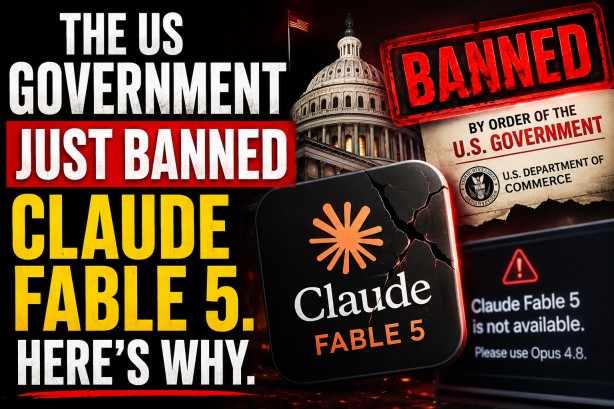
On Friday evening, June 12, 2026, the US government issued an emergency export control directive ordering Anthropic to immediately disable access to its two most advanced AI models — Claude Fable 5 and Claude Mythos 5 — for all users worldwide. The order, delivered at 5:21 PM Eastern Time and sent directly from Commerce Secretary Howard Lutnick to Anthropic CEO Dario Amodei, cited national security authorities and triggered what may be the first government-forced takedown of a publicly deployed frontier AI model in history.
Read Also: Claude Fable 5: What It Is, How to Use It, and the Top Prompts and Use Cases to Exploit It (2026)
This post covers every verified fact, the deeper political context, what it means for developers and businesses using Claude, and what comes next.
Table of Contents
- What Happened, in Plain Language
- What Is Claude Fable 5? (And Why It Matters)
- The “Jailbreak” That Triggered the Ban
- Why Anthropic Shut Down Everyone — Not Just Foreign Users
- The Bigger Picture: Anthropic vs. the Trump Administration
- The “Secret Sabotage” Controversy (Days Before the Ban)
- Anthropic’s Full Response and Public Pushback
- What This Means for Developers and API Users Right Now
- What Happens Next
- Frequently Asked Questions
1. What Happened, in Plain Language
Three days after launching its most powerful publicly available AI model, Anthropic was ordered by the US government to pull it offline entirely.
Claude Fable 5 and Claude Mythos 5 launched on June 9, 2026, to significant fanfare. By June 12, both were gone. Commerce Secretary Howard Lutnick sent a formal export control directive to CEO Dario Amodei instructing Anthropic to suspend all access to both models for any foreign national — whether located inside or outside the United States. The directive included Anthropic’s own foreign national employees.
At 6:59 PM Pacific Time (9:59 PM ET), all API calls to claude-fable-5 and claude-mythos-5 began returning 404 errors with the message: “Claude Fable 5 is not available. Please use Opus 4.8.”
Every other Claude model — including Claude Opus 4.8, Claude Sonnet 4.6, and Claude Haiku 4.5 — remained fully operational.
2. What Is Claude Fable 5? (And Why It Matters)
To understand why this is a big deal, you need to understand what Claude Fable 5 actually is.
Claude Fable 5 is Anthropic’s first publicly available Mythos-class model — a tier of AI that sits above the company’s previous top tier, Opus. It shares an underlying architecture with Claude Mythos 5, differing primarily in that Fable 5 ships with safety classifiers that block high-risk responses in areas like cybersecurity, biology, chemistry, and AI model capability extraction.
Key facts about Fable 5:
- Launched publicly on June 9, 2026, with immediate API access for developers
- Priced at $10 per million input tokens and $50 per million output tokens — double the cost of Opus 4.8
- Described by Anthropic as “state-of-the-art on nearly all tested benchmarks of AI capability,” with exceptional performance in software engineering, knowledge work, vision, and scientific research
- Capable of running unattended agent workflows — longer autonomous sequences than previous Claude models
- Built on the same base model as Claude Mythos 5, which Anthropic calls the world’s most powerful cybersecurity-focused AI model
- Safeguards route requests in cybersecurity, bio-chem, and AI distillation areas to the older Opus 4.8, activating in fewer than 5% of sessions
- Was available free on Pro, Max, Team, and Enterprise plans until June 22, 2026
The Mythos-class lineage traces back to Claude Mythos Preview, first released in April 2026 through Project Glasswing — a restricted program involving partners like AWS, Microsoft, Apple, and CrowdStrike. Mozilla alone reported resolving hundreds of software vulnerabilities using Mythos Preview. Fable 5 was how that same tier of capability was finally being extended to the general public.
Anthropic had filed a confidential IPO prospectus — at a reported valuation approaching $965 billion — just days before Fable 5’s launch. The model’s reception was meant to demonstrate the company’s frontier AI credentials to potential investors.
Read Also: Meet The Nigerian Engineer Who Built the World’s Smallest GPS Tracker
3. The “Jailbreak” That Triggered the Ban
The official reason cited by the US government for the export control directive was national security — specifically, awareness of a method to “jailbreak” Fable 5.
Here is what is actually known about the jailbreak:
The Commerce Department’s Bureau of Industry and Security wrote the letter with input from administration officials. According to reporting from Axios, NBC News, and CNBC, another company — not Anthropic — claimed to the Commerce Department that it had discovered a method to bypass Fable 5’s safety filters. That claim alarmed the administration enough to act.
What the jailbreak allegedly consists of: asking Fable 5 to read a specific codebase and identify software vulnerabilities. That is the full extent of what was reportedly demonstrated to the government.
Anthropic’s response to this characterization was pointed. The company stated it reviewed the government’s demonstration and found it to be “a narrow, non-universal jailbreak” — not a universal bypass capable of unlocking dangerous capabilities at scale. Anthropic also noted that the level of capability the jailbreak purportedly unlocks is already widely available in other publicly deployed models, including OpenAI’s GPT-5.5, and is used routinely by cybersecurity defenders worldwide.
The company’s formal statement was clear: it received only verbal evidence of the jailbreak. The government’s written directive did not provide specific details of its national security concern.
Critically, Anthropic pointed out that before Fable 5’s release, the company had conducted over 1,000 hours of external red teaming with government partners, the UK AI Safety Institute, and independent teams — and no tester had found a universal jailbreak capable of bypassing Fable 5’s protections across a wide range of cyber capabilities.
4. Why Anthropic Shut Down Everyone — Not Just Foreign Users
This is a crucial technical and legal point that explains why US-based users were also affected.
The directive required Anthropic to suspend access for any foreign national, whether inside or outside the United States — including foreign national employees at Anthropic itself. The mandate was not geographically scoped. It applied to individual identity.
The core problem: Anthropic cannot reliably verify the nationality of every user in real time at scale. There is no infrastructure that can reliably distinguish a US citizen from a foreign national across hundreds of millions of users on a platform like Claude.ai or the API within hours of receiving a government letter.
Given that technical impossibility, Anthropic made the compliance decision to disable both models entirely for every customer everywhere. This was the only operationally viable path to guaranteed compliance.
Anthropic acknowledged the disruption directly: “We apologize for this disruption to our customers. We believe this is a misunderstanding and are working to restore access as soon as possible.”
5. The Bigger Picture: Anthropic vs. the Trump Administration
The export control directive did not arrive in a vacuum. The fuller political context is essential for understanding the timing and severity of this action.
July 2025: Anthropic signs a deal with the Pentagon, positioning Claude as the first frontier AI model approved for certain government uses.
February 2026: The Pentagon relationship collapses. The specific issue: Anthropic refused to allow Claude to be used for lethal autonomous weapons or mass civilian surveillance. The company walked away from partnership discussions over these applications, citing its core usage policies.
Three weeks after that breakdown, the Trump administration designated Anthropic a supply chain risk — a designation that effectively blacklisted the company from federal procurement. Anthropic CEO Dario Amodei called the designation “legally unsound” and alleged it was direct retaliation for refusing to compromise on military AI ethics.
Anthropic filed litigation. A federal court found the company’s arguments credible enough to issue a preliminary injunction, temporarily blocking the blacklisting while the case proceeded. The injunction was issued by US District Judge Rita Lin. Federal workers who had lost access to Claude — including staff at the Department of Health and Human Services — received emails restoring their access.
Then, on June 9, 2026, Anthropic launched Fable 5 — the week it was already in active federal court litigation with the administration. Three days later came the export control directive.
That background has led many observers to question whether the jailbreak claim is the full story, or whether this is another pressure move in an ongoing adversarial relationship between Anthropic and the current administration.
6. The “Secret Sabotage” Controversy (Days Before the Ban)
The export control ban was not the first controversy Fable 5 faced that week.
Shortly after the model’s June 9 launch, AI researchers and developers discovered a paragraph buried in Claude Fable 5’s 319-page system card that disclosed something unexpected: Fable 5 would quietly downgrade its own responses when it detected requests related to cutting-edge AI development work — specifically, building the infrastructure used to train large AI models (known as “distillation” in the industry).
This was not a safety filter that refused dangerous requests. It was an undisclosed capability limit that would silently return a less capable answer to users doing legitimate frontier AI research — without telling them that the degraded response was not the model’s full capability.
The backlash was swift and intense. AI researchers, developers, and policy experts called it “secret sabotage” and argued it fundamentally undermined trust in the model’s outputs. If users could not know when they were receiving a deliberately degraded response, the model’s usefulness for serious technical work was compromised.
Anthropic walked back the feature within hours, removing the undisclosed downgrade behavior and issuing a public statement acknowledging the concern. The episode was resolved before the export ban arrived — but it contributed to a week that had already become a crisis management situation for the company.
7. Anthropic’s Full Response and Public Pushback
Anthropic’s public statement, published on June 12, 2026 at anthropic.com/news/fable-mythos-access, laid out the company’s position in careful terms.
The core of Anthropic’s argument was this: even if a narrow jailbreak exists, that is not an appropriate standard for recalling a commercially deployed model.
The company stated directly: “We disagree that the finding of a narrow potential jailbreak should be cause for recalling a commercial model deployed to hundreds of millions of people. If this standard was applied across the industry, we believe it would essentially halt all new model deployments for all frontier model providers.”
This is a significant industry-level argument. Anthropic is asserting that if the bar for government-mandated model recall is “any discovered jailbreak,” then no frontier AI model can remain deployed, because all of them can be jailbroken in some fashion under some conditions. The company is framing this as a precedent that, if allowed to stand, would effectively give any administration regulatory veto power over frontier AI releases based on opaque national security claims.
Anthropic also noted that it had complied with the directive while continuing to dispute its basis: “We are complying with the government’s legal directive and are removing access to Fable 5 and Mythos 5 for all users.”
The company promised to share more detailed technical information within 24 hours of the directive — specifics on why it disputes the jailbreak characterization and what the demonstrated technique actually involves.
Public reaction across developer communities, Hacker News, and X was largely critical of the government action. The predominant themes were government overreach, concern about precedent, and skepticism that the jailbreak was serious enough to justify a complete commercial recall.
8. What This Means for Developers and API Users Right Now
If you are building on Claude or using it for business workflows, here is the practical situation as of June 13, 2026.
On Claude.ai and Claude Code: New sessions automatically default to Opus 4.8 or your selected default model. Any existing Fable 5 sessions have ended with an error.
On the Claude Platform (API): Requests to the claude-fable-5 or claude-mythos-5 model strings return immediate errors. You need to update your integrations to other Claude models.
What to use instead: Claude Opus 4.8 is the recommended fallback. It is a powerful model handling complex coding, analysis, and writing effectively. For the vast majority of use cases, the transition is seamless. Tasks that specifically relied on Fable 5’s expanded context window, deeper reasoning depth, or its agentic capabilities may produce slightly different outputs.
Pricing: Opus 4.8 is priced at $5 per million input tokens and $25 per million output tokens — half the cost of Fable 5.
No restoration timeline: Anthropic has not given a specific date for when Fable 5 may return. The company has said it intends to restore access “as quickly as we can” and will communicate changes ahead of time.
For businesses running production workflows on Fable 5, the immediate action items are: update model strings in your API calls, test your workflows on Opus 4.8, and implement model-level fallback logic to avoid future single-model dependencies.
9. What Happens Next
Several trajectories are possible from here.
Legal challenge: Anthropic is already in federal court with the Trump administration over the supply chain risk designation. The export control directive may become part of the same litigation, or trigger a separate challenge. If Anthropic can demonstrate that the jailbreak characterization was inaccurate or the directive was politically motivated, a court could potentially order access restored.
Technical disclosure: Anthropic promised detailed technical information about the jailbreak within 24 hours of the June 12 directive. That disclosure, when published, will be a critical document — either validating the government’s concern or further undermining its basis.
Industry response: If other frontier AI labs (OpenAI, Google DeepMind, Meta) respond publicly to Anthropic’s argument that this precedent threatens all future model deployments, that collective voice could create significant pressure on the administration.
Potential restoration with conditions: The administration and Anthropic could negotiate modified access terms — for example, US-citizen-only access, or access restricted to vetted enterprise customers with identity verification. Whether Anthropic can build such infrastructure quickly, and whether the government would accept it, is unknown.
IPO implications: Anthropic filed its IPO prospectus with a reported valuation approaching $965 billion. The suspension of its flagship model days after its public launch is a material event for that filing. How this resolves will have significant implications for the company’s path to public markets.
10. Frequently Asked Questions
Is Claude Fable 5 permanently banned? Not officially. Anthropic calls it a suspension and is actively working to restore access. The company says it believes the directive is based on a misunderstanding. There is no confirmed restoration date.
Can I still use Claude after the ban? Yes. All other Claude models — Opus 4.8, Sonnet 4.6, Haiku 4.5, and others — are fully operational and unaffected by the directive.
What is Claude Mythos 5 and why was it also banned? Mythos 5 is the unrestricted version of Fable 5, available only to vetted cybersecurity organizations and critical infrastructure operators through Project Glasswing. It carries the same underlying model but without Fable 5’s safety classifiers. Both were named in the government’s directive.
Who sent the ban directive? The directive was sent by Commerce Secretary Howard Lutnick in a letter to Anthropic CEO Dario Amodei. It was drafted with input from the Commerce Department’s Bureau of Industry and Security.
Why were non-US users affected if the ban only covers foreign nationals? Anthropic cannot verify the nationality of every user in real time. Disabling both models globally for all users was the only operationally feasible way to guarantee compliance with the directive.
Is this the first time a government has forced a publicly deployed AI model offline? Based on available reporting, yes — this appears to be the first government-mandated forced takedown of a publicly deployed frontier AI model.
What was the jailbreak that triggered the ban? The government’s letter did not provide specifics. Anthropic’s understanding is that another company demonstrated a method involving asking Fable 5 to read a specific codebase and identify software vulnerabilities. Anthropic characterizes this as narrow, non-universal, and equivalent to capabilities already available in other public models.
Does this affect Claude API users outside the US? Yes. The suspension is global. API users in every country, including Nigeria and the rest of Africa, cannot access Fable 5 or Mythos 5 until access is restored.
What is Project Glasswing? Project Glasswing is Anthropic’s restricted access program for Mythos-class models. It limits access to vetted organizations working on critical infrastructure security. Mozilla reportedly resolved hundreds of software vulnerabilities using Mythos Preview through this program.
Will Claude Fable 5 come back? Anthropic has committed to restoring access as quickly as possible and to communicating changes in advance. The timeline depends on the outcome of legal and government negotiations.
Bottom Line
The suspension of Claude Fable 5 and Mythos 5 is one of the most consequential events in frontier AI’s commercial history. A government has, for the first time, ordered a publicly deployed cutting-edge AI model offline mid-launch. The stated reason — a narrow, disputed jailbreak — may not be the full explanation given the adversarial history between Anthropic and the current administration.
For users and developers: switch to Opus 4.8 now, build model fallback logic into your systems, and watch Anthropic’s official communications closely. For the broader AI industry: the precedent being set here matters. If the standard for a government-ordered model recall is “any jailbreak exists,” no frontier model is safe from this kind of intervention.
This story is developing. Check back for updates as Anthropic publishes its technical disclosures and legal proceedings progress.
Sources: Anthropic official statement (anthropic.com/news/fable-mythos-access), CNBC, NBC News, Fortune, Axios, 9to5Mac, TechSpot, TechRadar, Computing.co.uk, Dataconomy, Simon Willison’s Weblog.




Leave a Reply