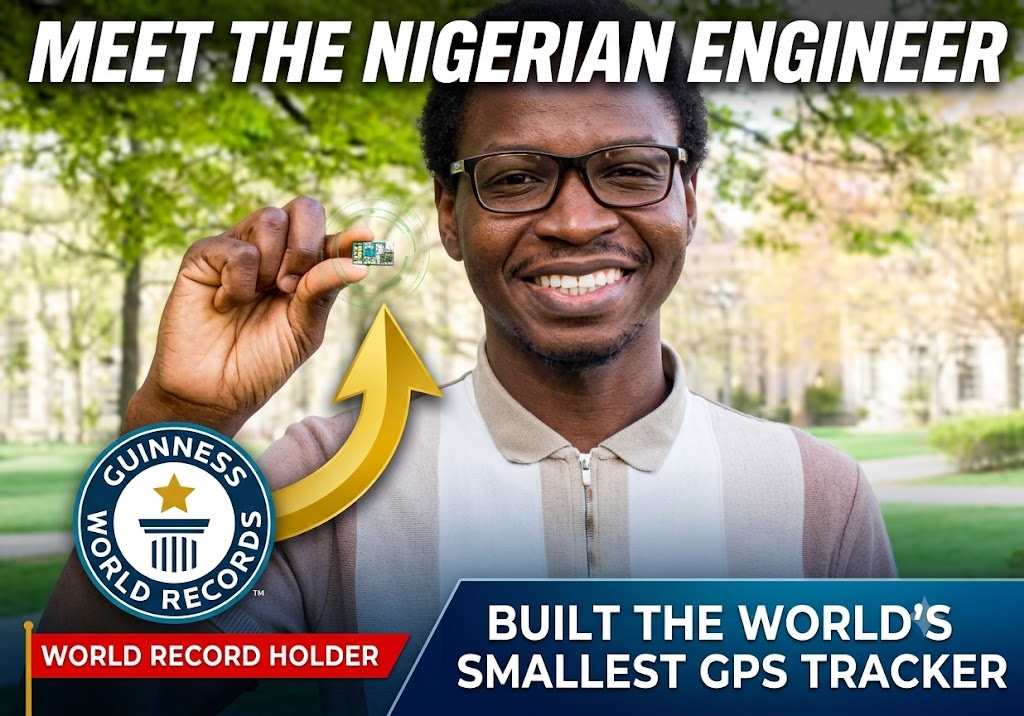
From a donated computer lab in Ibadan to a Guinness World Record at MIT, the full story of the inventor rewriting what’s possible in miniaturised technology.
Smallest GPS Tracking Device Prototype · 22.93 × 11.92 mm · Certified April 27, 2025
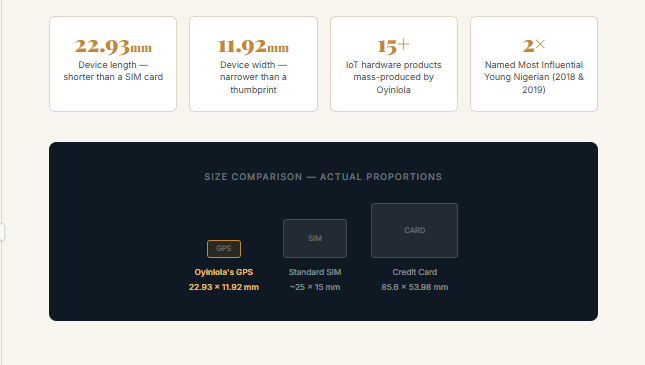
It is smaller than your thumbnail. It is smaller than the SIM card in your phone. In fact, if you placed it on a Nigerian ₦50 coin, you’d still see coin around its edges. And yet this tiny rectangle — measuring exactly 22.93 mm × 11.92 mm — can receive GPS signals from satellites orbiting hundreds of kilometres above the Earth, log precise location data, and stream it wirelessly over Bluetooth. All on its own. No external antenna needed.
Read Also: Breaking: Claude Fable 5 Banned by US Government — Everything You Need to Know
This is not science fiction. It is the work of Oluwatobi “Tobi” Oyinlola, a Nigerian engineer and researcher at the Massachusetts Institute of Technology (MIT), who on April 27, 2025, was officially awarded the Guinness World Record for the world’s smallest GPS tracking device prototype. And the story of how he got there — from a boy who had never touched a computer at age 13, to a world record holder at one of the most prestigious research institutions on the planet — is the kind of story that should be told loudly, and told often.
The Boy Who Taught Himself to Code with a Pen and Paper
Oluwatobi Oyinlola was born on May 10, 1992, in Ibadan — Nigeria’s second-largest city, a sprawling, layered metropolis in Oyo State known for its intellectuals, its markets, and its deep cultural pride. He was not born into a tech ecosystem. He was not handed a laptop. In the early years of his education at Bishop Philips Academy, computers were not part of the curriculum, and access to technology was a distant aspiration for most families in his community.
The turning point came when Tobi was around 13 years old. His secondary school received a donation of fully equipped computers from an alumnus: Seyi Makinde, then an engineer and later the Governor of Oyo State. For most students, it was a curiosity. For Tobi, it was a portal.
“From the moment I booted it up, I was absolutely captivated. I remember spending hours after class tinkering with basic programs and exploring every part of the system just to understand how it all worked. That early exposure ignited an endless curiosity in me and set me on the path that led to where I am today.”— Oluwatobi Oyinlola, to Guinness World Records
What followed was remarkable. Without home access to a computer, Tobi did what only the most determined young engineers do: he obtained textbooks on C programming and taught himself to write code by hand, with pen and paper, visualising the logic, debugging mentally, learning the architecture of machines he could not yet touch. It is one of those origin details that could sound like myth if it were not so well documented — and it says everything about the level of hunger that has driven his career since.
He went on to complete his undergraduate studies at Tai Solarin University of Education and later earned a Master’s degree in Internet of Things and Embedded Computing Systems at the African Centre of Excellence in IoT (ACEIoT) at the University of Rwanda — as a World Bank scholar. Before he ever set foot at MIT, he was already changing Africa.
Before MIT: The Inventions That Put Tobi on the Map
Oyinlola’s professional journey before MIT is not a footnote — it is its own chapter of remarkable, impact-first engineering. He has been popularly known in tech circles as “Internet of Tobi”, a nickname that captures his singular dedication to making IoT work for Africa, not just in theory, but in the hands of real people in real communities.
Nigeria’s First Pay-As-You-Go Solar Energy System
One of his most impactful early inventions was pioneering Nigeria’s first pay-as-you-go solar energy system. Working with a Lagos-based solar energy firm, Oyinlola built an IoT solution that allowed consumers to pay for electricity incrementally — and allowed operators to remotely manage access for customers across Abeokuta, Ibadan, and beyond. In a country where grid electricity has remained unreliable for decades, this was not just an engineering achievement. It was infrastructure for everyday survival.
SolarPocha — The World’s First Solar-Powered IoT Workstation
In 2019, Oyinlola created SolarPocha, described as the world’s first solar-powered outdoor workstation equipped with IoT technology. The concept: a standalone unit that could be deployed anywhere — universities, parks, restaurants — providing both electricity and internet access without requiring proximity to a power grid. He installed the first unit at his own undergraduate institution, making it available to students who lacked both stable power and affordable data. In regions where power outages and expensive data remain barriers to academic competition, SolarPocha was a direct assault on that disadvantage.
Pay-As-You-Cook Technology for Rwanda
Tobi also developed Pay-As-You-Cook, an IoT device enabling consumers to pay incrementally for LPG gas usage — a solution designed to make cleaner cooking fuel more accessible and affordable across Rwanda, where wood and charcoal remained the dominant household energy source.
Elon Musk’s Hyperloop — Representing Africa
Perhaps the most eye-catching pre-MIT credential on Oyinlola’s CV: he was part of the engineering team at rLoop Incorporated, the crowdsourced engineering collective that entered SpaceX’s Hyperloop Pod Competition. rLoop emerged from a Reddit group of engineers collaborating online, and Tobi represented Africa on this global team — a top-30 finalist and winner of the Pod Innovation Award in the 2016 competition.
Intel, Hackaday, and Global Recognition
By 2017, Oyinlola had been recognised as an Intel Software Innovator — one of a select group of engineers Intel spotlights for pioneering work. He was also chosen to represent Africa at the Hackaday Superconference in San Francisco, where he developed a sensor to detect lightning strikes. He was named to the 100 Most Influential Young Nigerians list by Avance Media in both 2018 and 2019, and serves on the board of the Open Source Hardware Association (OSHWA).
By any measure, he had already built a career that most engineers would be proud to finish with. But Tobi was just getting started.
Read Also: ChatGPT 5.5: What It Is, How to Use It, and Top Use Cases to Exploit
At MIT: Research at the Edge of Cities and Technology
Oyinlola joined MIT’s Senseable City Lab — one of the world’s leading research groups studying how technology is reshaping urban life. Founded by Professor Carlo Ratti, the lab sits at the intersection of data science, urban planning, and smart infrastructure. It is the kind of environment where the question isn’t “is this possible?” but “how fast can we make it real?”
At the Senseable City Lab, Oyinlola specialises in IoT and urban sensing technologies, contributing to projects like the City Scanner — a mobile sensing platform mounted on city vehicles that collects granular environmental data: air quality, noise levels, temperature, road conditions. The kind of real-time urban intelligence that helps cities make smarter decisions about health, infrastructure, and climate response.
It was in this environment of miniaturisation, precision, and purpose-driven engineering that the GPS project was born — not as a brief from a supervisor, but as a personal challenge.
The Invention: How Do You Build the World’s Smallest GPS Tracker?
Oyinlola’s frustration had a very practical source. Existing GPS devices were too bulky, too power-hungry, or required external antennas to function. For the kinds of applications he envisioned — embedding GPS into cutting-edge wearables, medical devices, or tiny IoT sensors — the technology on the market simply didn’t fit. He needed to shrink it. Radically.
“I realised that if we wanted to embed GPS functionality into cutting-edge wearables, medical devices, or tiny sensors, we needed to dramatically shrink the technology. My goal was to develop a tracker so compact that it could be embedded in almost any object or device — from consumer electronics to critical safety gear — without compromising functionality.”— Oluwatobi Oyinlola
What’s Inside the Device?
Despite its staggering smallness, the prototype packs a complete, functional GPS system:
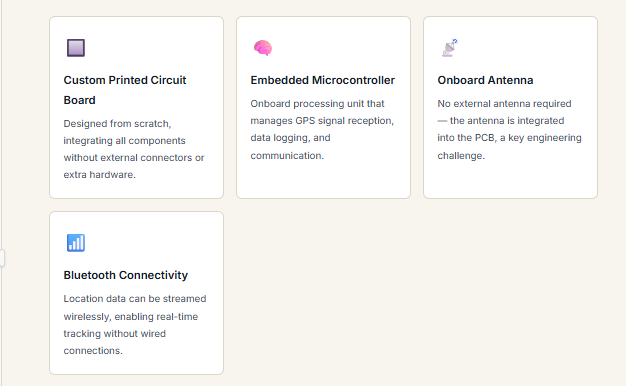
Location data can be streamed wirelessly, enabling real-time tracking without wired connections.
The device was designed, developed, and produced in Cambridge, Massachusetts. To qualify for the Guinness World Record, it underwent independent review by two engineers and an architect, who confirmed both its functionality and its dimensions. On April 27, 2025, Guinness World Records made it official: Oyinlola’s prototype was the smallest GPS tracking device in the world.
The record was not something Oyinlola had planned from the start. He describes it as a personal engineering challenge that kept pushing further:
“At first, it was just a personal challenge. But once I realised how small and functional the device actually was, I thought — why not take it a step further and attempt a world record?”— Oluwatobi Oyinlola, GWR application
Why It Matters: The Real-World Applications of a SIM-Sized GPS
The practical significance of this invention stretches far beyond the record itself. The ability to embed a fully functional GPS tracker into an object the size of a SIM card opens doors that were previously closed — across medicine, conservation, logistics, safety, and the future of smart cities.
🏥
Medical Microchips & Implants
Enabling precise patient tracking within hospitals, or GPS functionality in medical implants — without the bulk that made this previously impractical.
🦁
Wildlife Monitoring
“Imagine tracking wildlife with a tag practically invisible to the animal,” Oyinlola says. Near-invisible tags reduce stress on animals and expand the scope of conservation research.
⌚
Next-Generation Wearables
GPS-enabled jewellery, ultra-thin smartwatches, children’s safety bands — product categories previously constrained by GPS component size.
🔐
Personal Safety Devices
Covert personal trackers for vulnerable individuals — embedded in everyday objects with no visible hardware signature.
📦
Logistics & Supply Chain
Tracking individual items — not just pallets or containers — opens granular supply chain visibility at a scale previously cost-prohibitive.
🏙️
Smart City Infrastructure
Urban sensing at micro-scale — embedded in city infrastructure to provide real-time data on movement, environment, and asset location.
Guinness World Records itself described the invention as a major advancement in the trend toward more compact and powerful electronics, commending Oyinlola for “pushing the boundaries of what’s possible” in compact, high-performance technology.
Nigeria’s Response: A Nation Celebrates Its Own
The announcement of Oyinlola’s record spread quickly across Nigeria — and the reaction, from the presidency to ordinary citizens on social media, captured something more than ordinary national pride. It tapped into a deep, collective longing: proof that Nigerian talent, given access and opportunity, competes at the highest levels of global science and technology.
“Congratulations, Oluwatobi, on this feat. You have just shown the world that Nigerian youth can! Oluwatobi’s invention is a testament to the brilliance and potential of our young people. His work on the world’s smallest GPS tracking device is not just a personal achievement but a national pride.”— President Bola Ahmed Tinubu, via X (Twitter), May 6, 2025
Bosun Tijani, Nigeria’s Minister of Communications, Innovation and Digital Economy, added a personal dimension to his congratulations — noting that he had backed Oyinlola’s early IoT startup years before the world recognised him:
“Long before this global recognition, I had the privilege of backing Oluwatobi. His journey, now continuing at MIT, is a powerful reminder of the extraordinary potential of our people.”— Bosun Tijani, Minister of Communications, Innovation & Digital Economy
Oyinlola was also featured on TVC News Nigeria and received extensive coverage across national and pan-African media. For the Nigerian tech community — engineers, students, founders — it was a moment that resonated beyond celebration. It was validation.
Tobi on the Record, the Mission, and What Comes Next
What is striking about Oyinlola’s public statements around the record is their consistency — not with the language of personal ambition, but with the language of mission. He is remarkably clear about why he invents:
“I love that with science and technology you can have an idea in your mind and then actually bring it to life — it’s like turning imagination into reality through innovation. It’s not just about theory; it’s about building solutions with your own hands and constantly learning new things along the way.”— Oluwatobi Oyinlola
On the record itself, he described the feeling as “incredible — and a bit surreal”, but was careful not to treat it as a destination:
“Breaking a record isn’t a finish line for me — it’s a starting point. It proves that with dedication and creativity, we can achieve what once seemed impossible. I plan to carry this momentum forward, continuing to research, learn, and invent new solutions to challenging problems.”— Oluwatobi Oyinlola, Guinness World Records
His broader vision is expressed in terms that go well beyond personal career milestones: improving access to technology in underserved communities, designing devices that save lives, and inspiring others — particularly young Africans — to see technology as a force for good.
The 13-year-old in the Ibadan computer lab, scribbling C code by hand in a notebook, is never far from the narrative. And perhaps that is intentional — because that boy is exactly the audience Oyinlola is now speaking to.
Oluwatobi Oyinlola: A Timeline of Achievements
- ~2005 First Contact with a Computer — Ibadan, NigeriaAt age 13, Oyinlola used a computer for the first time at his secondary school, after a donation from alumnus Seyi Makinde. He begins teaching himself C programming from textbooks, writing code by hand.
- 2015 Joins rLoop — Elon Musk’s Hyperloop ProjectBecomes part of the engineering team at rLoop Incorporated for the SpaceX Hyperloop Pod Competition, representing Africa in a globally crowdsourced engineering effort.
- 2016 SpaceX Hyperloop Competition — Top 30 FinalistrLoop achieves top-30 placement and wins the Pod Innovation Award.
- 2017 Intel Software Innovator AwardRecognised by Intel for pioneering IoT work, representing Africa in international innovation spotlights. Also represents Africa at Hackaday Superconference in San Francisco.
- 2018 100 Most Influential Young Nigerians (Avance Media)Named to this prestigious list for his pay-as-you-go solar energy systems and IoT innovations. Repeated in 2019.
- 2019 SolarPocha — World’s First Solar IoT Outdoor WorkstationInstalls the first unit at Tai Solarin University of Education, providing students with solar-powered electricity and internet access outdoors.
- 2021+ Joins MIT Senseable City LabBegins research as a Fellow at MIT’s Senseable City Lab, working on IoT and urban sensing. Contributes to the City Scanner project — a mobile platform for urban environmental data collection.
- Apr ’25 Guinness World Record — World’s Smallest GPS Tracking DeviceOn April 27, 2025, Guinness World Records officially certifies Oyinlola’s prototype (22.93 × 11.92 mm) as the world’s smallest GPS tracking device, following independent verification by two engineers and an architect.
- May ’25 Presidential Congratulations — National PridePresident Bola Ahmed Tinubu and Minister Bosun Tijani publicly celebrate the achievement. Oyinlola is featured on TVC News Nigeria and covered across pan-African and global media.
The Bigger Picture: What Oluwatobi Oyinlola’s Record Means for Africa
It would be easy — and incomplete — to frame this story purely as an individual triumph. It is that, certainly. But it is also something else: a data point in a longer argument about African talent, African institutions, and the conditions required to produce world-class innovation.
Oyinlola’s path to this record was not linear. It required a donated computer lab, a World Bank scholarship, early backing from an ecosystem supporter, a global engineering competition, a master’s programme built specifically for African IoT researchers, and finally, access to the world’s most recognised research institution. Each node on that path mattered. Remove any one of them, and the story does not reach this conclusion.
This is the argument Oyinlola himself makes — not in the language of policy papers, but in the way he describes his own motivation: access to technology should not be a function of geography or economic status. His inventions — solar energy systems for off-grid communities, outdoor workstations for students without power, affordable cooking gas solutions for Rwandan households — are all, at their root, attempts to close that gap.
The GPS record is the most globally visible expression of what happens when that philosophy meets the resources of MIT. But it is the same engineer who once wrote code on paper in Ibadan. That continuity is the point.
For the next generation of engineers in Nigeria, in Rwanda, in every African city where a 13-year-old is teaching themselves something with limited tools and unlimited curiosity — Oluwatobi Oyinlola is now, irrevocably, a reference point. A proof of concept. An answer to every well-meaning adult who has ever said “that’s not realistic for someone from here.”
“With passion and perseverance, we can turn even the boldest ideas into reality.”
— Oluwatobi Oyinlola, Guinness World Records, May 2025
Frequently Asked Questions About Oluwatobi Oyinlola
Who is Oluwatobi Oyinlola?
Oluwatobi “Tobi” Oyinlola (born May 10, 1992, Ibadan, Nigeria) is a Nigerian inventor, embedded systems engineer, IoT evangelist, and researcher at MIT’s Senseable City Lab. He holds the Guinness World Record for developing the world’s smallest GPS tracking device prototype (22.93 × 11.92 mm), officially certified on April 27, 2025. He is also known as “Internet of Tobi” for his decade-long work implementing IoT solutions across Africa. What is the world’s smallest GPS tracking device?
The world’s smallest GPS tracking device prototype was developed by Oluwatobi Oyinlola at MIT. It measures 22.93 mm × 11.92 mm (0.90 × 0.46 inches) — roughly the size of a standard mobile SIM card and smaller than a human thumbprint. It integrates a custom printed circuit board, embedded microcontroller, onboard antenna, and Bluetooth connectivity, operating without any external antenna. When did Oluwatobi Oyinlola set the Guinness World Record?
Guinness World Records officially certified the prototype as the world’s smallest GPS tracking device on April 27, 2025. The public announcement and media coverage followed in early May 2025, including congratulations from Nigeria’s President Bola Ahmed Tinubu. Where did Oluwatobi Oyinlola grow up and study?
Oyinlola grew up in Ibadan, southwestern Nigeria. He attended Bishop Philips Academy for secondary school, earned his undergraduate degree at Tai Solarin University of Education, and completed a Master’s degree in IoT and Embedded Computing Systems at the African Centre of Excellence in IoT (ACEIoT) at the University of Rwanda — as a World Bank scholar. He is currently a researcher at MIT’s Senseable City Lab. What does Oluwatobi Oyinlola do at MIT?
Oyinlola is a Research Fellow at MIT’s Senseable City Lab, where he specialises in IoT and urban sensing technologies. He contributes to projects including the City Scanner — a mobile sensing platform mounted on city vehicles to collect granular urban environmental data including air quality, noise levels, and road conditions. What other inventions has Oluwatobi Oyinlola created?
Oyinlola has invented and mass-produced over 15 IoT-enabled hardware products. His notable inventions include Nigeria’s first pay-as-you-go solar energy system; SolarPocha, the world’s first solar-powered IoT-enabled outdoor workstation; and Pay-As-You-Cook, an affordable LPG access solution for Rwanda. He was also part of the engineering team for Elon Musk’s Hyperloop competition via rLoop Incorporated, and was recognised as an Intel Software Innovator. What are the applications of Oyinlola’s miniaturised GPS tracker?
The device has transformative potential in: medical microchips and implants (enabling GPS in medical devices previously too small to accommodate trackers), wildlife monitoring (near-invisible animal tags), next-generation wearables (ultra-thin GPS smartwatches and safety bands), personal safety devices (covert tracking embedded in everyday objects), logistics and supply chain management, and smart city infrastructure. How was the Guinness World Record verified?
The GPS tracking device prototype underwent independent review by two engineers and an architect, who confirmed both its functional capabilities and precise dimensions before Guinness World Records issued official certification on April 27, 2025. What is Oluwatobi Oyinlola’s nickname?
He is widely known in tech and innovation circles as “Internet of Tobi”, a nickname reflecting his decade of work implementing Internet of Things (IoT) solutions across Africa. Did Nigeria’s government react to Oluwatobi Oyinlola’s record?
Yes. President Bola Ahmed Tinubu congratulated Oyinlola publicly on X (Twitter), calling it “a moment of national pride” and saying “You have just shown the world that Nigerian youth can!” Minister of Communications Bosun Tijani also praised the achievement, noting he had personally backed Oyinlola’s early IoT startup before the global recognition.
OA
Olasunkanmi Adeniyi · AI Discoveries
AI content creator, blogger, and tech solutions provider at aidiscoveries.io. Covering AI tools, Nigerian innovation, and the builders reshaping Africa’s future. Based in Lagos, Nigeria.
Sources & Further Reading
- Guinness World Records — Official Profile: Oluwatobi Oyinlola (May 28, 2025)
- Vanguard News — Meet Oluwatobi Oyinlola (May 7, 2025)
- Technology Times Nigeria — Guinness World Record Profile (June 2, 2025)
- ITWeb Africa — Nigerian Tech Prodigy Sets World Record (May 8, 2025)
- The Portfolio Magazine — Redefining Innovation Through IoT (May 8, 2025)
- MIT Senseable City Lab — Current Members
- Royal Academy of Engineering Africa Prize — Oluwatobi Oyinlola (SolarPocha)
- Oluwatobi Oyinlola’s Personal Website — internetoftobi.com





Leave a Reply