
The Anatomy of the Perfect Grain
In West African culinary arts, Nigerian Party Jollof Rice stands as an elite cultural monument. It is defined by an intense, brilliant deep-orange hue, a distinct smoky aroma (the “party scent”), and grains that are fully cooked yet fiercely individualistic. In the culinary lexicon, these grains “stand at attention”—unbroken, separate, and pristine.
Read Also: The Ultimate Better-Than-Takeout Chinese Orange Chicken Recipe (Under 30 Minutes)
However, the path to achieving this standard is littered with failure. The most common technical failure is scrambling (often referred to colloquially as mushy jollof, sticky jollof, or asaro-style rice). This occurs when the rice breaks down into a sticky, clumped mass resembling starch porridge rather than a premium pilaf.
The traditional consensus among novice cooks suggests that high, direct heat is necessary to drive off moisture and forge the legendary smoky flavor profile. This is a fundamental thermodynamic misunderstanding. The secret to preventing structural degradation (scrambling) while simultaneously maximizing flavor absorption and controlled bottom-pot burning (imio) lies within the manipulation of residual steam.
This comprehensive, scientifically rigorous guide explores the macromolecular structures, thermal dynamics, and fluid physics that govern the transformation of simple long-grain parboiled rice into the perfect plate of Smoky Nigerian Party Jollof.
1. The Starch Matrix: Gelatinization and Retrogradation
To understand why Jollof rice scrambles, we must first examine the chemical composition of the rice grain itself. Rice starch is composed of two distinct macromolecular polysaccharides: Amylose and Amylopectin.
The Amylose-to-Amylopectin Ratio
The physical behavior of rice during thermal processing is dictated by its internal ratio of these two starches:
- Amylose is a straight, linear chain of glucose units. It dissolves poorly in hot water, creates a rigid structure upon cooling, and prevents grains from sticking together.
- Amylopectin is a highly branched, complex polymer of glucose. When heated in liquid, it hydrates rapidly, swells, and leaches out a sticky, gelatinous matrix that causes grains to bind to one another.
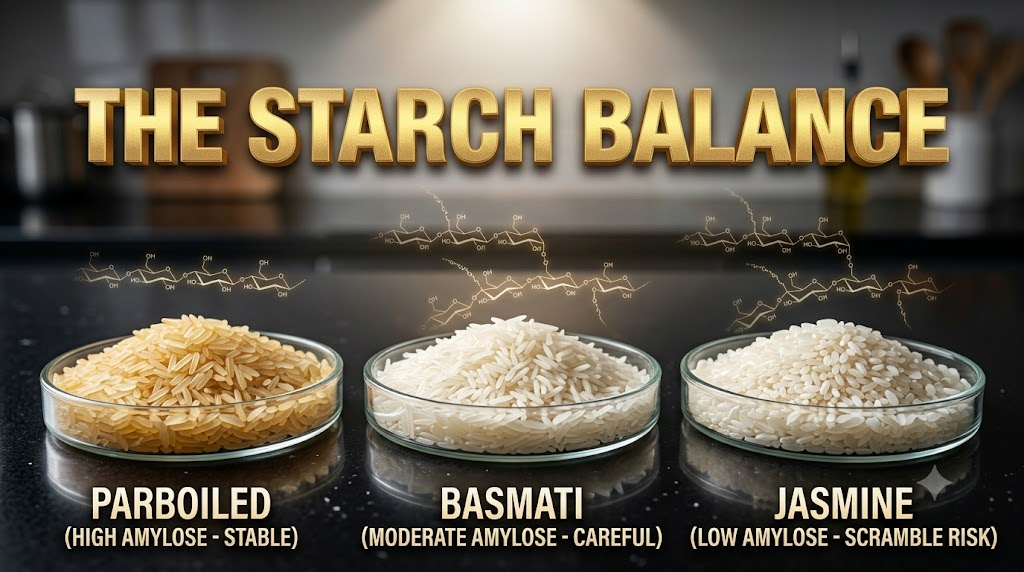
| Rice Variety | Amylose Content | Amylopectin Content | Propensity to Scramble |
| Long-Grain Parboiled (Standard) | ~22% – 25% | ~75% – 78% | Low (Highly Stable) |
| Basmati (Aromatic) | ~20% – 22% | ~78% – 80% | Moderate (Requires Low Fluid) |
| Short-Grain / Jasmine | ~15% – 18% | ~82% – 85% | Critically High (Unsuitable for Jollof) |
For authentic Nigerian Jollof, long-grain parboiled rice is preferred because its high amylose baseline offers structural integrity against the high-acid, high-sugar environment of the tomato-pepper base (obe-ata).
Read Also: We Tested a 7-Day AI-Generated Fridge-Clean Meal Plan (Real Results & Costs)
The Mechanism of Gelatinization
When rice is introduced to a hot liquid base, heat disrupts the semi-crystalline granules of the starch matrix. Water penetrates the granules, causing them to swell irreversibly. This process is called starch gelatinization.
If the rice is subjected to constant direct heat and physical agitation (stirring) during this phase, the swollen amylopectin structures rupture, spilling out free starches into the cooking liquid. The result is a viscous, glue-like paste that encapsulates the grains, causing them to scramble into a singular mass.
2. The Fluid Dynamics of the Pepper Base (Obe-Ata)
Jollof rice is not boiled in water; it is cooked within a complex, emulsified fluid matrix composed of:
- Red Bell Peppers (Tatashe)
- Scotch Bonnets (Ata Rodo)
- Onions
- Tomato Paste / Purée
- Vegetable Oil & Meat Stock (Omi Eran)
Viscosity and Heat Transfer Mechanics
Unlike water, which has a low, uniform viscosity ($~0.89\text{ mPa}\cdot\text{s}$ at $25^\circ\text{C}$), the obe-ata base is a highly viscous, non-Newtonian suspension loaded with dissolved plant sugars, insoluble cellulose fibers, and free lipids.
[High Heat] ---> Rapid Bottom Desiccation ---> Starch Rupture & Scorched Paste (Scrambling)
[Low Steam] ---> Uniform Vapor Penetration ---> Gradual Swelling & Intact Grains (Perfect Jollof)
When high direct heat is applied to the bottom of a pot containing this thick mixture, the fluid cannot undergo normal convective heat transfer. Water cannot circulate freely to distribute the thermal energy. Instead, heat transfer happens almost entirely via conduction at the bottom interface.
This creates a critical thermal gradient: the bottom layer of the fluid rapidly loses its water content through flashing evaporation, leaving behind a concentrated paste of sugars and starches that scorches and cakes, while the top layers remain undercooked and waterlogged.
The Role of Acid and Frying
The initial step of frying the pepper base until the oil separates (the paper towel test) serves an essential chemical purpose:
$$\text{Sucrose} + \text{Heat} \xrightarrow{\text{Acid Interaction}} \text{Fructose} + \text{Glucose} \rightarrow \text{Complex Caramelization Polymers}$$
Frying reduces the raw, volatile water content of the peppers and concentrates the lipids. This ensures that when the rice is finally added, the external surfaces of the grains are instantly coated in a thin film of hydrophobic oil. This lipid barrier acts as a physical shield, slowing down the rate of initial water absorption and preventing premature starch rupture.
3. Direct Heat vs. Residual Steam Thermodynamics
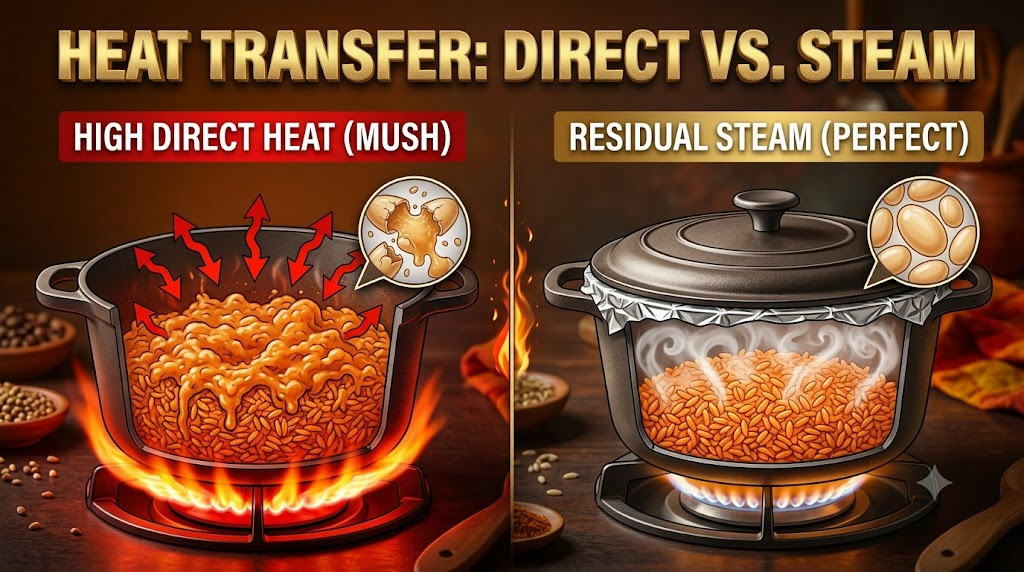
The fundamental flaw in modern domestic Jollof preparation is the over-reliance on direct burner heat to drive the cooking process to completion.
The Problem with High Conduction
When a pot of Jollof rice is left over direct medium-to-high heat without intervention, the thermal energy entering the system exceeds the latent heat of vaporization required by the water inside.
The liquid at the bottom of the pot hits its boiling point instantly, converting to steam violently. This high-pressure localized boiling physically rattles the rice grains, causing them to rub against each other. This friction mechanically strips away the outer gelatinized layer of the grain, shedding amylopectin into the surrounding sauce and creating a scrambled texture.
The Physics of Enclosed Steam Cooking
True mastery of Jollof rice relies on converting the system from an open convective/conductive cook to a closed thermodynamic steam chamber.
When the pot is sealed tightly—traditionally achieved by placing a layer of heavy aluminium foil or clean parchment paper directly under a heavy, tight-fitting lid—and the heat is dropped to a minimal simmer (or turned off completely during the final phase), the mechanism changes:
- Vaporization: The small amount of remaining liquid in the pot turns into steam.
- Pressure Buildup: The foil barrier prevents the vapor from escaping, causing a mild micro-pressure environment inside the pot.
- Latent Heat Delivery: As steam rises through the packed matrix of rice grains, it encounters cooler surfaces. The steam condenses back into liquid directly onto the grain surfaces, releasing its latent heat of vaporization ($~2260\text{ kJ/kg}$).
- Uniform Hydration: This thermal energy is delivered evenly across all layers of the rice, from the bottom to the absolute top. Because the heat is delivered via gas condensation rather than bubbling, turbulent liquid, the grains remain completely motionless. They hydrate and expand gently through molecular diffusion without any mechanical agitation or shearing forces.
4. The Pitfalls of Parboiling and Hydration Mismanagement
Managing the absolute volume of water entering the Jollof matrix determines whether the final dish succeeds or fails.
The Starch Clearance Process
If you choose to parboil the rice before introducing it to the pepper base, you must do so with scientific intent. Parboiling must only go far enough to set the outer starch matrix without initiating full gelatinization.
- The Danger Area: Boiling the rice until it bends or softens completely means it has already reached its peak gelatinization capacity. When thrown into the acidic pepper sauce, the internal starches have no structural storage capacity left; they will fracture, leak, and turn the pot into a scrambled mass.
- The Proper Wash Method: If omitting parboiling (which is preferred by many professional chefs to maximize stock flavor absorption), the rice must be washed repeatedly in warm water until the effluent runs perfectly clear. This removes surface-bound, free-milling amylose starches created during commercial milling, which would otherwise form an immediate glue when mixed with the hot obe-ata.
Calculating the Water-to-Rice Ratio
Because Jollof contains high concentrations of solids (tomato paste and pepper solids), the available free water is significantly lower than it appears. The ideal volume of liquid should sit no higher than 1 cm to 1.5 cm above the compressed surface of the rice once combined. Any excess liquid forces the chef to keep the heat high to evaporate the water, driving the pot straight into the scrambled danger zone.
5. The Chemistry of True Firewood Smokiness (The Party Vibe)
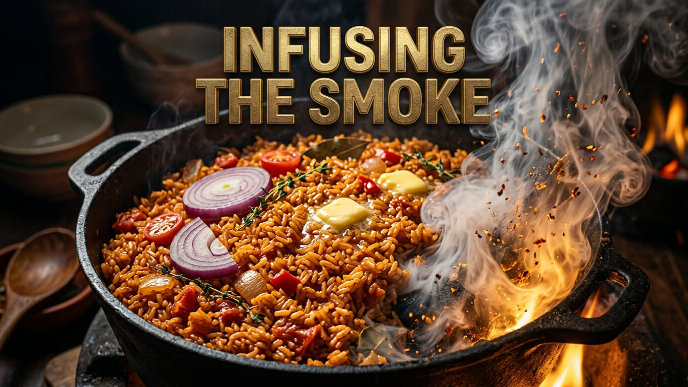
The defining characteristic of premium Jollof is its deeply nostalgic, woodsmoke flavor profile. In traditional catering, this is achieved effortlessly using large cast-iron cauldrons (koko-irin) over open hardwood fires. Indoors, replicating this requires a precise application of thermal desiccation.
Maillard Reaction vs. Caramelization
The smoky notes in Jollof are not the result of simple charring; they are a delicate balance of the Maillard Reaction and Caramelization:
- Maillard Reaction: The reaction between the amino acids present in the concentrated meat stock and the reducing sugars of the reduced peppers. This occurs at temperatures between 140 Degrees Celcius and 165Degrees Celcius.
- Caramelization: The thermal pyrolysis of fructose and sucrose within the tomato base, which begins around 160 Degrees Celcius.
Read Also: We Tested a 7-Day AI-Generated Fridge-Clean Meal Plan (Real Results & Costs)
Controlled Bottom-Burn (Imio) Strategy
To safely execute this stovetop “hack” without ruining the entire batch of rice:
- Complete the Steam Phase: Allow the rice to cook to 95% doneness purely via low-temperature residual steam (sealed with foil).
- Introduce the Lipids: Uncover the pot, add knobs of unsalted dairy butter and fresh onion slices across the top, and gently fold them into the upper layers only. The fats lower the overall surface tension and add rich notes.
- The High Heat Flash: Crank the burner to high for 5 to 7 minutes. Because the moisture has been perfectly modulated by the steam phase, this intense heat instantly drives out the final traces of water from the very bottom layer of rice, initiating rapid caramelization and Maillard browning against the metal pot base.
- The Scent Signal: The moment you smell a sweet, intensely toasted, non-acrid smoke aroma, turn off the heat completely. Do not touch the pot. Keep it sealed.
- The Vapor Distillation: Let the pot rest undisturbed for 10 to 15 minutes. The localized smoke generated at the scorched base will rise up through the resting rice grains, carrying volatile flavor compounds (guaiacol, syringol, and furfurals) upwards, naturally infusing every single grain with authentic party smokiness.
6. The Step-by-Step Blueprint for Non-Scrambled, Smoky Jollof
Follow this culinary protocol to achieve zero clumping and maximum flavor depth.
Kitchen Metrics & Ingredients
- Rice: 4 Cups (Premium Long-Grain Parboiled Rice, washed until water is crystal clear)
- Concentrated Base: 2 Cups (Blended and reduced Red Bell Peppers, Scotch Bonnets, and Onions)
- Tomato Paste: 3 Tablespoons (Double-concentrated tomato paste fried down completely)
- Liquid Medium: 3 to 4 Cups (Rich, gelatinous, seasoned Bone-in Beef or Chicken Stock)
- Fats: 100ml Beef/Chicken fat or Vegetable Oil; 2 Tablespoons Unsalted Butter
- Aromatics: 3 Dried Bay Leaves, 1 tbsp Curry Powder, 1 tbsp Dried Nigerian Thyme, 1 tsp White Pepper
Execution Protocol
Step 1: Fry Base & Paste ---> Step 2: Incorporate Rice & Stock ---> Step 3: Seal with Foil (Steam Phase) ---> Step 4: High Heat Flash (Smoke Gen) ---> Step 5: Disted Vapor Rest
1. The Aromatics & Paste Base
Heat your frying oil in a heavy-bottomed cast iron or Dutch oven pot. Drop in sliced onions and let them brown slightly. Add the curry powder, thyme, white pepper, and bay leaves directly into the hot fat to bloom their fat-soluble essential oils. Add the tomato paste and stir continuously on medium heat for 5 minutes until it loses its sour edge and breaks into small pebbles.
2. The Pepper Reduction & Stock Integration
Pour in the reduced pepper base. Fry until the oil separates and floats elegantly on top. Pour in your seasoned meat stock. Bring the mixture to a rolling boil, then taste and adjust for salt and seasoning cubes. The liquid must taste slightly over-seasoned at this point, as the rice will absorb a massive amount of flavor.
3. The Rice Introduction
Dump in your thoroughly washed and drained raw rice. Stir gently with a flat wooden spatula once to ensure even distribution. The liquid level should be roughly 1 cm above the rice bed.
4. The Foil Condensation Seal
Immediately place a sheet of high-density aluminum foil over the mouth of the pot, crinkling the edges to create an airtight lock. Press the heavy lid firmly over the foil. Turn the heat down to your stove’s lowest possible simmer setting. Walk away and let it sit undisturbed for 25 to 30 minutes. Do not open it to check; every time you open the lid, you lose the precise volume of steam required to cook the top layer of rice.
5. The Butter and Smoke Treatment
Remove the lid and foil. The rice grains should be swollen and separate, with minimal moisture visible. Drop the butter, fresh tomato slices, and onion rings over the top. Increase the burner heat to maximum. Monitor the pot closely. Within 5 minutes, you will hear a distinct crackling sound as the bottom layer vaporizes its remaining moisture, followed by the aroma of rich, wood-like smoke.
6. The Structural Rest Phase
Turn off the heat completely. Put the foil and lid back on. Let the pot sit undisturbed for 15 minutes. During this rest, temperature equalization occurs: the high heat from the bottom diffuses outward, the starches settle through retrogradation (firming up the individual grains), and the trapped smoke permeates the entire batch. Open, fluff gently with a large fork, and serve.
7. Troubleshooting and Diagnostic Matrix
| Symptom | Root Molecular Cause | Real-Time Solution |
| Top layer of rice is chalky/raw; bottom is perfectly cooked. | Steam escaped due to an improper seal; thermal energy didn’t reach the upper layers. | Drizzle 3–4 tablespoons of boiling meat stock over the top, reseal instantly with fresh aluminum foil, and let it rest on a warm, turned-off burner for 15 minutes. |
| Rice is turning into a sticky, porridge-like paste (Scrambling). | Excess initial fluid volume combined with constant stirring over high direct heat. | Immediately uncover the pot, spread the rice out in a thin layer across a wide baking sheet, and place it under a broiler or in a low oven ($120^\circ\text{C}$) to rapidly flash evaporate surface moisture and dry out the grain exteriors. |
| The rice has scorched, but there is zero smoky aroma. | The pepper base wasn’t fried down enough; the bottom layer is wet-burning rather than undergoing dry caramelization. | Do not stir from the bottom (avoid mixing the bitter charcoal paste into the rice). Scoop the clean upper rice out into a fresh pot, add a touch of butter, and finish cooking via steam. |
Read Also: The Ultimate Better-Than-Takeout Chinese Orange Chicken Recipe (Under 30 Minutes)
8. Common Search Intent Queries (FAQ)
Why does my Jollof rice always turn out mushy or soggy?
Mushy Jollof rice is caused by managing water volumes poorly and using too much direct heat. When you boil rice in an excess of watery pepper base over high heat, the rice grains collide, rupture their outer starch walls, and leak amylopectin into the sauce. Washing the starch off your rice thoroughly and sealing the pot with foil to let it cook using gentle steam prevents this structural breakdown.
Can I use Basmati rice instead of long-grain parboiled rice for Party Jollof?
Yes, you can use Basmati rice, but it requires adjusting your technique. Basmati rice has a delicate structure and hydrates much faster than long-grain parboiled rice. To prevent scrambling Basmati Jollof, reduce your stock volume by roughly 25-30%, shorten the active cooking time, and rely entirely on tight foil steam insulation to finish the grains.
How do you get the authentic smoky taste without using an open wood fire?
The authentic stovetop smoky flavor is achieved through a process called controlled bottom-burning (imio). Once the rice is 95% cooked through steaming, increase the stove heat to high for 5 to 7 minutes until the sugars from the tomato and pepper base catch and caramelize against the bottom of the pot. Turning off the heat and leaving the pot sealed allows that trapped smoke to rise and flavor every grain naturally.
Why is a heavy-bottomed pot required to cook Jollof rice properly?
Thin, inexpensive stainless steel or aluminum pots transfer heat too erratically, creating localized hot spots that instantly burn the sauce before the rice can cook. Heavy pots, such as cast-iron Dutch ovens or heavy cast-aluminum pots (koko-irin), distribute heat evenly across their base, allowing for stable steam production and a safe, uniform bottom-burn.
Conclusion: The Triumph of Thermodynamics
Mastering Nigerian Party Jollof Rice is an exercise in applied food science. Scrambling is not an unavoidable consequence of cooking rice in a heavy sauce; it is a physical indicator of ruptured starches caused by excessive direct heat and unnecessary stirring.
By shifting your technique from high-heat boiling to airtight, low-temperature residual steam cooking, you preserve the physical integrity of the starch matrix, ensure uniform moisture distribution, and lay the foundation for a flawless, controlled bottom-burn. Respect the science of steam, trust the foil seal, and let thermodynamics handle the rest.





Leave a Reply