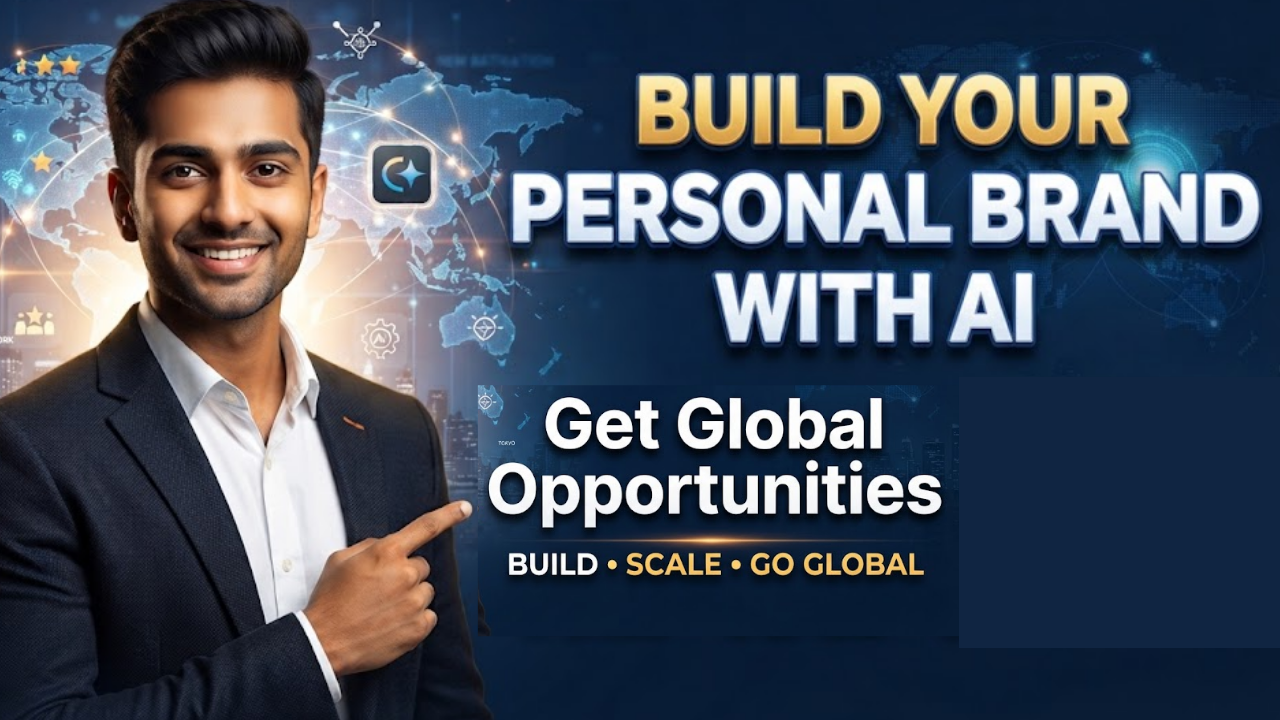
AI has changed the way professionals build visibility, demonstrate expertise, find opportunities, and compete in the global job market.
You no longer need to work for a multinational company, live in Silicon Valley, or have millions of followers to become visible to an international audience.
With the right strategy, you can use AI to clarify your expertise, improve your LinkedIn profile, create valuable content, build a portfolio, discover international opportunities, and connect with people around the world.
The key is understanding that AI should amplify your expertise, not replace it.
Your experience gives you something valuable to say. AI helps you package, distribute, and scale it.
This guide explains how to use AI to build a personal brand that attracts global opportunities, including jobs, freelance projects, speaking invitations, consulting clients, partnerships, scholarships, and business opportunities.
Why Personal Branding Matters More in the AI Era
The global job market is changing quickly.
The World Economic Forum’s Future of Jobs Report 2025 estimates that 170 million new jobs could be created globally by 2030, while 92 million jobs could be displaced, resulting in a net increase of 78 million jobs. The report also identifies AI and big data, technological literacy, creative thinking, analytical thinking, resilience, and lifelong learning among the skills increasing in importance.
Read Also: How to Learn AI for FREE from Harvard, Stanford, MIT & Google
Skills alone may no longer be enough.
People also need to communicate what they know, demonstrate what they can do, and make it easy for the right people to discover them.
That is where personal branding becomes important.
Your personal brand is the combination of your expertise, experience, reputation, ideas, work, communication, and the way people perceive your professional value.
A strong personal brand answers five questions:
Who are you?
What do you know?
Who do you help?
What problems can you solve?
Why should someone trust you?
AI can help you answer these questions faster and turn your answers into a repeatable personal branding system.
What AI Can Do for Your Personal Brand
AI can support almost every stage of personal branding.
You can use it to:
Research your industry.
Identify your target audience.
Find content ideas.
Improve your LinkedIn profile.
Write and repurpose content.
Analyze your competitors.
Build a content calendar.
Create presentations.
Develop case studies.
Create portfolio projects.
Prepare for interviews.
Find international opportunities.
Personalize networking messages.
Analyze job descriptions.
Identify skills employers are requesting.
Turn your knowledge into digital products.
Translate and localize your content.
Create videos and visual content.
The important distinction is this:
Do not use AI to pretend you have expertise you do not have.
Use AI to communicate your real expertise more effectively.
Step 1: Define Your Personal Brand Positioning
Before asking AI to create content, determine what you want to be known for.
A common mistake is trying to build a personal brand around everything you know.
That makes your positioning unclear.
Instead, choose a specific professional intersection.
For example:
Logistics + AI
Marketing + AI
Finance + AI
Human resources + AI
Healthcare + technology
Product management + AI
Education + technology
Cybersecurity + business
Operations + automation
Sales + AI
You can then use a simple positioning formula:
I help [specific audience] achieve [specific outcome] using [your expertise].
For example:
I help small businesses use AI and automation to reduce repetitive work and improve productivity.
Or:
I help logistics companies use technology and data to improve delivery operations.
Use an AI tool to test your positioning.
Give it your professional background, skills, industries, interests, target audience, and career goals.
Then ask it to identify:
Your strongest areas of expertise.
The problems you are qualified to discuss.
Potential audiences.
Your most credible positioning options.
Topics you should avoid claiming expertise in.
This gives you a starting point.
But make the final decision yourself.
Step 2: Use AI to Audit Your Existing Personal Brand
Your existing online presence contains valuable information.
Search for your name on Google and review your LinkedIn profile, portfolio, social media accounts, published articles, videos, interviews, and other public profiles.
Ask:
What would a recruiter think I specialize in?
What would a potential client think I can help them with?
Is my expertise obvious within 10 seconds?
Does my profile communicate measurable results?
Do my posts demonstrate knowledge?
Does my portfolio prove that I can do the work?
Is my professional story consistent across platforms?
AI can help you analyze this information and identify gaps.
For example, you can provide your current LinkedIn headline and About section and ask AI to identify:
Weak positioning.
Generic language.
Missing keywords.
Unclear value propositions.
Evidence that should be added.
Potential improvements.
LinkedIn itself also provides AI-powered writing assistance for some Premium users, including suggestions for the Headline, About, and Experience sections.
Your goal should not be to make your profile sound impressive.
Your goal should be to make your value obvious.
Step 3: Build an AI-Optimized LinkedIn Profile
LinkedIn remains one of the most useful platforms for professional visibility because your profile can function as a public professional landing page.
LinkedIn describes the profile as a place to manage your professional brand and communicate your experience, qualifications, interests, and professional identity.
Your profile should contain five important elements.
- A clear headline
Do not simply write:
Product Manager
Marketing Professional
Operations Manager
Instead, communicate expertise and value.
For example:
Product Manager | Building AI-Powered Products | Customer Research | Product Strategy
Or:
Operations Leader | Logistics & Supply Chain | AI Automation | Process Improvement
- A strong About section
Your About section should explain:
What you do.
Who you help.
What you have achieved.
What you are learning.
What problems interest you.
What opportunities you are open to.
- Evidence-based experience
Do not list responsibilities only.
Show outcomes.
Instead of:
Managed delivery operations.
Use:
Managed last-mile delivery operations across multiple service areas and improved operational efficiency through process optimization.
Add numbers whenever you can verify them.
- Relevant skills
Align your skills with the work you want to attract.
- Proof of work
Add projects, certifications, case studies, presentations, articles, videos, or other evidence that demonstrates your capabilities.
Step 4: Turn Your Experience Into Content
You do not need to become an influencer.
You need to become useful.
One of the best ways to build a personal brand is to turn your professional experience into educational content.
Think about the problems you have solved.
What mistakes have you made?
What have you learned?
What processes do you understand?
What questions do people repeatedly ask you?
What industry changes are you following?
What would you teach someone starting your career today?
These questions can produce months of content.
AI can help you organize your ideas into content pillars.
For example, someone working in logistics might create content around:
Logistics operations.
Last-mile delivery.
Customer experience.
AI in logistics.
Supply chain technology.
Career development.
Leadership lessons.
Product management.
The goal is to create a recognizable association between your name and a specific area of expertise.
Step 5: Create a Content System With AI
Consistency is easier when you have a system.
Instead of asking AI:
“Write me a LinkedIn post.”
Give it context.
Provide:
Your audience.
Your expertise.
Your personal experience.
Your preferred tone.
The problem you want to discuss.
The lesson you want people to learn.
The action you want readers to take.
For example:
“Act as a professional content strategist. I work in logistics operations and I am building a personal brand around AI, technology, operations, and career growth. My audience includes professionals, business owners, and technology beginners. Give me 20 content ideas based on real problems these audiences face. Prioritize practical educational topics and personal stories.”
Then turn those ideas into different formats.
One idea can become:
A LinkedIn post.
A newsletter.
A YouTube video.
A short video.
An X thread.
An article.
A carousel.
A presentation.
A podcast discussion.
This is where AI becomes powerful.
You create the original insight once, then distribute it across multiple formats.
Step 6: Use AI to Develop Your Unique Point of View
This is one of the most important steps.
AI can generate information.
Millions of other people can generate similar information.
Your advantage is your perspective.
Suppose 1,000 people write about AI in logistics.
You may still stand out if you have actual logistics experience and can explain how AI affects real delivery operations.
Your personal experience becomes the differentiator.
Instead of:
“AI can improve logistics.”
Say:
“Here are three areas where I believe AI can reduce repetitive work in last-mile delivery operations, based on what I have seen in the industry.”
The second statement contains a point of view.
That is what makes your content more valuable.
Use AI to challenge your thinking.
Ask:
What assumptions am I making?
What would someone who disagrees with me say?
What evidence supports this argument?
What evidence contradicts it?
What practical example could make this clearer?
What is missing from this explanation?
AI should act as a thinking partner, not your replacement.
Step 7: Create Proof of Work With AI
One of the biggest advantages of AI is that it allows professionals to build projects faster.
This matters because employers increasingly want evidence of what candidates can actually do.
LinkedIn reported in 2026 that AI proficiency has become a highly demanded skill and introduced ways for professionals to showcase verified proficiency with selected AI tools on their profiles.
LinkedIn also reported that posts showcasing projects and products had increased 4.5 times year over year, highlighting the growing importance of showing what you have built.
This creates an important strategy:
Do not only tell people what you can do.
Show them.
For example, if you want to become an AI product manager, build:
An AI product case study.
A customer research report.
A product requirements document.
A prototype.
A competitive analysis.
An AI workflow.
A product roadmap.
A usability test.
A product teardown.
Then publish the work.
You can use AI to accelerate research, documentation, analysis, brainstorming, prototyping, and presentation.
The finished work should still reflect your judgment.
Step 8: Use AI to Find Global Opportunities
Building a personal brand is only half the strategy.
You also need an opportunity discovery system.
Global opportunities include:
Remote jobs.
International internships.
Freelance projects.
Consulting opportunities.
Scholarships.
Fellowships.
Speaking opportunities.
International conferences.
Accelerators.
Startup collaborations.
Research projects.
Volunteer opportunities.
Mentorship programs.
AI can help you find and organize these opportunities.
For example, create a list of target companies and organizations.
Then use AI to analyze:
Their current priorities.
The skills they are hiring for.
Their common job requirements.
The problems they appear to be solving.
The people you could connect with.
The projects you could create to demonstrate relevant skills.
LinkedIn is also expanding AI-powered job search. In 2026, LinkedIn said its conversational AI-powered job search had expanded globally in several languages and was generating more than 25 million searches per week in English.
This means you can move beyond traditional keyword searches and describe the type of opportunity you want in natural language.
Step 9: Use AI to Match Your Skills With Global Jobs
Do not search for jobs randomly.
Start with your skills.
Suppose you have experience in:
Operations.
Customer service.
Project management.
Data analysis.
AI tools.
Logistics.
Process improvement.
Instead of searching for one job title, ask AI to identify roles where those skills overlap.
You might discover opportunities such as:
Operations Manager.
Product Operations Manager.
Program Manager.
Implementation Specialist.
Customer Success Manager.
AI Operations Specialist.
Business Operations Analyst.
Supply Chain Technology Specialist.
This approach can uncover opportunities you would miss by searching only for your current job title.
Step 10: Build a Global Portfolio
A global personal brand needs proof that travels with you.
Your portfolio does not need to be complicated.
It can be a simple website or organized collection of projects.
Include:
About me.
Skills.
Projects.
Case studies.
Results.
Testimonials.
Certifications.
Articles.
Videos.
Contact information.
For each project, explain:
The problem.
Your approach.
The tools you used.
Your decisions.
The result.
What you learned.
If possible, include numbers.
For example:
Reduced processing time by 35%.
Automated 5 repetitive tasks.
Analyzed 1,500 customer responses.
Created a workflow that saved 10 hours per week.
Improved response time from 24 hours to 4 hours.
Numbers make your work easier to evaluate.
Step 11: Use AI to Build Your Professional Network
Networking becomes easier when you stop thinking about it as asking strangers for favors.
Instead, think about creating professional relationships around shared interests.
Use AI to research people you genuinely want to learn from.
Look for:
People working in your target industry.
Hiring managers.
Recruiters.
Founders.
Product leaders.
Researchers.
Creators.
Community leaders.
Professionals who have made the transition you want to make.
Then engage with their work.
Leave useful comments.
Share relevant insights.
Ask thoughtful questions.
Create something inspired by their work.
When you eventually send a message, make it personal.
Avoid:
“Hello, I want to connect with you because I am looking for a job.”
Instead, explain why you are reaching out.
Mention something specific you learned from their work.
Then make a small and reasonable request.
AI can help you research the person and improve your draft, but you should never automate your relationships.
People can recognize generic messages.
Step 12: Build Your Personal Brand Around Expertise, Not AI-Generated Content
This distinction is becoming increasingly important.
AI can generate polished content in seconds.
That means polished writing alone is no longer a competitive advantage.
Your advantage is original knowledge.
Your experience.
Your experiments.
Your results.
Your opinions.
Your stories.
Your ability to explain complicated ideas clearly.
Recent reporting has also highlighted growing concerns among LinkedIn users about the flood of AI-generated professional content and the pressure to constantly post.
The answer is not to stop using AI.
The answer is to use it differently.
Use AI behind the scenes.
Keep your thinking in front.
A useful rule is:
AI creates the draft.
You provide the experience.
AI improves the structure.
You provide the judgment.
AI helps with distribution.
You build the relationships.
Step 13: Create a Personal Brand Content Engine
You can build a simple weekly system.
Monday:
Share an educational insight.
Tuesday:
Share a personal experience or lesson.
Wednesday:
Share a useful tool, framework, or resource.
Thursday:
Publish a case study or proof of work.
Friday:
Share an opinion about an industry trend.
Then use AI to repurpose your strongest piece into other formats.
For example:
One LinkedIn post becomes a newsletter.
The newsletter becomes a YouTube script.
The YouTube script becomes five short videos.
The key ideas become an X thread.
The framework becomes a carousel.
The article becomes a downloadable checklist.
This allows you to increase your visibility without creating everything from scratch.
Step 14: Use AI to Improve Your Professional Communication
Global opportunities often depend on communication.
AI can help you improve:
CVs.
Cover letters.
Proposals.
Cold emails.
Networking messages.
Interview answers.
Presentations.
Professional biographies.
Speaker profiles.
Portfolio descriptions.
But do not copy and paste generic AI-generated applications.
Give AI the job description and your actual experience.
Ask it to identify the strongest matches.
Then rewrite your application around those real matches.
For interviews, ask AI to simulate the role of a hiring manager.
Give it:
The job description.
Your CV.
Your experience.
The company information.
Then ask it to conduct a realistic interview.
After each answer, ask:
What was weak?
What was unclear?
What evidence was missing?
What would make this answer stronger?
This creates a practical feedback loop.
Step 15: Learn AI as a Career Skill
You do not necessarily need to become a machine learning engineer.
For most professionals, the immediate opportunity is learning how to work effectively with AI.
Google’s AI Essentials program, for example, is designed for people without prior experience and covers AI fundamentals, productivity, prompting, responsible AI, and staying current with AI developments.
You can build your AI skills around five areas:
AI literacy.
Prompting.
AI-assisted research.
AI automation.
AI-powered problem solving.
Then combine those skills with your existing professional expertise.
This combination can be more valuable than learning AI in isolation.
For example:
AI + marketing.
AI + logistics.
AI + finance.
AI + healthcare.
AI + HR.
AI + education.
AI + product management.
AI + sales.
AI + operations.
The goal is to become the person who understands both the industry problem and how AI can help solve it.
Step 16: Make Your Personal Brand Discoverable
A personal brand should exist beyond one social platform.
Create a digital footprint around your name and expertise.
Consider publishing:
LinkedIn posts.
Articles.
YouTube videos.
Podcasts.
Case studies.
Guest articles.
Research summaries.
Presentations.
Portfolio projects.
Digital products.
Community contributions.
Your content should repeatedly reinforce your core topics.
If you want to be known for AI and logistics, for example, consistently publish around AI, automation, operations, logistics technology, productivity, and related subjects.
Over time, search engines and people can build a clearer understanding of what you are known for.
Step 17: Create Content That AI Systems Can Understand
If you want your work to be discovered by both Google and AI systems, clarity matters.
Use descriptive titles.
Answer questions directly.
Define important terms.
Use clear sections.
Include examples.
Provide original insights.
Support factual claims with credible sources.
Create useful FAQs.
Avoid filling articles with vague statements.
For example, instead of:
“AI is transforming the future.”
Write:
“AI can help professionals build a personal brand by speeding up content research, profile optimization, portfolio creation, networking research, and job discovery.”
The second statement gives search engines and AI systems something specific to understand.
This approach also supports Answer Engine Optimization, sometimes called AEO.
The objective is simple:
Make your content easy for humans to understand and easy for machines to interpret.
A 30-Day AI Personal Branding Plan
You do not need to spend a year building your personal brand.
Start with 30 days.
Days 1 to 3:
Define your niche.
Identify your target audience.
Write your positioning statement.
Audit your existing online presence.
Days 4 to 7:
Optimize your LinkedIn profile.
Rewrite your headline.
Improve your About section.
Add relevant skills.
Add projects and proof of work.
Days 8 to 14:
Create five content pillars.
Generate 30 content ideas.
Publish three useful posts.
Document one real project.
Days 15 to 21:
Build or improve your portfolio.
Publish a case study.
Connect with 20 relevant professionals.
Comment meaningfully on industry content.
Identify 20 international companies or organizations you want to work with.
Days 22 to 30:
Identify relevant global opportunities.
Customize your CV.
Practice interviews with AI.
Send personalized networking messages.
Publish your best project.
Review your analytics.
Double down on the topics generating the strongest engagement and conversations.
AI Personal Branding Prompt You Can Use
Use this prompt as a starting point:
“Act as my personal branding strategist and career advisor. I want to build a credible global personal brand around my expertise.
My professional background is: [insert background].
My strongest skills are: [insert skills].
The industries I understand are: [insert industries].
The roles or opportunities I want are: [insert target opportunities].
My target audience is: [insert audience].
My interests are: [insert interests].
Analyze my background and create:
- A clear personal brand positioning statement.
- Three possible professional niches.
- Five content pillars.
- Thirty content ideas.
- Ten portfolio project ideas.
- A LinkedIn headline.
- A LinkedIn About section.
- Ten global job titles I should consider.
- Ten types of international organizations I should target.
- A 30-day personal branding strategy.
Prioritize credibility, practical expertise, proof of work, and global opportunities. Do not invent experience, qualifications, achievements, or results that I have not provided.”
Common Mistakes to Avoid When Using AI for Personal Branding
Mistake 1: Letting AI become your voice
If every post sounds like everyone else’s AI-generated content, your brand becomes forgettable.
Mistake 2: Posting without a niche
If you talk about AI today, football tomorrow, cryptocurrency the next day, and career advice after that, people may struggle to understand what you represent professionally.
Mistake 3: Chasing followers instead of opportunities
A person with 2,000 relevant followers can have a stronger professional network than someone with 100,000 random followers.
Mistake 4: Creating content without proof
Talk less about what you want to do.
Show what you have done.
Mistake 5: Applying for everything
Target opportunities that match your skills and positioning.
Mistake 6: Automating networking
AI can help you research people.
It should not replace genuine relationships.
Mistake 7: Claiming AI expertise without evidence
If you say you understand AI, demonstrate it through projects, experiments, workflows, case studies, or measurable outcomes.
The AI Personal Brand Framework
A simple framework can help you remember the entire strategy:
Expertise → Positioning → Content → Proof → Visibility → Relationships → Opportunities
Expertise tells people what you know.
Positioning tells them what you want to be known for.
Content demonstrates your thinking.
Proof demonstrates your ability.
Visibility helps people discover you.
Relationships create access.
Opportunities become easier to find.
This is how AI can become a career multiplier.
What Global Employers Are Looking For
The future of work is not only about technical skills.
The World Economic Forum expects AI and big data to be among the fastest-growing skill areas, while creative thinking, resilience, flexibility, curiosity, analytical thinking, leadership, and collaboration also remain important.
That means your personal brand should communicate both sides.
Show that you can use technology.
Also show that you can think.
Show that you can analyze problems.
Also show that you can communicate.
Show that you understand AI.
Also show that you understand people, customers, business, and your industry.
The strongest professional brands sit at the intersection of expertise, technology, communication, and evidence.
How to Measure Your Personal Brand Growth
Do not measure your brand only by followers.
Track:
Profile views.
Search appearances.
Relevant connection requests.
Messages from recruiters.
Messages from potential clients.
Interview invitations.
Speaking invitations.
Collaboration requests.
Website traffic.
Portfolio views.
Content saves.
Content shares.
Qualified leads.
Job opportunities.
The most important metric is not visibility.
It is opportunity.
If your content gets 100,000 views but produces nothing useful, you may need to change your strategy.
If 5,000 views produce three strong professional relationships and one international opportunity, that may be far more valuable.
Final Thoughts
AI has lowered the cost of building a professional presence.
You can research faster.
Write faster.
Learn faster.
Create faster.
Build projects faster.
Find opportunities faster.
But AI does not automatically give you credibility.
Credibility comes from what you know, what you have done, what you can prove, and how consistently you help other people.
The winning strategy is therefore not to become another person who uses AI to produce more content.
Become a professional who uses AI to communicate real expertise, demonstrate real capability, and connect with the right people.
Start with one niche.
Build one strong profile.
Publish useful ideas.
Create proof of work.
Connect with people globally.
Use AI to accelerate the process.
Then let your reputation compound.
Frequently Asked Questions
What is AI personal branding?
AI personal branding means using artificial intelligence tools to help develop, communicate, and distribute your professional identity. This can include profile optimization, content creation, research, portfolio development, networking, job discovery, and career planning.
How can AI help me build a personal brand?
AI can help you identify your niche, define your positioning, generate content ideas, improve your professional profile, analyze your target audience, create portfolio projects, repurpose content, research opportunities, and prepare for interviews.
Can AI help me get international job opportunities?
Yes. AI can help you identify relevant international roles, analyze job descriptions, match your skills with job requirements, research companies, improve your CV, prepare for interviews, and organize your job search. LinkedIn also offers AI-powered job search features that allow users to describe opportunities conversationally.
Do I need to be an AI expert to use AI for personal branding?
No. You can start with basic generative AI skills. The most important advantage comes from combining AI capability with your existing professional expertise.
What should I post on LinkedIn to build my personal brand?
Post content based on your experience, expertise, lessons, opinions, projects, industry observations, case studies, and useful frameworks. Focus on helping a specific audience solve specific problems.
How often should I post?
Consistency matters more than volume. Start with two or three high-quality posts per week and increase your frequency only if you can maintain quality and authenticity.
Can AI write my LinkedIn posts?
Yes, but you should provide your own experiences, examples, opinions, and insights. Treat AI as an assistant rather than allowing it to completely replace your voice.
How can I use AI to find remote jobs?
Use AI to identify suitable job titles, search terms, companies, industries, and locations. You can also provide job descriptions to AI and ask it to compare the requirements with your actual skills and experience.
How do I make my personal brand attractive to global employers?
Make your expertise clear, demonstrate measurable results, publish useful content, build a portfolio, show relevant AI skills, communicate professionally, and create evidence that demonstrates what you can actually do.
What is the biggest mistake people make when using AI for personal branding?
The biggest mistake is using AI to produce large amounts of generic content without developing a clear point of view or demonstrating real expertise.
Can AI replace personal branding?
No. AI can accelerate many personal branding tasks, but your experience, judgment, reputation, relationships, and original perspective remain human advantages.
What is the best platform for building a professional personal brand?
LinkedIn is one of the strongest platforms for professional branding because it combines professional profiles, networking, content, job discovery, and recruiter visibility. However, your personal brand should ideally exist across multiple channels where your target audience spends time.
What should I do first?
Start by defining what you want to be known for. Then optimize your LinkedIn profile, create three to five content pillars, publish useful content, build proof of work, and begin connecting with people in your target industry.
SEO Title
How to Use AI to Build Your Personal Brand and Get Global Opportunities
Meta Description
Learn how to use AI to build a powerful personal brand, optimize LinkedIn, create content, showcase your skills, find global jobs, and attract international opportunities.
Suggested URL Slug
/use-ai-build-personal-brand-global-opportunities/
Primary Keyword
how to use AI to build your personal brand
Secondary Keywords
AI personal branding
personal branding with AI
AI for personal branding
how to build a personal brand with AI
AI tools for personal branding
how to get global opportunities
AI career opportunities
AI for career growth
how to build a global personal brand
LinkedIn personal branding with AI
AI-powered career growth

Leave a Reply