The new Tesla Roadster is an all-electric performance car that pushes beyond the traditional idea of a supercar. Unveiled in October 2026, the redesigned second-generation Roadster combines extreme acceleration, a high-power battery system, active aerodynamics, a specialized suction system, and SpaceX-inspired cold-gas thrusters on its more advanced versions.
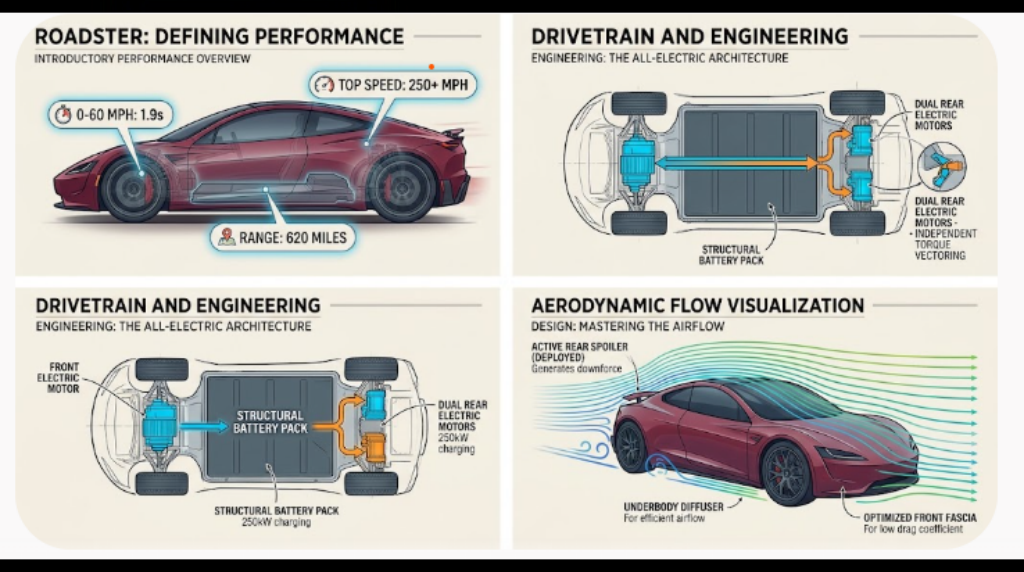
Tesla has demonstrated the Roadster accelerating from 0 to 60 mph in less than one second, performing aerial maneuvers, and using a suction system to travel along an inverted ramp. The company has also announced plans to begin production in 2028. However, the final production specifications, pricing, and regulatory status of some features remain uncertain. Source: Reuters
The new Tesla Roadster stands out for its reported 800-volt electrical architecture, specially developed 4680 battery cells, dual rear motors, and optional rocket-inspired propulsion technology. Tesla is also targeting a driving range of more than 300 miles per charge and a top speed above 230 mph.
This guide covers the latest Tesla Roadster specifications, battery technology, charging speed, acceleration, design, interior, Rocket trim, expected production date, and the questions prospective buyers should consider.
New Tesla Roadster at a Glance
| Specification | Reported details |
|---|---|
| Vehicle type | All-electric performance sports car |
| Latest unveiling | October 15, 2026 |
| Expected production | 2028 target |
| 0-60 mph acceleration | Under 1 second demonstrated or claimed for advanced versions |
| Roadster Rocket acceleration | 0.55-second target or rollout-adjusted figure reported for the Rocket configuration |
| Top speed | Over 230 mph stated, with more ambitious targets discussed |
| Driving range | More than 300 miles claimed |
| Peak power | Up to approximately 1,500 hp reported for the most extreme configuration |
| Drive system | Two rear-mounted electric motors |
| Electrical architecture | 800V reported |
| Battery | Special high-power 4680 cells |
| Charging target | 15% to 80% in 10 minutes, according to reported engineering details |
| Rocket technology | Cold-gas thrusters on selected versions |
| Pressure system | Carbon-fiber-overwrapped pressure vessels, or COPVs |
| Seating | Two seats on Performance and Thrust, one seat on Rocket |
| Expected base price | Not officially confirmed at the latest reveal |
| Rocket availability | Limited, invite-only production |
These figures combine Tesla’s public disclosures and reported engineering details. Some numbers, particularly the 0.55-second acceleration, 1,500-hp output, 10-minute charging time, and 330-mph-plus speed target, should be treated as reported targets or configuration-specific claims rather than verified specifications for every Roadster. Sources: Tesla, TechCrunch, Not a Tesla App.
Read also: How Small Businesses Can Use AI to Increase Revenue in 2026: 7 Practical Strategies
What Is New About the Tesla Roadster?
The most significant change is the Roadster’s combination of conventional electric propulsion with technologies designed to control airflow, increase cornering grip, and provide additional thrust.
The 2026 unveiling introduced three main configurations: Performance, Thrust, and Rocket. The Performance model is intended for road use, the Thrust version adds acceleration-focused cold-gas thrusters, and the Rocket model is presented as an exclusive configuration with a more extensive propulsion system. Source: TechCrunch
Tesla’s new Roadster also departs from the smooth, rounded design shown in 2017. Its latest styling draws inspiration from aircraft such as the SR-71 reconnaissance aircraft and the F-35 fighter jet.
The result is a more angular sports car with moving body panels, active aerodynamic components, and a chassis designed around performance.
1. Tesla Roadster Acceleration: Can It Really Go From 0 to 60 mph in 0.55 Seconds?
Acceleration is one of the new Roadster’s most remarkable claims.
Tesla demonstrated a sub-one-second 0-60 mph run at its October 2026 unveiling. Reporting on the event put the demonstrated time at approximately 0.81 seconds, while Tesla’s engineering figures and subsequent coverage have discussed even lower rollout-adjusted figures for the Rocket configuration. Sources: Reuters, Not a Tesla App.
A reported 0.55-second figure needs context. Acceleration measurements can differ depending on whether timing includes a one-foot rollout, the precise vehicle configuration, and whether the result comes from a controlled demonstration or a repeatable production-car test.
The key distinction is that the Roadster’s standard electric motors provide its driving force, while the advanced configurations can use additional cold-gas thrust to push performance beyond conventional electric-car acceleration.
At these speeds, traction, tire grip, road conditions, occupant forces, and vehicle control become critical engineering challenges. Independent testing will be needed to establish repeatable performance figures.
2. Dual Rear Motors and Up to 1,500 Horsepower
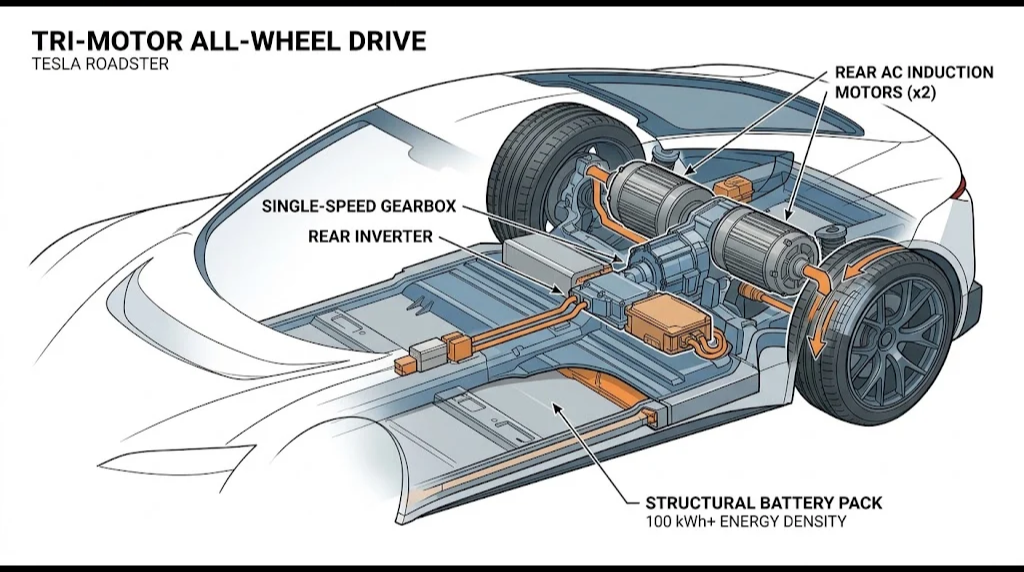
The new Tesla Roadster uses two electric motors mounted on the rear axle. Unlike an all-wheel-drive sports car, the reported configuration is rear-wheel drive.
Engineering details reported after the reveal describe a combined output exceeding one megawatt, more than 1,400 Nm of torque, and a potential peak output around 1,500 horsepower for the most extreme configuration.
The two motors can control the rear wheels independently. Each motor has its own inverter and uses an 8.4:1 planetary gear reduction, according to reported technical details.
Tesla’s reported design also omits a conventional differential. Independent wheel control can help the car distribute torque precisely between the left and right rear wheels.
This approach can improve traction and cornering response. It also creates additional demands on the control software, cooling system, motors, and tires.
The distinction matters because the Roadster’s performance is not determined by horsepower alone. Its ability to deliver power to the road, control wheel slip, and maintain stability will determine how much of that output drivers can use.
3. A Special 4680 Battery Built Specifically for the Roadster
The battery is another major part of the Roadster’s engineering story.
Tesla’s 4680 battery format measures approximately 46 mm in diameter and 80 mm in height. The company has developed this larger cylindrical cell format for high-volume electric vehicle manufacturing, but the Roadster reportedly uses a special high-power chemistry tailored to its performance requirements.
Reported technical details include:
- A bespoke 4680 cell designed for the Roadster.
- Aluminum cell cans instead of conventional steel cans.
- Double-sided cell cooling to improve heat transfer.
- A titanium upper battery plate.
- An aluminum lower battery plate.
- An 800-volt electrical architecture.
The goal is to deliver substantial power during acceleration while managing the heat generated by repeated high-performance driving.
A battery designed for a performance car faces a different challenge from one optimized primarily for maximum driving range. It must supply large amounts of current without overheating or suffering excessive performance loss.
The Roadster’s reported battery design appears focused on that balance.
Tesla has not publicly disclosed a final battery capacity in kilowatt-hours. Without that figure, it is difficult to independently calculate the pack’s energy density, charging requirements, or expected highway efficiency.
4. Tesla Roadster Charging Speed: 15% to 80% in 10 Minutes
Tesla is reportedly targeting a 10-minute charge from 15% to 80% for the Roadster’s new high-power battery.
If achieved under appropriate charging conditions, this would make the Roadster exceptionally quick to recharge.
Charging from 15% to 80% adds 65 percentage points of battery capacity. However, the actual energy delivered depends on the size of the battery pack.
For example, a hypothetical 100-kWh battery would need to receive 65 kWh during that charging window. Delivering that energy in 10 minutes would require an average battery-side charging power of approximately 390 kW, before accounting for charging losses. A larger battery would require proportionally more power.
This illustrates why the battery’s chemistry, cooling system, charging hardware, and thermal management matter.
The Roadster’s reported 800V architecture can also support high-power charging by reducing current for a given power level compared with a lower-voltage system. The final charging experience will still depend on compatible charging equipment, battery temperature, state of charge, and the vehicle’s production software.
Until Tesla publishes validated charging curves and final specifications, the 10-minute figure should be treated as a target rather than a guaranteed result for every charging session.
5. Tesla Roadster Range: More Than 300 Miles per Charge
Tesla is targeting more than 300 miles of range for the new Roadster.
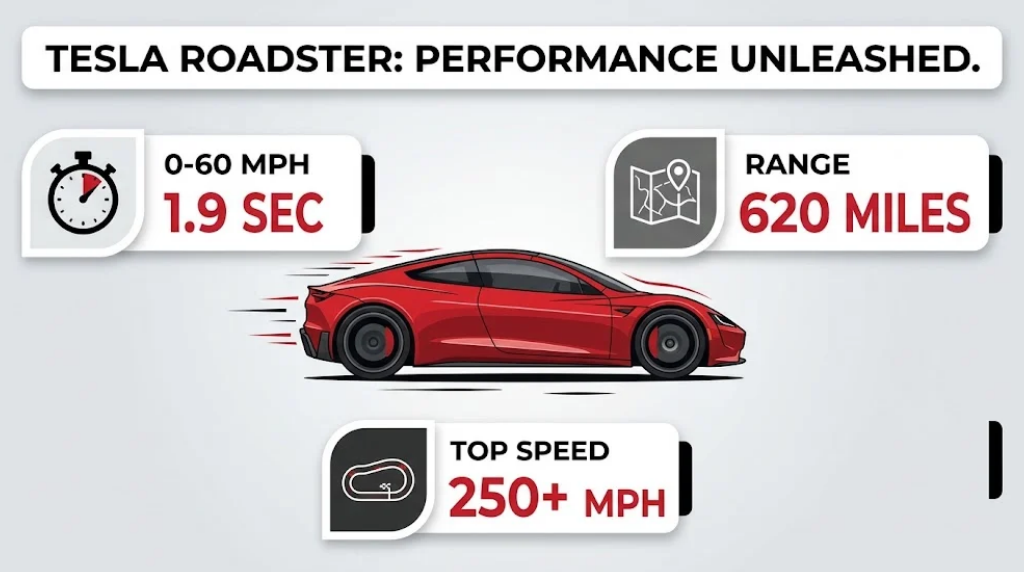
This is lower than the 620-mile range displayed on Tesla’s older Roadster product information, but the redesigned vehicle has a different performance focus and a more ambitious set of propulsion and aerodynamic systems. Reuters reported that the new model’s stated range exceeds 300 miles. Source: Reuters.
Real-world range will depend on several factors:
- Driving speed and acceleration.
- Ambient temperature.
- Tire choice and pressure.
- Road gradient and traffic.
- Use of the vehicle’s high-performance systems.
- Aerodynamic configuration and driving mode.
Track driving can consume energy much faster than ordinary road driving. Tesla reportedly targets 25 to 30 minutes of unlimited track driving per charge, although the precise meaning of that target and the conditions used to measure it require clarification.
The battery’s final capacity and the official range-testing procedure will be essential to evaluating the production vehicle.
6. The Tesla Roadster Rocket Trim and SpaceX Technology
The Rocket trim is the feature that separates the new Roadster from most other electric supercars.
Tesla has shown a version equipped with cold-gas thrusters developed through its collaboration with SpaceX. The system uses compressed gas rather than conventional combustion rocket engines.
Reported engineering details describe carbon-fiber-overwrapped pressure vessels, or COPVs, storing gas at pressures of up to 10,000 psi. The gas can be released through strategically positioned thrusters to produce brief bursts of force.
At the reveal, Tesla demonstrated a Roadster performing aerial maneuvers and moving over other vehicles. The company presented these capabilities as part of its vision for the Rocket configuration. Source: TechCrunch.
The system is designed to supplement the car’s electric propulsion. It does not mean the Roadster can operate as a conventional aircraft or travel through the air like a passenger airplane.
What is a COPV tank?
A COPV is a carbon-fiber-overwrapped pressure vessel. It combines a liner with a strong composite outer layer to store gas at high pressure while keeping weight relatively low.
COPVs are used in aerospace applications where weight and pressure resistance matter.
For the Roadster, the reported system uses stored compressed gas to generate short-duration thrust. Each burst is brief, so the tank must be replenished before the system can deliver another full set of maneuvers.
Tesla is reportedly targeting a refill time of less than 30 minutes. Current refill times and the final production system’s service requirements have not been fully established.
Another unusual detail is the reported use of an actuator derived from Tesla’s Optimus humanoid robot program. This illustrates how Tesla may be applying components and engineering knowledge across its vehicle, robotics, and aerospace projects.
The Rocket system will also introduce practical questions about servicing, safety, operating restrictions, and the circumstances under which its thrust functions can legally be used.
Will the Tesla Roadster actually fly?
The demonstrations show the vehicle using thrust to perform brief aerial maneuvers. However, that is different from establishing that the Roadster can function as a practical flying vehicle in ordinary traffic.
Its ability to perform those maneuvers on public roads will depend on the final design, safety requirements, and local regulations. The Rocket configuration is also expected to be a limited, invite-only offering rather than the standard Roadster.
7. Active Aerodynamics and a Suction System for Extreme Cornering
The new Roadster’s aerodynamic system includes moving body panels designed to manage airflow and vehicle stability.
Reported features include:
- Front wings that can move through an angle of up to 80 degrees.
- Pop-out side aerodynamic panels, sometimes described as scales or barge boards.
- An active hood vent.
- Four rear-mounted fans.
- Four deployable side skirts.
- An adjustable ride height and adaptive suspension.
The rear fans and deployable skirts form what Tesla describes as a suction system. Rather than relying only on conventional wings to generate aerodynamic downforce, the system is intended to reduce pressure beneath the vehicle and pull it toward the road.
Tesla has claimed this arrangement can produce more than 2 g of cornering capability from very low speeds, with the precise performance depending on configuration and conditions.
If the claim holds up under independent testing, the system could give the Roadster an unusual advantage during low-speed cornering, when conventional aerodynamic downforce is limited.
The side skirts reportedly use replaceable rubber and nylon-bristle components because they must maintain contact with the road or manage airflow close to the ground.
Track Mode is also reported to lower the vehicle by approximately 40 mm and substantially increase suspension stiffness. The claimed threefold stiffness change should be understood as a reported engineering figure until Tesla explains the measurement and production calibration.
8. Suspension, Steering and Braking Technology
The Roadster’s reported suspension layout combines double wishbones at the front with a multi-link rear suspension and adaptive dampers.
This arrangement is common in performance-oriented vehicles because it gives engineers control over wheel movement, tire contact, ride quality, and cornering behavior.
The vehicle is also reported to use steer-by-wire and brake-by-wire systems.
Steer-by-wire replaces a direct mechanical steering connection with electronically controlled actuation. Brake-by-wire uses electronic control to manage braking force.
These systems can help coordinate the steering, braking, suspension, and aerodynamic controls, but their production implementation must meet stringent reliability and safety requirements.
A car capable of extreme acceleration and cornering needs more than a powerful motor. It needs predictable control, effective braking, and stable behavior when the driver changes direction or encounters a sudden obstacle.
Tesla’s final production specifications and regulatory approvals will determine how these systems are implemented on customer vehicles.
Read Also: Gemini 4 Argon: Features, Pricing, Access, and Use Cases
9. Tesla Roadster Design: Moving Panels, Thin Headlights and Aircraft-Inspired Glass
The redesigned Roadster features an angular exterior inspired by modern aerospace design.
One of its unusual reported characteristics is that almost every exterior panel moves in some way. The purpose is to support active aerodynamics, cooling, access, or other vehicle functions.
The design details reported so far include:
- Extremely thin pop-down headlights, approximately 15 mm tall.
- Front aerodynamic wings that can move up to 80 degrees.
- Deployable side panels.
- An active hood vent.
- Orange-tinted titanium-oxide rear glass inspired by aircraft materials.
- Removable roof panels.
- A body width of approximately two metres.
The headlights are designed to sit nearly flush with the body when not in use. This can reduce visual clutter and help the car achieve a distinctive appearance.
The removable roof panels preserve an open-air driving option, while the rear glass uses a material treatment intended to give the vehicle a distinctive aircraft-inspired finish.
These features remain subject to final production design. Moving panels, complex actuators, and specialized glass can also increase manufacturing complexity and repair costs.
10. Tesla Roadster Interior and Driver Comfort
Although the Roadster is focused on performance, its reported interior includes several everyday comfort features.
These include heated seats, a wireless phone charger, and a next-generation heat pump.
One unusual design detail is that the seats are reportedly fixed while the pedals move to accommodate different drivers. This could help maintain a consistent seating position while adjusting the driving controls.
The approach may also support the car’s low seating position and compact performance-focused cabin.
The reported use of electronic steering and braking controls could give Tesla more flexibility in designing the cockpit and coordinating vehicle functions.
The Rocket trim is different from the other versions. Tesla describes it as a single-seat configuration, while the Performance and Thrust models are presented as two-seat vehicles. Source: TechCrunch.
Tesla has not yet provided a complete final production interior specification, so buyers should wait for confirmed details about storage, visibility, comfort adjustments, and standard equipment.
11. Tesla Roadster Weight and Track Performance
Reported development figures put the Roadster’s target weight at just under 1,700 kg, or approximately 3,700 pounds. This figure is not final.
That would be a notable engineering achievement for a high-performance electric vehicle carrying a substantial battery and additional systems.
The car’s weight will influence braking distance, tire wear, cornering response, and the energy needed for acceleration. A high-output electric drivetrain can compensate for some of that mass in a straight line, but weight remains important during repeated braking and cornering.
Tesla’s combination of adaptive suspension, active aerodynamics, independent rear-motor control, and suction fans appears intended to address these challenges.
The company reportedly has four to five prototypes built, with a larger build planned for early 2027. That should not be confused with mass production, which Tesla has targeted for 2028.
Track performance will ultimately depend on repeatability. A convincing demonstration is one thing. Sustaining performance over repeated laps without overheating the battery, motors, brakes, or tires is another.
Tesla’s stated goal of 25 to 30 minutes of unlimited track driving per charge will therefore be an important benchmark to verify.
12. Tesla Roadster Performance, Thrust and Rocket Versions Compared
Tesla has introduced three main configurations for the redesigned Roadster.
Performance
The Performance version is intended to be the road-focused model. It is designed to combine electric acceleration with active aerodynamics and the vehicle’s suction system.
Tesla’s reservation information has listed a $50,000 reservation payment for this version. That is a reservation amount, not the confirmed final purchase price.
Read Also: How to Use Arena AI: Battle Mode vs Direct Chat vs Side-by-Side
Thrust
The Thrust version adds cold-gas thrusters to improve acceleration and deliver additional performance capabilities. Tesla describes it as race-ready and has listed a $250,000 reservation payment.
The exact production specifications, equipment, and customer delivery terms still need to be confirmed.
Rocket
The Rocket version is the most exclusive configuration. Tesla describes it as invite-only, with a single-seat layout and a full propulsion system.
It is intended to demonstrate the most extreme version of Tesla’s combined automotive and aerospace engineering.
The reported 0.55-second acceleration figure and some of the highest performance targets relate to this advanced configuration, not necessarily to every Roadster.
Tesla has not announced a final confirmed retail price for all three versions.
13. When Will the New Tesla Roadster Be Released?
Tesla has targeted 2028 for Roadster production, following years of delays.
The second-generation Roadster was first unveiled as a concept in 2017, with deliveries originally expected much earlier. The October 2026 event finally provided a substantially updated look at the vehicle and its advanced propulsion concepts. Source: Reuters.
However, a production target is not a guaranteed delivery date. Tesla must still finalize the vehicle, validate its systems, establish manufacturing capacity, and address applicable safety and regulatory requirements.
The Rocket version faces additional questions because its propulsion system goes beyond the capabilities of a conventional road car.
Buyers considering a reservation should review the current terms carefully, including cancellation rules, delivery estimates, the final vehicle specification, and whether the chosen configuration can be registered for road use in their country.
14. How Much Will the New Tesla Roadster Cost?
Tesla has not confirmed a final retail price for the redesigned Roadster at its October 2026 unveiling.
The company has listed reservation payments of $50,000 for Performance and $250,000 for Thrust, while Rocket is presented as an invite-only version. These amounts should not be mistaken for the final purchase prices of the vehicles. Source: Reuters.
Earlier Roadster announcements referenced a starting price of approximately $200,000, but the redesigned vehicle’s final pricing and configuration structure may differ.
The cost of ownership will also depend on insurance, tires, repairs, charging equipment, maintenance, and the availability of trained service technicians.
Specialized aerodynamic components and the Rocket propulsion system could add further complexity to servicing the most advanced version.
Prospective buyers should rely on Tesla’s current official order page rather than old concept-car pricing or unverified estimates.
15. How Does the New Tesla Roadster Compare With Other Electric Supercars?
The Roadster’s main selling point is its combination of high-speed electric performance and additional aerodynamic and propulsion systems.
The table below compares its reported capabilities with the broader performance focus of two established electric performance vehicles.
| Vehicle | Main performance focus | Important distinction |
|---|---|---|
| Tesla Roadster | Sub-one-second acceleration claim, active aerodynamics, optional thrusters | Extreme performance targets, with final specifications still to be validated |
| Rimac Nevera | High-output electric powertrain and all-wheel drive | Established electric hypercar engineering and performance testing |
| Porsche Taycan Turbo GT | Track-focused electric performance and chassis control | Combines road usability with a performance-oriented electric drivetrain |
These vehicles serve different purposes. The Roadster’s rear-wheel-drive layout and optional cold-gas propulsion system distinguish it from conventional electric hypercars, while the Rimac Nevera and Porsche Taycan Turbo GT provide useful reference points for evaluating real-world performance.
A fair numerical comparison requires consistent test conditions, verified production specifications, and independent results. Tesla’s most ambitious targets should not be compared directly with another vehicle’s independently measured figures without accounting for those differences.
16. What Could Prevent the Tesla Roadster From Meeting Its Targets?
The Roadster’s technical ambitions also create substantial engineering challenges.
Battery heat management: Extremely high power output and fast charging generate heat. Tesla must control cell temperatures to preserve safety, performance, and battery life.
Tire and road grip: Sub-one-second acceleration requires extraordinary traction. Tire limitations and road conditions will affect repeatable performance.
Propulsion system complexity: COPVs, high-pressure gas plumbing, valves, actuators, and thrusters add components that require testing, maintenance, and safety controls.
Active aerodynamic reliability: Moving wings, skirts, fans, and panels must work reliably at high speeds and under changing loads.
Manufacturing: Specialized materials and mechanisms can increase production complexity, cost, and repair time.
Regulatory approval: The roadworthiness of each configuration will depend on its final equipment and the rules in the markets where Tesla intends to sell it. The Rocket version’s aerial capabilities raise questions that do not apply to ordinary electric sports cars.
Production timing: Tesla has previously delayed the second-generation Roadster several times. The 2028 target remains a plan, not proof that deliveries will begin on schedule.
These challenges do not mean the vehicle cannot succeed. They explain why final specifications and independent testing matter as much as an impressive launch demonstration.
17. Is the New Tesla Roadster Worth Waiting For?
The new Roadster is worth watching if you are interested in high-performance electric vehicles, advanced battery technology, active aerodynamics, and the crossover between automotive and aerospace engineering.
Its most compelling features include the reported high-power 4680 battery, dual rear motors, rapid-charging target, independent rear-wheel control, and optional cold-gas thrusters.
However, buyers should separate the vehicle’s demonstrated capabilities from its most ambitious targets. The production date, final price, official battery capacity, verified acceleration, and real-world range will determine its practical value.
For most drivers, a conventional electric performance car will remain easier to buy, insure, service, and use every day. The Roadster is aimed at a much narrower market that values unusual engineering and extreme performance.
Tesla calls it a defining driver’s car. Whether it earns that reputation will depend on the production vehicle, not only the unveiling.
Frequently Asked Questions About the New Tesla Roadster
What is the 0-60 mph time of the new Tesla Roadster?
Tesla demonstrated the new Roadster accelerating from 0 to 60 mph in less than one second. A reported 0.55-second figure relates to the Rocket configuration and rollout-adjusted performance reporting. Final production specifications and independent testing are still needed.
What is the top speed of the new Tesla Roadster?
Tesla has stated a top speed above 230 mph. More ambitious targets, including speeds above 330 mph, have been discussed, but those should not be treated as verified production performance.
What is the range of the 2026 Tesla Roadster?
Tesla has stated that the redesigned Roadster can travel more than 300 miles on a charge. The final official range rating and battery capacity have not been fully disclosed.
How fast can the new Tesla Roadster charge?
Reported engineering details indicate a target of charging from 15% to 80% in 10 minutes. The final charging curve, required charger, and conditions for achieving that time remain important unknowns.
Does the Tesla Roadster have two motors or three?
The reported new Roadster configuration uses two electric motors mounted on the rear axle. Each motor independently controls its respective rear wheel.
Can the new Tesla Roadster fly?
The Rocket version uses cold-gas thrusters to perform brief aerial maneuvers. This is different from conventional aircraft flight, and the vehicle’s permitted use will depend on its final design and applicable regulations.
What is a COPV in the Tesla Roadster?
COPV stands for carbon-fiber-overwrapped pressure vessel. It is a lightweight, high-pressure gas tank used in the Roadster’s reported thruster system.
How much will the new Tesla Roadster cost?
Tesla has not confirmed the final retail price. Reported reservation payments are $50,000 for Performance and $250,000 for Thrust. Rocket is invite-only.
When will the new Tesla Roadster enter production?
Tesla has targeted 2028 for production. The exact delivery schedule remains subject to development, manufacturing, and regulatory requirements.
Will the Tesla Roadster be available in Nigeria?
Tesla has not confirmed a Nigeria-specific launch, price, or delivery schedule. Availability would depend on Tesla’s sales arrangements, import requirements, local registration rules, servicing, and support for the chosen version.
Final Thoughts
The new Tesla Roadster is one of the most ambitious electric sports cars Tesla has presented. Its reported battery innovations, independent rear motors, rapid-charging target, active aerodynamics, and SpaceX-inspired propulsion system make it technically unusual.
The biggest question is no longer whether Tesla can produce an attention-grabbing demonstration. It is whether the company can deliver a production car that meets its performance targets, satisfies regulatory requirements, and offers a dependable ownership experience.
The 2028 production target gives Tesla time to address those challenges. Until production specifications and independent test results are available, the Roadster should be judged as a highly ambitious vehicle in development rather than a fully validated production supercar.
For official updates, visit the Tesla Roadster website.
Written by Olasunkanmi Adeniyi
✍️ About the Author
Olasunkanmi Adeniyi is a product manager, AI prompt engineer, and the founder of AI Discoveries (aidiscoveries.io). With hands-on expertise in leading AI models, no-code automation, and digital strategy, he helps businesses and creators adopt practical artificial intelligence. He is the author of several business and tech guides, including ChatGPT Mastery Guide for Business Owners, AI-POWERED LINKEDIN GROWTH AUDIT
and SELL YOURSELF. All content is rooted in real-world testing, modern workflows, and a commitment to smart, actionable technology adoption.
Learn more and explore his latest work at www.aidiscoveries.io.




Leave a Reply