Updated 21-10-2026
Have you ever wondered why one website appears at the top of Google while another website covering the same topic sits on page five?
The answer lies in search algorithms.
Search algorithms help search engines discover web pages, understand their content, and determine which results are most relevant to a user’s query. They influence which websites people find when they search for information, products, services, or solutions online.
Understanding how search algorithms work can help you create better content, improve your website’s visibility, attract organic traffic, and increase your chances of being referenced by AI-powered search tools.
In this guide, you will learn how search algorithms work, the factors that influence rankings, how Google evaluates web pages, and what you can do to improve your website’s visibility in traditional search results and AI-generated answers.
What Is a Search Algorithm?
A search algorithm is a set of computational rules and processes that a search engine uses to find, evaluate, organize, and rank information in response to a user’s query.
Search engines such as Google and Bing use complex ranking systems to identify web pages that best match what someone is searching for.
For example, when you search for “best free AI tools for content creation,” the search engine evaluates relevant pages in its index and determines which results are most useful for that query.
It considers multiple signals, including relevance, content quality, context, freshness, and usability.
The goal is to help you find useful information as quickly as possible.
Search algorithms are not limited to traditional web search. Search engines also organize images, videos, local business listings, news articles, and other types of content.
How Do Search Algorithms Work?
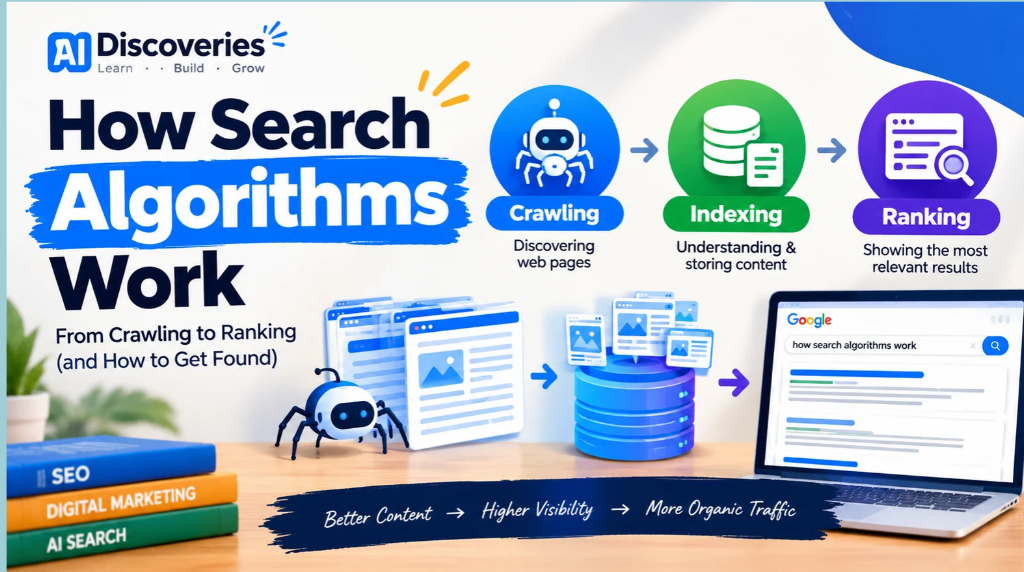
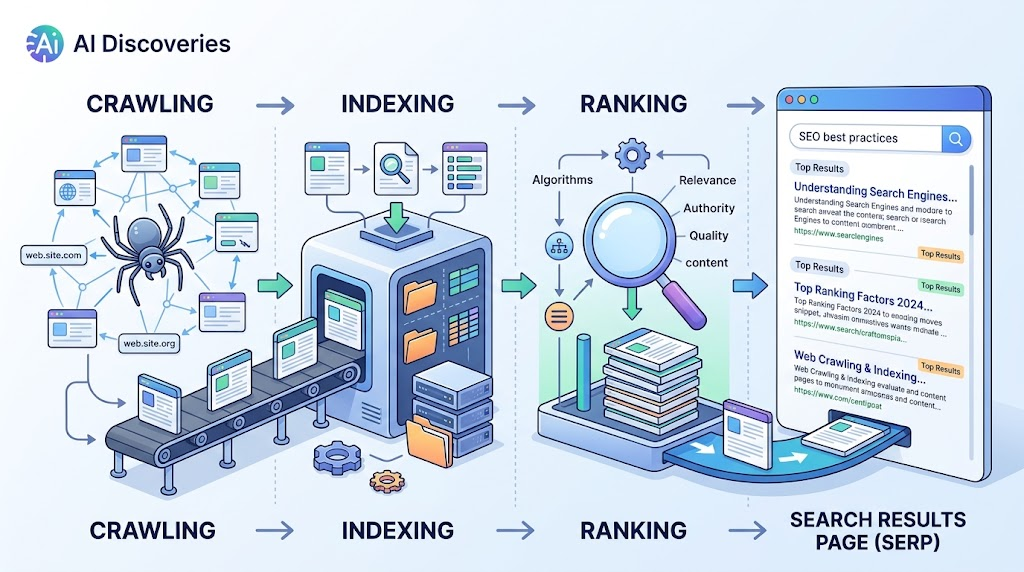
Search engines generally operate through three major stages: crawling, indexing, and ranking or serving search results.
Google explains these stages in its official documentation on how Google Search works.
1. Crawling: Discovering Web Pages
Crawling is the process through which search engines discover web pages and retrieve their content.
Search engines use automated programs called web crawlers, spiders, or bots to explore publicly accessible websites.
Google uses a crawler called Googlebot.
These crawlers discover pages through links from other pages, XML sitemaps, and previously known URLs. They may revisit pages to check for updates.
For example, imagine you publish an article titled “10 Practical Ways to Use AI at Work.”
Googlebot may discover the article through your XML sitemap or a link from another page on your website. It can then access the page and process its content.
However, discovering a URL does not guarantee that a search engine will crawl or index it.
Common crawling problems include:
- Broken links and server errors.
- Pages blocked by robots.txt.
- Poor website navigation.
- Pages that require authentication.
- Technical problems that prevent crawlers from accessing important content.
To improve crawlability, maintain a logical website structure, link related articles together, submit an accurate XML sitemap, and fix technical errors.
2. Indexing: Understanding and Storing Content
After discovering and crawling a page, a search engine may analyze its content and decide whether to add it to its index.
A search index is a large, organized database of information about web pages and other content.
During indexing, search engines can process information such as:
- Page titles and headings.
- Main text and related topics.
- Images and their alternative text.
- Links to other pages.
- Canonical URLs and duplicate content.
- Other technical and contextual signals.
Consider an article about email marketing automation.
The search engine may analyze the article’s title, headings, explanations, examples, and related terms to understand its subject.
It may recognize that the page discusses email workflows, automated campaigns, customer segmentation, and marketing software.
This understanding helps the search engine determine which queries the page may be relevant to.
However, crawling does not guarantee indexing. A page may be excluded because of technical restrictions, duplication, low-value content, or other factors.
If your article is not indexed, it generally cannot appear as a standard organic result for a search query.
You can use Google Search Console’s URL Inspection tool to check whether Google has indexed a specific page and identify potential problems.
3. Ranking: Selecting the Most Relevant Results
Ranking is the process of ordering eligible search results in response to a user’s query.
When someone searches Google for “how to start a blog,” Google does not simply scan the entire internet from scratch. Its systems use the search index to identify potentially relevant content and rank results for the query.
Google uses many signals and ranking systems to assess relevance and usefulness.
These can include:
- The meaning and intent behind the query.
- How closely a page matches the topic.
- The quality and originality of the content.
- The context and freshness of the information.
- Links and signals that help establish the relevance of a page.
- Page usability and technical accessibility.
- The user’s language, location, and search context.
The importance of individual signals varies depending on the query.
For example, freshness may be especially important for breaking news, while an established educational resource may remain useful for years.
Google does not publish a simple universal ranking formula that website owners can use to calculate their exact position.
That is why effective SEO focuses on improving a website’s overall usefulness, accessibility, relevance, and credibility rather than trying to manipulate one ranking signal.
How Search Engines Decide Which Website Ranks First
Search engines evaluate different signals to estimate which results will best satisfy a user’s needs.
Here are six important areas to understand.
1. Search Intent and Relevance
Search intent describes the reason behind a user’s query.
Someone searching for “what is SEO” probably wants an explanation. Someone searching for “best SEO tools” likely wants to compare available products.
Someone searching for “Ahrefs pricing” may want current subscription information.
These queries require different types of content.
The main categories of search intent are:
Informational intent: The user wants to learn something.
Example: “How do search algorithms work?”
Navigational intent: The user wants to reach a particular website or page.
Example: “Google Search Console login.”
Commercial investigation: The user is researching options before making a decision.
Example: “Best AI writing tools for bloggers.”
Transactional intent: The user wants to take an action, such as buying a product or subscribing to a service.
Example: “Buy a domain name.”
To improve your content’s relevance, identify the dominant intent behind your target keyword before writing.
If people want a tutorial, provide clear instructions. If they want comparisons, explain the differences between the options. If they want a definition, answer the question directly.
2. Content Quality and Usefulness
Search engines aim to surface content that helps users accomplish their goals.
A long article does not automatically outrank a short one. Content performs well when it provides relevant, accurate, useful information in a format that meets the reader’s needs.
Strong content typically:
- Answers the main question clearly.
- Provides sufficient detail for the topic.
- Includes examples, evidence, or original insights where appropriate.
- Uses accurate and current information.
- Organizes explanations with descriptive headings.
- Avoids unnecessary repetition and misleading claims.
For instance, an article about search algorithms that explains crawling, indexing, ranking, and practical SEO improvements is more useful to a beginner than a page that repeats the phrase “search algorithm” dozens of times without explaining the subject.
Focus on satisfying the reader’s question instead of increasing word count for its own sake.
3. Website Authority and Links
Links help search engines discover pages and understand relationships between web pages.
Internal links connect pages within the same website. They help visitors navigate your content and help search engines discover related resources.
External links connect your website to other websites.
Backlinks are links from other websites to yours. Relevant, editorially earned backlinks can help search engines understand the importance and reputation of a page.
Google’s PageRank is one of its established link analysis systems. It has evolved considerably since Google’s early years and remains part of its broader ranking systems.
However, backlinks are not the only factor that matters.
Buying links to manipulate rankings, creating artificial link networks, or spamming irrelevant websites can violate search engine guidelines.
A more sustainable approach is to publish valuable research, original case studies, useful tools, and well-supported explanations that other websites may naturally want to reference.
4. Freshness and Accuracy
Some searches require current information, while others do not.
A search for “latest AI regulations in Nigeria” requires more recent information than a search for “what is a search algorithm.”
Search engines use freshness systems to identify queries where newer information is likely to be more useful.
To keep your content competitive:
- Review articles that depend on changing information.
- Update outdated facts and examples.
- Replace broken links.
- Correct errors.
- Make substantial improvements when new information becomes available.
Changing the publication date without improving the content does not make an article more useful.
5. Page Experience and Technical SEO
A useful article can still struggle in search if technical problems prevent search engines or visitors from accessing it properly.
Technical SEO helps search engines crawl, render, and understand your website.
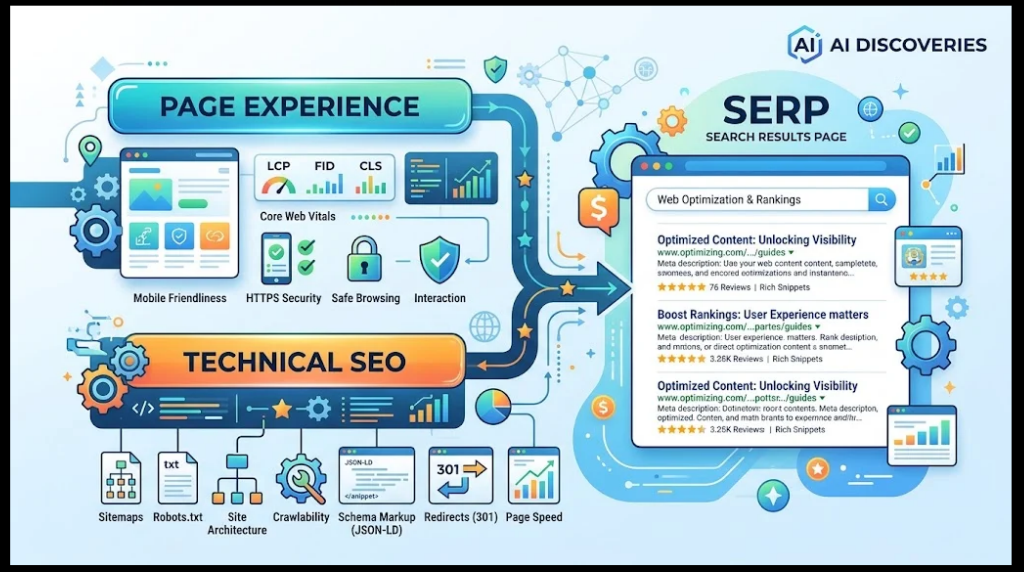
Important areas include:
- Mobile usability.
- Page loading performance.
- HTTPS security.
- Clear site navigation.
- Descriptive URLs.
- Proper canonical tags.
- Accurate title tags and meta descriptions.
- Appropriate indexing directives.
- Accessible content and images.
Google uses page experience signals, including Core Web Vitals, as part of its broader assessment of user experience. Strong performance does not guarantee high rankings, and relevance remains essential.
If you publish on WordPress, use a lightweight theme, optimize images, limit unnecessary plugins, and monitor your Core Web Vitals.
6. Context, Language, and Location
Search results can vary depending on the context of a query.
For example, someone searching for “digital marketing agency” in Lagos may receive different local results from someone searching in London.
Search engines can also consider language, device context, and other signals that help interpret the query.
This is important for businesses targeting specific countries or cities.
If your business serves customers in Nigeria, create content that addresses their needs and use accurate business information, relevant local terminology, and appropriate location pages where they provide genuine value.
Do not add city names to every paragraph simply to manipulate rankings. Local relevance should reflect the actual audience and services you serve.
What Is the Difference Between a Search Algorithm and a Ranking Factor?
These terms are related, but they are not identical.
A search algorithm is part of the broader computational system that processes a query and determines which results to show.
A ranking factor or signal is an input that a search system may use to assess a page’s relevance, quality, authority, or usefulness.
For example, Google’s search systems may use language understanding, freshness systems, and link analysis to help evaluate results.
The search algorithm combines information from different systems and signals to produce a ranked set of results.
There is no single publicly available checklist that guarantees a number-one position.
How Artificial Intelligence Is Changing Search Algorithms
Artificial intelligence is changing how search engines interpret questions, retrieve information, and present answers.
Traditional search commonly presents a list of links ranked by relevance. AI-powered search experiences may also generate summaries, combine information from multiple sources, and provide citations or links to supporting pages.
These experiences still depend on the ability to discover and retrieve relevant information.
For website owners, this creates an opportunity to make content easier for both people and machines to understand.
What Is AI Search Optimization?
AI search optimization is the practice of making useful, accurate content easier for AI-powered search experiences to discover, understand, retrieve, and reference.
Two related terms are Generative Engine Optimization (GEO) and Answer Engine Optimization (AEO).
GEO focuses on improving the likelihood that content will be surfaced or referenced in generative AI experiences. AEO focuses on making content suitable for direct answers to specific questions.
Neither practice guarantees that an AI system will mention your website.
Useful approaches include:
- Providing direct answers to clearly defined questions.
- Using descriptive headings and logical content structure.
- Explaining names, products, organizations, and concepts precisely.
- Citing trustworthy sources for factual claims.
- Including original data, practical examples, and expert insights.
- Keeping important information accessible in the page’s text.
- Maintaining technically accessible, indexable pages.
Microsoft’s Bing Webmaster Guidelines explain how established SEO practices can support visibility across Bing, Copilot, and AI-powered search experiences.
The central principle is straightforward: create information that is useful to people and easy for search systems to verify and interpret.
Does SEO Still Matter for AI Search?
Yes. Technical accessibility, relevant content, clear structure, and trustworthy information remain important.
Google’s AI search experiences and Microsoft’s Copilot have their own systems for retrieving and presenting information. There is no universal GEO formula that guarantees citations across every AI platform.
You should therefore continue to build a strong SEO foundation while making your content clear, specific, accurate, and useful for AI-assisted discovery.
How to Optimize Your Website for Search Algorithms
If you want your website to attract more organic traffic, follow this practical workflow.
Step 1: Research the Right Keywords
Find the questions your target audience actually asks.
Use tools such as Google Keyword Planner, Google Trends, Google Search Console, and relevant SEO platforms to identify search terms, related questions, and opportunities.
Look beyond search volume. Consider the intent behind each keyword, the competition, and whether the topic aligns with your website.
For example, an AI education website could target:
- How search algorithms work.
- How Google ranks websites.
- How to improve blog SEO.
- What is Generative Engine Optimization?
- How to get content cited by AI search engines.
Step 2: Study the Search Results
Search your target keyword and review the pages that currently rank.
Identify the questions they answer, the content formats they use, and the gaps that remain.
Do not simply copy competing articles.
Create a better resource by adding original explanations, more practical examples, useful visuals, credible references, or insights that competing pages lack.
Step 3: Build a Clear Content Structure
Give every important page a clear primary topic.
Use one descriptive H1 heading, followed by logical H2 and H3 subheadings. Write paragraphs that develop one main idea at a time.
For example, an article about search algorithms could include sections on crawling, indexing, ranking signals, AI search, and SEO improvements.
Add a concise answer near the beginning of the article. This helps readers understand the topic quickly and gives search systems a clear explanation to interpret.
Step 4: Strengthen Internal Linking
Connect related articles using descriptive anchor text.
For example, an article about search algorithms could link to a detailed guide on technical SEO, another on keyword research, and a third on Generative Engine Optimization.
This helps readers explore related topics and gives search engines additional paths to discover your pages.
Only link where the destination genuinely adds value.
Step 5: Improve Technical Accessibility
Use Google Search Console to inspect indexing issues, sitemap status, search performance, and individual URLs.
Check that important pages are accessible, return appropriate HTTP status codes, and do not accidentally contain noindex directives.
Compress large images, improve mobile usability, and fix broken internal links.
If you operate a WordPress website, check that your SEO plugin generates appropriate metadata and that your caching and security settings do not block legitimate search crawlers.
Step 6: Demonstrate First-Hand Knowledge
Add information that distinguishes your content from generic articles.
Examples include:
- A case study showing how a website improved organic traffic.
- Original research about search behavior.
- Screenshots of real Search Console data.
- Practical examples from a campaign you managed.
- Expert commentary supported by reliable evidence.
Explain your methods and limitations honestly. Do not invent statistics, experience, testimonials, or research findings.
Step 7: Measure and Improve Performance
Use Google Search Console to monitor impressions, clicks, click-through rate, average position, and indexing status.
Use analytics tools to understand what visitors do after reaching your website.
If a page receives impressions but few clicks, review its title and description to make sure they accurately communicate the value of the content.
If a page receives traffic but fails to satisfy readers, improve its explanations, examples, navigation, and calls to action.
SEO is an ongoing process of measuring performance, identifying problems, and making useful improvements.
Common Search Algorithm Myths to Avoid
Several misconceptions can lead website owners to waste time.
Myth 1: Publishing more articles always increases traffic.
Publishing more content does not guarantee more traffic. Each article should serve a real audience need and provide meaningful value.
Myth 2: Keyword density guarantees rankings.
Repeating a keyword a specific number of times does not guarantee a higher position. Use relevant terms naturally and explain the subject thoroughly.
Myth 3: Backlinks are the only ranking factor.
Links can matter, but search systems use many signals. Technical accessibility, relevance, content quality, and query context also matter.
Myth 4: Google indexes every published page.
Google may discover a page without indexing it. Technical problems, duplication, and other quality or eligibility considerations can prevent indexing.
Myth 5: Structured data guarantees rich results or AI citations.
Structured data can help search engines interpret specific information, but it does not guarantee enhanced search appearances or AI citations.
Myth 6: There is a secret SEO trick that guarantees the first position.
No legitimate technique can guarantee a number-one ranking for every query. Search systems change, competitors improve, and user needs vary.
Frequently Asked Questions About Search Algorithms
How does Google’s search algorithm work?
Google uses automated systems to discover web pages, organize information in its index, and rank relevant results for each query. Its ranking systems consider multiple signals, including relevance, meaning, content usefulness, links, freshness, and context.
What are the three main stages of Google Search?
The three main stages are crawling, indexing, and serving search results. Crawling discovers and retrieves content. Indexing processes and organizes information. Serving results selects relevant pages for a user’s query.
How often does Google update its search algorithm?
Google continually adjusts and improves its search systems. It also announces certain major changes, such as core updates and spam updates, through its official Search Central channels. Not every change receives a public announcement.
How long does SEO take to improve rankings?
There is no fixed timeline. Results depend on factors such as the website’s current condition, competition, content quality, indexing, and the changes made. Some changes may be reflected quickly, while meaningful improvements can take weeks or months.
Can a new website rank on Google?
Yes. A new website can rank if its pages are accessible, relevant, useful, and competitive for the queries it targets. However, indexing and ranking are not guaranteed, and established competitors may have advantages.
Does Google use AI in its search algorithm?
Yes. Google uses machine learning and AI-based systems for different search tasks, including understanding language and interpreting queries. Google describes several ranking systems in its official documentation. It does not follow that every AI model is used as a general-purpose ranking system.
What is the difference between SEO and GEO?
SEO, or Search Engine Optimization, focuses on improving a website’s visibility in search engines. GEO, or Generative Engine Optimization, focuses on improving content’s eligibility to be retrieved, surfaced, or cited in generative AI search experiences. The two overlap in areas such as technical accessibility, content clarity, and information quality.
How can I check whether Google has indexed my website?
Open Google Search Console, use URL Inspection to check a specific page, and review the page’s indexing status. You can also search for a URL using the site: operator as a rough check, but Search Console provides more useful diagnostic information.
Does paying Google improve organic rankings?
Google does not accept payment to crawl a website more frequently or to improve its organic rankings. Paid search advertisements are separate from organic search results.
Final Thoughts
Search algorithms help people find relevant information among an enormous amount of online content.
Understanding how they work gives you a practical advantage. You can make your website easier to crawl, help search engines interpret your pages, and publish content that directly answers the questions your audience asks.
Start with the fundamentals: understand search intent, create useful content, maintain a technically accessible website, build relevant internal links, and monitor your results.
As AI-powered search continues to evolve, these foundations also help make your content easier for retrieval systems to understand and evaluate.
The objective is not to trick an algorithm. It is to create a resource that genuinely deserves to be found.
Further Reading
- Google’s Guide to How Search Works
- Google’s Guide to Search Ranking Systems
- Google Search Essentials
- Bing Webmaster Guidelines
Written by Olasunkanmi Adeniyi | AI Discoveries




Leave a Reply