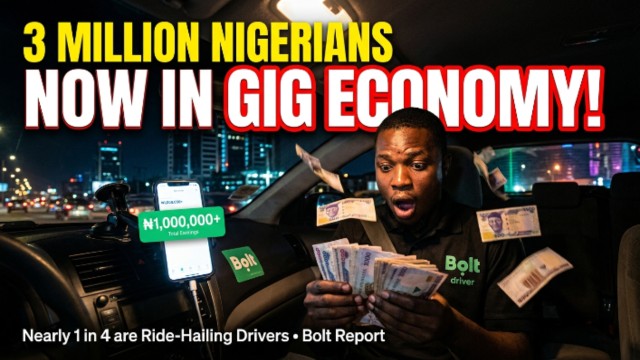
In a country where formal jobs feel like a myth for millions of young Nigerians, a quiet revolution is underway. According to a explosive new report commissioned by Bolt and conducted by Ipsos, Nigeria’s gig economy has ballooned to a staggering $5.17 billion, supporting three million workers as of 2024 – and nearly one in four (24%) are grinding it out in ride-hailing.
That’s roughly 720,000 drivers ferrying passengers across Lagos, Abuja, and beyond, turning their cars into mobile offices in one of Africa’s most dynamic (and chaotic) economies. E-commerce leads at 38%, but ride-hailing is the undisputed second-place engine, outpacing freelancing (19%), micro-tasks, and remote work.
This isn’t just side-hustle noise. The gig sector now contributes 2.8% to Nigeria’s GDP (based on a ~$187.6 billion economy at mid-2025). And the report’s verdict? For most participants, it’s delivering real wins – even as rising fuel prices, platform commissions, and economic headwinds threaten to stall the momentum.
The Numbers That Will Make You Rethink “Just a Side Gig”
The Bolt-Ipsos study – which also covered Kenya and South Africa – paints Nigeria as the heavyweight champion of Africa’s platform economy. With three million gig workers, Nigeria dwarfs Kenya’s 1.55 million ($1 billion economy) and edges out South Africa’s two million participants.
Here’s what stands out:
- Long-term commitment, not temp work: 59% of ride-hailing participants have stuck with it for more than a year. This isn’t “bridge income” – it’s becoming a career path.
- Living standards upgraded: 64% of ride-hailing workers report significant improvements in their quality of life; another 31% saw slight gains. Only 1% said things got worse.
- Youth-powered engine: With overall unemployment at 2.99% but youth unemployment higher at 5.05%, platforms are absorbing young people who combine gigs with studies, entrepreneurship, or migration dreams.
- The gender gap is glaring: Women make up just 3% of ride-hailing participants – a stark reminder that safety concerns, vehicle ownership barriers, and cultural norms still sideline half the population from this lucrative slice.
Bolt’s Senior General Manager for West Africa, Teddy Appa-Dankyi, put it bluntly: “This report shows that ride-hailing is not just about mobility; it is helping people diversify income, manage financial uncertainty, and participate more actively in the digital economy.

Why Ride-Hailing Is Eating the Gig Economy (But Drivers Are Feeling the Burn)
Ride-hailing isn’t new to Nigeria – Bolt, Uber, inDrive, and Lagride have been battling for market share for years. What the report reveals is how deeply embedded it’s become as an economic lifeline in urban centres.
Drivers love the flexibility: log on when you want, earn while learning new routes, and even access health coverage or micro-loans through some platforms. Many describe it as “earning while learning” – building financial literacy, customer service skills, and pride in independence.
But here’s the unfiltered reality the report only hints at: operational costs are crushing profitability. Just weeks before the report dropped, thousands of ride-hailing drivers in Lagos staged a three-day strike in March 2026. Their demands? Higher fares to match fuel prices now topping ₦1,000 per litre, lower commissions (often 25-30%), minimum base fares, and better transparency on how algorithms set prices.
Drivers report working longer hours for less take-home pay after fuel, maintenance, inflation, and platform cuts. One union leader from the Amalgamated Union of App-Based Transporters of Nigeria (AUATON) summed it up: many now spend entire trips complaining about how the economics no longer add up.
This tension highlights the gig economy’s double-edged sword: it creates opportunity without rigid entry barriers, yet leaves workers exposed to macroeconomic shocks – fuel subsidy removal fallout, naira volatility, and global oil price swings.

Beyond the Wheel: The Broader Gig Landscape and What’s Next
While ride-hailing grabs headlines, e-commerce (think Jumia sellers, delivery riders, and online resellers) dominates at 38%. Freelancing on platforms for writing, design, or virtual assistance adds another 19%. Micro-tasks and remote work round it out.
The report frames the gig economy as a shock absorber for Nigeria’s massive informal workforce (already over 90% of employment in some estimates). In a nation producing millions of graduates yearly into a job-scarce market, platforms democratize access to income.
Future-proofing opportunities the report flags:
- E-mobility push: Electric vehicles and two-wheelers to slash fuel costs.
- Financial inclusion: Micro-lending, savings, and insurance baked into platforms.
- Safety and regulation: Stronger government-platform collaboration on licensing, rider verification, and driver protections.
- Diversification: More parcel delivery, food logistics, and on-demand services.
Bolt’s Head of Regulatory and Policy for Africa, Weyinmi Aghadiuno, called for collaboration: “As flexible earning opportunities become more common across Africa, there is an opportunity for policymakers, platforms and stakeholders to work together to ensure the gig economy continues to expand access to opportunity while remaining sustainable and inclusive.”
The Human Side: One Driver’s Story (and Why This Matters to Every Nigerian)
Imagine Chinedu, a 28-year-old Lagos graduate who couldn’t land a banking job after NYSC. He started driving for Bolt part-time to cover rent. Two years later, it’s his full-time hustle – funding his tech certification courses and supporting his family back home. He’s one of the 64% who say his living standards have jumped significantly.
Stories like his are multiplying. Yet for every success, there’s a driver logging off apps in frustration after a 14-hour day that barely covers fuel and car repairs.
The Road Ahead: Policy, Platforms, and People
Nigeria’s gig boom isn’t going anywhere – it’s accelerating. But for it to deliver lasting impact, three things must happen:
- Fare and commission reforms that tie pricing to real costs.
- Targeted inclusion drives – especially for women – through safety tech, training, and incentives.
- Digital infrastructure investment to lower barriers for rural and semi-urban hustlers.
The Bolt report isn’t just data; it’s proof that Nigerians are entrepreneurial survivors. In an economy that often feels stacked against the average person, three million gig workers are voting with their time, cars, and phones: flexibility and hustle beat waiting for the perfect job.
The question now isn’t whether the gig economy will grow. It’s whether Nigeria – government, platforms, and society – will build the guardrails to make sure it grows for the drivers, sellers, and freelancers powering it.
What’s your take? Are you in the gig game, or thinking about jumping in? Drop a comment below – and if you’re a ride-hailing driver reading this, respect for keeping Lagos (and Nigeria) moving.
Sources: Bolt/Ipsos Gig Economy Report (2026), Nairametrics, Technext, and industry reports on driver strikes.
Stay hustling, Nigeria. The wheel is turning – let’s make sure it turns in your favour. 🚗💨





Leave a Reply