The traditional “bench-to-bedside” pipeline is notoriously slow, often taking 10 to 15 years and billions of dollars to bring a single drug to market. Today, that timeline faced its biggest challenger yet.
On April 16, 2026, OpenAI officially unveiled GPT-Rosalind, its first domain-specific frontier reasoning model purpose-built for the life sciences. Named after the legendary crystallographer Rosalind Franklin, this model isn’t just a chatbot—it’s a specialized biological reasoning engine designed to compress the earliest, most volatile stages of drug discovery from years into months.
Read Also: Doctors Get Their Own ChatGPT: OpenEvidence Raises $200M at $6B Valuation – AI Discoveries
What is GPT-Rosalind?
GPT-Rosalind is a specialized AI model fine-tuned for biochemistry, genomics, and protein engineering. While general-purpose models like GPT-5.4 are impressive, they lack the deep, nuanced “wet lab” intuition required for high-stakes scientific research. Rosalind bridges this gap by integrating with a new Life Sciences Research Plugin, giving it programmatic access to over 50 public multi-omics databases and biological tools.
Key Capabilities at a Glance:
- Target Identification & Validation: Scans massive genomic datasets to find the most viable “pockets” for new drugs.
- Evidence Synthesis: Parses thousands of scientific papers to generate and refine research hypotheses.
- Experimental Planning: Designs complex molecular cloning protocols and reagents (outperforming human experts in specific tasks like CloningQA).
- RNA & Protein Design: In tests with Dyno Therapeutics, the model ranked in the 95th percentile of human experts for RNA sequence-to-function prediction.
Slashing the 10-Year Timeline
The primary bottleneck in pharma is the “Valley of Death”—the early discovery phase where 90% of candidates fail. GPT-Rosalind targets this specific window.
1. From Months to Weeks in Antibody Design
Early adoption trials with partners like Memorial Sloan Kettering (MSK) have already shown that GPT-Rosalind can reduce the timeline for antibody design—specifically for pediatric cancer therapies—from months down to just a few weeks.
2. Multi-Step Scientific Reasoning
Unlike previous AI that simply predicted patterns, GPT-Rosalind uses frontier reasoning to handle multi-step workflows. It can identify a target, query a database for similar structures, design an experiment to test a variant, and interpret the resulting (simulated or real) data.
3. Integration with the “Wet Lab”
The model is designed to be a “scientific translator.” It helps researchers bridge the gap between dry-lab computational models and wet-lab experimental execution, ensuring that the AI’s suggestions are actually feasible in a physical laboratory setting.
Performance Benchmarks: Better Than GPT-5.4?
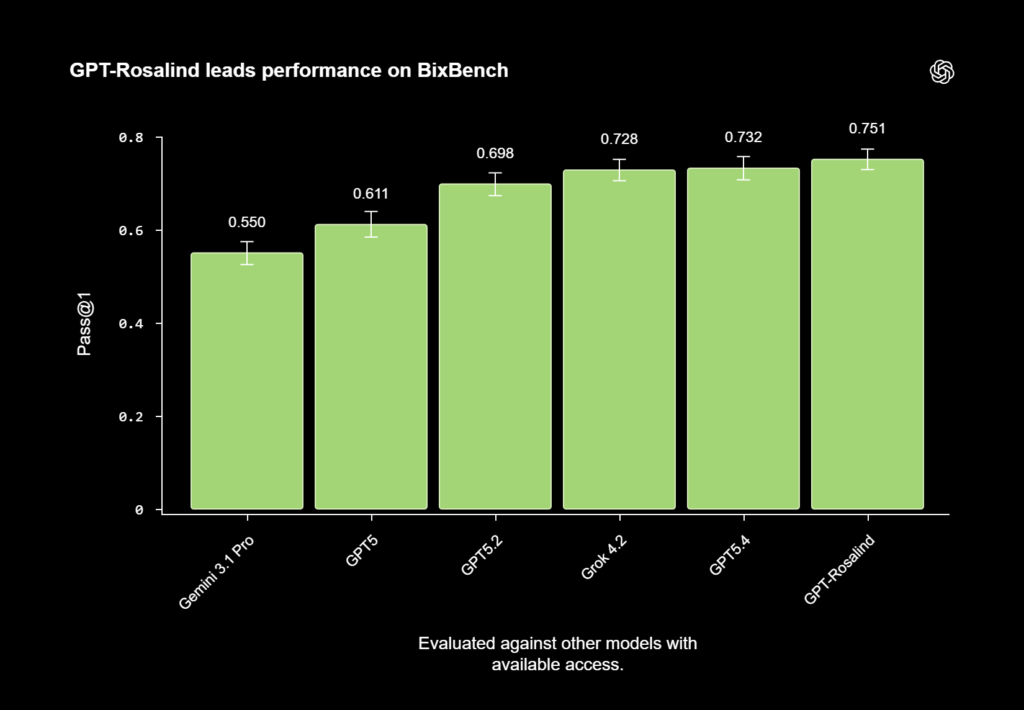
In the world of biology, general intelligence isn’t enough. OpenAI tested GPT-Rosalind against the industry-standard BixBench and the research-heavy LABBench2.
| Benchmark | GPT-Rosalind Performance | Comparison |
| BixBench | 0.751 Pass Rate | Leading industry result |
| LABBench2 | Won 6 out of 11 tasks | Outperformed GPT-5.4 |
| RNA Prediction | 95th Percentile | Beat human expert benchmarks |
“The life sciences field demands precision at every step. GPT-Rosalind is designed to support researchers where the data is most complex and the stakes are highest.” — Sean Bruich, Senior VP of AI and Data at Amgen.
Read Also: Mocha – The Best Free AI Tool To Build Your Dream App Without Coding – AI Discoveries
Security and the “Trusted Access” Program
Given the power of a model that understands biology at this level, OpenAI is not releasing GPT-Rosalind to the general public. To prevent the potential misuse of the model in designing harmful pathogens, it is currently locked behind a Trusted Access Program.
- Eligibility: Restricted to qualified enterprise customers in the US (e.g., Moderna, Amgen, Thermo Fisher Scientific).
- Compliance: The platform features Regulated Workspaces and is HIPAA-aligned.
- Privacy: OpenAI has reiterated that it does not train on customer data provided through these enterprise research channels.
Read Also: 10 Prompts to Learn Any Topic Fast: Master New Skills in Record Time – AI Discoveries
The Future of Medicine
The launch of GPT-Rosalind marks a shift from “Generative AI” to “Reasoning AI” in science. While we aren’t at the point of “one-click drug discovery” yet, the ability to automate the drudgery of literature review and experimental design means scientists can spend more time on what matters: saving lives.
As we move through 2026, the industry will be watching closely to see if these accelerated timelines in the lab translate into faster regulatory approvals and, ultimately, better patient outcomes.
For more updates on AI breakthroughs in 2026 and the latest in life sciences technology, subscribe to our newsletter.





Leave a Reply