AI Business Opportunity
November 2026
What if you could earn money helping businesses use artificial intelligence without building an AI startup, launching a software product or developing your own AI model?
That is the opportunity behind OpenAI’s new OpenWorks program.

OpenAI is recruiting individuals, small teams and AI consultancies to help independently owned small businesses solve practical business problems using artificial intelligence.
Selected OpenWorks Partners can receive a monthly stipend of up to $8,000, alongside technical resources, tools and workshop support from OpenAI.
In exchange, partners work directly with local businesses, help employees understand AI and demonstrate how these technologies can improve everyday business operations.
The interesting part is that you do not necessarily need to invent something new.
You need to understand how businesses operate, identify problems that cost them time and money, and know how to use AI to solve those problems.
And that distinction could create significant opportunities for AI consultants, freelancers, automation specialists and digital entrepreneurs.
Let’s examine how OpenWorks works, who can participate, what OpenAI is offering and what aspiring AI entrepreneurs can learn from this development.
1. What Is OpenAI OpenWorks?
OpenWorks is an initiative by OpenAI designed to help small businesses adopt artificial intelligence through practical, hands-on support.
The idea is straightforward.
Many small business owners know that AI could improve their operations. However, they often lack the technical knowledge, time or resources to identify the right tools and implement them.
OpenAI wants to close that gap by connecting these businesses with local AI experts.
Instead of simply giving business owners access to ChatGPT and expecting them to figure everything out, OpenWorks Partners work alongside them to identify problems, implement solutions and teach employees how to use AI independently.
According to OpenAI, partners can help businesseshe initiative is designed around measurable business improvements rather than AI experimentation.
OpenAI describes its ambition as building a nationwide network of local AI partners who can help businesses across America.
You can explore the initiative directly on the official OpenWorks website. OpenAI
2. How Much Does OpenAI Pay OpenWorks Partners?
The financial incentive is one of the most interesting parts of the program.
OpenAI offers selected OpenWorks Partners a monthly stipend of up to $8,000.
However, there is an important distinction.
This is not an automatic $8,000 monthly salary or a guaranteed payment for everyone who applies. Partners work as independent contractors, and OpenAI has not publicly explained how it calculates individual stipends or how long payments will continue.
Here is what the published program involves:
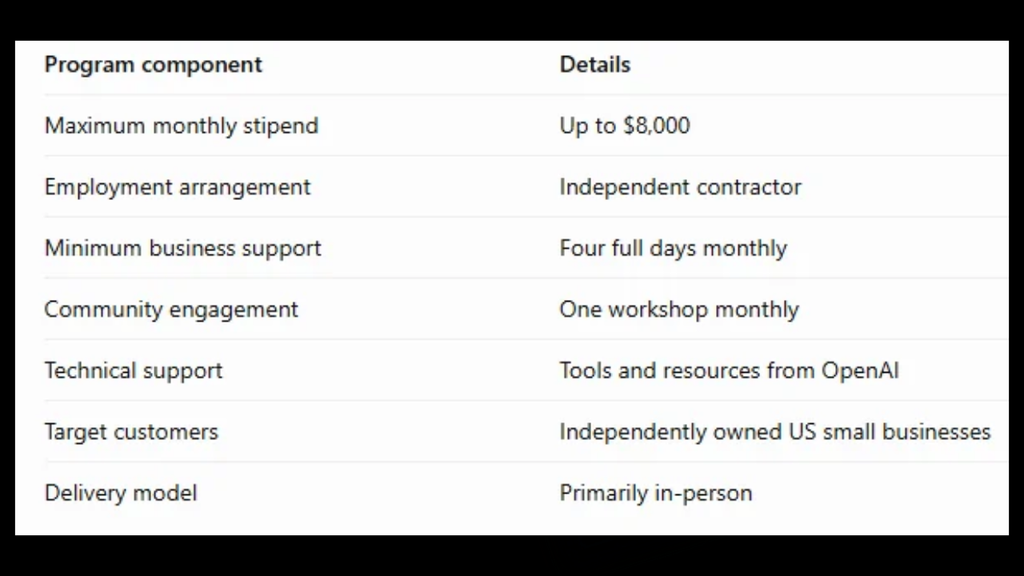
Partners are expected to dedicate at least four full days each month to helping businesses and organise one community workshop.
OpenAI also encourages software developers, AI consultancies and small teams to participate alongside their existing client work.
This makes the initiative particularly interesting for people who already provide automation, software development, marketing or digital transformation services.
Importantly, the $8,000 figure represents the maximum advertised stipend, not a confirmed monthly earning for every successful applicant. OpenAI Help Center+1
3. Real Businesses Are Already Using OpenWorks to Solve Expensive Problems
The strongest part of this initiative is the actual business problems OpenAI has highlighted.
These examples demonstrate how relatively accessible AI tools can help businesses improve operations without commissioning expensive custom software.
Here are four examples from OpenAI’s published case studies.
Case Study 1: A Gift Shop Replaces an Estimated $50,000 Software Project

A gift shop called Tiny Things in Fargo, North Dakota, was struggling to manage more than 1,000 products.
The owners needed a better way to track inventory and ensure their bestselling products remained available.
OpenWorks Partner Jake Ottiger helped them use ChatGPT to build a custom inventory dashboard connected to their existing inventory tools.
According to co-owner Jordan Maahs, commissioning a similar solution professionally would have cost approximately $50,000.
Think about that.
The business had a specific operational problem. Instead of immediately paying a software development company to build a solution, the owners worked with an AI partner to create a practical alternative.
This is an important example of how AI implementation can create economic value for smaller businesses. OpenAI
Case Study 2: A Microgreens Business Increased Its Customer Response Rate

Ghost Grow 843, a microgreens and hydroponic lettuce business in Charleston, South Carolina, needed more restaurant customers.
The owner, Garret Fleming, had been approaching restaurants to find potential buyers.
An OpenWorks Partner helped him use ChatGPT to:
- Identify restaurants that served microgreens.
- Find relevant chefs and decision-makers.
- Research potential customers.
- Write personalised outreach emails in his own voice.
The reported results were impressive.
According to Fleming’s estimates, his response rate increased from 20% to 75%.
He also gained 10 new restaurant customers within four months.
This example demonstrates how AI can support customer acquisition without requiring a business to hire a large sales team. OpenAI
Case Study 3: A Manufacturing Business Saves Up to Five Hours Every Week
Sign Badgers, a sign production company in Fargo, had another operational challenge.
An employee, Jen Robertson, spent hours every week tracking inventory and comparing supplier prices.
This reduced the time she could spend on creative and production work.
OpenWorks Partner Jake Ottiger showed her how to use Codex and ChatGPT to automate inventory tracking and vendor price checks.
The results:
- Pricing checks that previously took hours now take approximately 15 to 20 minutes.
- The employee reports saving between two and five hours every week.
- The company gained better visibility into supplier prices.
This is the kind of problem many businesses overlook.
Employees spend valuable time performing repetitive tasks that could be partially or fully automated. OpenAI
Case Study 4: A Retail Supplier Uses AI to Identify Costly Invoice Errors.
Black Paper Party, a business producing gift wrap and holiday decorations, needed to simplify the paperwork involved in supplying major retailers.
The founders used ChatGPT to match purchase orders against shipping records.
This helped them identify errors in vendor invoices, dispute incorrect charges and avoid thousands of dollars in chargebacks.
The lesson is clear.
AI does not always need to create a new revenue stream to deliver value.
Sometimes, preventing financial losses is equally valuable.
These four examples come directly from OpenAI’s OpenWorks case studies. The financial and productivity figures are estimates reported by the businesses, rather than independently audited results. OpenAI
4. Who Can Apply for the OpenAI OpenWorks Program?
OpenAI is looking for technically skilled and curious individuals and small teams who can help local businesses adopt AI.
You do not necessarily need to own an AI startup or have a registered technology company.
The application guidance also states that there is no published degree requirement.
Potential applicants include:
- AI consultants.
- Automation specialists.
- Software developers.
- No-code and low-code developers.
- Digital transformation consultants.
- Marketing automation specialists.
- AI implementation agencies.
- Small technology teams.
OpenAI also encourages existing software and AI consultancies to participate alongside their current client work.
However, applicants should understand that technical knowledge alone is not enough.
The program is looking for people who can demonstrate practical experience solving problems with AI.
According to OpenAI’s application guidance, applicants should prepare:
- A real example of a problem they have solved using AI.
- An explanation of what they built or implemented.
- Evidence of the difference their solution made.
- A link to a social media profile or portfolio.
You can use a personal email address. If you do not have a registered company, OpenAI says you can enter N/A in the company name field.
These details make the application accessible to independent practitioners, not just established companies. OpenAI Help Center
5. Which Businesses Can Benefit From OpenWorks?
The program currently targets independently owned small businesses in the United States.
Eligible business categories include:
- Restaurants.
- Retail stores.
- Manufacturing businesses.
- Professional service firms.
- Other independently owned small businesses.
However, software and SaaS companies, venture-backed businesses and private equity-owned businesses are excluded from receiving the business support.
Nonprofits and faith-based organisations are also welcome to apply, according to OpenAI’s Help Center.
Businesses do not need previous AI experience.
They simply need to identify a task or operational problem they would like to improve.
Examples include managing receipts, organising customer information, improving follow-up emails and streamlining daily administrative work. OpenAI Help Center+1
6. Where Is OpenAI OpenWorks Currently Available?
OpenAI has launched the pilot across 20 communities in the United States.
The locations are:
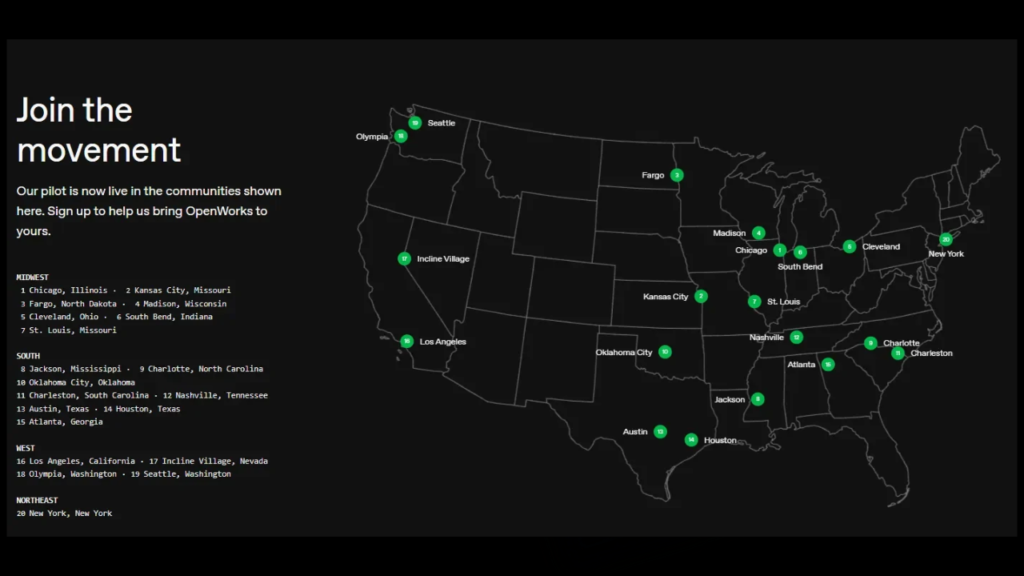
This geographical limitation is important.
OpenWorks is currently designed around in-person support. OpenAI’s Help Center explicitly states that remote participation and partners based outside the United States are not available yet.
People outside the listed communities can still express interest through the program’s application process, but OpenAI does not guarantee expansion or partner availability in their locations.
Therefore, someone living in Nigeria, for example, cannot currently join as a remote OpenWorks Partner under the published pilot arrangements.
That does not mean the underlying AI consulting opportunity is limited to America. OpenAI+1
7. How to Apply for the OpenAI OpenWorks Program
If you live in one of the participating US communities and have practical AI implementation experience, you can apply through OpenAI’s official website.
The application process has three main routes:
- Become an OpenWorks Partner: For individuals and teams who want to help local businesses implement AI.
- Get AI support for your business: For eligible business owners who need help solving an operational problem.
- Nominate a business or partner: For people who want to recommend a business or someone with relevant AI experience.
Official OpenWorks application
Apply directly through OpenAI’s website. Visit OpenAI OpenWorks
The partner application is currently open. OpenAI has not published a general application deadline.
Before applying, prepare a practical AI project you can demonstrate.
For example, you could show how you:
Focus on the problem, your solution and the measurable result.
OpenAI’s application guidance places particular importance on what you have already accomplished with AI. OpenAI Help Center
8. What This Means for AI Entrepreneurs in Nigeria and Africa
Read Also: 25+ AI Startup Funding Programs in 2026: Grants, Credits and Accelerators
Here is where I think the bigger opportunity lies.
Although OpenWorks is currently restricted to the United States, its business model provides an important lesson for AI entrepreneurs across Nigeria and Africa.
You do not have to wait for OpenAI to launch a similar program in your country before building an AI consulting business.
Thousands of businesses across Africa deal with operational problems that AI can help solve.
Consider some examples.
Take a Nigerian logistics company, for example.
Imagine a company managing 50 delivery riders across different locations.
Its operations team might spend hours every day:
n AI consultant could help build a workflow that collects operational data, generates reports, identifies recurring problems and alerts managers when specific performance targets are missed.
The business does not necessarily need another employee to perform these repetitive tasks.
It needs a better system.
And someone who can build that system can create measurable value.
This is the opportunity AI implementation consultants should pay attention to.
9. How to Build an AI Consulting Business Without Developing Your Own AI Model
One of the biggest misconceptions about making money with AI is that you must build an AI application, launch a SaaS company or develop your own technology.
That is not necessarily true.
You can build a profitable AI consulting business by combining existing AI tools with your understanding of a particular industry.
Here is a practical five-step framework.
Step 1: Choose One Industry
Avoid positioning yourself as someone who helps everybody with everything.
Start with one industry.
Examples: Logistics, Restuarant, Finance, Farms
- Logistics companies.
- Real estate agencies.
- Retail businesses.
- Accounting firms.
- Restaurants.
- Recruitment agencies.
- Manufacturing companies.
pecialisation makes it easier to understand the problems businesses face and develop repeatable solutions.
Step 2: Identify an Expensive or Repetitive Problem
Talk to business owners and employees.
Find out:
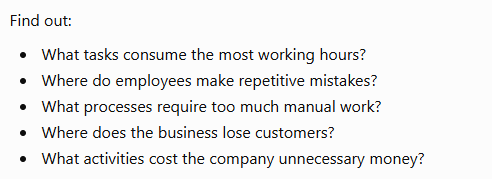
- What tasks consume the most working hours?
- Where do employees make repetitive mistakes?
- What processes require too much manual work?
- Where does the business lose customers?
- What activities cost the company unnecessary money?
Do not begin by asking businesses whether they want AI.
Ask what is making their operations difficult.
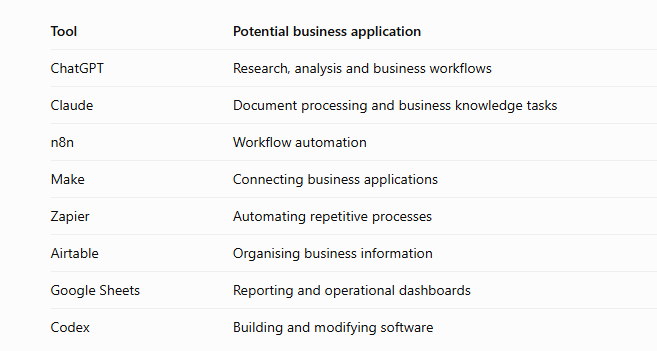
Step 3: Learn the Tools That Solve Those Problems
You do not need to master every AI platform.
Learn the tools that help you deliver the outcome.
For example:
| Tool | Potential business application |
|---|---|
| ChatGPT | Research, analysis and business workflows |
| Claude | Document processing and business knowledge tasks |
| n8n | Workflow automation |
| Make | Connecting business applications |
| Zapier | Automating repetitive processes |
| Airtable | Organising business information |
| Google Sheets | Reporting and operational dashboards |
| Codex | Building and modifying software |
Your goal is to understand how these tools work together to solve a business problem.
Step 4: Build a Demonstration Project
Before approaching potential clients, build a simple working demonstration.
For example, if you target logistics companies, create a delivery performance dashboard.
Show how it can:
- Track successful and failed deliveries.
- Calculate delivery success rates.
- Identify underperforming routes.
- Generate daily operational reports.
- Highlight recurring delivery problems.
A working demonstration is more convincing than a presentation explaining what AI can do.
Step 5: Sell the Business Outcome
This is where many aspiring AI consultants make mistakes.
They sell tools instead of outcomes.
Compare these two offers:
WEAK POSITIONING
“I help businesses use ChatGPT and AI automation tools.”
STRONGER POSITIONING
“I help logistics companies reduce manual reporting, monitor delivery performance and improve operational visibility using AI-powered systems.”
The second offer communicates a specific problem, a target customer and a business outcome.
That is easier for a business owner to understand and evaluate.
10. Why OpenAI Is Making This Move
OpenWorks also reveals something important about the direction of the AI industry.
Making powerful AI tools available is only one part of getting businesses to adopt them.
Many business owners still need someone who understands their operations and can translate AI capabilities into practical applications.
This creates an implementation gap.
Consider the difference:
- AI developers build technology.
- AI researchers improve models.
- AI consultants identify business problems and recommend solutions.
- AI implementation specialists integrate technology into existing operations.
- Automation specialists connect systems and eliminate repetitive work.
OpenWorks focuses on the people who can bridge the gap between AI technology and everyday business operations.
It also gives OpenAI a way to introduce ChatGPT Business to smaller companies that might not otherwise explore paid business AI solutions.
Participating businesses receive three months of ChatGPT Business at no cost.
This gives owners an opportunity to experience the technology while working on an actual business project.
OpenAI has not yet published the long-term commercial terms or what happens to individual businesses after their free access ends. OpenAI+1
11. Five Important Lessons for Anyone Building an AI Business in 2027
There are five lessons I believe aspiring AI entrepreneurs should take from OpenWorks.
1. Business problems are more valuable than tool knowledge.
Knowing how to use ChatGPT, Claude or other AI tools is useful.
Knowing how to apply them to a problem that costs a business thousands of dollars is commercially valuable.
2. You do not need to build everything from scratch.
Existing AI models, automation platforms and no-code tools make it possible to develop useful business solutions without building an entire technology company.
3. Specialisation creates stronger positioning.
An AI consultant who understands logistics operations can develop more relevant solutions for logistics companies than someone who offers generic AI services.
4. Demonstrable results build trust.
A working solution that saves a company five hours every week is a stronger sales asset than a collection of AI certificates.
5. AI implementation is a business opportunity.
As more businesses experiment with AI, demand for people who can implement, customise and manage these systems could continue to grow.
The opportunity is in helping businesses move from experimenting with AI to using it consistently.
Frequently Asked Questions About OpenAI OpenWorks
1. What is OpenAI OpenWorks?
OpenAI OpenWorks is a pilot program that connects independently owned small businesses in the United States with local AI experts who help them implement practical AI solutions. OpenAI also provides participating businesses with three months of ChatGPT Business at no cost.
2. Does OpenAI pay $8,000 every month?
OpenAI offers selected OpenWorks Partners a stipend of up to $8,000 per month. This is a maximum advertised amount, not a guaranteed payment. OpenAI has not disclosed its stipend calculation or payment duration.
3. Can individuals apply without owning an AI company?
Yes. Individuals, small teams, software developers and AI consultancies can apply. OpenAI does not list a degree requirement, and applicants without a registered company can enter N/A in the company name field.
4. Can Nigerians apply for OpenAI OpenWorks?
Nigerians can express interest through the program, but the current pilot does not accept partners working remotely or from outside the United States. OpenAI currently prefers in-person participation in its US communities.
5. Does OpenWorks require coding skills?
OpenAI looks for technically skilled applicants with practical AI experience. However, the published eligibility guidance does not establish a specific programming language or formal coding qualification as a requirement.
6. Which businesses qualify for OpenWorks?
Independently owned US small businesses, including restaurants, retailers, service firms and manufacturers, can apply. Software and SaaS companies, venture-backed businesses and private equity-owned businesses are excluded from the business support program.
7. How much does it cost a small business to participate?
The pilot offers eligible businesses free hands-on AI support and three months of ChatGPT Business.
8. Where can I apply for OpenWorks?
Visit the official OpenAI website at openai.com/openworks to access the partner, business support and nomination applications.
9. Is OpenWorks a full-time job?
No. OpenWorks Partners are independent contractors. The minimum commitment is four full days each month working with businesses, plus one monthly community workshop.
10. Does OpenAI have plans to expand OpenWorks internationally?
OpenAI has not announced a confirmed international expansion timeline. Its current pilot focuses on US communities.
Final Thoughts: Stop Learning AI Tools. Start Solving Business Problems.
Afrisyntech Solutions | AI, Software Development & Digital Innovation
The biggest lesson I take from OpenWorks is simple.
The future of making money with AI will not depend entirely on who knows the most AI tools.
It will increasingly reward people who understand how businesses work and can use technology to solve problems that matter.
A restaurant owner does not necessarily care whether you know 20 different AI platforms.
They care about getting more customers.
A logistics manager does not care how impressive your automation workflow looks.
They care about reducing failed deliveries, improving reporting and controlling operational costs.
A retailer does not need another AI tutorial.
They need a better way to manage inventory.
That is the difference between being someone who knows AI and someone who can create business value with AI.
OpenAI’s OpenWorks program is a practical demonstration of this direction.
And even if you live outside the United States and cannot participate in the current pilot, you can start building the same kind of expertise in your local market.
Find a business problem.
Understand what it costs.
Build a solution.
Measure the results.
Then show another business how you can achieve something similar.
That is a much stronger foundation for an AI consulting business than simply collecting certificates and learning every new AI tool that launches.
The real opportunity is in implementation.
Sources and Further Reading
For readers who want to verify the program details and explore the original announcements:
1. OpenAI: Introducing OpenWorks. Official program details, participating communities, partner benefits and business case studies.
2. OpenAI Help Center: How to Apply for OpenWorks. Eligibility, application requirements, stipend conditions and geographical restrictions.
3. Forbes: OpenAI Will Pay AI Experts Up to $8,000 a Month. Additional reporting on the initiative.
4. Decrypt: OpenAI Will Pay You Up to $8K to Help Small Businesses Use AI. Additional context on the partner opportunity and business examples.
Want to build a business around AI?
You don’t need to chase every new AI tool. Learn practical ways to use AI, automation and digital systems to solve real business problems.
Explore AI tools, practical tutorials, prompts and business automation guides at AI Discoveries.Explore AI Discoveries
Written by Olasunkanmi Adeniyi | AI Discoveries




Leave a Reply