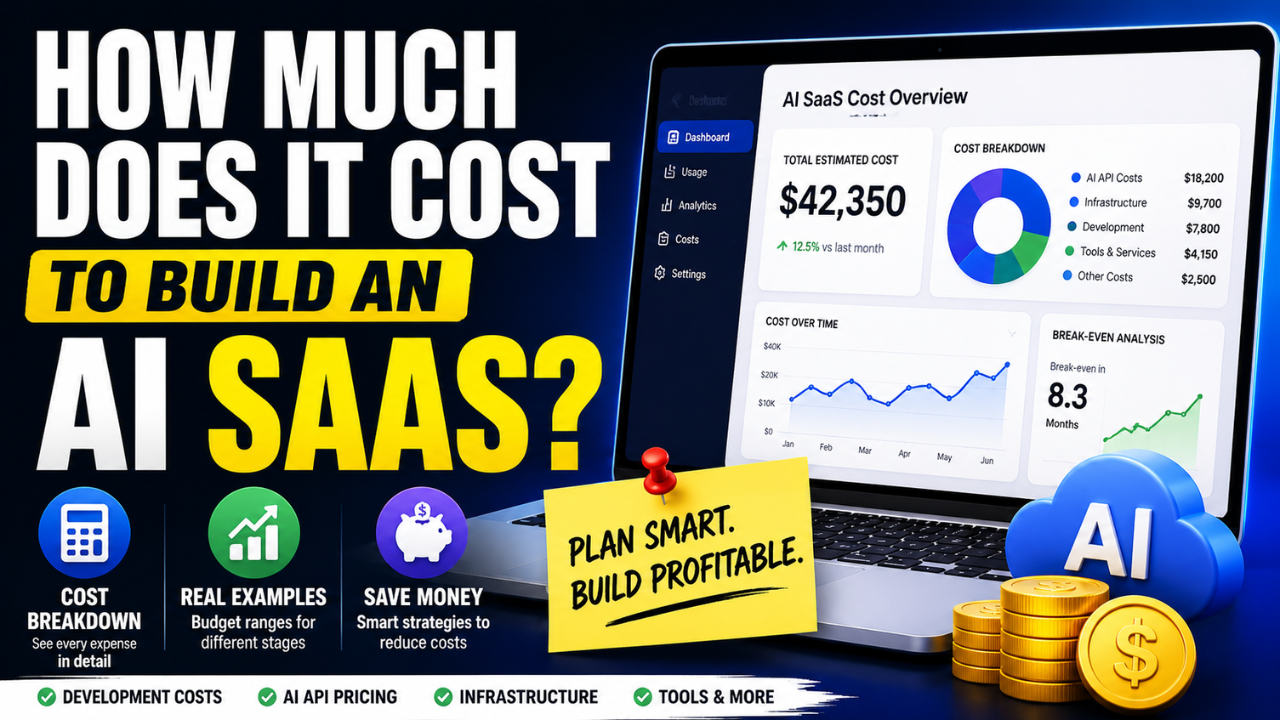
If you are asking, “How much does it cost to build an AI SaaS?”, the honest answer is that it can cost anywhere from about $6,000 for a simple AI MVP to $500,000 or more for a complex enterprise AI platform.
For most startups, however, you do not need to spend hundreds of thousands of dollars to launch.
A focused AI SaaS MVP using existing AI models, cloud infrastructure, authentication, payments, and a simple user interface can often be built for roughly $10,000 to $40,000.
A more sophisticated AI SaaS product with RAG, AI agents, multiple integrations, advanced analytics, stronger security, and production-grade infrastructure can cost $40,000 to $150,000 or more.
The biggest mistake founders make is treating “AI SaaS” as one type of product.
A simple AI writing assistant and an enterprise AI agent platform are both AI SaaS products, but their development costs are completely different.
This guide explains the real costs involved, what you should budget for in 2026, what affects the price, and how to launch an AI SaaS without overspending.
Quick Answer: How Much Does It Cost to Build an AI SaaS?
Here is a practical 2026 estimate:
| AI SaaS type | Estimated development cost | Typical timeline |
|---|---|---|
| Simple AI wrapper | $6,000 to $15,000 | 3 to 6 weeks |
| AI SaaS MVP | $10,000 to $40,000 | 6 to 12 weeks |
| RAG AI SaaS | $15,000 to $50,000 | 8 to 14 weeks |
| AI agent SaaS | $20,000 to $75,000+ | 10 to 18 weeks |
| Advanced AI SaaS | $50,000 to $150,000+ | 3 to 6 months |
| Enterprise AI platform | $150,000 to $500,000+ | 6 to 12+ months |
| Custom AI model platform | $250,000 to $1 million+ | 9 to 18+ months |
These are planning ranges, not fixed quotes.
For a first-time founder, a sensible target is usually a $10,000 to $30,000 MVP rather than attempting to build the final version of the business immediately.
Calculate Your AI SaaS Costs Before You Build
If you are planning an AI SaaS, estimating the development cost is only half the equation.
You also need to understand your potential AI API costs, subscription revenue, profit margins, and break-even point.
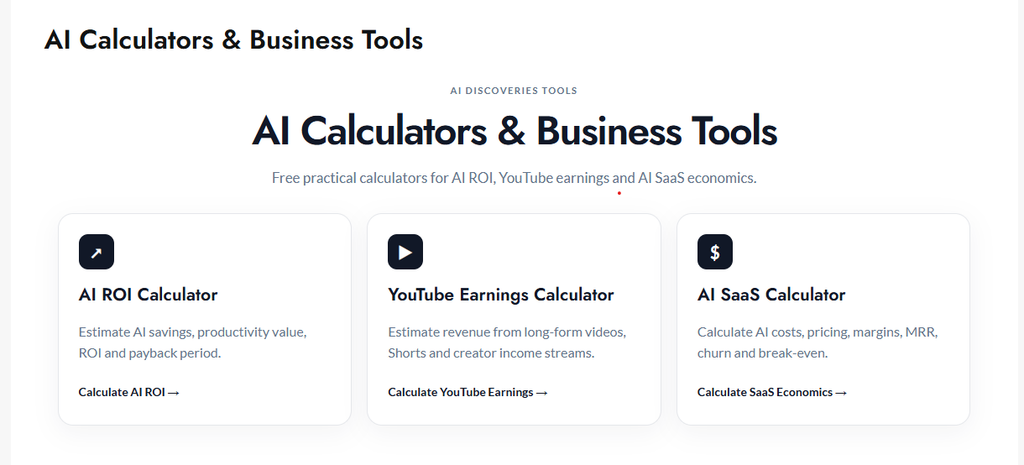
This is where the AI Discoveries business tools can help.
Use the AI Discoveries AI SaaS Cost Calculator to estimate your potential API costs, revenue, profit, and break-even point before investing heavily in development.
It can help you answer practical questions such as:
• How much could each customer cost me?
• What happens to my margins if users consume more AI tokens?
• How many customers do I need to break even?
• What subscription price could support healthy margins?
• How much could my AI API bill become at scale?
Running these calculations early can prevent you from building an AI SaaS business with poor unit economics.
AI Discoveries Business Calculators and Tools
If you are researching an AI business, the AI Discoveries calculator and business tools can help you make decisions using numbers rather than assumptions.
The AI Discoveries AI SaaS Cost Calculator is particularly useful when planning an AI SaaS because it focuses on API costs, profit, and break-even calculations.
You can also use the AI Discoveries AI ROI Calculator to estimate the potential financial return from implementing AI in a business. This is useful if you are building an AI automation product, selling AI services, or trying to justify an AI investment to a client.
If your business model involves YouTube, the AI Discoveries YouTube Earnings Calculator can help estimate potential YouTube revenue based on views and other relevant inputs.
Together, these tools can help you move from an idea to a more realistic financial model.
What Is an AI SaaS?
AI SaaS means software delivered over the internet that uses artificial intelligence as part of its core functionality.
Users typically pay a monthly or annual subscription to access the software.
Examples include:
• AI writing tools
• AI customer support platforms
• AI meeting assistants
• AI sales assistants
• AI document analysis tools
• AI recruitment platforms
• AI marketing tools
• AI coding assistants
• AI financial analysis software
• AI knowledge-base applications
• AI workflow automation platforms
The AI itself may come from an existing model provider.
You do not necessarily need to train your own AI model.
In fact, most startups should avoid training a foundation model unless there is a strong technical or commercial reason to do so.
Instead, you can build your product around existing models through APIs and focus your development budget on the workflow, user experience, data, integrations, and customer problem.
The 7 Main Costs of Building an AI SaaS
Your total AI SaaS budget normally consists of several separate expenses.
The major categories are:
- Product research and planning
- UI and UX design
- Software development
- AI integration
- Infrastructure
- Third-party services
- Testing, maintenance, and optimization
There are also business expenses such as marketing, legal work, payment processing, customer support, and sales.
Understanding these costs before development begins can prevent expensive surprises.
1. Product Research and Planning Cost
Before writing code, you need to establish exactly what you are building.
This includes:
• Customer research
• Competitor research
• Problem validation
• Feature prioritization
• User stories
• Product requirements
• Technical architecture
• MVP definition
• Pricing strategy
• Go-to-market planning
You can do much of this yourself.
Read Also: I Tested 50 AI Money-Making Ideas. Here Are the 7 I’d Actually Start in 2026
Estimated cost:
DIY: $0 to $2,000
With a product consultant: $2,000 to $10,000+
The important point is that product planning can reduce development costs.
If you spend $20,000 building features customers do not want, the problem is not your development team.
The problem started before development.
2. UI and UX Design
Your AI SaaS needs an interface that makes the AI useful.
That could include:
• Landing page
• Sign-up and login
• Dashboard
• AI workspace
• Chat interface
• Document upload
• Results page
• Billing page
• Account settings
• Usage dashboard
• Admin dashboard
A basic MVP can use an existing design system.
A highly customized product requires more design work.
Typical cost:
Basic MVP design: $1,000 to $5,000
Custom SaaS design: $5,000 to $15,000+
Enterprise UX: $15,000 to $50,000+

One of the easiest ways to reduce your initial budget is to avoid designing every screen from scratch.
Build the minimum interface required to solve the customer’s problem.
3. Software Development Cost
Software development is usually one of the largest initial expenses.
Your development team may need to build:
• Frontend
• Backend
• Database
• Authentication
• User management
• Subscription billing
• AI integrations
• API integrations
• Admin tools
• Analytics
• Notifications
• Security controls
• Usage tracking
Development costs depend heavily on who you hire.
A freelancer may charge considerably less than a specialized US development agency.
You should evaluate developers based on:
• Relevant SaaS experience
• AI integration experience
• Previous products
• Code quality
• Communication
• Security practices
• Ability to maintain the product
• Understanding of your business problem
4. AI Model and API Costs
This is where AI SaaS differs from traditional SaaS.
Every time your users send requests to an AI model, your business may incur an AI inference cost.
Depending on your architecture, you may pay for:
• Input tokens
• Output tokens
• Embeddings
• Image generation
• Speech-to-text
• Text-to-speech
• Model reasoning
• Retrieval
• Agent actions
This creates an important difference between traditional SaaS and AI SaaS.
Your revenue may be recurring.
Your AI costs may also be recurring and usage-based.
Before launching, estimate your AI cost per active customer.
Then compare it with your subscription price.
The AI Discoveries AI SaaS Cost Calculator can help you model this relationship and estimate API costs, profit, and break-even.
Example AI API Cost Calculation
Suppose you build an AI writing assistant.
A user generates 100 pieces of content per month.
Each request consumes approximately:
2,000 input tokens
1,000 output tokens
That means each user consumes roughly 300,000 tokens per month across 100 requests.
Multiply that by 1,000 users and your application could process hundreds of millions of tokens every month.
Your actual cost depends on the model you use, the provider’s current pricing, caching, context length, output size, and other implementation details.
This is why you should calculate AI cost per customer before deciding your subscription price.
5. Hosting and Cloud Infrastructure
Your AI SaaS also needs infrastructure.
Common components include:
• Application hosting
• Database
• File storage
• CDN
• Serverless functions
• Background workers
• Monitoring
• Logging
• Backups
• Security services
For an early-stage SaaS, these costs can be relatively low.
As usage increases, infrastructure costs can grow significantly.
The goal is not to build the infrastructure for one million users on day one.
The goal is to build an architecture that can grow without requiring a complete rewrite.
6. Database and Vector Database Costs
Traditional SaaS applications use databases to store information such as:
• Users
• Accounts
• Subscriptions
• Transactions
• Settings
• Projects
• Usage data
AI SaaS products may need additional storage for:
• Documents
• Embeddings
• Knowledge bases
• Conversation history
• AI outputs
• Metadata
If your product uses Retrieval-Augmented Generation, commonly called RAG, you may need a vector database or vector search capability.
Popular approaches include:
• PostgreSQL with pgvector
• Pinecone
• Weaviate
• Qdrant
• Other managed vector databases
You do not automatically need a separate vector database.
For some MVPs, PostgreSQL with vector search can be enough.
7. Authentication, Payments, Email and Other SaaS Services
Your AI model is only one part of the product.
You may also need:
• Authentication
• Subscription billing
• Transactional email
• Analytics
• Error tracking
• Customer support
• Product analytics
• File storage
• CAPTCHA
• Notifications
Some services have free tiers.
Others charge based on users, transactions, storage, or usage.
At MVP stage, you can often keep these expenses relatively low.
The goal is to avoid paying for enterprise plans before you actually need them.
How Much Does an AI SaaS MVP Cost?
For most founders, this is the most important question.
A realistic AI SaaS MVP can cost approximately:
$10,000 to $40,000.
Some simple products can be built for less.
More sophisticated products can cost considerably more.
A practical MVP might include:
• Landing page
• User registration
• Login
• Dashboard
• One core AI workflow
• AI API integration
• Database
• Subscription payments
• Usage limits
• Basic analytics
• Admin dashboard
• Email notifications
• Basic security
• Deployment
You do not need:
• 20 AI features
• A mobile app
• Custom AI model training
• Complex animations
• Advanced enterprise dashboards
• Dozens of integrations
• Multi-agent architecture
Build the smallest product that proves customers will pay.
How Much Does It Cost to Build a RAG AI SaaS?
RAG stands for Retrieval-Augmented Generation.
A RAG application allows an AI model to retrieve information from a specific knowledge base before generating an answer.
Examples include:
• Chat with your company documents
• AI legal document analysis
• AI employee handbook assistant
• AI research assistant
• AI customer support knowledge base
• AI financial document analysis
A basic RAG SaaS MVP can cost approximately:
$15,000 to $50,000.
The cost increases because you now need to handle:
• Document uploads
• Text extraction
• Chunking
• Embeddings
• Vector search
• Retrieval
• Context construction
• Citation or source display
• Access control
• Data deletion
• Retrieval quality
• Hallucination management
How Much Does It Cost to Build an AI Agent SaaS?
AI agents can cost more because they do more than generate text.
An agent may:
• Read information
• Decide what action to take
• Call external tools
• Search databases
• Send emails
• Update records
• Generate documents
• Execute workflows
• Ask for human approval
• Continue through multiple steps
A simple AI agent MVP might cost $20,000 to $75,000+.
More advanced agent systems can exceed $100,000.
The more autonomous your AI becomes, the more important testing, monitoring, permissions, reliability, and cost controls become.
How Much Does an Enterprise AI SaaS Cost?
Enterprise AI SaaS can cost:
$150,000 to $500,000+
Some projects can exceed $1 million.
Enterprise customers may require:
• Single sign-on
• Role-based access control
• Audit logs
• Advanced permissions
• Data isolation
• Enterprise integrations
• Custom workflows
• High availability
• Security reviews
• Compliance requirements
• Advanced monitoring
• Dedicated support
• Custom reporting
• Service-level agreements
At this level, you are no longer building only an AI feature.
You are building enterprise software infrastructure.
Do You Need to Train Your Own AI Model?
Usually, no.
You can often build an AI SaaS using existing foundation models through APIs.
Instead of spending hundreds of thousands of dollars training a model, you can spend your budget on:
• Customer research
• Product development
• AI workflow design
• Proprietary data
• Integrations
• User experience
• Distribution
• Sales
Custom model training becomes more attractive when you have a strong reason such as proprietary data, specialized performance requirements, regulatory constraints, latency requirements, or economics at very large scale.
For most early-stage founders, using existing models is the faster path to validation.
How to Calculate Your AI SaaS Unit Economics
This is one of the most important calculations you can make.
Suppose you charge:
$29 per month.
Your average customer generates:
$4 in AI API costs
$2 in infrastructure
$1 in third-party services
Your approximate variable cost is:
$7 per customer.
That leaves:
$22 before other business expenses.
Your gross margin would be approximately 76%.
The numbers will vary by product.
The principle remains the same.
You should know how much each customer costs you to serve.
The AI Discoveries AI SaaS Cost Calculator can make this process easier by helping you estimate API costs, revenue, profit, and the number of customers required to reach break-even.
For businesses considering AI adoption rather than building an AI SaaS, the AI Discoveries AI ROI Calculator provides another useful way to estimate whether an AI investment could generate enough financial value to justify its cost.
AI SaaS Pricing Strategy
Your AI SaaS pricing should account for both customer value and your costs.
Common pricing models include:
Flat monthly subscription
Example:
$19/month
$49/month
$99/month
Simple and easy to understand.
Usage-based pricing
Customers pay according to:
• AI generations
• Tokens
• Documents
• API calls
• Agent executions
• Minutes of voice usage
This can protect you when heavy users create significantly higher AI costs.
Hybrid pricing
For many AI SaaS businesses, hybrid pricing can work well.
For example:
Starter: $19/month
Professional: $49/month
Business: $149/month
Each plan includes a different usage allowance.
Customers can then purchase additional usage when they exceed their included limits.
The Hidden Cost of AI SaaS
Many founders focus on development and forget everything else.
Your total budget may also include:
• Domain name
• Branding
• Legal documents
• Privacy policy
• Terms of service
• Payment processing
• Email
• Customer support
• Analytics
• Monitoring
• Security
• Backups
• Marketing
• Sales
• Customer onboarding
• Product maintenance
You should also budget for bugs.
You should budget for failed experiments.
You should budget for changes after real customers start using the product.
A 20% to 30% contingency can be sensible for an early product budget.
Should You Build an AI SaaS Yourself?
If you have technical skills, building the first version yourself can dramatically reduce cash requirements.
You may still spend money on:
• AI APIs
• Hosting
• Domain
• Database
• Email
• Payment processing
• Software tools
A technical founder could potentially launch a basic AI SaaS for hundreds or a few thousand dollars.
A non-technical founder can also reduce development costs by using:
• No-code tools
• Low-code platforms
• AI coding assistants
• Pre-built SaaS templates
• Managed APIs
• Open-source components
However, using AI coding tools does not eliminate product development.
You still need to understand the customer problem, architecture, security, testing, and economics.
A Better Way to Build Your First AI SaaS
If you are starting from scratch, use this sequence.
Step 1: Find a painful problem
Talk to potential customers.
Find a repetitive task that costs them time or money.
Step 2: Validate demand
Before spending $20,000, try to get people interested in the solution.
Create a landing page.
Talk to prospects.
Collect emails.
Offer early access.
Try to get pre-orders if possible.
Step 3: Define one core workflow
Write down exactly what the user gives your product and what your product returns.
Step 4: Calculate your economics
Estimate:
• Development cost
• AI API cost
• Infrastructure cost
• Customer acquisition cost
• Subscription revenue
• Gross margin
• Break-even customers
Use the AI Discoveries AI SaaS Cost Calculator to model the numbers before development.
Step 5: Build the smallest MVP
Use existing AI models.
Use managed infrastructure.
Avoid unnecessary features.
Step 6: Charge early
Do not wait until you have 100 features.
Charge for the solution once it provides meaningful value.
Step 7: Measure usage
Track:
• AI cost per user
• Customer acquisition cost
• Monthly recurring revenue
• Churn
• Activation
• Retention
• Gross margin
• Average revenue per user
Step 8: Improve after validation
Only add expensive features after customers demonstrate that they need them.
Other AI Business Calculations Worth Making
Building an AI SaaS is only one way to make money with AI.
You might also be:
• Starting an AI automation agency
• Selling AI consulting
• Creating AI content
• Building a YouTube channel
• Implementing AI for businesses
• Selling AI-powered digital products
• Creating AI tools
Different business models require different financial calculations.
For YouTube creators and people researching content businesses, the AI Discoveries YouTube Earnings Calculator can help estimate potential earnings from YouTube activity.
For companies considering AI adoption, the AI Discoveries AI ROI Calculator can help estimate potential returns from an AI investment.
For founders building software, the AI Discoveries AI SaaS Cost Calculator focuses on the numbers that matter for an AI SaaS, including API costs, profit, and break-even.
These calculations are useful because they force you to test the business model before committing significant time and money.
Frequently Asked Questions
How much does it cost to build an AI SaaS?
A simple AI SaaS MVP can cost approximately $6,000 to $15,000. A more complete AI SaaS MVP commonly falls around $10,000 to $40,000. More sophisticated RAG, agentic, or enterprise products can cost $50,000 to $500,000 or more.
Can I build an AI SaaS for $5,000?
Yes, if you keep the scope extremely small and use existing AI APIs, templates, managed infrastructure, and your own development work.
A $5,000 budget is unlikely to be enough for a sophisticated production-ready platform built entirely by a professional agency.
Can I build an AI SaaS without coding?
Yes.
You can combine no-code or low-code tools with AI APIs and automation platforms.
However, complex products eventually require custom development.
Do I need to train an AI model?
Usually no.
Most early-stage AI SaaS products can use existing foundation models through APIs.
How much does it cost to run an AI SaaS per month?
A small product may operate for $100 to $1,000+ per month. Growing products can cost several thousand dollars per month, while high-volume AI SaaS businesses can spend tens of thousands of dollars or more.
Your biggest variable expense may be AI inference.
What is the cheapest way to build an AI SaaS?
The cheapest practical approach is to:
• Choose one narrow problem
• Use an existing AI API
• Build a web application
• Use managed infrastructure
• Use a pre-built UI
• Avoid custom model training
• Build only essential features
• Do some development yourself
• Validate demand before scaling
Is AI SaaS more expensive than traditional SaaS?
It can be.
Traditional SaaS generally has infrastructure and software costs.
AI SaaS adds model inference, embeddings, AI processing, and potentially more expensive workloads.
However, existing AI APIs have also made it possible for small teams to build sophisticated AI products without owning expensive AI infrastructure.
How much should I budget for my first AI SaaS?
If you are validating a new idea, I would target $10,000 to $30,000 for a focused MVP.
If you need sophisticated RAG, agents, integrations, enterprise security, or complex workflows, consider $30,000 to $100,000+.
Do not start with a $100,000 build simply because you have $100,000 available.
Start with the smallest version that can prove customers will pay.
Final Answer: What Should You Expect to Pay?
The cost to build an AI SaaS depends mainly on what you are actually building.
A useful 2026 planning range is:
Simple AI SaaS: $6,000 to $15,000
Focused AI MVP: $10,000 to $40,000
RAG SaaS: $15,000 to $50,000
AI agent SaaS: $20,000 to $75,000+
Advanced SaaS: $50,000 to $150,000+
Enterprise AI SaaS: $150,000 to $500,000+
Custom AI platform: $250,000 to $1 million+
Before spending money, calculate your economics.
Estimate your development cost.
Estimate your AI API cost.
Estimate your infrastructure cost.
Estimate your revenue per customer.
Then calculate your gross margin and break-even point.
The AI Discoveries AI SaaS Cost Calculator can help you run these numbers.
If you are evaluating AI investments for an existing business, use the AI Discoveries AI ROI Calculator.
If you are building a YouTube business, use the AI Discoveries YouTube Earnings Calculator.
The smartest approach is not to spend the most money.
It is to spend enough money to validate the business.
Start with one customer problem.
Use existing AI models.
Keep your architecture simple.
Monitor your AI costs.
Charge customers early.
Then invest more when the market proves that the product deserves it.
Key Takeaways
• A simple AI SaaS can cost as little as $6,000 to $15,000 to develop.
• A realistic focused MVP often falls between $10,000 and $40,000.
• RAG and AI agents increase development complexity and operating costs.
• Enterprise AI SaaS can cost $150,000 to $500,000 or more.
• You usually do not need to train your own AI model.
• AI API usage becomes an important recurring expense after launch.
• You should calculate AI cost per customer before setting your subscription price.
• The AI Discoveries AI SaaS Cost Calculator can help estimate API costs, profit, and break-even.
• The AI Discoveries AI ROI Calculator can help evaluate potential returns from AI investments.
• The AI Discoveries YouTube Earnings Calculator can help creators estimate potential YouTube earnings.
• Your development budget should match your MVP scope.
• The best way to reduce cost is to reduce unnecessary scope.
• Before investing heavily, validate that customers actually want and will pay for the solution.
✍️ About the Author
Olasunkanmi Adeniyi is a solo founder, product builder, AI practitioner, no-code and low-code developer, and SEO/content strategist. He builds websites, SaaS products, digital tools, and content systems using AI and modern development tools.
Rather than writing about AI from theory alone, Olasunkanmi focuses on testing, building, experimenting, and documenting what actually works. His work explores AI-powered workflows, product development, automation, SEO, content strategy, online business, and the practical use of emerging technologies.
Through AI Discoveries, he publishes practical tutorials, in-depth guides, experiments, and real-world use cases designed to help entrepreneurs, professionals, creators, and businesses understand and apply AI more effectively.
His goal is simple: make AI practical, understandable, and actionable—so readers can move from learning about what AI can do to actually using it to build, work, and grow.
Learn more and explore his latest work at www.aidiscoveries.io.


Leave a Reply