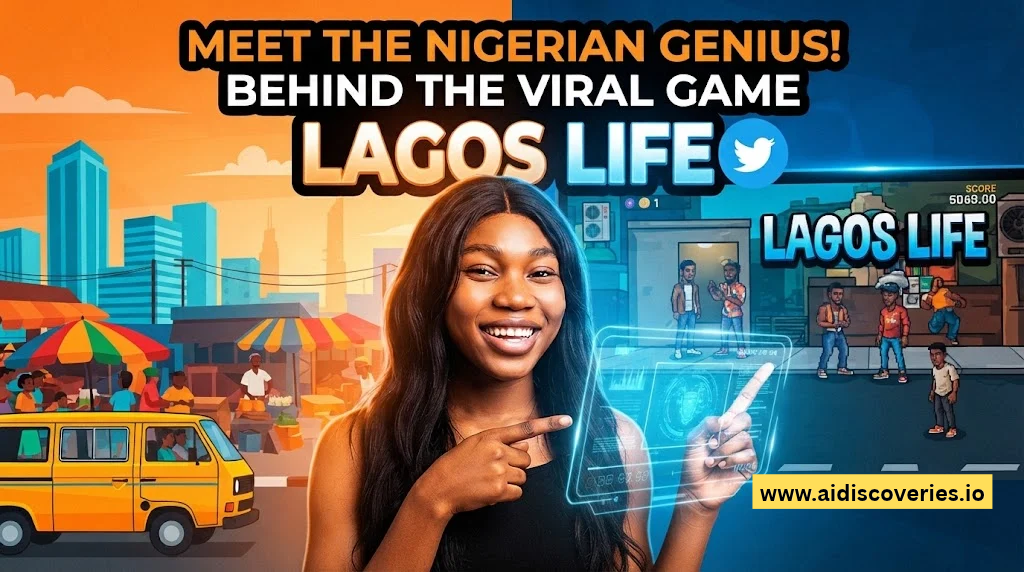
A few days ago, Lagos was simply a city.
Now, millions of people are living in a virtual version of it through the game called, Lago Life
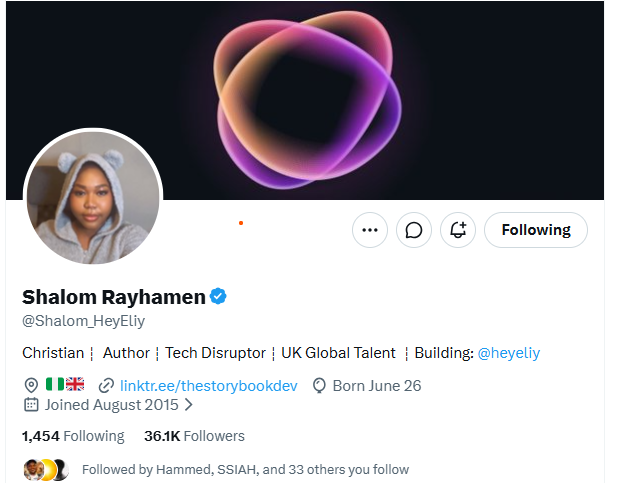
Behind it is Ijeoma Shalom Rayhamen, the Nigerian software developer better known online as Shalom Rayhamen and through her development outfit, Eliy.
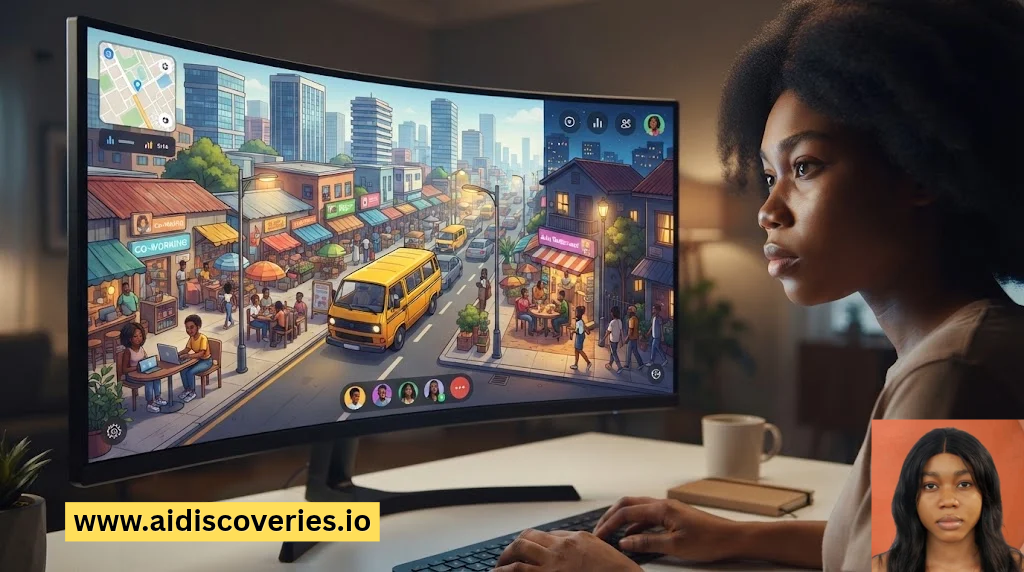
The story of Lagos Life is bigger than a viral game.
It is a story about culture, technology, timing and what can happen when a developer builds something that feels instantly familiar to millions of people.
On Lagos Life Game People are getting jobs. Paying rent. Buying houses. Going broke. Making friends. Going to Quilox. Eating amala at Shitta. Trying to move up the social ladder.
And somehow, many of them are doing all of this from their phones and laptops.
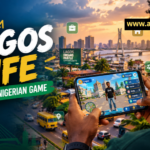
The game behind the craze is Lagos Life, a Nigerian-built browser-based life simulation that has exploded across X and other social platforms just days after launch.
Who Is Shalom Rayhamen?
Shalom Rayhamen is a Nigerian software developer and the creator of Lagos Life.
The game’s official statistics page credits Shalom Rayhamen as its creator and links to her X account, @Shalom_HeyEliy. The game’s official disclaimer also identifies her as the operator of Lagos Life.

She is also building the project under Eliy.
Reports describe her as a Nigerian developer based in the UK, although the official game materials identify her as the operator of Lagos Life in Nigeria.
What makes her story particularly interesting is that Lagos Life was not born inside a large gaming studio.
It came from an individual developer who saw an opportunity and moved quickly.
From The Sims 3 to Lagos Life
The idea behind Lagos Life goes back to Shalom’s childhood.
She grew up playing The Sims 3, the popular life-simulation game where players create characters, build homes, get jobs and construct virtual lives.
But there was always a gap.
The world inside The Sims did not look or feel like the world she knew.
Then another Nigerian game helped close that gap.
Shalom came across Lagos Run, a browser game created by Nigerian developer Opeyemi Adeniran, known online as Eureka. Lagos Run put players behind the wheel of a danfo and turned familiar Lagos traffic into a playable experience.
That sparked an idea.
What if the entire experience of living in Lagos could become a game?
Not Lagos as a backdrop.
Lagos as the game.
That idea became Lagos Life.
She reportedly built the first version remarkably quickly, with Condia reporting that the game was built in under 12 hours.
Then the internet discovered it.
Lagos Life Launches on Nigeria’s Independence Day
Lagos Life launched on October 1, 2026, Nigeria’s Independence Day.
The timing could hardly have been better.
Instead of downloading an app or buying a console game, users could simply open their browser and enter a virtual Lagos.
That lowered the barrier to entry dramatically.
No PlayStation.
No expensive gaming PC.
No app-store download.
Just a browser and an account.
Read Also: 30 Legitimate Ways to Make Money Online in 2026: A Beginner’s Opportunity Map
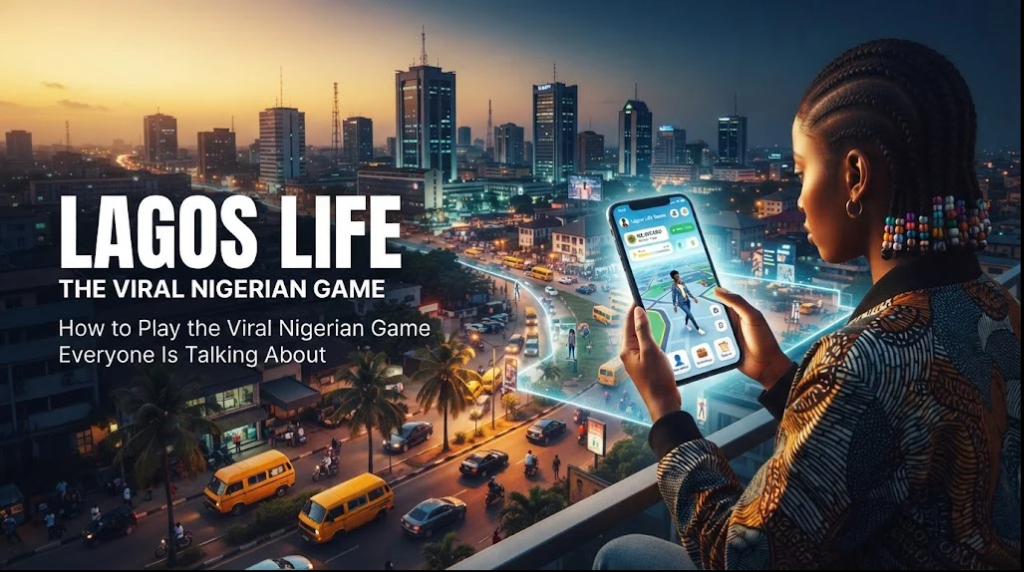
The official terms describe Lagos Life as an online life-simulation game where players create characters, work jobs, earn and spend virtual naira, buy items and interact with the virtual world.
And unlike a traditional single-player simulation, Lagos Life is built around a shared world.
You are not alone.
Other people are living their Lagos lives at the same time.
That social element is one of the biggest reasons the game has become so addictive.
Why Lagos Life Feels Different
The easiest way to explain Lagos Life is:
The Sims, but set in Nigeria.
But that description does not fully explain why the game has connected with so many people.
The game takes familiar Nigerian experiences and turns them into gameplay.
You can get a job.
You can earn virtual money.
You can rent a home.
You can explore locations.
You can interact with other players.
You can build relationships.
You can experience the pressure of money and social mobility.
The game also includes familiar locations and cultural references, including Amala Shitta and Quilox.
This matters because the player does not need a tutorial to understand the world.
A Lagosian already understands what rent means.
They understand the importance of getting a job.
They understand transportation.
They understand nightlife.
They understand the difference between struggling for money and having money.
Lagos Life takes those everyday experiences and converts them into a digital playground.
The result is a game that feels culturally specific rather than generic.
The Viral Explosion
The growth has been extraordinary.
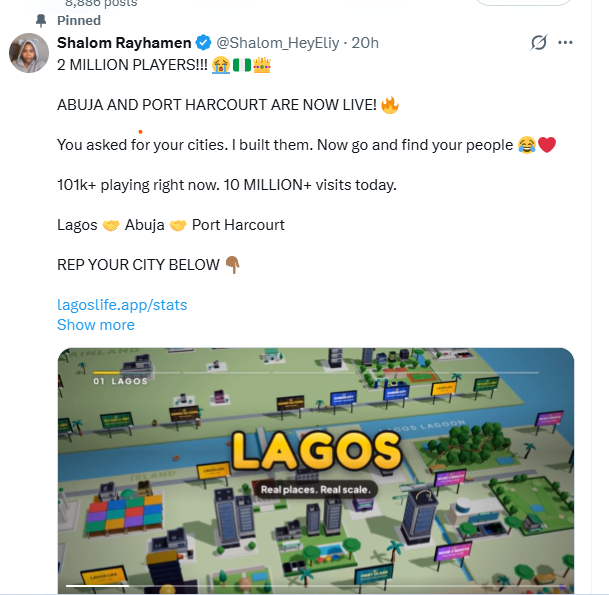
According to BusinessDay, Lagos Life moved from more than 100,000 users to more than one million players within days of launch.
TechPoint Africa reported that the game crossed one million players within four days and was already generating revenue through advertising opportunities inside its virtual world.
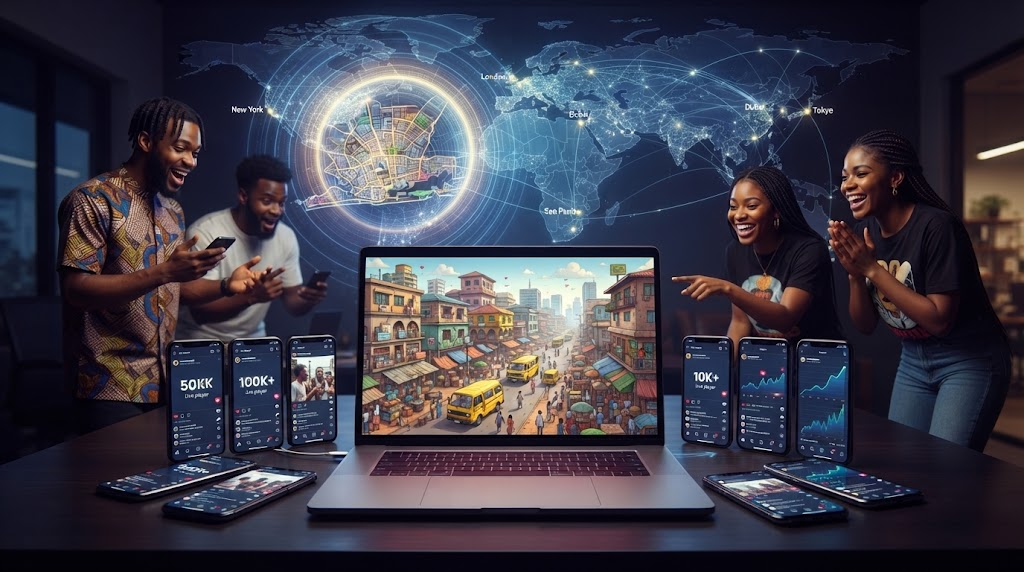
Other reports have cited more than 100,000 concurrent players at its peak.
The official stats page also provides live player and visit counters, although those figures change continuously.
The numbers are impressive.
But the more interesting story is how the game spread.
There was no massive traditional advertising campaign.
People discovered it through X.
They posted screenshots.
They shared their characters.
They showed off virtual houses.
They joked about virtual rent.
They compared their digital lives with their real ones.
And every post became another advertisement for the game.
X Became Part of the Growth Engine
Shalom’s presence on X has played an important role in the game’s viral journey.
Her account, @Shalom_HeyEliy, has become a place where players can follow updates and see milestones from the project. The official Lagos Life stats page directly links the creator to that account.
This created an unusual feedback loop.
Shalom builds.
Players discover.
Players post.
The posts attract more players.
More players create more stories.
Those stories create more posts.
The cycle continues.
That is one of the most powerful forms of modern product marketing.
The users become the distribution network.
Lagos Life Is More Than a Game
There is another reason the game is generating so much conversation.
It reflects real Nigerian life.
Work.
Money.
Housing.
Class.
Relationships.
Status.
Ambition.
Hustle.
Even the game’s economic mechanics create a familiar experience.
Players have to make decisions about how they spend their virtual money and how they improve their virtual lives.
The game therefore becomes both entertainment and social commentary.
People are laughing at the virtual version of Lagos because they recognise parts of their real lives in it.
The developer herself describes the project as a fictional entertainment experience inspired by different aspects of Nigerian life. The official disclaimer specifically says the game draws inspiration from employment, transportation, relationships, finance, property, entertainment, government and other aspects of everyday life.
Why This Could Be Bigger Than Lagos
Perhaps the most interesting question is what happens next.
Lagos Life has already demonstrated that a Nigerian developer can create a culturally specific digital product and attract a huge audience extremely quickly.
That changes the conversation around African gaming.
For years, African developers have often had to build for global audiences using settings, characters and stories that may have little connection to African life.
Lagos Life flips that approach.
It starts with local culture.
And the local audience becomes the initial growth engine.
That creates a potential path toward something much larger.
If Lagos can become a virtual city, why not Abuja?
Why not Port Harcourt?
Why not Accra?
Why not Nairobi?
Why not Johannesburg?
A successful Lagos Life ecosystem could eventually become the foundation for a broader African virtual world.
Reports already indicate that additional cities such as Abuja and Port Harcourt are being considered or developed for the wider experience.
The Business Opportunity Inside the Game
Lagos Life is also showing something important about digital advertising.
Traditional advertising puts a billboard on a physical road.
Lagos Life can put a billboard inside a virtual city.
TechPoint Africa reported that the game was already monetising through virtual advertising, with businesses able to reach players inside the digital environment.
Imagine a player walking through virtual Lagos and seeing a familiar brand.
A bank.
A telecom company.
A restaurant.
A fashion brand.
A fintech startup.
A real estate company.
Instead of simply seeing an advertisement on a website, the player encounters the brand as part of the virtual environment.
That could become a significant business model if the audience continues to grow.
What Shalom’s Story Teaches Nigerian Builders
The biggest lesson from Lagos Life may have nothing to do with gaming.
It is about building for a specific audience.
Shalom did not need to invent a completely new category.
Life simulation games already existed.
The Sims already proved that people enjoy creating virtual lives.
What she changed was the context.
She asked a simple question:
What would this look like if it felt like home?
That question produced something people immediately understood.
And that is a valuable lesson for Nigerian founders, developers and creators.
You do not always need a completely new idea.
Sometimes you need to take an existing idea and make it deeply relevant to the people you understand.
Lagos Life took a familiar global concept and gave it Nigerian identity.
That identity became its advantage.
The Bigger Story Behind the Viral Game
The rise of Lagos Life is happening at an interesting time for Nigeria’s technology and creative industries.
Nigeria has millions of young internet users.
It has a large developer community.
It has a massive entertainment industry.
It has one of Africa’s most influential social media cultures.
What has often been missing is the infrastructure and distribution needed to turn local ideas into products that can reach millions.
Lagos Life offers a glimpse of what happens when those pieces come together.
A developer sees an idea.
A culturally relevant product gets built quickly.
A browser removes friction.
X provides distribution.
Players create the content.
And the audience takes it from there.
That is why the story of Lagos Life deserves attention beyond gaming.
It is a Nigerian product story.
It is a creator story.
It is a startup story.
And it may be an early signal of where African digital entertainment is heading.
Meet the Woman Behind the Lagos Life Craze
For now, millions of people are busy trying to survive their virtual Lagos.
They are chasing jobs.
Counting virtual naira.
Paying rent.
Exploring the city.
Meeting strangers.
Building relationships.
And sharing their experiences on X.
Behind all of it is Shalom Rayhamen, a Nigerian developer who took inspiration from a childhood game and a viral danfo-driving experiment, then turned the idea into a shared digital version of Lagos.
Lagos Life shows what can happen when technology meets culture at exactly the right moment.
The game may be fictional.
But the opportunity it represents for Nigerian creators and developers is very real.
And this may only be the beginning.
✍️ About the Author
Olasunkanmi Adeniyi is a product manager, AI prompt engineer, and the founder of AI Discoveries (aidiscoveries.io). With hands-on expertise in leading AI models, no-code automation, and digital strategy, he helps businesses and creators adopt practical artificial intelligence. He is the author of several business and tech guides, including ChatGPT Mastery Guide for Business Owners, AI-POWERED LINKEDIN GROWTH AUDIT
and SELL YOURSELF. All content is rooted in real-world testing, modern workflows, and a commitment to smart, actionable technology adoption.
Learn more and explore his latest work at www.aidiscoveries.io.



Leave a Reply