AI DISCOVERIES | TECHNOLOGY & E-COMMERCE | NOVEMBER 14th 2026
Imagine telling ChatGPT:
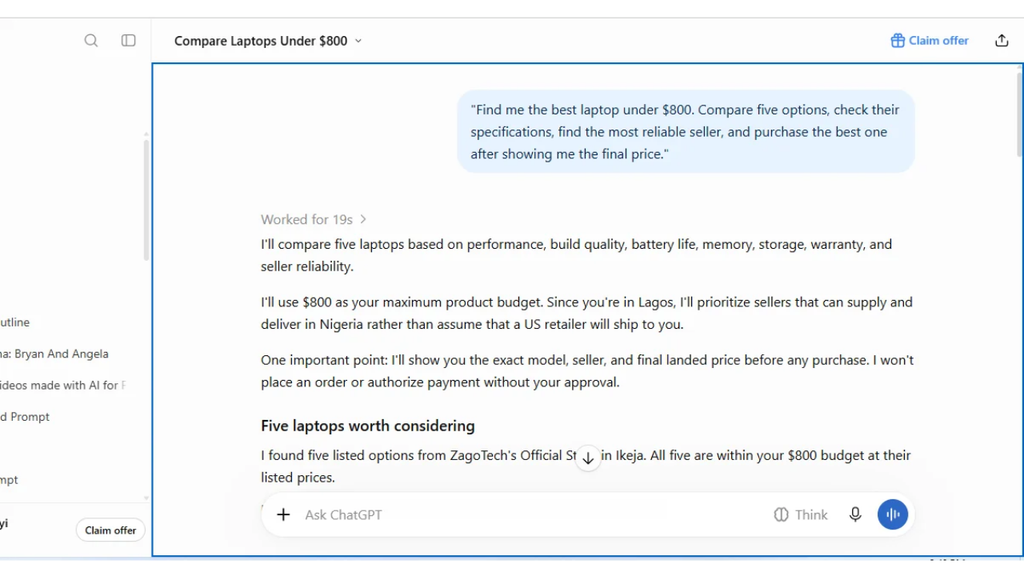
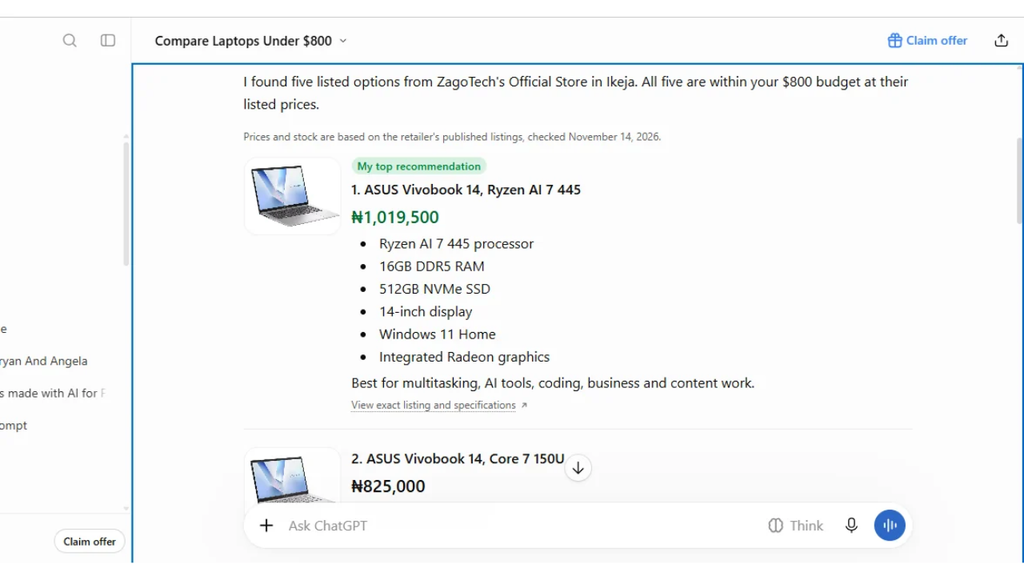
“Find me the best laptop under $800. Compare five options, check their specifications, find the most reliable seller, and purchase the best one after showing me the final price.”
Instead of giving you a list of links and leaving you to do the rest, an AI agent could research products, compare prices, navigate a merchant’s website, prepare your order and complete the payment after you approve it.
This is the future OpenAI is beginning to build with ChatGPT Wallet.
Announced on November 13, 2026, ChatGPT Wallet introduces a new way for OpenAI’s AI agents, known as Dots, to make purchases on behalf of users without accessing their actual payment card details.
The development could fundamentally change how people discover products, interact with online stores and complete purchases.
It also raises an important question for businesses: what happens when your next customer is an AI agent rather than a human browsing your website?
In this guide, you’ll learn what ChatGPT Wallet is, how it works, how AI agents will shop and pay, the security measures behind the technology, what it means for e-commerce businesses, and how online retailers can prepare for the emerging era of agentic commerce.
What Is ChatGPT Wallet?
ChatGPT Wallet is OpenAI’s new AI-powered payment feature that allows its AI agents to complete purchases on behalf of users through a secure payment authorization process.
Unlike traditional digital wallets, where users manually select products and initiate payments, ChatGPT Wallet allows an AI agent to handle much of the shopping process.
A user can ask an agent to find a product, compare available options, prepare an order and initiate checkout.
The user then reviews the purchase and approves the transaction using a security check, such as Face ID or fingerprint authentication.
OpenAI developed ChatGPT Wallet in partnership with three major payment networks:
- American Express.
- Mastercard.
- Visa.
The goal is to make AI-powered purchases work with existing payment infrastructure rather than requiring every merchant to build an entirely new payment system.
According to OpenAI, the initial rollout is through Dots for eligible ChatGPT Pro subscribers aged 18 and older in the United States with eligible US-issued cards.
This distinction matters. ChatGPT Wallet is not yet a globally available payment service, and users in countries such as Nigeria cannot assume they can access it at launch.
OpenAI also says users retain eligible card rewards and protections for qualifying disputes.
Source: OpenAI’s official ChatGPT Wallet announcement.
How Does ChatGPT Wallet Work?
The most interesting part of ChatGPT Wallet is how it connects AI agents with existing payment systems.
To understand the process, consider a practical example.
You want to buy a new smartphone but don’t have time to visit different online stores.
You tell your ChatGPT agent:
“Find me a smartphone with at least 256GB storage, a good camera and a battery that lasts all day. My budget is $600.”
Here is what happens next.
Step 1: You give the AI agent your shopping instructions
You describe what you need, your budget and any important requirements.
The agent interprets your instructions and determines what products match your criteria.
Step 2: The AI agent researches available products
The agent searches accessible merchant websites, gathers product information and compares relevant options.
It can evaluate factors such as:
- Product specifications.
- Prices and discounts.
- Availability.
- Seller information.
- Delivery options.
- Other relevant product details.
Instead of opening 15 browser tabs, you can receive a shortlist based on your requirements.
Step 3: The agent prepares your purchase
After identifying a suitable product, the agent can navigate the merchant’s website and prepare the order.
This includes selecting the product and reviewing the checkout information.
The merchant remains responsible for its inventory, pricing, order fulfilment, returns and customer service.
Step 4: You review and approve the payment
Before payment, you can review the selected items, total cost and payment card.
This is an important part of OpenAI’s initial security design.
The agent cannot simply spend your money without your approval.
Step 5: The payment network generates a secure payment token
Once you approve the transaction, the payment network provides a token that substitutes for your actual card details.
The token contains payment credentials designed for the authorized transaction.
The merchant receives the information needed to process the payment without receiving your actual card number from the AI agent.
Step 6: The merchant processes the order
The merchant’s existing payment infrastructure processes the transaction.
The business remains responsible for delivering the product and handling the customer’s order.
The entire process moves AI from recommending products to helping execute commercial transactions.
How ChatGPT Wallet Protects Your Money
Giving artificial intelligence the ability to spend money introduces serious security questions.
What happens if an AI agent selects the wrong product? What if someone manipulates an agent into making an unauthorized purchase? Can an AI system access your credit card information?
OpenAI’s approach to ChatGPT Wallet focuses on three important security mechanisms.

1. Payment tokenisation
Payment tokenisation replaces sensitive card information with a substitute digital credential.
This means the AI agent does not need direct access to your actual card number, security code or expiration date.
Instead, the payment network generates a token that can be used to authorize the transaction.
This approach builds on technology already used across the digital payments industry.
2. Biometric verification
Every purchase in the initial ChatGPT Wallet rollout requires a security check.
Depending on the supported device, this could involve:
- Face ID.
- Fingerprint authentication.
- Another supported security verification method.
This gives users an opportunity to review and authorize a purchase before money leaves their account.
3. Transaction-specific authorization
OpenAI’s system is designed to connect payment authorization to the purchase the user has approved.
The user can inspect the selected products, payment method and total amount before approving the transaction.
This creates a record of what the user authorized.
There is another important distinction worth understanding.
OpenAI has described a future where users could give agents permission to make certain purchases automatically using predefined rules.
For example, you might authorize an agent to:
- Purchase groceries up to $100 per week.
- Buy office supplies below a specified amount.
- Renew approved subscriptions.
- Purchase products from selected categories.
However, these are future possibilities, not capabilities you should assume are available in the initial launch.
For now, each purchase requires user approval and a security check.
Source: OpenAI: Introducing ChatGPT Wallet.
What Makes ChatGPT Wallet Different From Traditional Digital Wallets?
You might be wondering:
“Don’t we already have Apple Pay, Google Wallet, PayPal and other digital payment services?”
Yes. But ChatGPT Wallet introduces a different relationship between the customer, the payment system and the shopping process.
Traditional digital wallets primarily help people pay for purchases they have already selected.
ChatGPT Wallet introduces an AI agent that can participate in finding products, comparing options and preparing purchases.
Here is how the approaches differ.
| Feature | Traditional digital wallet | ChatGPT Wallet |
|---|---|---|
| Product discovery | Primarily user-driven | AI-assisted |
| Product comparison | User-driven or app-assisted | AI agent-assisted |
| Shopping research | Manual | AI can research |
| Checkout preparation | User-driven | AI agent-assisted |
| Payment authorization | User authentication | User approval and security check |
| Future automated purchasing | Depends on service | Planned with delegated permissions |
The biggest difference is the agent’s role.
With traditional online shopping, you do the research, make the decision, navigate checkout and pay.
With agentic commerce, you can delegate several of those activities to AI.
The user remains responsible for approving purchases under the initial ChatGPT Wallet model.
What Is Agentic Commerce and Why Does It Matter?
To understand why ChatGPT Wallet matters, you need to understand a concept called agentic commerce.
Agentic commerce refers to a system in which artificial intelligence agents can perform shopping-related activities and transactions on behalf of people or businesses.
Instead of simply answering questions, an AI agent can take actions using connected tools, websites and services.
Consider the difference.
Traditional AI shopping:
You: “Which laptop should I buy?”
AI: “Here are five laptops you might like.”
Agentic shopping:
You: “Find me the best laptop under $800, compare the options and prepare the best purchase.”
AI: Researches products, compares prices, checks available sellers, prepares checkout and asks you to authorize payment.
The second experience moves AI closer to becoming an active participant in the economy.
And OpenAI is not the only company pursuing this direction.
The competition is already heating up
Several major technology and commerce companies are building infrastructure for agentic shopping.
Chatte mit den besten KI-Modellen der Welt.
OpenAI
ChatGPT Wallet brings payment capabilities to its Dots agents. The company is also developing business profiles and tools that help merchants become accessible to AI-powered customers.
Shopify is opening merchant checkout experiences to browser-based AI agents through WebMCP support, allowing agents to interact with checkout workflows with buyer authorization.
Walmart has introduced its Agent Gateway, which helps approved AI agents connect with its inventory and commerce systems.
Visa
Visa is partnering with OpenAI to connect agent-authorized purchases with existing payment infrastructure.
These developments suggest that the next phase of e-commerce competition will involve more than attracting human visitors.
Businesses will also need to make their products accessible to AI agents.
Sources: TechCrunch+3.
How ChatGPT Wallet Could Change E-Commerce Forever
The implications go far beyond making online checkout faster.
ChatGPT Wallet could influence how customers discover products, how businesses attract buyers and how online stores compete.
Here are seven important changes to watch.
10 Side Hustles That Actually Work in 2026 (Low-Cost Ideas) – AI Discoveries
1. AI agents could become the new personal shoppers
For decades, online shoppers have depended on search engines, advertisements, influencers and product reviews to decide what to purchase.
AI agents could combine these activities into one experience.
Imagine an agent that understands your preferences, spending limits, preferred brands and previous purchases.
You could ask it to find a suitable washing machine, compare available options and identify the best deal.
Instead of spending an hour researching, you could receive a shortlist with a prepared purchase.
This could make personalised shopping more accessible to ordinary consumers.
2. Search engine traffic could face a new competitor
Google has dominated product discovery for years.
People search for products, visit different websites, compare prices and eventually purchase from a retailer.
But AI-powered shopping introduces another route.
A customer could discover a product through ChatGPT, evaluate alternatives and proceed to checkout without starting with a traditional Google search.
This does not mean Google is disappearing.
It means businesses may need to compete for visibility across two discovery environments:
- Traditional search engines.
- AI-powered discovery platforms.
This is where Generative Engine Optimization (GEO) becomes increasingly important.
Businesses will need clear product information, accurate pricing, structured data, credible reviews and accessible product pages that AI systems can understand.
3. Product descriptions will become more important
An AI agent cannot make a reliable product recommendation if it cannot understand what a business sells.
A vague product description such as “Premium quality laptop, best price, order now” provides very little useful information.
Compare that with:
“Lenovo ThinkPad with 16GB RAM, 512GB SSD, Intel Core i7 processor, 14-inch display and a one-year manufacturer warranty.”
The second description gives an AI system meaningful information to evaluate.
Product specifications, availability, shipping costs, warranty information and return policies will become increasingly important in AI-driven product discovery.
4. E-commerce websites will need to become AI-agent friendly
Most online stores are designed primarily for human visitors.
They contain navigation menus, product images, buttons, shopping carts and checkout forms.
AI agents need reliable ways to access information and interact with these systems.
OpenAI is encouraging businesses to prepare their websites by:
- Making accurate product information available.
- Providing updated pricing and inventory information.
- Avoiding unnecessary blocking of legitimate AI agents.
- Working with payment and fraud-prevention providers.
- Building integrations that allow agents to interact with business systems.
Shopify’s WebMCP development is another example of how the infrastructure is evolving.
The practical lesson is simple: businesses should start considering whether an authorized AI agent can discover their products and navigate their checkout process.
5. Shopping could become more personalised
Traditional e-commerce platforms often personalise recommendations using browsing history, previous purchases and user preferences.
AI agents could take this further by understanding natural-language instructions and combining several requirements.
For example:
“Find me a birthday gift for my wife. She enjoys photography, has a budget of $150 and prefers practical gifts.”
An AI agent could interpret the request, compare suitable products and present a shortlist.
The more useful context users provide, the more relevant the recommendations could become.
However, this also makes privacy and responsible data handling essential.
How to Access Restricted AI Tools From Anywhere: A Developer & Creator’s Guide – AI Discoveries
6. Small businesses could reach customers through AI agents
A small business does not necessarily need a massive advertising budget to benefit from AI-powered discovery.
A retailer with accurate product listings, competitive prices, trustworthy reviews and a functional online store could become discoverable through AI shopping experiences.
This creates an opportunity for businesses that have struggled to compete with larger retailers on advertising budgets.
However, visibility is not guaranteed. AI systems still need reliable information, accessible websites and appropriate merchant integrations.
7. The relationship between customers and brands could change
Today, businesses invest heavily in building direct relationships with customers.
They use email marketing, social media, loyalty programmes, websites and advertising to influence purchasing decisions.
With agentic commerce, customers may increasingly delegate product research and purchasing decisions to AI assistants.
This introduces a new challenge.
What happens when a customer becomes loyal to an AI shopping assistant rather than a particular retailer?
Businesses will need to compete through product quality, pricing, reliability, fulfilment and customer experience.
The merchant still owns the customer relationship and handles the order, but the AI agent could increasingly influence which merchant gets the sale.
What ChatGPT Wallet Means for E-Commerce Businesses
Generative engine optimization: expert guide
If you own an online store, run a Shopify business, sell products through WooCommerce or operate a retail brand, this development deserves your attention.
Your next customer might not visit your website through a Google search or click an Instagram advertisement.
An AI agent might discover your product, compare it with competitors and initiate a purchase on behalf of a customer.
This creates a new area of digital marketing and e-commerce strategy.
Here are six things businesses should start doing.
1. Optimise your product pages for AI discovery
Your product pages should answer the questions customers and AI agents are likely to ask.
Include:
- Exact product names and specifications.
- Clear, descriptive product titles.
- Current prices and available discounts.
- Stock availability.
- Shipping costs and delivery timelines.
- Warranty and return policies.
- High-quality product images.
Avoid descriptions filled with generic marketing language.
Specific information makes it easier for customers and AI systems to understand what you offer.
2. Implement structured data on your website
Structured data helps search engines understand the information published on your website.
For e-commerce businesses, important Schema.org types include:
- Product.
- Offer.
- Organization.
- BreadcrumbList.
- Review, where eligible and supported.
For example, Product and Offer structured data can communicate a product’s name, price, currency and availability.
This does not guarantee that an AI agent will recommend your product. It improves the clarity and machine-readability of your product information.
If you use WordPress and WooCommerce, check whether your SEO and e-commerce plugins generate accurate product structured data.
3. Make your website accessible to legitimate AI agents
A website that blocks every automated request could create unnecessary barriers to AI-powered shopping.
OpenAI specifically recommends that businesses review their CDN and firewall configurations to ensure legitimate ChatGPT agent requests are not accidentally blocked.
Its announcement also discusses Web Bot Auth, which helps websites verify signed requests.
This does not mean removing security protections or allowing every bot to access your website.
It means distinguishing legitimate AI agents from malicious automated traffic.
4. Prepare your checkout and payment infrastructure
An AI agent may successfully discover your product but fail to complete a purchase if your checkout infrastructure rejects its interaction.
Work with your payment provider to understand:
- Whether agent-initiated transactions are supported.
- How payment tokens are handled.
- Whether fraud systems recognise legitimate agent transactions.
- How failed payments and disputed transactions are managed.
- Whether your checkout can support appropriate agent integrations.
OpenAI says it is working with payment service providers such as Stripe, Adyen and Checkout.com, alongside fraud-prevention companies.
5. Keep your business information updated on ChatGPT
OpenAI is also expanding its business ecosystem through Business Hub.
Businesses can create profiles, verify information and provide product feeds containing current pricing and availability.
Eligible businesses can also create specialised business agents.
This is an important development because product discovery increasingly depends on accurate business information.
Make sure your business name, website, contact information, product catalogue and service descriptions are consistent.
6. Start thinking beyond traditional SEO
Traditional SEO helps your website appear when people search for information.
GEO focuses on making your brand, content and information understandable and useful to generative AI systems.
For e-commerce, this means creating content that answers questions such as:
- What is this product?
- Who is it designed for?
- How much does it cost?
- What makes it different?
- Where can customers purchase it?
- What are its specifications?
- What do verified customers say about it?
Businesses that build strong search visibility, credible brand authority and accurate product information will be better positioned to compete as AI-powered discovery grows.
What Does ChatGPT Wallet Mean for Nigeria and African Businesses?
SokoKart: Le Shopify africain, optimisé pour Mobile Money
This is particularly interesting for African entrepreneurs.
Nigeria has a growing digital commerce ecosystem, with businesses selling through websites, social media, online marketplaces and messaging platforms.
However, there is an important limitation.
ChatGPT Wallet’s November 13 launch is initially restricted to eligible US ChatGPT Pro subscribers aged 18 and above with eligible US-issued payment cards.
It is not currently a payment solution that Nigerian merchants or consumers can assume they can use.
Nevertheless, Nigerian businesses should pay attention to the infrastructure being developed.
Here are five opportunities worth exploring.
1. Nigerian e-commerce stores can prepare for AI discovery.
Businesses using WooCommerce, Shopify and other e-commerce platforms should improve their product descriptions, pricing information, product feeds and structured data.
2. Digital entrepreneurs can build AI shopping assistants.
There is an opportunity to develop specialised agents that help customers discover products, compare prices and navigate local online stores.
3. Payment companies can explore agentic payment infrastructure.
Fintech companies could investigate how tokenised payments, transaction authorisation and fraud prevention will work in an environment where AI agents initiate transactions.
4. African retailers can prepare for international customers.
Businesses selling fashion, electronics, beauty products, agricultural products and digital services should consider how AI-powered discovery could help international buyers find their offerings.
5. SEO professionals can expand into GEO services.
Businesses will increasingly need people who understand how to make their brands and product information discoverable across search engines and AI platforms.
For digital marketers, developers, SEO consultants and e-commerce entrepreneurs, this is an emerging area worth learning before it becomes mainstream.
The Biggest Challenges Facing ChatGPT Wallet
Although ChatGPT Wallet introduces an interesting development, several challenges could determine whether agentic commerce becomes widely adopted.
1. Trust and unauthorised purchases
People must trust an AI agent with increasingly important activities.
Even with transaction approval, users will want assurances that agents select the correct products, display accurate prices and do not manipulate purchase decisions.
2. Merchant compatibility
Not every online retailer supports AI-agent interactions.
Some websites restrict automated browsing and purchasing.
Payment providers and fraud systems may also reject legitimate transactions initiated through agents.
3. Product recommendation accuracy
An AI agent can only make good purchasing decisions when it has reliable product information.
Outdated pricing, inaccurate inventory data and misleading product descriptions could result in poor recommendations.
4. Refunds and customer service
What happens when an agent buys the wrong product?
Who handles refunds, delivery problems and product replacements?
OpenAI’s model keeps merchants responsible for fulfilment, returns and customer service. Clear communication between agents, customers and retailers will remain important.
5. Privacy and financial data
AI-powered shopping involves sharing information about purchasing preferences, products and payment activity.
Businesses and technology providers must handle this information responsibly.
Security, transparency and user control will be essential to widespread adoption.
What Is the Future of Shopping With AI Agents?
The biggest change may happen when AI agents move from asking for permission for every individual action to operating within carefully defined purchasing permissions.
OpenAI has already described its longer-term direction.
Imagine setting up an AI shopping assistant with these instructions:
“Monitor the price of my preferred laptop. If it falls below $700, find a trusted seller, check the warranty and delivery conditions, and notify me when a purchase is ready.”
Or:
“Every month, identify the best available deals for my household essentials. Keep the total below $200 and ask for my approval before purchasing.”
Eventually, users may be able to establish spending limits, product categories and time-based permissions for delegated purchases, with additional safeguards.
This could create a shopping experience where people spend less time browsing websites and more time specifying what they need.
However, the future will depend on reliable AI systems, secure payment infrastructure, merchant participation and consumer trust.
The technology is moving in that direction, but fully autonomous shopping should not be confused with what ChatGPT Wallet offers today.
Frequently Asked Questions About ChatGPT Wallet
1. What is ChatGPT Wallet?
ChatGPT Wallet is OpenAI’s AI-powered payment feature that allows its Dots agents to make purchases on behalf of users through secure payment authorisation. Users review and approve each purchase in the initial rollout.
2. Is ChatGPT Wallet available to everyone?
No. At launch on November 13, 2026, it is initially available to eligible ChatGPT Pro subscribers aged 18 and above in the United States with eligible US-issued payment cards.
3. Can ChatGPT buy things without my permission?
Not under the initial Wallet system. Every purchase requires user approval and a security check. OpenAI has described plans for future delegated purchasing with predefined permissions and additional safeguards.
4. Does ChatGPT Wallet store my credit card details?
OpenAI says its agents do not have access to your actual card details. The payment network generates a substitute payment token after the user approves a transaction.
5. Which payment companies support ChatGPT Wallet?
OpenAI announced partnerships with American Express, Mastercard and Visa.
6. Can Nigerian users use ChatGPT Wallet?
Nigeria is not included in the initial rollout. The launch is restricted to eligible US users with qualifying US-issued cards. OpenAI has not announced a confirmed Nigerian launch date.
7. Will ChatGPT replace Google Shopping?
Not necessarily. However, AI-powered product discovery could compete with traditional search and shopping platforms by helping users research, compare and purchase products through conversational interfaces.
8. How can online businesses prepare for AI shopping?
Businesses should improve product descriptions, implement accurate structured data, maintain updated product feeds, make their websites accessible to legitimate AI agents and work with payment providers to support agent-initiated transactions.
9. What is the difference between agentic commerce and traditional e-commerce?
Traditional e-commerce generally requires customers to search, compare and purchase products themselves. Agentic commerce allows AI agents to perform many of these activities on their behalf, subject to the permissions and safeguards of the system.
Final Thoughts: The Next Big E-Commerce Customer Might Be an AI Agent
ChatGPT Wallet represents an important development in the relationship between artificial intelligence and online commerce.
For years, AI has helped people research products, write product descriptions, generate advertisements and automate business operations.
Now, AI agents are beginning to participate in the actual purchasing process.
This changes the opportunity for entrepreneurs, developers, retailers and digital marketers.
The businesses that prepare early could gain an advantage as AI-powered product discovery and purchasing become more common.
If you run an online business, start making your products easier for AI systems to understand and discover.
If you work in digital marketing, start learning GEO and agentic commerce.
And if you are a developer, consider the opportunities in building AI shopping assistants, merchant integrations and payment infrastructure.
The future of e-commerce will increasingly involve a conversation between people, businesses and intelligent agents.
The question is no longer whether AI will influence how people shop. It is how prepared your business will be when AI starts helping them buy.




Leave a Reply