If someone searches for your business on Google today, you are no longer competing only for a blue link.
Your website could appear inside an AI-generated answer.
A potential customer might ask ChatGPT for the best software for their business. Someone else might use Perplexity to research a product. Another person might ask Gemini for recommendations. A Google user might see an AI Overview that summarizes several websites before they ever click a traditional search result.
Read Also: How to Get Your Business Cited by ChatGPT, Gemini & Google AI — The 4-Step AEO Framework

This changes the SEO game.
The goal is no longer simply to rank on page one.
You also want your brand, website, research, products, and expertise to become sources that AI systems can discover, understand, trust, and cite.
That is where Generative Engine Optimization, or GEO, comes in.
In this guide, you will learn what GEO means in 2026, how AI search engines discover sources, how GEO differs from traditional SEO, and what you can do to increase your chances of being mentioned or cited by ChatGPT, Google AI Overviews, Gemini, and Perplexity.
What Is GEO?
Generative Engine Optimization, commonly called GEO, is the practice of improving your online content so AI-powered search and answer engines can discover, understand, select, and cite your website when generating answers.
Traditional SEO focuses heavily on ranking pages for search queries.
GEO focuses on becoming a useful source inside AI-generated answers.
A simple way to think about it is:
SEO → Get discovered in search results.
GEO → Become a source for AI-generated answers.
The concept of GEO emerged as generative search systems began synthesizing information from multiple online sources rather than simply presenting a list of links. Research into GEO has found that specific content optimization strategies can increase visibility in generative engine responses, although results vary by domain and system.
The important point is that GEO does not replace SEO.
It extends it.
Google’s current guidance makes this especially clear. Google says the same fundamentals that help websites perform well in traditional Search remain relevant for its generative AI search experiences.
Why GEO Matters in 2026
AI search is becoming a major discovery channel.
Google says its AI Overviews now reach more than 2.5 billion monthly active users, while AI Mode has surpassed one billion monthly users. Google also says its AI search experiences are designed to help users discover websites and include prominent links to sources.
That creates a new opportunity for publishers, businesses, creators, and professionals.
Imagine someone asks:
“What are the best AI productivity tools for small businesses?”
An AI system could respond with a list of tools.
If your website has published a well-researched comparison of AI productivity tools, your page could potentially become one of the sources used to construct that answer.
The same applies to searches such as:
“Best logistics companies in Nigeria”
“How can a small business use AI?”
“What are the best AI tools for content creation?”
“How much does SEO cost?”
“What is the best CRM for startups?”
“How do I automate my business?”
The competition is moving from:
“Who ranks #1?”
to:
“Which sources does the AI system trust enough to include?”
How AI Search Differs From Traditional Google Search
Traditional search usually works like this:
User query → Search engine → Ranked pages → User chooses a result
AI search can work more like this:
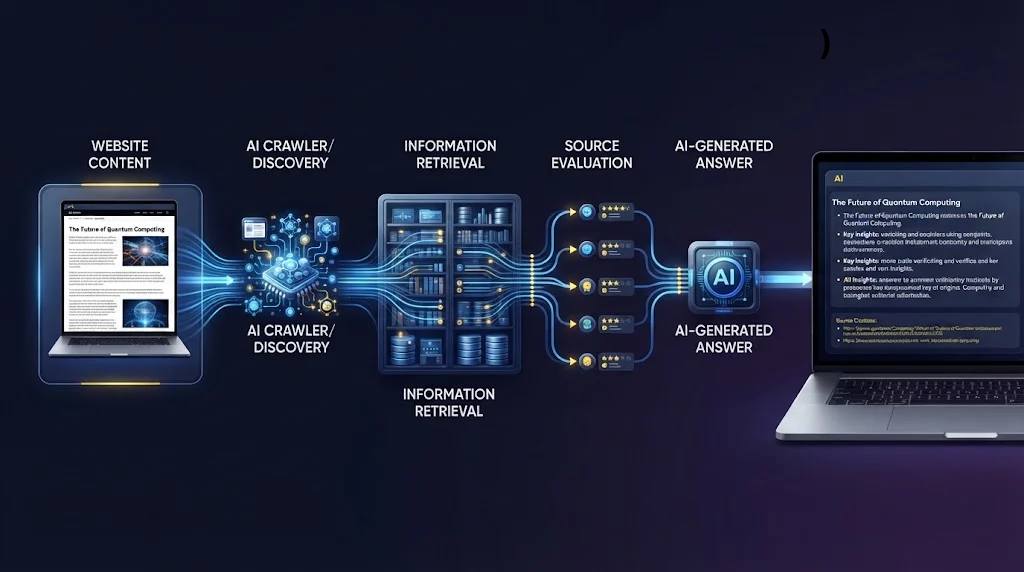
User question → Query expansion → Source discovery → Evidence retrieval → AI synthesis → Answer + citations
Google has specifically described the use of query fan-out in its generative search experiences. This allows AI search to explore related queries and find relevant information from multiple parts of the web.
That has an important implication.
You should not optimize an article only for one keyword.
You should build content that comprehensively answers the underlying topic.
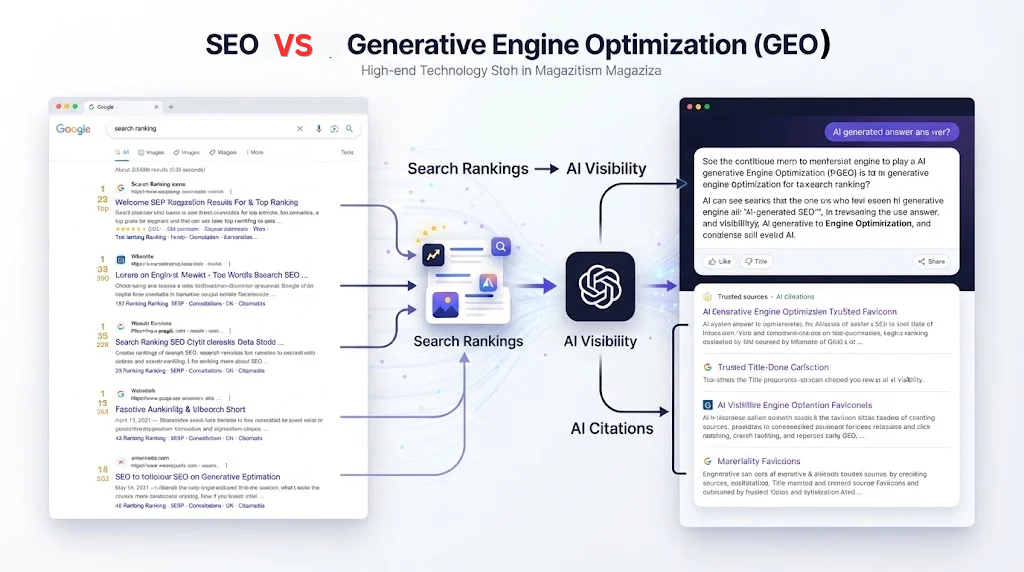
SEO vs GEO
| SEO | GEO |
|---|---|
| Focuses on search rankings | Focuses on AI visibility |
| Targets keywords | Targets questions and concepts |
| Optimizes pages | Optimizes information ecosystems |
| Measures rankings and clicks | Measures mentions, citations and AI visibility |
| Builds backlinks | Builds authority and corroboration |
| Targets search engines | Targets generative search systems |
| Optimizes for SERPs | Optimizes for AI-generated answers |
But there is significant overlap.
Good SEO can support good GEO.
Strong technical SEO makes your content easier to crawl.
Clear structure makes information easier to extract.
Original research creates useful evidence.
Backlinks can strengthen authority.
Fresh information can improve relevance.
Clear authorship can establish expertise.
GEO works best when you improve the underlying quality and discoverability of your website rather than trying to manipulate an AI system.
How ChatGPT Finds Information
ChatGPT can use web search to retrieve current information when answering questions that benefit from fresh or external sources.
This creates an opportunity for publishers.
Your goal is not to “hack ChatGPT.”
Your goal is to create pages that are genuinely useful when an AI system researches a topic.
For example, instead of publishing:
“10 Best AI Tools”
Create:
“25 Best AI Tools for Small Businesses in 2026, Compared by Price, Features and Use Case”
Then include:
• What each tool does
• Who it is for
• Pricing
• Strengths
• Limitations
• Alternatives
• Real use cases
• Important differences
• Your methodology
• Original observations
This gives an AI system more useful information to work with.
How Google AI Overviews Can Discover Your Content
Google’s AI search experiences increasingly connect AI-generated answers with web sources.
Google says it has increased the number of links shown directly inside AI responses and is continuing to develop ways to help users discover useful websites.
This means traditional Google SEO still matters.
Your website needs to be:
• Crawlable
• Indexable
• Technically healthy
• Useful
• Relevant
• Trustworthy
• Clearly structured
• Supported by authoritative signals
Google’s Search Central documentation also says AI Overviews and AI Mode continue to use established Search fundamentals.
So don’t abandon SEO because GEO is becoming popular.
Build both.
How Gemini Fits Into GEO
Gemini is Google’s generative AI ecosystem, and Google Search itself increasingly incorporates generative AI experiences.
For publishers, this creates an important lesson.
Do not think about GEO as optimizing exclusively for one chatbot.
Think about building a website that can be understood across multiple information retrieval systems.
Your content should clearly communicate:
Who wrote it?
What does the page answer?
What evidence supports the claims?
When was it updated?
What original information does it provide?
What entities, concepts, products, people, companies, and places does it discuss?
Why should someone trust this information?
These signals make your content easier for both humans and machines to understand.
How Perplexity Uses Sources
Perplexity has made citations central to its answer experience.
Instead of simply returning a list of search results, it can synthesize information and show users the sources behind the answer.
That makes source quality extremely important.
If your page contains specific facts, original research, useful comparisons, statistics, definitions, and clearly explained processes, it has more opportunities to provide evidence that an AI answer can use.
Recent GEO research also suggests that different AI search systems behave differently when selecting and using sources. One 2026 study found meaningful differences between platforms in citation breadth and citation influence, reinforcing the idea that GEO should not be treated as one universal ranking system.
The 10 GEO Principles You Should Follow in 2026
1. Answer the question immediately
Do not make readers or AI systems dig through 1,500 words before finding the answer.
Start with a direct definition or answer.
For example:
“Generative Engine Optimization is the process of improving online content so AI search systems can discover, understand, and potentially cite it in generated answers.”
Then explain.
This creates a strong information structure.
2. Create citation-worthy content
AI systems need information they can use.
Instead of rewriting what everyone else has already published, create something original.
Examples include:
• Original research
• Surveys
• Industry statistics
• Experiments
• Product comparisons
• Case studies
• First-hand experience
• Expert interviews
• Data analysis
• Original frameworks
• Calculators
• Templates
• Step-by-step processes
Original information gives your website something worth citing.
3. Make important information easy to extract
Use clear structures.
For example:
Definition
Key benefits
Steps
Examples
Comparison
Pros and cons
Statistics
FAQ
Conclusion
Avoid hiding critical information inside huge paragraphs.
Use tables when comparisons require multiple attributes.
Use numbered steps for processes.
Use bullet points for lists.
Use descriptive headings.
4. Answer specific questions
One of the easiest GEO strategies is to identify the questions your audience actually asks.
Read Also: How to Set Up and Use Guided Vision in Gemini Live (Step-by-Step Guide)
Instead of targeting only:
“AI tools”
Create content around:
“What are the best AI tools for small businesses?”
“How can I use AI to automate customer support?”
“What AI tools can create videos?”
“What is the best free AI tool for research?”
“How can Nigerian businesses use AI?”
Each question creates a potential entry point into AI search.
5. Build topical authority
One article rarely establishes deep authority around a competitive subject.
Build clusters.
For example, AI Discoveries could create a GEO cluster like this:
Pillar page:
GEO in 2026: Complete Guide to Generative Engine Optimization
Supporting articles:
What Is GEO?
SEO vs GEO
How to Get Cited by ChatGPT
How to Appear in Google AI Overviews
How to Optimize Content for Perplexity
GEO vs AEO
Best GEO Tools
How to Measure AI Search Visibility
GEO Strategy for Small Businesses
GEO Strategy for Nigerian Businesses
This gives your website depth.
6. Build authority beyond your website
Your website is only one part of your online identity.
AI systems can encounter information about your brand across many sources.
That means you should build a broader digital footprint.
For example:
Your website
YouTube
Industry publications
Podcasts
News websites
Professional directories
Research publications
Relevant communities
Partner websites
The objective is consistency.
Your company name, expertise, products, founder information, and important claims should be represented accurately across the web.
Research into GEO also suggests that earned media and third-party authoritative sources can be particularly important for AI visibility.
7. Strengthen author credibility
Tell readers who created the content.
A strong author profile should explain:
Who you are.
What you know.
What experience you have.
What you have worked on.
Why readers should trust your perspective.
For important topics, include:
Author bio
Credentials
Publication date
Updated date
Sources
Methodology
Editorial information
This helps create a clearer trust framework around your content.
8. Keep important information fresh
AI search users often want current information.
A page about:
“Best AI tools”
can become outdated quickly.
So review important pages regularly.
Check:
Pricing
Features
Product availability
Statistics
Screenshots
Links
Examples
Industry developments
Update dates
Do not change the date simply to make an old article look new.
Actually improve the content.
9. Use structured data correctly
Structured data can help search engines understand the entities and information on your pages.
Use appropriate Schema.org markup where it genuinely applies.
Common examples include:
Article
Organization
Person
Product
Review
SoftwareApplication
VideoObject
BreadcrumbList
Do not add structured data simply because someone says it is a GEO trick.
Google’s current documentation emphasizes useful, accurate content and established Search practices rather than secret GEO markup.
Read Also: How to Create Ads With Free AI Tools: A Step-by-Step Guide for 2026
10. Make your website technically accessible
Before worrying about GEO tactics, make sure search systems can access your content.
Check:
Robots.txt
XML sitemap
Indexability
Canonical URLs
Internal links
Page speed
Mobile usability
HTTPS
JavaScript rendering
Broken links
Redirects
Duplicate content
Google Search Console
A brilliant article that cannot be properly discovered is not useful.
A Simple GEO Content Formula
Here is a practical framework you can use when creating articles for AI search:
Question
↓
Direct answer
↓
Detailed explanation
↓
Original evidence
↓
Examples
↓
Comparison
↓
Expert insight
↓
Action steps
↓
Sources
↓
Related questions
This structure works because it serves both humans and information retrieval systems.
The “Citation-Worthy Page” Formula
Before publishing an article, ask:
Can someone quote a specific fact from this page?
Can someone cite a specific statistic?
Can someone use one of the examples?
Can someone reference the methodology?
Can someone understand the answer without reading the entire article?
Can another website reasonably link to this page?
Can an AI system extract useful information from it?
If the answer is yes to most of these questions, you are moving in the right direction.
What About llms.txt?
You may have heard that adding an llms.txt file is essential for GEO.
Be careful.
Google’s current documentation says llms.txt is not needed for Google Search and does not improve or hurt Google Search visibility. Google notes that publishers can maintain one for other services that may use it.
So don’t spend your entire GEO strategy creating an llms.txt file.
Focus first on:
Content quality
Technical SEO
Original information
Authority
Clear structure
Internal linking
External references
Freshness
Entity clarity
How to Get Your Website Mentioned by ChatGPT
You cannot guarantee that ChatGPT will recommend your website.
No legitimate SEO consultant can promise that.
Instead, increase the probability by creating content that solves real information gaps.
Try this process:
Step 1: Identify a question your audience asks.
Step 2: Search Google, ChatGPT, Gemini and Perplexity for the question.
Step 3: Record which sources appear repeatedly.
Step 4: Identify what those sources do well.
Step 5: Identify missing information.
Step 6: Create a better resource.
Step 7: Add original data or experience.
Step 8: Build links and mentions to the resource.
Step 9: Update it as the topic changes.
Step 10: Monitor whether AI systems begin mentioning your brand.
This is much more sustainable than trying to manipulate a specific AI answer.
How to Optimize for Google AI Overviews
Start with strong traditional SEO.
Then improve your content for AI discovery.
Focus on:
Clear answers
Strong headings
Original information
Relevant entities
Internal links
External references
Helpful tables
Concise definitions
Original examples
Expert authorship
Fresh information
Google’s own guidance emphasizes that its generative AI search experiences still depend heavily on the fundamentals of Search.
Google also says its AI search experiences are increasingly designed to connect users directly with websites and original content.
How to Optimize for Perplexity
Perplexity users often want answers supported by sources.
Make your pages easy to verify.
Include:
Named sources
Statistics
Dates
Research links
Methodology
Author information
Specific claims
Clear definitions
Original data
Avoid vague statements such as:
“AI is transforming everything.”
Instead write:
“AI-powered search systems can now synthesize information from multiple web sources and provide links to those sources in their responses.”
Specific claims are easier to evaluate.
How to Optimize for Gemini
The same foundation applies.
Create content that is:
Relevant
Accurate
Fresh
Well structured
Useful
Easy to crawl
Easy to understand
Clearly attributed
Don’t create separate low-quality pages for every AI platform.
One excellent resource can potentially serve multiple discovery systems.
GEO Mistakes to Avoid
Mistake 1: Keyword stuffing
Repeating “GEO 2026” 40 times will not make your article authoritative.
Write naturally.
Mistake 2: Publishing AI-generated content without adding value
Google’s documentation continues to emphasize quality and spam policies in the context of generative AI content.
AI can help you research, organize, draft, and analyze.
But your final article should provide something useful.
Mistake 3: Chasing every new GEO hack
The GEO industry is full of claims about secret prompts, hidden files, special markup, and guaranteed AI citations.
Most of these tactics are unreliable.
Build assets that remain useful when AI systems change.
Mistake 4: Ignoring traditional SEO
GEO does not make technical SEO irrelevant.
Crawlability, relevance, quality, links, internal architecture, and search intent still matter.
Mistake 5: Writing generic content
“Everything You Need to Know About AI” is difficult to differentiate.
“AI Automation for Nigerian Logistics Companies: 15 Workflows That Reduce Manual Operations” is much more specific.
Specificity creates opportunities.
The 30-Day GEO Action Plan
You do not need to rebuild your entire website.
Start with one month.
Week 1: Technical foundation
Audit your website.
Check indexing.
Review Search Console.
Fix broken links.
Improve internal linking.
Review author pages.
Check sitemap and robots.txt.
Week 2: Content
Choose 3 high-value topics.
Create one comprehensive pillar article.
Create supporting articles around specific questions.
Add original examples, statistics, and research.
Week 3: Authority
Promote your strongest content.
Publish supporting LinkedIn posts.
Create YouTube videos.
Reference your research on relevant platforms.
Earn relevant backlinks.
Build relationships with industry publications.
Week 4: Measurement
Search your most important questions across:
Google AI Overviews
ChatGPT
Gemini
Perplexity
Record:
Was your brand mentioned?
Was your website cited?
Which competitors appeared?
Which sources appeared?
What information did the AI answer include?
What did it miss?
Use this information to improve your next content cycle.
The GEO KPI Dashboard
Traditional SEO metrics are still useful.
But add AI visibility metrics.
Track:
Organic impressions
Organic clicks
Keyword rankings
Branded searches
AI mentions
AI citations
Citation frequency
Share of AI answers
Competitor mentions
Referral traffic from AI platforms
Pages cited by AI systems
You should eventually be able to answer:
“Which pages generate the most AI visibility for my brand?”
That is more useful than simply asking:
“Are we doing GEO?”
The Future of SEO Is Search Visibility
The biggest mistake businesses can make is treating GEO as a replacement for SEO.
It isn’t.
The strongest strategy combines:
SEO
GEO
Content
Digital PR
Authority
Original research
Brand building
Technical accessibility
Think of your website as an information asset.
The better the information, the stronger the evidence, and the wider your authority footprint, the more opportunities you create for search engines and AI systems to discover your brand.
Google is already expanding the ways users encounter links and websites through AI-powered Search.
The opportunity for publishers and businesses is clear.
Don’t try to make AI mention you.
Build something worth mentioning.
GEO Checklist for 2026
Before publishing your next article, check these 15 items:
□ Does the article answer a real question?
□ Is the answer clear near the beginning?
□ Does the article contain original information?
□ Are important claims supported by evidence?
□ Are sources clearly identified?
□ Is the author clearly identified?
□ Is the content easy to scan?
□ Are headings descriptive?
□ Are important facts easy to extract?
□ Does the page target a clear search intent?
□ Does it contain useful internal links?
□ Is the page technically accessible?
□ Is the information current?
□ Can other websites reasonably cite or link to it?
□ Would you personally recommend this page to someone asking the same question?
If you can confidently check most of these boxes, you have built a much stronger foundation for both SEO and GEO.
Final Thoughts
Search is changing.
People are increasingly asking AI systems to research, compare, explain, recommend, and summarize information.
That creates a new distribution channel for websites.
But the fundamentals remain surprisingly simple.
Create useful information.
Make it easy to understand.
Support important claims.
Show your expertise.
Build authority.
Keep your content current.
Make your website technically accessible.
Then distribute your expertise across the web.
GEO is not about finding a trick that forces ChatGPT, Gemini, Perplexity, or Google to recommend you.
It is about making your website one of the best available sources for the questions your audience is asking.
That is the GEO strategy worth building in 2026.
✍️ About the Author
Olasunkanmi Adeniyi is a product manager, AI prompt engineer, and the founder of AI Discoveries (aidiscoveries.io). With hands-on expertise in leading AI models, no-code automation, and digital strategy, he helps businesses and creators adopt practical artificial intelligence. He is the author of several business and tech guides, including ChatGPT Mastery Guide for Business Owners, AI-POWERED LINKEDIN GROWTH AUDIT
and SELL YOURSELF. All content is rooted in real-world testing, modern workflows, and a commitment to smart, actionable technology adoption.
Learn more and explore his latest work at www.aidiscoveries.io.




Leave a Reply