OpenAI has released 722 mathematical manuscripts generated by an internal AI model that the company has not yet released publicly.
The collection, published on October 6, 2026, contains work spanning hundreds of difficult mathematical problems. OpenAI says the manuscripts were produced during an internal evaluation in which the model was presented with approximately 4,000 open research problems. The result was published in OpenAI Repositry
The results are organized into 372 research families, covering areas including number theory, theoretical computer science, geometry, algebra, mathematical physics, probability and analysis.
Read Also: 50 Powerful AI Websites You Should Bookmark in 2026
OpenAI has also released supporting materials, including Lean formalizations for many proofs, selected summaries of the model’s reasoning, information about computational resources and the source files for the manuscripts.
The release is significant for a simple reason: AI is moving beyond solving textbook-style mathematics and increasingly attempting problems that mathematicians themselves consider open research questions.
But there is an important distinction.
722 manuscripts does not mean 722 independently verified mathematical breakthroughs.
OpenAI itself says the collection contains results at different stages of verification, and some manuscripts do not yet have formal Lean proofs. The company also acknowledges that some unformalized results could contain errors.
- What exactly did OpenAI release?
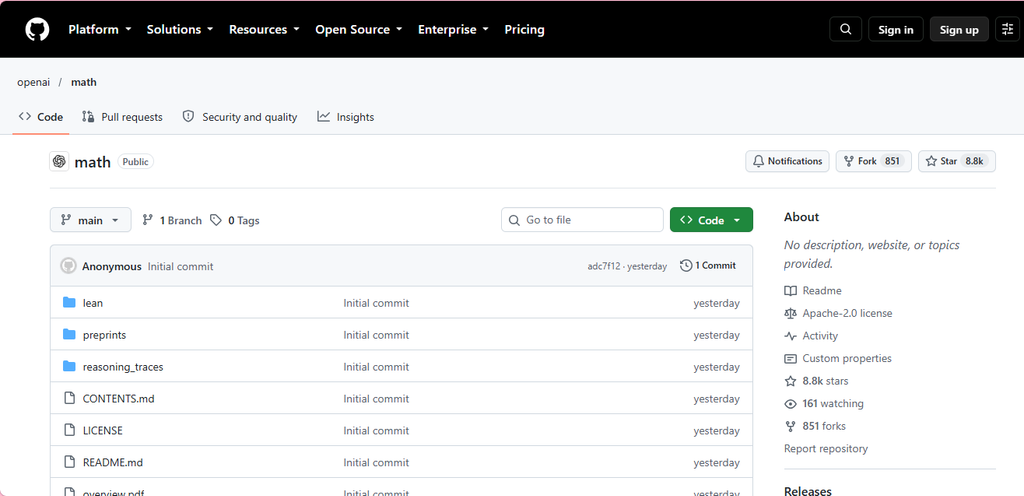
OpenAI published the research in a public GitHub repository called OpenAI Math.
The repository currently contains:
722 mathematical manuscripts
372 result families
Approximately 4,000 problems posed to the model
Lean formalizations for many of the results
Selected summaries of the model’s reasoning
PDFs and source files for individual manuscripts
Citation information and revision history
The 372 result families are important because the 722 manuscripts are not equivalent to 722 completely unrelated discoveries.
A single family can contain a principal result, companion arguments, consequences or alternative proofs. This means the headline number should be understood as the size of the manuscript collection, rather than the number of separate mathematical discoveries.
How did the AI model produce the results?
OpenAI says the vast majority of the results came from the same internal procedure.
The company gave an unreleased internal model approximately 4,000 mathematical research problems.
The model then attempted to solve them.
OpenAI says each result used an average of roughly three hours of ChatGPT Pro thinking compute with the internal model.
The company then selected significant outputs and organized them into research families and manuscripts.
That process produced the 722-manuscript collection now available publicly.
The model itself has not been released
This may be the most interesting part of the announcement.
OpenAI has published the mathematical outputs, but it has not released the model that generated them.
The company describes it as an internal frontier model and says it is working toward responsibly releasing the model that produced these results.
That means researchers can inspect many of the mathematical arguments without having direct access to the system that generated them.
Read Aslo: Lagos Life Game: How to Play the Viral Nigerian Game Everyone Is Talking About
This creates an unusual situation.
The scientific community can examine the output, but it cannot independently reproduce the original discovery process using the same model.
For AI research, that distinction matters because reproducibility is an important part of establishing whether a result is reliable.
What kinds of mathematics are included?
The collection covers a surprisingly broad range of mathematics.
OpenAI’s research catalog includes results in number theory, theoretical computer science, geometry and topology, algebra, analysis, probability, mathematical physics and other areas.
Some of the listed results are particularly ambitious.
The catalog includes work on the quasi-Riemann hypothesis, Hilbert’s tenth problem over the rational numbers, the Unique Games Conjecture, Erdős-related problems, the Mahler conjectures and problems involving mathematical physics.
The repository also highlights results such as:
The irrationality exponent of π
Symmetric and general Mahler conjectures
Quasipolynomial bounds for arithmetic progressions
Kaplansky’s direct-finiteness conjecture
The Mézard–Parisi formula for diluted spin glasses
Spontaneous magnetization in the quantum Heisenberg ferromagnet
Isomorphism of free group factors
The three-dimensional relativistic Vlasov–Maxwell system
These are research-level mathematical questions, not ordinary arithmetic exercises.
OpenAI’s catalog even lists a result claiming to prove the Unique Games Conjecture, a major problem in theoretical computer science. It also lists a result concerning the quasi-Riemann hypothesis and another concerning Hilbert’s tenth problem over the rational numbers.
Why Lean formalization matters
One of the strongest aspects of the release is the inclusion of formal mathematical proofs.
OpenAI is using Lean, a programming language and proof assistant that allows mathematical arguments to be checked computationally.
This matters because a conventional AI-generated proof can look convincing while containing a subtle logical mistake.
A formal proof gives researchers a much stronger way to test whether the argument follows from the specified mathematical foundations.
However, formal verification and human understanding are different things.
A computer may verify that a proof follows from a set of formal assumptions without explaining why the result matters, how the key idea was discovered or how the result connects to the broader mathematical literature.
OpenAI acknowledges that not every manuscript has yet been formalized. The company says it plans to continue adding Lean formalizations as they become available.
This is why the 722 manuscripts should be viewed as a research corpus that is now open for examination, rather than 722 finished discoveries that have already passed full academic review.
OpenAI had already reported a major mathematical breakthrough
The October release did not come out of nowhere.
In September, OpenAI announced that an internal system had produced a proposed solution to the Navier–Stokes existence and smoothness problem, one of the famous Millennium Prize Problems.
OpenAI said its system produced a proof showing that three-dimensional fluid dynamics can develop a singularity in finite time. The company released both a written proof and a Lean formalization.
OpenAI said the system used for the Navier–Stokes result was significantly more capable than GPT-6 Astra.
The company also said it did not intend to claim the Millennium Prize for the result.
That earlier announcement helped establish the context for the much larger mathematics release that followed.
OpenAI’s internal model had already reportedly resolved more than 100 long-standing open problems across mathematics, according to an earlier company announcement.
Why OpenAI is releasing the research now
OpenAI says it wants to make AI-generated mathematical progress more useful to researchers.
Instead of keeping the results inside the company, it has published the manuscripts, formal proof artifacts and additional information about how the results were generated.
The company says the repository includes protocols for revisions and citations. It also plans to improve future releases by strengthening mathematical exposition, citations and presentation.
OpenAI also says it plans to fund workshops, conferences and special programs focused on understanding major results produced by AI.
That suggests the company sees AI-generated mathematics becoming a new research category rather than simply another benchmark for AI models.
Why mathematicians are concerned
The excitement around these results comes with serious questions.
Mathematics depends heavily on verification, attribution and human understanding.
When an AI system produces hundreds of research-level results faster than a traditional research community can evaluate them, the bottleneck changes.
The problem is no longer simply whether AI can generate mathematical ideas.
It becomes whether humans can verify, understand, explain and build on those ideas quickly enough.
The Institute for Advanced Study has hosted an independent Advisory Group on Mathematics and Artificial Intelligence that has been advising on how AI-generated mathematical results should be handled.
The group includes prominent mathematicians from institutions including Stanford, Harvard, Oxford, Cambridge and the Institute for Advanced Study.
The group was formed partly because mathematicians have raised concerns about AI companies using difficult open problems as capability benchmarks and then publishing results outside traditional academic processes.
The central concern is straightforward.
If private AI laboratories can use proprietary models to solve important mathematical problems before independent researchers can access those systems, the field could develop an imbalance between the companies building the models and the researchers trying to understand their discoveries.
That is one reason the verification process surrounding the 722 manuscripts may ultimately be as important as the results themselves.
AI may be changing the speed of mathematical discovery
For decades, mathematical progress depended primarily on human researchers working through ideas, proofs, counterexamples and calculations.
AI introduces a different possibility.
A model can explore thousands of potential approaches, discard failed strategies and continue reasoning without the same time constraints as an individual researcher.
The OpenAI release provides a large-scale example of what that could look like.
Approximately 4,000 problems were presented to an internal model.
The resulting work was then filtered into hundreds of research results and manuscripts.
Even if a portion of the manuscripts ultimately turns out to be incorrect, incomplete or less significant than initially believed, the scale of the experiment is notable.
The role of the mathematician may therefore change.
Instead of spending all of their time searching for a proof from scratch, mathematicians could increasingly spend time selecting promising problems, directing AI systems, checking arguments, formalizing proofs, identifying hidden assumptions and developing the ideas into useful mathematics.
OpenAI’s own academic research initiative points in this direction. The company has been expanding access to its frontier models for scientists, mathematicians and engineers, arguing that researchers should be able to use AI as a research tool while remaining in control of their work.
What the 722 manuscripts do not prove
It is tempting to interpret the announcement as proof that AI has solved mathematics.
That would be premature.
The release demonstrates that an internal AI system can generate a very large volume of sophisticated mathematical research output.
It does not establish that every manuscript is correct.
It does not mean every result represents a completely new mathematical discovery.
It does not mean mathematicians have independently verified the entire collection.
It does not mean AI can autonomously replace mathematicians.
And it does not mean the unreleased model is available for public use.
OpenAI explicitly says the manuscripts exist at different stages of verification and that some unformalized results may contain issues.
The correct question is therefore not “Did AI solve 722 math problems?”
A better question is:
How many of these results survive independent mathematical scrutiny, and what new mathematics becomes possible once researchers understand them?
That answer will take time.
Why this matters beyond mathematics
The implications extend far beyond pure mathematics.
Advanced mathematical reasoning is closely connected to computer science, cryptography, physics, engineering and scientific research.
If AI systems become significantly better at generating and verifying difficult mathematical arguments, they could help researchers make progress in fields where mathematical complexity currently limits discovery.
Read Also: How to Generate 100 Videos Per Day With Free AI Video Tool – There’s An AI For That
This could affect areas such as:
Algorithm design
Cryptography
Optimization
Physics
Engineering
Machine learning theory
Computer science
Financial mathematics
Scientific simulation
The potential value is therefore much larger than the mathematics community alone.
OpenAI has already positioned advanced AI research tools as a way to accelerate scientific discovery across disciplines. Its academic researcher program aims to provide frontier AI access to scientists, mathematicians and engineers while giving researchers control over how they use the systems.
The bigger AI race may be about discovery
The most important takeaway from OpenAI’s 722-manuscript release may not be any individual theorem.
It is the direction of AI development.
AI companies increasingly want their models to do more than generate text, write code or answer questions.
They want models that can conduct research.
That means identifying problems, developing hypotheses, exploring possible solutions, producing technical arguments, writing code, checking results and contributing to scientific knowledge.
The 722 manuscripts offer one of the clearest demonstrations yet of what that research-oriented AI workflow could look like.
But the next stage will require something AI companies cannot easily automate away.
Human judgment.
Researchers still need to determine which results matter, which proofs are correct, which assumptions are reasonable, which discoveries are genuinely new and how the findings should influence future research.
The future of AI-powered mathematics may therefore be less about humans versus machines and more about how effectively researchers can work with increasingly capable systems.
What happens next?
The immediate task is verification.
Mathematicians and computer scientists now have access to the manuscripts, source files and many formal proof artifacts.
Researchers can inspect the arguments, test the formalizations, compare the claims against existing literature and attempt to extend the results.
OpenAI says it will continue updating the repository with additional Lean formalizations and corrections. Earlier versions will remain accessible so that the development of individual manuscripts can be tracked.
That makes the repository particularly interesting.
The real story may not be the initial 722 manuscripts.
It may be what happens after thousands of researchers begin testing them.
Some results may fail.
Some may require corrections.
Some may turn out to be rediscoveries or variations of existing work.
Others could survive scrutiny and become important pieces of mathematical research.
If even a small fraction leads to genuinely new mathematics, the release could become an important milestone in the history of AI-assisted scientific discovery.
Final thoughts
OpenAI’s release of 722 mathematical manuscripts marks a significant shift in the conversation around AI.
The question is no longer simply whether an AI model can solve difficult mathematical problems.
The more important question is whether AI can become a reliable partner in the process of scientific discovery.
OpenAI has provided an unusually large public dataset for researchers to investigate that question.
The numbers are striking: 722 manuscripts, 372 research families, approximately 4,000 attempted problems and an average of about three hours of thinking compute per result.
But the number that ultimately matters is not 722.
It is the number of results that withstand independent verification and contribute something genuinely new to mathematics.
For now, the manuscripts are an invitation to investigate.
The next chapter will be written by the mathematicians who test them.
Where to explore the research
OpenAI’s official announcement explains how the company produced and released the results.
The public OpenAI Math repository contains the 722 manuscripts, source files, research catalog, Lean formalizations and selected reasoning summaries.
Readers interested in AI, mathematics and scientific discovery can use the repository as a starting point for following how these claims develop as researchers examine them.
✍️ About the Author
Olasunkanmi Adeniyi is a product manager, AI prompt engineer, and the founder of AI Discoveries (aidiscoveries.io). With hands-on expertise in leading AI models, no-code automation, and digital strategy, he helps businesses and creators adopt practical artificial intelligence. He is the author of several business and tech guides, including ChatGPT Mastery Guide for Business Owners, AI-POWERED LINKEDIN GROWTH AUDIT
and SELL YOURSELF. All content is rooted in real-world testing, modern workflows, and a commitment to smart, actionable technology adoption.
Learn more and explore his latest work at www.aidiscoveries.io.





Leave a Reply