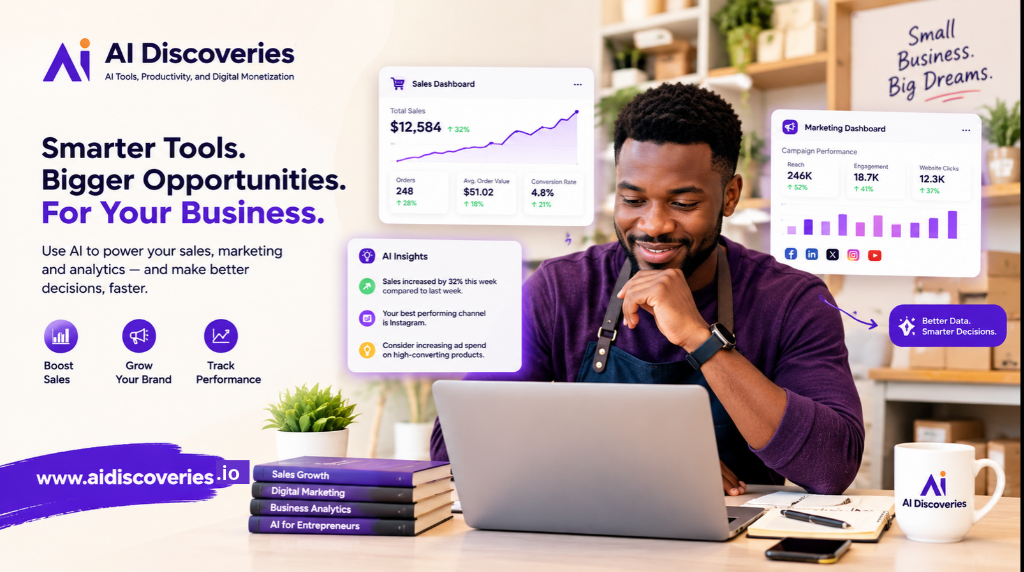
Small businesses can use artificial intelligence (AI) to attract more customers, increase sales conversions, improve customer retention, and grow revenue without proportionally increasing operating costs.
In 2026, AI tools can help small business owners identify potential customers, create targeted marketing campaigns, automate customer support, personalize offers, optimize pricing, recover lost sales, and analyze business performance.
You do not need a large technology budget or an in-house development team to get started. Many businesses can begin with an AI assistant, a spreadsheet, and a simple workflow.
The key is to connect AI to a measurable business goal.
In this guide, you will discover seven practical ways to use AI to increase small business revenue in 2026, the tools you can use, and sample prompts you can copy and adapt to your business.
What Is AI-Powered Revenue Growth?
AI-powered revenue growth is the use of artificial intelligence to improve the activities that generate income, including marketing, sales, customer service, pricing, and customer retention.
For example, an online store can use AI to recommend relevant products. A consulting business can use AI to research prospective clients. A local service provider can use an AI assistant to respond to inquiries and follow up with potential customers.
AI does not guarantee higher revenue. Results depend on customer demand, the quality of your offer, implementation, and your ability to measure performance.
1. Use AI to Generate More Qualified Sales Leads
Finding potential customers is one of the biggest challenges for small businesses. Traditional prospecting can require hours of research, manual data entry, and repetitive messaging.
AI can help you define your ideal customer, research suitable prospects using available information, identify potential customer needs, and prepare personalized outreach messages.
How to implement this strategy
- Define your ideal customer profile, including industry, location, business size, and common challenges.
- Find relevant prospects through professional networks, business directories, and your existing customer database.
- Use AI to organize prospect information and prioritize businesses that match your criteria.
- Prepare personalized outreach messages.
- Track replies, meetings booked, and sales won.
Sample AI prompt: Find your ideal customers
Copy this prompt into ChatGPT or Claude and replace the information in brackets.
Prompt:
Act as an experienced B2B sales strategist.
My business sells [describe your product or service]. We help customers solve [describe the problem you solve].
My target market is [industry, location, company size, or customer type].
My average selling price is [amount], and my main competitive advantage is [describe your advantage].
Help me define my ideal customer profile by identifying:
- The five customer segments most likely to buy from me.
- The problems these customers urgently need to solve.
- The signs that indicate a business may need my solution.
- The decision-makers I should contact.
- The best channels for finding these customers.
- Five personalized outreach angles that focus on customer problems rather than generic sales pitches.
Do not invent real company names, contact details, or evidence. Separate assumptions from facts and recommend practical ways to validate the opportunities.
AI tools to consider
- ChatGPT for customer research and sales planning.
- Claude for analyzing prospect information and creating structured workflows.
- HubSpot for organizing leads and managing the sales pipeline.
Practical example
A small digital marketing agency wants to work with independent healthcare providers. Instead of sending the same message to 200 businesses, the agency researches relevant prospects and prepares tailored messages based on each business’s services and publicly visible marketing gaps.
The agency can focus its time on qualified prospects and meaningful conversations.
Revenue opportunity: More qualified sales conversations can create more opportunities to win customers without increasing prospecting hours at the same rate.
2. Automate Customer Support to Capture More Sales
Customers often ask questions before buying. They may want to know your prices, delivery times, payment methods, return policies, or product features.
When those questions go unanswered, potential customers may choose a competitor.
AI-assisted customer support can help businesses answer common questions, recommend relevant products, collect inquiry details, and direct customers to the next step.
How to implement this strategy
Start by documenting your frequently asked questions, pricing, product details, service descriptions, delivery information, and business policies.
Use this information to configure a chatbot or customer support assistant. Set clear rules for when the assistant should answer, when it should request more information, and when it should refer a question to a human.
Sample AI prompt: Build a customer support assistant
Prompt:
Act as a customer support specialist for my business.
Business name: [business name]
What we sell: [products or services]
Target customers: [customer type]
Pricing: [prices or pricing rules]
Business hours: [hours]
Delivery or service area: [locations]
Frequently asked questions: [insert questions and answers]
Create a customer support assistant that helps customers understand our products, services, prices, policies, and ordering process.
Follow these rules:
- Give short, friendly, clear answers.
- Use only the business information I provide.
- Never invent prices, delivery times, guarantees, or policies.
- Ask a clarifying question when customer requirements are unclear.
- Recommend a suitable product or service only when the information supports the recommendation.
- Direct customers to [website, booking page, or contact channel] when they are ready to buy.
- Escalate complaints, unusual requests, refunds, and questions you cannot answer to a human representative.
Provide 15 realistic customer questions and suitable responses. Then identify any missing information needed to make the assistant reliable.
AI tools to consider
- Tidio for AI-assisted customer service and chatbot workflows.
- Intercom for customer support automation.
- WhatsApp Business with a suitable chatbot or automation integration for businesses that receive inquiries through WhatsApp.
Check current pricing, available features, integrations, and regional availability before selecting a platform.
Practical example
A Nigerian logistics company receives daily WhatsApp inquiries about local deliveries and international shipping. An AI-assisted workflow answers common questions, collects package details and destination information, and directs customers to the correct quotation process.
Staff members can focus on complex shipments and closing orders.
Revenue opportunity: Faster responses can reduce lost inquiries and help convert more prospects into paying customers.
3. Create Better Marketing Content in Less Time
Small businesses need consistent marketing to attract customers. However, creating blog articles, social media posts, email campaigns, product descriptions, and advertisements can consume valuable time.
Generative AI can help you develop campaign ideas, write first drafts, repurpose content, and adapt messages for different audiences.
The goal is to publish useful content that attracts the right customers and encourages them to take action.
How to implement this strategy
Choose one customer problem and one business objective. Build a content campaign around them.
For example, a business selling accounting services to small companies could publish a blog post about bookkeeping mistakes, turn it into LinkedIn posts, create a short educational video, and send an email offering a free bookkeeping checklist.
Sample AI prompt: Create a revenue-focused content campaign
Prompt:
Act as a content marketing strategist who specializes in helping small businesses generate qualified leads and sales.
My business: [business name and description]
My target audience: [describe your ideal customers]
My main offer: [product or service]
My audience’s biggest problem: [describe the problem]
My main marketing channel: [LinkedIn, Instagram, Facebook, YouTube, blog, or email]
My campaign goal: [website visits, qualified leads, bookings, or sales]
Develop a seven-day content campaign that attracts relevant prospects and moves them toward purchasing my offer.
For each day, provide:
- The content topic and opening hook.
- The complete draft.
- A practical tip, example, or insight.
- A natural call to action.
- The customer problem the content addresses.
- The stage of the buying journey it supports.
Avoid generic advice, exaggerated claims, fabricated statistics, and repetitive promotional posts. Use simple language and include realistic examples relevant to my industry.
Recommend one performance metric for each content type so I can evaluate its contribution to business growth.
AI tools to consider
- ChatGPT for campaign planning, writing, and repurposing content.
- Canva for AI-assisted marketing visuals.
- Grammarly for editing and improving clarity.
- Google Analytics for measuring website engagement and conversions.
Practical example
A small business owner publishes one detailed article answering a common customer question. AI helps transform it into five social posts, an email newsletter, and a short video script.
One research effort now supports several marketing channels.
Revenue opportunity: Consistent, relevant content can increase qualified traffic, generate inquiries, and support sales without requiring a large marketing team.
4. Personalize Offers and Product Recommendations
Customers are more likely to consider offers that match their needs, budgets, and interests.
AI can help businesses organize customer information, identify purchasing patterns, group audiences into useful segments, and recommend relevant products or services.
This strategy is useful for online stores, subscription businesses, training providers, professional services, and companies with repeat customers.
How to implement this strategy
Start with information you already collect appropriately, such as previous purchases, product categories, inquiry history, and customer preferences.
Identify customer groups with different needs. Then create offers and messages that match each group’s interests.
For example, you could prepare different campaigns for new customers, repeat buyers, customers who have not purchased recently, and prospects who requested a quotation.
Sample AI prompt: Create personalized offers
Prompt:
Act as an e-commerce growth strategist.
My business sells [products or services] to [target audience].
Our main products or service packages are:
[Insert product names, prices, costs if available, and descriptions.]
Our typical customers include:
[Describe your main customer groups.]
Using only the information provided, identify five opportunities to increase average order value and encourage repeat purchases.
For each opportunity, explain:
- The customer segment it targets.
- The customer’s likely need.
- The recommended offer, bundle, or complementary product.
- A sample promotional message.
- The best channel for presenting the offer.
- The metric to track, such as average order value, repeat purchase rate, or gross profit per customer.
- Any risks, such as unnecessary discounting or unsuitable recommendations.
Do not assume customer preferences that are not supported by the data. Clearly label hypotheses that require testing.
Prioritize offers that create genuine customer value and protect profitability.
AI tools to consider
- HubSpot for CRM-based customer segmentation.
- Klaviyo for e-commerce email marketing.
- Shopify features and compatible apps for product recommendations and store marketing.
Practical example
A skincare retailer notices that customers often buy cleansers but rarely purchase complementary moisturizers. The business tests a relevant product recommendation at checkout and through follow-up emails.
It compares average order value and gross profit per customer before and after the change.
Revenue opportunity: Relevant recommendations can increase average order value and encourage repeat purchases when they match genuine customer needs.
5. Use AI to Improve Pricing and Increase Average Order Value
Many small businesses set prices by copying competitors or adding a simple markup to costs. This approach can overlook customer willingness to pay, differences in service value, and the profitability of individual products.
AI can help analyze sales records, costs, customer feedback, and competitor information to support better pricing decisions.
It can also help businesses explore service bundles, compare package profitability, and identify opportunities for relevant add-ons.
How to implement this strategy
Collect your product or service costs, selling prices, sales volumes, discounts, and gross profit margins.
Use AI to organize the information and explore possible improvements. Verify all calculations in a spreadsheet or accounting system.
Consider introducing different service tiers, bundling complementary products, offering relevant add-ons, or testing prices with appropriate customer groups.
Sample AI prompt: Analyze your pricing and profit margins
Prompt:
Act as a pricing strategist for a small business.
My business sells [products or services].
Here is my current pricing and cost information:
[Insert product or service name, selling price, direct costs, sales volume, and other relevant expenses.]
My target customers are [customer type], and my main competitors are [competitors, if known].
Analyze the information I provide and help me identify ways to improve profitability.
Please:
- Calculate gross profit per item or service where the data allows.
- Calculate gross margin percentages.
- Identify products or services with low margins.
- Suggest three possible bundles or premium packages.
- Explain which complementary products or add-ons customers may find useful.
- Model three pricing scenarios and show their assumptions.
- Identify information I still need before changing prices.
Do not invent competitor prices, customer willingness to pay, or missing cost figures. Clearly distinguish calculations from estimates.
Recommend small, measurable tests before implementing major price changes.
AI tools to consider
- ChatGPT or Claude for analyzing suitable sales data and exploring scenarios.
- Microsoft Excel or Google Sheets for calculations.
- Your accounting or e-commerce platform for verified financial figures.
Practical example
A cleaning business introduces a premium package that includes deep cleaning, window cleaning, and priority scheduling. It tests demand and calculates the additional labor and material costs before deciding whether to expand the offer.
Revenue opportunity: Better pricing and profitable bundles can increase revenue per transaction. Track gross profit as well as sales.
6. Automate Follow-Ups to Recover Lost Sales
Many potential sales disappear because businesses fail to follow up. A prospect requests a quotation, a customer abandons a shopping cart, or someone expresses interest but never completes a purchase.
AI-assisted automation can help businesses draft relevant messages, create reminders, and trigger follow-ups based on customer activity.
How to implement this strategy
Map your sales process from the first inquiry to the completed purchase.
Identify where customers commonly stop responding. Then create a workflow that assigns the next action.
For example, when a prospect requests a quotation, your system can record the inquiry, assign a responsible team member, and create a reminder if the prospect has not responded after an appropriate interval.
You can use similar workflows for abandoned carts, renewal reminders, appointment confirmations, and post-purchase offers.
Sample AI prompt: Build a sales follow-up sequence
Prompt:
Act as a sales conversion specialist.
My business sells [product or service] to [target audience].
My average order value is [amount].
Customers usually contact us through [WhatsApp, email, website, phone, or social media].
Our sales process is [describe the current process].
The most common reasons prospects do not buy are [list known objections, or state that the reasons are unknown].
Create a five-message follow-up sequence for prospects who have requested information or a quotation but have not yet purchased.
For each message, provide:
- The recommended timing.
- The complete message.
- Its purpose.
- A helpful response to a common objection.
- A clear but non-aggressive next step.
- Conditions under which the message should not be sent.
Keep the messages personal, concise, and focused on the customer’s needs. Do not use fake urgency, invented testimonials, or misleading discounts.
Include a process for stopping follow-ups when a customer declines, opts out, or completes a purchase. Respect applicable marketing consent and privacy requirements.
AI tools to consider
- Make for connecting apps and automating workflows.
- Zapier for app integrations and trigger-based automation.
- n8n for customizable workflows, including self-hosted deployments.
- HubSpot for sales pipeline management and available automation features.
Practical example
A consulting firm receives 30 quotation requests each month but frequently forgets to follow up with prospects. It introduces automated reminders and a structured follow-up sequence.
The firm tracks responses, new sales, and gross profit from converted prospects.
Revenue opportunity: Consistent follow-ups can recover opportunities that would otherwise be lost and reduce time spent managing reminders.
7. Use AI Analytics to Identify Your Most Profitable Growth Opportunities
More traffic, more leads, and more sales do not always mean a healthier business. A company can increase revenue while losing money through excessive discounts, expensive advertising, inefficient fulfillment, or low-margin products.
AI analytics can help business owners understand what drives profitable growth and where to focus limited resources.
How to implement this strategy
Bring together the business metrics that matter most:
- Website visitors and conversion rates.
- Leads generated and sales conversion rates.
- Average order value.
- Customer acquisition cost.
- Gross profit margin.
- Repeat purchase rate.
- Customer retention.
- Revenue by product, service, or marketing channel.
Use a spreadsheet, analytics platform, or AI-enabled business intelligence tool to identify patterns and investigate specific questions.
Sample AI prompt: Find your biggest revenue opportunities
Prompt:
Act as a business analyst who specializes in helping small businesses improve revenue and profitability.
My business operates in [industry] and serves [target audience].
I will provide business data covering [time period].
The data may include revenue, sales volume, costs, leads, conversion rates, marketing spend, and repeat purchases.
Analyze the data and answer these questions:
- Which products, services, or customer segments generate the most revenue?
- Which generate the highest gross profit, based on available data?
- Where do we appear to lose potential customers?
- Which marketing channels produce the strongest results?
- What patterns could explain changes in revenue or profitability?
- What are the five most promising opportunities for improvement?
- Which opportunity should we test first, and why?
For each recommendation, state the evidence, assumptions, likely business impact, implementation difficulty, and metric to track.
Do not confuse correlation with causation. Do not invent missing figures or claim that a strategy will guarantee growth.
End with a 30-day action plan using the available data. Identify any additional information needed to make the analysis more reliable.
AI tools to consider
- Google Analytics for website traffic and conversion analysis.
- Microsoft Power BI for business reporting and data visualization.
- ChatGPT or Claude for analyzing suitable spreadsheets and explaining patterns.
Practical example
An online retailer discovers that one product generates substantial revenue but has a low gross profit margin after advertising, packaging, and delivery costs. Another product generates fewer sales but delivers better margins and attracts repeat buyers.
The retailer uses this information to adjust its marketing budget and test new bundles.
Revenue opportunity: Better decisions can help businesses direct resources toward customers, products, and channels that contribute more to sustainable profit.
How to Choose the Right AI Strategy for Your Small Business
You do not need to implement all seven strategies at once. Start with the business problem that costs you the most money or prevents growth.
| Your main challenge | Strategy to prioritize | What to measure |
|---|---|---|
| Too few sales opportunities | AI lead generation | Qualified leads and sales won |
| Slow customer responses | AI customer support | Response time and inquiry conversion |
| Inconsistent marketing | AI content creation | Qualified traffic and conversions |
| Low order value | Personalized recommendations | Average order value and gross profit |
| Weak margins | Pricing and bundling | Gross profit per transaction |
| Prospects stop responding | Automated follow-ups | Follow-up conversion rate |
| Unclear growth opportunities | AI analytics | Profitability by channel and product |
Choose one strategy, establish a baseline, run a controlled test, and compare the results before expanding.
A Practical 30-Day AI Revenue Growth Plan
Here is a simple implementation plan for a small business that wants to use AI without overwhelming its team.
| Period | Action | Expected output |
|---|---|---|
| Days 1 to 7 | Identify your biggest revenue bottleneck and record current performance | A clear problem and baseline |
| Days 8 to 14 | Select an AI tool and build a simple workflow | A working initial solution |
| Days 15 to 21 | Test the workflow with real business activity | Early performance data |
| Days 22 to 30 | Compare results, fix weaknesses, and calculate financial impact | A decision to improve, expand, or stop |
For example, if your business loses potential customers because of slow responses, spend the first week measuring response times and missed inquiries. During the second week, build an AI-assisted response workflow. Test it in the third week, then compare inquiry conversion and operating costs in the fourth week.
Your first goal is to establish whether the workflow creates measurable business value.
How Much Does It Cost to Use AI in a Small Business?
AI implementation costs vary depending on the tools, usage limits, integrations, and complexity of the workflow.
A small business may begin with free AI plans, existing spreadsheet software, and basic automation. More advanced customer support systems, CRM subscriptions, API usage, and custom integrations can introduce recurring costs.
Consider three practical levels.
Level 1: Start with existing tools. Use an available AI assistant to draft marketing content, analyze sales data, and prepare customer responses for human review.
Level 2: Connect your workflow. Add a CRM, email marketing platform, or automation tool to reduce manual work and organize follow-ups.
Level 3: Build a connected system. Integrate customer support, sales, analytics, inventory, and marketing when the expected financial benefit justifies the cost.
Before purchasing a subscription, estimate the total monthly cost, including setup, maintenance, training, and human review.
A simple way to assess financial return is:
ROI (%) = [(Financial benefit − Total implementation cost) ÷ Total implementation cost] × 100
For example, suppose an AI-assisted sales workflow generates an additional ₦300,000 in gross profit over a month and costs ₦75,000 in software, setup, and operating expenses.
ROI = [(₦300,000 − ₦75,000) ÷ ₦75,000] × 100 = 300%.
This is an illustrative scenario, not a guaranteed outcome. Use incremental gross profit or verified cost savings when calculating benefits, and avoid counting the same benefit twice.
Common Mistakes Small Businesses Should Avoid When Using AI
AI can improve business performance, but poor implementation can waste money and damage customer trust.
1. Automating a broken process. Fix ineffective sales or support processes before automating them.
2. Using AI without a measurable goal. Define the result you want, such as more qualified leads, faster responses, or higher gross profit per order.
3. Publishing unverified AI content. Check factual claims, product information, pricing, and customer-facing messages before publishing.
4. Choosing too many tools. Start with the smallest set of tools that solves the problem.
5. Ignoring customer privacy. Do not upload confidential customer records, payment details, passwords, or sensitive business information without appropriate authorization and safeguards.
6. Removing human oversight. Keep people involved in sensitive customer complaints, financial decisions, unusual transactions, and important sales negotiations.
7. Measuring revenue without profit. Track implementation costs, gross margins, customer acquisition costs, and retention. More sales are not always more profitable sales.
Frequently Asked Questions About AI and Small Business Revenue
How can a small business use AI to make more money in 2026?
A small business can use AI to generate qualified leads, respond to customer inquiries, create marketing content, personalize offers, improve pricing, automate follow-ups, and analyze sales performance. The best starting point depends on the business’s biggest growth constraint.
What is the best AI tool for small businesses?
There is no single best AI tool for every business. ChatGPT and Claude can help with research, writing, analysis, and planning. Make, Zapier, and n8n can automate workflows. HubSpot can support CRM and sales processes. The right choice depends on your use case, budget, integrations, privacy requirements, and technical skills.
Can small businesses use AI without technical skills?
Yes. Many AI assistants and business platforms offer interfaces that do not require coding. Business owners can start with content creation, spreadsheet analysis, customer response templates, and simple workflow automation. More complex integrations may require technical support.
Can AI increase sales without increasing advertising costs?
Yes, potentially. AI can help improve conversion rates, recover missed sales, personalize offers, and encourage repeat purchases. Results depend on execution, customer demand, and the quality of your existing sales process.
How can Nigerian small businesses use AI to increase revenue?
Nigerian businesses can use AI to support WhatsApp-based customer inquiries, prepare quotations, develop localized marketing content, follow up with prospects, analyze sales, and manage e-commerce operations. Businesses should verify local payment and platform availability and account for applicable Nigerian data protection requirements.
Is AI expensive for a small business?
Not necessarily. Many businesses can begin with free or low-cost tools. Expenses increase when a business needs premium subscriptions, API usage, automation, custom integrations, or technical support. Start small and expand when the financial results justify the cost.
Will AI replace employees in small businesses?
AI can automate some repetitive tasks, but businesses still need people to make decisions, manage relationships, handle exceptions, ensure quality, and take responsibility for outcomes. Many small businesses will benefit from using AI to help existing employees work more effectively.
Final Thoughts: Turn AI Into a Practical Revenue Growth System
Small businesses do not need a large technology budget to begin benefiting from AI in 2026. They need a clear understanding of their customers, a specific business problem, and a practical way to measure results.
Start with one of the seven strategies. If you struggle to find customers, test AI-assisted lead generation. If inquiries go unanswered, improve customer support. If prospects disappear after requesting a quotation, automate follow-ups. If sales are growing but profits remain low, use AI-assisted analysis to examine your margins.
Measure the financial impact before investing in more tools.
The businesses that benefit most from AI will be those that connect it to real customer needs, reliable processes, and measurable commercial outcomes.
Your next step: Identify one repetitive task or revenue bottleneck in your business. Choose an AI tool that addresses it, run a 30-day test, and track the results.
At AI Discoveries, we help professionals, founders, and businesses explore practical AI tools, prompts, and workflows that improve productivity and support business growth. Explore AI Discoveries for more guides on using AI to work smarter and build more effective business systems.




Leave a Reply