Updated: 27-10-2026
Anthropic, the company behind Claude AI, has officially filed for an initial public offering (IPO), revealing financial figures that show both the extraordinary growth and the enormous costs of building advanced artificial intelligence.
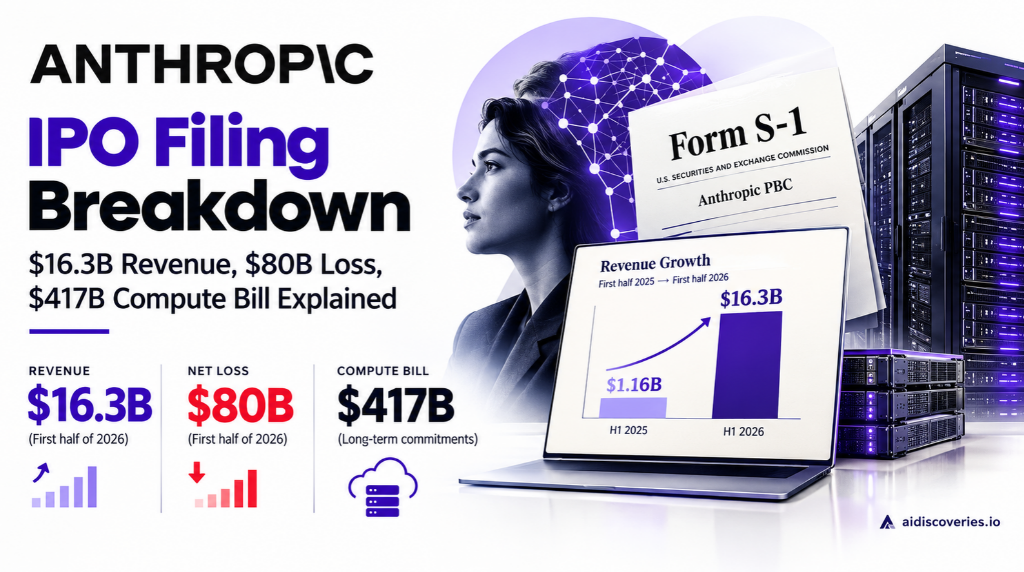
In its Form S-1 filing dated October 26, 2026, Anthropic reported $16.3 billion in revenue for the first six months of 2026. It also disclosed an $80.7 billion net loss for the same period and massive long-term commitments to computing infrastructure.
The headline numbers raise an important question: How can an AI company generate billions of dollars in revenue, report an enormous loss, and still demonstrate improving operating performance?
The answer lies in the difference between revenue, operating profit, accounting losses, and the cost of computing power.
This breakdown explains Anthropic’s IPO filing, what its financial numbers actually mean, why its compute commitments matter, and what investors should understand before the company enters the public market.
Anthropic IPO Filing: Key Numbers at a Glance
According to Anthropic’s publicly filed registration statement and reporting published on October 26, 2026, these are the most important figures investors should understand.
| Financial metric | Reported figure |
|---|---|
| Revenue, first half of 2026 | $16.3 billion |
| Revenue, full year 2025 | $4.59 billion |
| Revenue growth, first half of 2026 year over year | Approximately 1,300% |
| Net loss, first half of 2026 | $80.7 billion |
| Non-cash fair-value changes on financing instruments | $72.4 billion |
| Operating loss, first half of 2026 | $693 million |
| Operating cash flow, first half of 2026 | Approximately $3.9 billion |
| Compute and infrastructure spending, second quarter of 2026 | Approximately $5.6 billion |
| Proposed Nasdaq ticker | ANT |
| IPO offer price and share count | Not yet specified in the preliminary filing |
Source: Anthropic’s SEC Form S-1 filing and TechCrunch’s October 26, 2026 report.
One distinction matters immediately. The $80.7 billion figure is Anthropic’s reported net loss, not its operating loss. Most of that headline loss came from accounting changes in the value of financing instruments rather than ordinary operating expenses.
Also, the $417 billion compute figure in this article’s headline should not be treated as a verified total for all of Anthropic’s compute obligations. Reported estimates vary depending on which contracts, minimum payments, optional purchases, and other infrastructure commitments are included.
1. What Is Anthropic, and Why Is Its IPO Important?
Anthropic is an artificial intelligence company founded in 2021 by former OpenAI researchers and executives, including CEO Dario Amodei and President Daniela Amodei.
The company develops Claude, a family of AI models used for tasks such as writing, software development, research, document analysis, business automation, and enterprise applications.
Unlike a company that primarily sells traditional software licenses, Anthropic operates in a market where delivering each AI response requires computing resources. More usage can generate more revenue, but it can also increase infrastructure costs.
Anthropic’s business has expanded rapidly as companies adopt AI tools for software engineering, customer support, research, and other work.
Its IPO filing is important because it gives public-market investors a detailed look at the financial economics of a leading AI model developer.
Before the filing, much of the public discussion focused on private valuations, fundraising, product launches, and competition. The S-1 provides financial disclosures that help investors assess revenue growth, expenses, risks, ownership, and long-term commitments.
Anthropic intends to list on the Nasdaq Global Select Market under the ticker symbol ANT. The preliminary filing does not establish a final IPO price, share count, or trading date.
Read Also: GPT‑6 Astra vs. Claude Opus 5.5 vs. Gemini 3.8: Which AI Actually Wins in 2026?
2. Anthropic’s Revenue Reached $16.3 Billion in Six Months
The first major finding is Anthropic’s extraordinary revenue growth.
The company generated approximately $16.3 billion in revenue during the first half of 2026, compared with approximately $1.16 billion in the same period of 2025.
That represents year-over-year growth of roughly 1,300%.
For context, Anthropic generated approximately $4.59 billion in revenue for the entire year of 2025.
This means that the company generated more than three times its full-year 2025 revenue during the first six months of 2026.
Anthropic’s reported revenue growth
| Period | Revenue |
|---|---|
| 2023 | $41 million |
| 2024 | $386 million |
| 2025 | $4.59 billion |
| First half of 2025 | $1.16 billion |
| First half of 2026 | $16.29 billion |
Source: Anthropic’s S-1 financial statements.
The figures show how quickly demand for Claude and Anthropic’s business products has expanded.
However, there is an important limitation. Six-month revenue should not automatically be treated as a reliable full-year forecast. Revenue growth can change, and the company faces competition, infrastructure constraints, pricing pressure, and customer concentration risks.
Where does Anthropic make its money?
Anthropic generates revenue by providing access to its AI models and related products.
Its revenue sources include:
- Claude subscriptions for individual and professional users.
- Claude Code and other AI-powered software development tools.
- API access that allows developers to integrate Claude into their own applications.
- Enterprise agreements for companies deploying AI across their operations.
- Usage-based access to Claude models through cloud platforms and other distribution channels.
The business model creates several growth opportunities.
A company may begin with a small number of Claude users, then expand access across engineering, research, customer support, and other departments. As usage increases, Anthropic can generate additional revenue from subscriptions, API consumption, and enterprise contracts.
The challenge is ensuring that the revenue generated by each customer exceeds the cost of serving that customer.
That brings us to the most misunderstood number in the filing.
3. Why Did Anthropic Report an $80.7 Billion Loss?
At first glance, an $80.7 billion net loss alongside $16.3 billion in revenue looks catastrophic.
But the headline figure does not tell the entire story.
Anthropic reported an $80.7 billion net loss for the six months ended June 30, 2026. Approximately $72.4 billion of that loss came from changes in the fair value of financing instruments, primarily convertible notes.
These accounting adjustments reflected increases in the estimated value of the company’s outstanding convertible debt as its enterprise valuation rose.
What does a fair-value accounting loss mean?
Companies sometimes raise capital through financial instruments whose accounting value changes as the company’s valuation changes.
When the value of a liability increases under the applicable accounting rules, the company may need to record a loss in its financial statements.
That loss can occur without an equivalent amount of cash leaving the company’s bank accounts during the reporting period.
For example, imagine a startup issues a convertible financial instrument when investors value the business at $10 billion. Later, the company’s valuation rises substantially, changing how the instrument is valued for accounting purposes.
Depending on the instrument’s terms and applicable accounting rules, the company may recognize a large accounting loss even though the revaluation itself does not require an immediate cash payment of the same amount.
That is broadly why Anthropic’s headline net loss requires additional explanation.
Read Also: How to Create Ads With Free AI Tools: A Step-by-Step Guide for 2026
Breaking down the $80.7 billion loss
| Item | Approximate amount |
|---|---|
| Reported net loss | $80.7 billion |
| Fair-value changes on financing instruments | $72.4 billion |
| Remaining net loss after that adjustment | $8.3 billion |
The $8.3 billion figure is a simple subtraction, not a separate reported operating-loss figure. It includes the combined effect of other income-statement items.
The key takeaway is that Anthropic did not spend $80.7 billion in cash simply to operate Claude during the first half of 2026.
However, the accounting loss still matters. It reflects the company’s financing structure and affects reported financial results. Investors must understand both the accounting treatment and the underlying economics of the business.
4. Is Anthropic Actually Profitable?
The answer depends on which measure of profitability you examine.
Anthropic reported an operating loss of approximately $693 million for the first half of 2026, compared with an operating loss of approximately $2.1 billion in the same period of 2025.
That is a substantial improvement.
The company also reported approximately $3.9 billion in positive operating cash flow for the first half of 2026.
These figures suggest that the underlying business has improved considerably, even though the company reported a very large net loss.
Three financial measures investors should understand
Operating profit or loss measures the results of the company’s core business activities after operating expenses.
Net profit or loss also incorporates non-operating items, including relevant financing-related gains and losses.
Operating cash flow measures cash generated or used by operating activities, subject to the accounting rules and adjustments that apply to the statement of cash flows.
These metrics answer different questions.
A company can report an operating loss while generating positive operating cash flow because revenue recognition, customer payments, supplier payments, and other accounting items do not always occur at the same time.
Similarly, a company can report a large net loss because of non-cash accounting adjustments even when its operating performance improves.
What does Anthropic’s financial position tell us?
Anthropic’s first-half figures suggest three things.
First, customer demand has expanded rapidly.
Second, operating losses have narrowed significantly compared with the previous year.
Third, the company remains exposed to substantial infrastructure expenses, financing risks, and future investment requirements.
It would therefore be inaccurate to describe Anthropic as simply an unprofitable AI company based only on its $80.7 billion headline loss.
It would also be inaccurate to conclude that the company has achieved sustainable profitability based only on its improved operating performance.
Investors need to evaluate the full financial statements and determine whether the company can sustain its growth while covering its infrastructure, research, and operating costs.
5. The Compute Bill: Why Building Advanced AI Costs So Much
One of the most important challenges facing Anthropic is the cost of computing power.
Large AI models require specialized chips, data centers, electricity, networking, storage, and supporting infrastructure. Training models can require substantial computing resources, while serving millions of requests creates recurring inference costs.
Inference is the process of using a trained AI model to generate responses to user requests.
Every time someone asks Claude to analyze a long document, write code, summarize research, or perform a complex task, the company must allocate computing resources to produce the result.
The cost varies depending on the model, request length, hardware, utilization, and other technical factors.
Why compute costs can rise with revenue
Consider an AI company that charges customers based on the number of tokens processed.
As customers send more requests, the company generates more usage-based revenue. But those requests also consume computing capacity.
If the cost of serving the requests rises as quickly as revenue, the company may struggle to improve its margins.
If infrastructure becomes more efficient, however, the company can potentially serve more requests without increasing costs at the same rate.
That is why AI companies focus on model efficiency, hardware utilization, caching, routing requests to different models, and other infrastructure improvements.
Anthropic’s second-quarter compute economics
Anthropic reportedly spent approximately $5.6 billion on compute in the second quarter of 2026 while generating approximately $11.6 billion in revenue.
That works out to roughly $2.08 in revenue for every $1 spent on compute.
The calculation is straightforward:
$11.6 billion ÷ $5.6 billion = approximately 2.07.
This ratio is useful, but it is not the same as profit margin.
Revenue must also cover research and development, salaries, sales, administration, other operating expenses, and applicable financing and other costs.
Furthermore, reported compute spending may not capture every future obligation associated with infrastructure agreements.
The ratio therefore offers a useful snapshot of the relationship between revenue and compute expenses, not a complete measure of Anthropic’s profitability.
6. What Does the $417 Billion Compute Bill Actually Mean?
The figure in the headline refers to the scale of Anthropic’s reported long-term infrastructure commitments, but it needs careful interpretation.
Anthropic has entered into major agreements with cloud providers and computing infrastructure partners to secure the capacity needed to develop and operate its AI models.
Reuters reported on October 26, 2026, that Anthropic had commitments exceeding $600 billion across approximately eight partners over a decade. Reported agreements included at least $110 billion with Amazon, $114.5 billion with Google, and $44.9 billion with Microsoft.
These figures should not be confused with a single, immediately payable cash bill.
Long-term infrastructure agreements can contain different types of obligations, including minimum spending requirements, lease payments, usage-based charges, conditional purchases, and optional capacity arrangements.
The amount a company ultimately pays depends on the terms of each agreement and whether conditions or purchase options are exercised.
Consequently, a headline figure such as $417 billion should not be presented as the exact amount Anthropic has already spent, the amount it owes immediately, or a verified total of all its contracts without a clearly defined source and calculation.
Why would Anthropic commit to so much computing capacity?
There are several reasons.
First, the company needs computing capacity to train and improve advanced AI models.
Second, it must serve increasing demand from individual users, developers, and enterprise customers.
Third, access to infrastructure can become a competitive advantage. A company that cannot obtain enough computing capacity may struggle to launch models, meet customer demand, or maintain performance.
Fourth, infrastructure agreements can help a company plan for future demand, although they can also expose it to large financial obligations if demand grows more slowly than expected.
The risk of committing too much
Long-term infrastructure commitments create a difficult balancing act.
If demand grows faster than expected, securing capacity early can help Anthropic serve customers and compete effectively.
If demand slows, model efficiency improves dramatically, or prices fall, the company could face commitments that are harder to justify economically.
The central question is not simply whether Anthropic has large compute contracts. It is whether the revenue generated by that capacity will justify the cost over time.
7. Amazon, Google, and Microsoft: Why Big Tech Matters to Anthropic
Anthropic’s relationship with major cloud providers is another important part of its financial story.
Cloud infrastructure providers supply computing resources that AI companies need to train and operate their models. They may also distribute AI products to customers and invest in AI developers.
These relationships can benefit both sides.
Anthropic gains access to computing infrastructure and distribution. Cloud providers can generate revenue from infrastructure usage while strengthening their position in the AI market.
However, the arrangement also creates dependencies.
If Anthropic relies heavily on a small number of infrastructure providers, changes in pricing, capacity availability, contract terms, or technical performance could affect its operations.
The relationships also raise questions about how AI companies and their infrastructure partners finance one another.
When a technology provider invests in an AI company that subsequently spends money on the provider’s infrastructure, both companies may benefit from the arrangement. But investors must distinguish between genuine end-customer demand and spending supported by financing relationships.
This does not automatically mean that reported revenue is artificial or that the business model is unsustainable. It means investors should examine the underlying contracts, customer payments, capital commitments, and cash flows carefully.
8. Anthropic’s Enterprise Customers Are a Major Growth Driver
Anthropic’s filing also highlights the scale of its enterprise business.
According to reporting on the filing, as of September 2026, Anthropic had more than:
- 11,900 customers spending at least $100,000 annually.
- 1,900 customers spending at least $1 million annually.
- 250 customers spending at least $10 million annually.
These figures suggest that companies are increasingly treating AI as an operational tool rather than merely an experiment.
Businesses can use Claude for software development, customer service, internal knowledge management, research, data analysis, and workflow automation.
Enterprise customers can be especially valuable because they may generate recurring revenue, expand their usage over time, and purchase additional services.
However, enterprise concentration introduces risk.
If a small number of large customers account for a substantial share of revenue, losing one or several of them could materially affect financial performance.
Anthropic also depends on third-party cloud marketplaces and distribution channels to reach customers. Changes in those relationships could affect customer acquisition, revenue, or margins.
For investors, the quality and durability of enterprise revenue may matter as much as the headline growth rate.
9. Anthropic’s Biggest IPO Risks
Rapid growth does not eliminate business risk. Anthropic’s public filing gives investors several areas to examine.
Compute and infrastructure commitments
Anthropic must secure sufficient computing resources to compete in a market where infrastructure can be expensive and supply constrained.
Large long-term commitments could become a burden if customer demand or pricing falls below expectations.
Competition from other AI companies
Anthropic competes with OpenAI, Google, Meta, and other AI developers.
Competitors may release more capable models, reduce prices, improve efficiency, or bundle AI products with existing software.
Any of these developments could pressure Anthropic’s market share or margins.
Customer concentration
Large enterprise customers provide meaningful revenue, but dependence on a limited number of customers creates exposure to contract changes and spending cuts.
Dependence on cloud providers
Anthropic relies on external infrastructure and distribution relationships. Changes in these relationships could affect its ability to serve customers efficiently.
Model safety and legal exposure
Advanced AI systems can create security, privacy, reliability, and misuse risks.
Anthropic’s public-benefit mission and focus on AI safety are central to its identity, but investors must still evaluate how safety obligations, regulation, litigation, and product incidents could affect the business.
Uncertain long-term profitability
Anthropic’s improving operating performance is encouraging. However, the company has warned that it may not achieve or sustain profitability.
Investors should assess whether revenue growth, infrastructure efficiency, and pricing power can eventually support sustainable profits.
10. What Anthropic’s IPO Means for AI Investors
Anthropic’s IPO filing offers a rare opportunity to examine the financial economics of a leading AI company.
The figures point to a business with exceptional revenue growth, a rapidly expanding enterprise customer base, improving operating performance, and substantial infrastructure requirements.
But the filing does not establish that Anthropic’s future valuation will be justified.
A company’s IPO valuation depends on more than revenue growth. Investors must consider operating margins, cash flow, capital requirements, competitive positioning, dilution, governance, and the price they pay for the shares.
Anthropic’s preliminary filing does not yet provide a final offer price or share count. That makes it too early to calculate a definitive IPO valuation from the filing alone.
Questions investors should ask before buying Anthropic stock
- What valuation will Anthropic seek at the IPO?
- How much revenue growth can it sustain over the next three to five years?
- Can compute costs fall as a percentage of revenue?
- How much cash will the company need to fund future infrastructure commitments?
- Can it convert improving operating performance into consistent profitability?
- How much control will founders and the company’s governance structure retain after listing?
- What risks arise from customer concentration, competition, and dependence on cloud partners?
These questions help investors distinguish a fast-growing business from a stock that offers an attractive return at a particular price.
11. What the Anthropic IPO Reveals About the Future of AI
Anthropic’s financial disclosures highlight a broader shift in the technology industry.
AI is becoming a major commercial market, but building and operating advanced AI systems requires substantial infrastructure investment.
For software businesses, the traditional appeal of digital products has been the ability to serve additional customers at relatively low incremental cost.
AI changes that equation.
Although software distribution can scale efficiently, generating AI responses consumes computing resources. Companies must balance the cost of serving customers against the revenue those customers generate.
This creates opportunities for businesses that can improve model efficiency, develop valuable applications, secure enterprise contracts, and build products that customers use regularly.
It also creates risks for companies that invest heavily in infrastructure without establishing durable demand.
Anthropic’s IPO is therefore relevant beyond its own shareholders. It provides a case study in how the economics of AI may shape cloud computing, software development, enterprise automation, and technology investment.
The companies that succeed over the long term will need more than impressive models. They will need business models that convert AI capabilities into sustainable economic value.
Frequently Asked Questions About Anthropic’s IPO
Has Anthropic filed for an IPO?
Yes. Anthropic publicly filed a Form S-1 registration statement with the US Securities and Exchange Commission on October 26, 2026. The filing proposes a Nasdaq listing under the ticker ANT. The final IPO price and share count have not yet been specified in the preliminary filing.
How much revenue did Anthropic generate in 2026?
Anthropic reported approximately $16.3 billion in revenue for the first half of 2026, up from approximately $1.16 billion in the same period of 2025.
Why did Anthropic report an $80.7 billion loss?
The company reported an $80.7 billion net loss for the first half of 2026. Approximately $72.4 billion came from changes in the fair value of financing instruments, primarily convertible notes. These accounting adjustments were largely non-cash in nature.
Is Anthropic profitable?
Anthropic reported an operating loss of approximately $693 million for the first half of 2026, while operating cash flow was approximately $3.9 billion positive. These figures indicate improving operating performance, but they do not establish that the company has achieved sustainable profitability.
What is Anthropic’s compute bill?
Anthropic’s compute costs include the computing resources required to train and operate its AI models. The company reported approximately $5.6 billion in compute spending during the second quarter of 2026. Separately, it has major long-term infrastructure agreements. Large contract totals should not be confused with cash already spent or amounts immediately payable.
What does the $417 billion figure represent?
The $417 billion figure is used in the headline to refer to the scale of Anthropic’s infrastructure commitments. However, it should not be treated as a verified total of all compute obligations without a defined source and calculation. Reported contract totals vary according to which minimum payments, usage-based charges, optional purchases, and other commitments are included.
What stock ticker will Anthropic use?
Anthropic’s proposed Nasdaq ticker is ANT, according to its preliminary registration statement.
Should investors buy Anthropic stock at its IPO?
It is too early to make a valuation-based judgment from the preliminary filing alone. Investors should review the final offer price, expected share count, financial statements, infrastructure commitments, governance arrangements, and principal risk factors before making a decision.
Final Takeaway
Anthropic’s IPO filing reveals two realities of the AI industry.
The first is the enormous commercial opportunity. Anthropic generated $16.3 billion in revenue during the first half of 2026, demonstrating how quickly demand for advanced AI products can expand.
The second is the cost of competing at the frontier. The company faces significant computing expenses, long-term infrastructure commitments, financing-related accounting volatility, and uncertainty about sustainable profitability.
The $80.7 billion net loss needs context because much of it came from non-cash accounting adjustments. At the same time, improving operating performance does not eliminate the financial risks associated with building advanced AI.
For investors, the central question is whether Anthropic can convert extraordinary growth into durable profits and cash flow.
For the wider technology industry, the filing offers a clear lesson: the future of AI will depend on both technological capability and the economics of delivering it at scale.
Sources and further reading
- Anthropic’s official SEC Form S-1 filing
- TechCrunch: Anthropic officially files for its public debut
- Reuters: Anthropic’s IPO, rapid growth, and computing costs
- Fortune: Anthropic’s S-1 reveals its financial performance
Editorial note: This article explains publicly reported financial disclosures. It is not investment advice. Financial figures and contract estimates should be checked against the latest SEC filing and subsequent amendments.





Leave a Reply