Published: September 7, 2026
Updated: September 7, 2026
Claude Fable 5.1 and GPT-6 Astra are two of the most capable AI models released in September 2026.
Anthropic released Claude Fable 5.1 on September 1. OpenAI released GPT-6 Astra two days later, on September 3. Both models target complex coding, research, knowledge work, computer use and long-running AI agent tasks.
So which one is better?
The short answer is that there is no universal winner.
Read Also: Make Yourself Impossible to ignore
GPT-6 Astra currently has a strong advantage in computer use, science, mathematics, cybersecurity and several agent benchmarks. Fable 5.1 is highly competitive in coding, research, knowledge work, long-running tasks and agentic software development. Anthropic also claims major cost improvements for agent workloads because of lower cache-read pricing.
Read Also: How to Build an Agentic OS with Claude Fable 5: The Complete 2026 Guide
For developers building autonomous agents, the choice may come down to workflow economics and tool integration.
For professionals, researchers and business users, the better model depends on the task.
This guide breaks down Fable 5.1 vs GPT-6 Astra across capabilities, benchmarks, pricing, coding, research, computer use, business workflows, safety and real-world use cases.
What is Claude Fable 5.1?
Claude Fable 5.1 is Anthropic’s latest model for coding and knowledge work.
Anthropic describes Fable 5.1 as its most capable generally available model for coding and knowledge work. It is designed for long-running problem solving, agentic coding, scientific research and complex professional tasks.
Fable 5.1 is also designed to be more efficient than the previous Fable 5.
Anthropic says typical token-based workloads cost about 25% less than Fable 5, while highly agentic workloads can see savings of up to approximately 45%. The main change comes from lower pricing for cache reads.
The model also improves computer use and software development.
Anthropic reports a 55.8% score for Fable 5.1 on Terminal-Bench 4.0 and 73.4% on CursorBench 3.2.0 at maximum effort. It also reports a 52.6% score on Terminal-Bench-Science 0.1.
Fable 5.1 is generally available, while Anthropic’s related Mythos 5.1 model uses different safeguards and is restricted to trusted access programs for certain cybersecurity and life-science applications.
What is GPT-6 Astra?
GPT-6 Astra is OpenAI’s latest frontier AI model for complex end-to-end work.
OpenAI positions Astra as its most capable model, with major improvements in reasoning, coding, computer use, browsing, cybersecurity, science and professional work.
The important difference is that Astra is designed to do more than generate an answer.
It can use computers, browse websites, work with software, create documents, generate spreadsheets and presentations, conduct research and complete multi-step workflows.
OpenAI says Astra can adapt when requirements change during a task instead of treating every new instruction as an entirely new objective.
At launch, Astra was initially available to a limited set of organizations, with broader availability planned across ChatGPT Plus, Pro, Business and Enterprise, as well as the OpenAI API, Microsoft Azure and Amazon Bedrock.
Fable 5.1 vs GPT-6 Astra: Quick Comparison
Model: Claude Fable 5.1
Company: Anthropic
Primary strengths: Coding, research, knowledge work, long-running agents
Release: September 1, 2026
API input price: $10 per million tokens
API output price: $50 per million tokens
Context: Approximately 1 million tokens according to current provider listings
Best suited for: Coding, research, agentic workflows and complex knowledge work
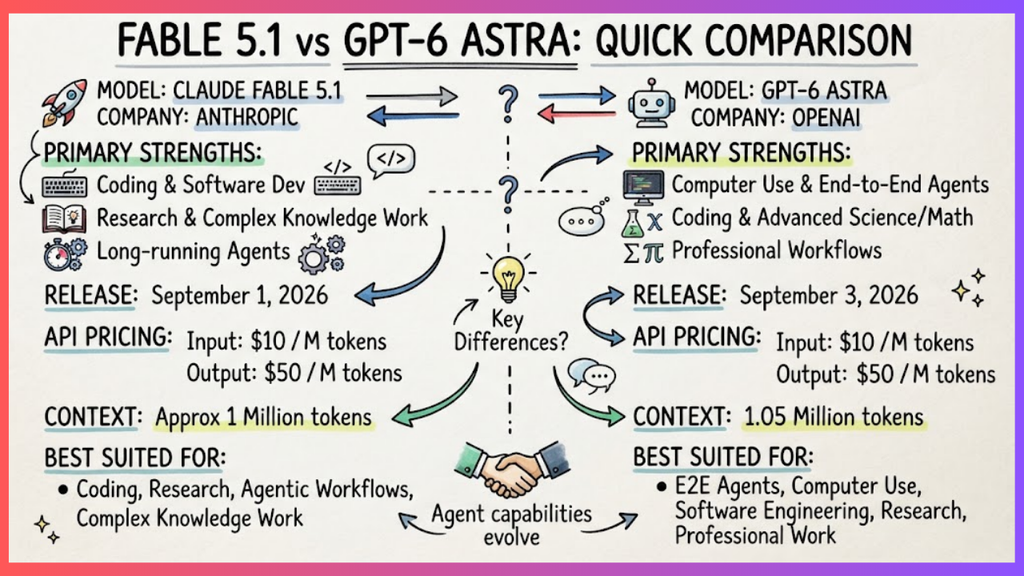
Model: GPT-6 Astra
Company: OpenAI
Primary strengths: Computer use, coding, research, science, mathematics and professional workflows
Release: September 3, 2026
API input price: $10 per million tokens
API output price: $50 per million tokens
Context: 1.05 million tokens
Best suited for: End-to-end agents, computer use, software engineering, research and professional work
Read Also: Google Docs Voice Typing: How to Dictate Better Emails With Your Voice
The headline API price is essentially identical.
The important difference is what happens after you start running long, repeated agent workflows.
Fable 5.1 vs GPT-6 Astra pricing
At the standard API level, both models are listed at $10 per million input tokens and $50 per million output tokens. OpenAI publishes those rates for GPT-6 Astra, while third-party model comparisons currently list the same headline rates for Fable 5.1.
But headline pricing does not tell the whole story.
Anthropic has specifically reduced the price of cache reads for Fable 5.1. The company says this makes the model approximately 25% cheaper for typical workloads and potentially up to 45% cheaper for highly agentic workloads compared with Fable 5.
For developers, this matters because AI agents repeatedly send context back to a model.
Imagine an agent working on a software repository.
It may repeatedly reference:
The same source files.
The same documentation.
The same project instructions.
The same tool outputs.
The same task history.
If those inputs can be cached efficiently, cache pricing can have a major effect on the final cost.
This is why comparing only the $10 input and $50 output prices can produce the wrong conclusion.
Fable 5.1 vs GPT-6 Astra: Context window
Long context is increasingly important for AI agents.
A model with a large context window can process large codebases, research collections, documents and tool histories without constantly removing information from the conversation.
Current model listings report approximately 1 million tokens for Fable 5.1 and 1.05 million tokens for GPT-6 Astra. OpenAI’s own developer information lists a 1,050,000-token context window for Astra.
That makes both models suitable for very large workloads.
However, context size alone does not determine performance.
A model can technically accept a million tokens and still struggle to identify which information matters.
The more useful question is:
Can the model find the right information, remember the important constraints and use that information correctly?
That is where real-world evaluations become more important.
Fable 5.1 vs GPT-6 Astra: Coding
Coding is one of the most interesting areas in this comparison.
Fable 5.1 is designed heavily around software engineering and long-running coding tasks.
Anthropic reports:
Terminal-Bench 4.0: 55.8%
CursorBench 3.2.0: 73.4%
Terminal-Bench-Science 0.1: 52.6%
Anthropic also reports that Fable 5.1 successfully diagnosed a rare software crash that had reportedly remained unexplained for several years.
GPT-6 Astra also performs strongly in software engineering.
OpenAI reports 57.9% on Terminal-Bench 4.0, compared with 55.8% for Fable 5.1 in the comparison presented by OpenAI.
The difference is relatively small.
That suggests developers should not choose between these models based on a single coding benchmark.
The real test is your repository.
If your work involves large codebases, debugging, architecture, automated testing and long-running coding agents, benchmark both models against your own tasks.
Read Also: How to Learn AI for FREE from Harvard, Stanford, MIT & Google
Winner for coding: Slight advantage to GPT-6 Astra on the cited Terminal-Bench 4.0 comparison, but Fable 5.1 remains extremely competitive and may be preferable for some long-running coding workflows.
Fable 5.1 vs GPT-6 Astra: Research
Research is another area where both models are strong.
Fable 5.1 was built to handle complex research workflows and long-running investigations.
Anthropic reports that Fable 5.1 achieved 52.6% on Terminal-Bench-Science 0.1. The company also highlights work involving scientific data, computational modeling and geological mapping.
GPT-6 Astra takes a different approach.
It combines reasoning with computer use.
That means an Astra-based research agent can potentially search the web, interact with software, analyze data and create a finished document instead of stopping after producing text.
OpenAI reports that Astra reached 64.6% on Terminal-Bench Science 0.1, compared with 52.6% for Fable 5.1 in its published comparison.
Winner for research: GPT-6 Astra based on the published Terminal-Bench Science comparison, particularly when research requires computer interaction and multi-step execution.
Fable 5.1 vs GPT-6 Astra: Computer Use
This is one of Astra’s clearest strengths.
OpenAI designed Astra to interact with computers as part of completing tasks.
It can fill online forms, update CRM records, organize calendars, conduct online research, work inside document editors, install and test software, troubleshoot problems and create websites and applications.
OpenAI reports an OSWorld 2.0 score of 72.6% for Astra in one comparison, with the model completing tasks in approximately 40 minutes compared with about 75 minutes for GPT-5.6 Sol.
Fable 5.1 also supports computer-use workflows.
Anthropic reports a 77.9% partial score and 41.7% strict score on OSWorld 2.0.
The benchmark methodologies and configurations matter, so these figures should not be treated as a universal ranking.
Winner for computer use: GPT-6 Astra has the stronger overall positioning because computer interaction is central to its design and deployment.
Fable 5.1 vs GPT-6 Astra: Business Work
This is where the comparison becomes more interesting for companies.
AI is moving from answering questions to completing workflows.
A traditional chatbot might tell you how to prepare a report.
An agent can research the data, update a spreadsheet, create the report and prepare the presentation.
Both Fable 5.1 and GPT-6 Astra are designed for this type of work.
Fable 5.1 scored 31.4% on Anthropic’s AutomationBench comparison, compared with 17.1% for Fable 5.
OpenAI positions Astra around complex professional work involving documents, presentations, spreadsheets, financial modeling, data analysis and other multi-step tasks.
For businesses, this means the question is changing.
Instead of asking:
“Which model writes better?”
You should ask:
“Which model completes my workflow with the least human intervention and lowest total cost?”
That is a much better way to evaluate enterprise AI.
Fable 5.1 vs GPT-6 Astra: Mathematics and Science
GPT-6 Astra currently has a strong position in advanced mathematical and scientific reasoning.
OpenAI reports a 98% result on FrontierMath Tier 4 and a 96.0% score on GPQA Diamond. It also reports a 99.9% result on ARC-AGI-3.
These are impressive numbers, but benchmark scores should be interpreted carefully.
Different benchmarks test different abilities.
A model can dominate one evaluation and lose another.
For researchers, the best model is the one that performs well on the actual scientific workflow you need to complete.
Winner for published math and science benchmarks: GPT-6 Astra.
Fable 5.1 vs GPT-6 Astra: Cybersecurity
Cybersecurity is one of the biggest differences between these models.
OpenAI says GPT-6 Astra has reached its Critical level for cybersecurity capability under its Preparedness Framework. The company says Astra can identify previously unknown security flaws and develop new exploitation methods with the appropriate tools and access.
That capability comes with additional safety controls.
Anthropic has also made cybersecurity changes to Fable 5.1.
Fable 5.1 can be used to identify software vulnerabilities, but Anthropic says it does not allow the model to develop exploits for those vulnerabilities. Anthropic also reports that its updated cybersecurity safeguards produce around 60% fewer interventions per Claude Code session compared with its previous Fable 5 safeguards.
For defensive security teams, both models have potential.
For organizations evaluating them, safety controls should be treated as part of the product rather than an afterthought.
Winner for raw cybersecurity capability: GPT-6 Astra.
Winner for constrained defensive vulnerability identification: Fable 5.1 offers a strong option with more restrictive boundaries around certain offensive cybersecurity tasks.
Fable 5.1 vs GPT-6 Astra: Which Is Better for AI Agents?
This may be the most important question.
Both models are built for agents.
An AI agent can:
Understand a goal.
Create a plan.
Use tools.
Read information.
Make decisions.
Execute actions.
Check its work.
Recover from errors.
Continue working for an extended period.
Fable 5.1 is particularly interesting for long-running coding and research agents.
Anthropic reports examples of Fable 5.1 working for extended periods, including a reported 38-hour research run from one early-access partner.
Astra focuses heavily on end-to-end computer work.
OpenAI describes it as a model capable of taking a task from an initial request through research, computer interaction and final output.
The winner therefore depends on the type of agent you are building.
For coding and research agents: Fable 5.1 is extremely strong.
For computer-use agents: GPT-6 Astra has a clear advantage.
For enterprise workflow automation: test both.
For cost-sensitive long-context agents: Fable 5.1 deserves close attention because of its cache-read economics.
For broad end-to-end agents: GPT-6 Astra is currently one of the strongest choices.
Fable 5.1 vs GPT-6 Astra: Which Is Better for Content Creation?
If your primary goal is writing blog posts, LinkedIn posts, emails or marketing copy, you probably do not need the most expensive frontier model for every task.
Both Fable 5.1 and GPT-6 Astra can produce high-quality written content.
The more important differences are workflow capabilities.
Fable 5.1 has strong knowledge-work and writing capabilities.
Anthropic reports that its early partners saw improvements in clarity, long-form work and following writing guidance.
Astra adds stronger computer and document-production capabilities.
For example, OpenAI says Astra can produce documents, presentations and spreadsheets that follow templates and instructions.
If you only need writing, both are excellent.
If you want the AI to research information, work with files, use a computer and produce a finished business artifact, Astra may offer more value.
Fable 5.1 vs GPT-6 Astra: Which Is Better for Businesses?
For business users, the answer depends on your workflow.
Choose Fable 5.1 when:
You spend a lot of time coding.
You run long research tasks.
You build software agents.
You want strong long-context performance.
You care about cache efficiency.
You want strong knowledge-work performance.
You need an AI model that can work independently for extended periods.
Choose GPT-6 Astra when:
You need computer-use automation.
You want end-to-end task execution.
You work heavily with spreadsheets and presentations.
You need advanced research and scientific reasoning.
You want strong software engineering performance.
You need advanced cybersecurity capabilities.
You want an AI agent that can interact directly with software and websites.
Read Also: Make Yourself Impossible to ignore
Fable 5.1 vs GPT-6 Astra: Safety and Reliability
Capability is only one side of the equation.
The more capable an AI agent becomes, the more important safety becomes.
A model that can browse, write code, use tools and modify files can also make mistakes at a much larger scale.
OpenAI has added additional monitoring to Astra to identify situations where agents may have misunderstood instructions. Its systems can pause or stop a task when a potential issue is detected.
OpenAI also says Astra demonstrated significant improvements in staying within authorized boundaries compared with GPT-5.6 Sol in one of its internal evaluations.
Anthropic has also strengthened Fable 5.1’s safeguards.
The company says its updated systems reduce unnecessary interventions while retaining restrictions around higher-risk cybersecurity and biological tasks.
For enterprise adoption, safety should therefore be evaluated alongside accuracy, speed and cost.
The best model is not necessarily the one with the highest benchmark score.
It is the model that performs the required work reliably while staying within the boundaries your organization needs.
Fable 5.1 vs GPT-6 Astra: Benchmark Comparison
Based on the providers’ published comparisons:
Terminal-Bench 4.0:
Fable 5.1: 55.8%
GPT-6 Astra: 57.9%
Terminal-Bench Science 0.1:
Fable 5.1: 52.6%
GPT-6 Astra: 64.6%
OSWorld 2.0:
Fable 5.1: 77.9% partial, 41.7% strict
GPT-6 Astra: 72.6% in OpenAI’s cited comparison
GPQA Diamond:
Fable 5.1: Not directly reported in the cited Anthropic comparison
GPT-6 Astra: 96.0%
CursorBench 3.2.0:
Fable 5.1: 73.4%
GPT-6 Astra: Not directly reported in the cited OpenAI comparison
AutomationBench:
Fable 5.1: 31.4%
GPT-6 Astra: Not directly reported in the cited OpenAI comparison
These numbers should not be interpreted as a single universal leaderboard.
Anthropic and OpenAI use different evaluation configurations, tools, effort settings and reporting methodologies.
For serious model selection, run the same tasks through both models using the same tools and constraints.
Which AI model is better, Fable 5.1 or GPT-6 Astra?
If you want a simple answer:
GPT-6 Astra is the stronger all-around choice for computer use, scientific reasoning, advanced mathematics, cybersecurity and complex end-to-end workflows based on the currently published results.
Fable 5.1 is one of the strongest alternatives for coding, research, knowledge work and long-running agentic workflows, with potentially attractive economics for repeated-context workloads.
The gap is not large enough to justify blindly choosing one model for every task.
The smarter approach is task-based model selection.
Use Astra where its computer-use, science and end-to-end capabilities matter most.
Use Fable 5.1 where its coding, research, long-running agent and cache economics give you an advantage.
And if your workload is important enough, use both.
The future of AI may not be about finding one model that wins every benchmark.
It may be about building systems that automatically route each task to the model that can complete it most accurately, quickly and cheaply.
Fable 5.1 vs GPT-6 Astra: Final Verdict
GPT-6 Astra currently looks like the more capable general-purpose frontier model across a broad range of advanced tasks.
Fable 5.1 is closer than the headline competition suggests.
It is particularly strong for software engineering, research, long-running knowledge work and agentic workflows.
For developers, the decision should come down to real-world performance rather than marketing claims.
For businesses, measure:
Task completion rate.
Human intervention rate.
Total cost per completed task.
Latency.
Error rate.
Tool-use reliability.
Security.
Data privacy.
Ability to recover from failures.
A model that scores 2% higher on a benchmark but costs twice as much to operate may be a worse choice for your business.
Likewise, a cheaper model that requires constant human supervision may cost more when you calculate the full workflow.
The best AI model is the one that produces the best business outcome for your specific workload.
Frequently Asked Questions
Is Fable 5.1 better than GPT-6 Astra?
Not across every task. GPT-6 Astra has stronger published results in several areas including computer use, science, mathematics and cybersecurity. Fable 5.1 remains highly competitive in coding, research and long-running knowledge work.
Is GPT-6 Astra better for coding?
GPT-6 Astra has a slight advantage on the Terminal-Bench 4.0 comparison published by OpenAI, with 57.9% versus 55.8% for Fable 5.1. However, Fable 5.1 performs extremely well on other coding evaluations, including CursorBench 3.2.0.
Which is cheaper, Fable 5.1 or GPT-6 Astra?
Their headline API prices are similar at $10 per million input tokens and $50 per million output tokens. However, cache pricing and workload structure can make the actual cost different. Anthropic specifically highlights lower cache-read costs for Fable 5.1.
Which model has the larger context window?
GPT-6 Astra has a 1.05 million-token context window according to OpenAI’s developer information. Current third-party listings put Fable 5.1 at approximately 1 million tokens.
Which is better for research?
GPT-6 Astra currently has stronger published results on Terminal-Bench Science 0.1, while Fable 5.1 is also designed for long-running scientific and knowledge-work tasks. Your choice should depend on whether your research workflow requires extensive computer interaction and tool use.
Which is better for AI agents?
Both are designed for agentic workflows. Fable 5.1 is particularly strong for long-running coding and research agents, while Astra has a major focus on computer-use agents and end-to-end task execution.
Which model should a small business use?
Start with the model that fits your highest-value workflow. For research, coding and long-running knowledge work, test Fable 5.1. For computer automation, document workflows and complex end-to-end tasks, test GPT-6 Astra.
Should you use both Fable 5.1 and GPT-6 Astra?
For organizations running serious AI workloads, yes. A model-routing strategy can send different tasks to different models based on capability, cost, latency and risk.
The Bigger Picture
The Fable 5.1 vs GPT-6 Astra competition shows where AI is heading.
The biggest change is not simply that models are becoming better at answering questions.
They are becoming better at doing work.
They can research.
They can code.
They can use computers.
They can analyze data.
They can create business documents.
They can operate tools.
They can work for extended periods.
That changes how individuals and companies should think about AI.
The question is moving from:
“What can AI tell me?”
to:
“What work can I safely delegate to AI?”
Fable 5.1 and GPT-6 Astra are early examples of this transition.
And the biggest competitive advantage may belong to people who learn how to design workflows around these models, rather than people who simply learn how to write better prompts.
Sources
OpenAI, GPT-6 Astra: A New Generation of Intelligence.
OpenAI, GPT-6 Astra Release Notes.
OpenAI, GPT-6 Astra Safety Overview.
Anthropic, Introducing Claude Fable 5.1 and Claude Mythos 5.1.
Anthropic, Claude Fable product page.
Last updated: September 7, 2026.
✍️ About the Author
Olasunkanmi Adeniyi is a solo founder, product builder, AI practitioner, no-code and low-code developer, and SEO/content strategist. He builds websites, SaaS products, digital tools, and content systems using AI and modern development tools.
Rather than writing about AI from theory alone, Olasunkanmi focuses on testing, building, experimenting, and documenting what actually works. His work explores AI-powered workflows, product development, automation, SEO, content strategy, online business, and the practical use of emerging technologies.
Through AI Discoveries, he publishes practical tutorials, in-depth guides, experiments, and real-world use cases designed to help entrepreneurs, professionals, creators, and businesses understand and apply AI more effectively.
His goal is simple: make AI practical, understandable, and actionable—so readers can move from learning about what AI can do to actually using it to build, work, and grow.
Learn more and explore his latest work at www.aidiscoveries.io.



Leave a Reply