What if your path into the technology industry depended less on your grades and more on what you had actually built?
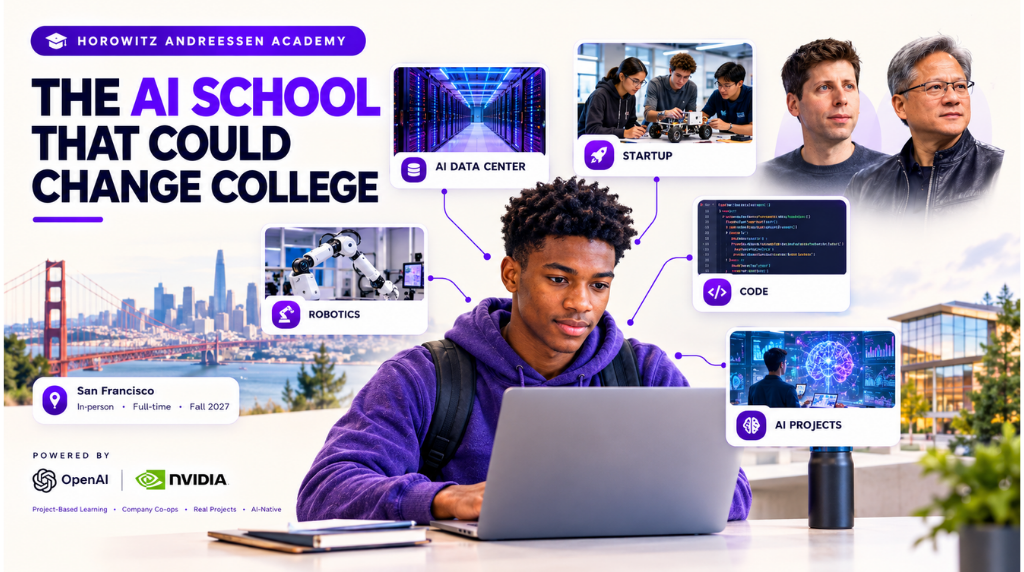
That is the idea behind the Horowitz Andreessen Academy, a new private, full-time school in San Francisco incubated by Andreessen Horowitz, also known as a16z.
The Academy is designed for young people coming out of high school who want to build products, conduct research, start companies, work with advanced technology, and learn directly from people working inside the technology industry.
Its founding class will begin in September 2027, with around 50 students expected to participate in a one-year, tuition-free fellowship. (Andreessen Horowitz)
The launch is significant because the Academy is testing a different model of education.
Instead of putting traditional coursework at the center, it emphasizes projects, mentorship, AI, real-world company experience, independent exploration, and proof of work.
For students interested in AI, startups, engineering, research, and technology, this could become one of the most closely watched education experiments of the next few years.
What Is the Horowitz Andreessen Academy?
The Horowitz Andreessen Academy is an independent educational program in San Francisco incubated by Andreessen Horowitz.
It is aimed at young people coming out of high school and does not award a traditional college degree or college credit. The first Founding Class Fellowship will bring together approximately 50 students for a full-time, in-person experience beginning in September 2027. (Andreessen Horowitz)
The Academy’s philosophy is built around a simple idea: young people should spend more time doing meaningful work and less time simply preparing to do it.
Students can work on software, startups, research, communities, creative projects, products, or other areas they care about.
The program describes its students as people who are already “in motion”, meaning they are already taking initiative and building things rather than waiting for permission.
Read Also: 50 Gmail Tricks That Save Time and Make Email Much Easier
How Does the Horowitz Andreessen Academy Work?
The first-year program combines independent projects, learning from industry leaders, company experience, and international exploration.
Read Also: Askya AI Growth Platform 2026: Up to $200,000 for African AI Startups
Students are encouraged to follow their interests rather than complete a rigid list of prescribed projects.
Someone might spend months building an AI product.
Another student might conduct scientific research.
Someone else might launch a company, create art, develop a new technical skill, or investigate a question they cannot stop thinking about.
Students also meet regularly with peers and mentors to discuss progress, obstacles, and next steps. (The Horowitz Andreessen Academy)
The program therefore puts significant responsibility on the student.
You are not simply given a timetable and told what to study.
You are expected to decide what you want to build and then demonstrate that you can execute.
AI Is Central to the Academy
Artificial intelligence sits at the center of the Academy’s broader educational philosophy.
Andreessen Horowitz argues that the internet made information widely accessible, while AI is making it increasingly possible for individuals to create and execute.
That changes the skills students need.
Instead of focusing only on memorizing information, students can use AI tools to research, prototype, code, analyze information, create products, and explore ideas much faster.
The Academy is therefore positioning itself around what it calls an AI-native approach to education. (Andreessen Horowitz)
This matters because AI is already changing the way software is developed, businesses operate, research is conducted, and creative work gets produced.
The Academy is effectively asking a larger question:
What should education look like when every student has access to increasingly capable AI tools?
Students Will Work Inside Technology Companies
One of the most unusual parts of the Academy is its company experience.
Every student will spend at least three months working full-time inside a company.
The Academy says students can work with hiring partners or use its broader network to find organizations aligned with their interests.
The current hiring partner list includes:
OpenAI
NVIDIA
Anthropic
Google
Meta
Stripe
Coinbase
Palantir
Replit
Anduril
The Academy says students will become part of real teams and contribute to real work during the experience. (The Horowitz Andreessen Academy)
That creates a very different learning environment from a conventional classroom.
Instead of only studying how technology companies operate, students can experience the process directly.
Students Also Get an International Project
The Academy is not limited to San Francisco.
Every student receives a $5,000 travel budget for independent research and travel.
Students can spend three to four weeks in another country exploring a research community, industry, craft, or area connected to their interests. (The Horowitz Andreessen Academy)
This gives students another opportunity to learn outside a traditional classroom.
The Academy’s First Class Is Tuition-Free
The Founding Class Fellowship does not charge tuition.
However, students are responsible for housing, meals, and personal living expenses. The Academy says need-based assistance for certain living expenses may be available to qualifying students. (The Horowitz Andreessen Academy)
This distinction matters.
“Free” does not mean that attending San Francisco comes with zero costs.
Students still need to plan for accommodation, food, transportation, and other living expenses.
Who Can Apply?
The Academy is targeting a specific type of young builder.
Applicants need to have completed high school, or an equivalent qualification, by August 2027.
Students currently attending college can apply, provided they have not completed more than one year of full-time college enrollment after high school by that date.
International applicants are also welcome. (The Horowitz Andreessen Academy)
The Academy gives priority to graduating high school seniors.
The application deadlines are:
Early application: November 5, 2026
Regular application: January 15, 2027
The Founding Class begins in September 2027.
How the Academy’s Admissions Process Is Different
This may be the most interesting part of the entire experiment.
The Academy says admission is heavily weighted toward proof of work.
Applicants submit a personal portfolio showing what they have built or driven.
That could include:
Software
Products
Original research
A community
An online audience
An event
A startup
Another project where the applicant took meaningful responsibility
Applicants also provide a short video, test scores, and a high school transcript.
Read Also: Askya AI Growth Platform 2026: Up to $200,000 for African AI Startups
However, the Academy says it prioritizes work and portfolio evidence rather than grades. Recommendation letters and essays are not required at the first stage. (The Horowitz Andreessen Academy)
The message is clear.
Don’t only tell us what you want to do.
Show us what you have already done.
The Applicants Already Give a Clue About What the Academy Wants
The Academy has published examples of applicants and their projects.
They include students who have:
Built a six-axis robot arm from scratch
Co-built an app that converts thoughts into speech in real time
Raised $100,000 for an enzyme engineering startup
Designed and donated low-cost prosthetic arms
Built an AI book indexer generating six-figure annual recurring revenue
Created an AI dating coach that received 1.7 million likes
Built a sports app used by 83,000 players
These examples illustrate the type of initiative the Academy is looking for. (The Horowitz Andreessen Academy)
This is also a useful lesson for students who are not applying.
Your portfolio can become a career asset.
A project you build at 16, 17, or 18 could demonstrate skills that a transcript cannot fully communicate.
Why the Academy Matters for the Future of AI Education
The Horowitz Andreessen Academy is arriving at an important moment.
AI is changing the economics of building software and digital products.
A teenager with a laptop can now use AI coding tools, research assistants, design systems, automation platforms, and generative models to build things that previously required a much larger team.
That creates a new question for education.
If technology makes building easier, should education spend more time teaching students how to build?
The Academy’s answer appears to be yes.
Its model puts projects, company experience, mentorship, AI tools, and independent work near the center of the experience.
What Happens After the Free Founding Year?
The free first year is not necessarily the long-term model.
The Academy plans to introduce a two-year program beginning in 2028, subject to regulatory approval.
According to reporting from The Wall Street Journal and Fortune, the future program is expected to charge tuition comparable to elite private universities. (The Wall Street Journal)
That creates an important contrast.
The first cohort gets a tuition-free opportunity.
Future students may face a significantly different financial calculation.
The Academy Is Not a Traditional University
There is another important distinction.
The Horowitz Andreessen Academy does not currently award a college degree or college credit.
That means students considering it are making a different kind of educational decision.
The value proposition is centered around skills, projects, networks, company experience, mentorship, and access to the technology ecosystem rather than a traditional university credential. (The Horowitz Andreessen Academy)
Whether that model produces strong long-term outcomes will take time to determine.
The Academy is new, so there is no decades-long graduate employment or earnings record to evaluate.
What This Means for Students in Africa and Nigeria
The Academy’s international admissions policy is particularly relevant to ambitious students outside the United States.
International applicants can apply to the Founding Class. (The Horowitz Andreessen Academy)
But even for students who never attend the Academy, its approach offers a useful lesson.
The global technology market increasingly rewards demonstrated ability.
A student in Lagos, Nairobi, Accra, Kigali, Cape Town, or elsewhere can begin building a portfolio long before graduating from university.
You could build an AI tool.
Launch a website.
Create a useful automation.
Conduct research.
Build a mobile application.
Start a community.
Publish technical writing.
Create an open-source project.
Build an AI agent.
Document your process.
The project itself becomes evidence of your ability.
The Future of Education May Be More About What You Can Build
The biggest story behind the Horowitz Andreessen Academy isn’t the celebrity names attached to it.
It is the experiment.
The Academy is testing whether a small group of highly motivated young people can learn faster by combining AI tools, independent projects, mentors, company experience, and a network of technology companies.
Read Also: 10 Practical Ways Founders and Business Owners Can Use GPT-6 Astra
Sam Altman and Jensen Huang may attract attention.
OpenAI, NVIDIA, Anthropic, Google, Meta, and Stripe may attract applicants.
But the deeper question is whether an education model built around proof of work can produce better outcomes for a particular type of student.
We do not know that yet.
The Academy has to prove it.
But the experiment has officially begun.
For young people entering the AI era, one principle is already becoming harder to ignore:
Don’t only build your résumé.
Build things worth putting on it.
Frequently Asked Questions About the Horowitz Andreessen Academy
What is the Horowitz Andreessen Academy?
The Horowitz Andreessen Academy is a private, full-time educational program in San Francisco incubated by Andreessen Horowitz. It is designed for young people coming out of high school and focuses on projects, technology, mentorship, company experience, and independent learning. (Andreessen Horowitz)
When does the Horowitz Andreessen Academy start?
The Founding Class Fellowship begins in September 2027. (The Horowitz Andreessen Academy)
Is the Horowitz Andreessen Academy free?
The Founding Class Fellowship has no tuition. Students are responsible for housing, meals, and personal living expenses, although certain need-based assistance may be available. (The Horowitz Andreessen Academy)
Who can apply to the Academy?
Students who will have completed high school or an equivalent qualification by August 2027 can apply. International applicants are welcome. Current college students can also apply under the Academy’s eligibility requirements. (The Horowitz Andreessen Academy)
Does the Academy require good grades?
Applicants must submit a high school transcript and test scores, but the Academy says admission is heavily weighted toward proof of work and that it prioritizes portfolios over grades. (The Horowitz Andreessen Academy)
Does the Academy offer a degree?
No. The Founding Class Fellowship does not award a college degree or college credit. (The Horowitz Andreessen Academy)
Which technology companies are involved?
The Academy lists OpenAI, NVIDIA, Anthropic, Google, Meta, Stripe, Coinbase, Palantir, Replit, and Anduril among its selected hiring partners. (The Horowitz Andreessen Academy)
When is the application deadline?
The early application deadline is November 5, 2026. The regular deadline is January 15, 2027, provided places remain. (The Horowitz Andreessen Academy)
Final Takeaway
The Horowitz Andreessen Academy is one of the most interesting new experiments in AI education because it challenges a familiar assumption: that the primary path from high school to a technology career must run through a traditional university.
Its first cohort will be small.
Its track record does not exist yet.
Its long-term model is still developing.
But its philosophy is already clear.
Build more.
Use AI.
Work on real problems.
Learn from people doing the work.
Create evidence of what you can do.
For the AI generation, that could become an increasingly important approach to education and career development.
AI Discoveries will continue tracking how this experiment develops and what it means for students, builders, founders, and professionals entering the AI economy.
Sources
Andreessen Horowitz, “Incubating The Horowitz Andreessen Academy.” (Andreessen Horowitz)
Horowitz Andreessen Academy, “Admissions.” (The Horowitz Andreessen Academy)
Horowitz Andreessen Academy, “The Program.” (The Horowitz Andreessen Academy)
Fortune, reporting on the Academy’s launch and future tuition model. (Fortune)
The Wall Street Journal, reporting on the Academy’s structure and planned two-year program. (The Wall Street Journal)



Leave a Reply