
Updated: September 10, 2026
If you are a founder or business owner, the most important thing about GPT-6 Astra is not that it is another powerful chatbot.
The important part is what it can do after you give it a goal.
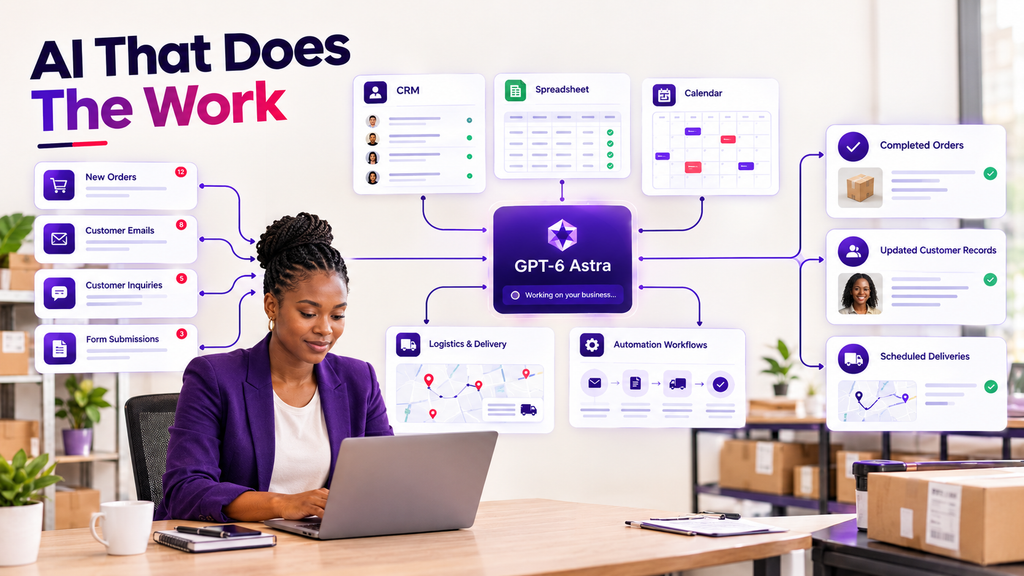
OpenAI describes GPT-6 Astra as its most capable model, with major improvements in computer use, browsing, software engineering, research and professional work. It can interact with websites and applications, update CRM records, fill forms, organize calendars, create documents and spreadsheets, build websites, test software and complete multi-step tasks.
That changes the business question.
Instead of asking, “What can GPT-6 Astra write for me?”
Founders should be asking:
“What work can I delegate to GPT-6 Astra?”
That distinction matters.
Astra is designed for complex, end-to-end work. OpenAI says it can work across websites, desktop applications and internal tools, even when those systems do not have APIs available for traditional automation.
Early users are already testing it across software development, 3D design, video editing, CRM operations, research, finance and other workflows.
Here are 10 practical ways founders and business owners can use GPT-6 Astra today.
- Automate repetitive business operations
One of the clearest use cases for GPT-6 Astra is repetitive computer work.
Think about what happens inside a typical business every day.
Someone receives an enquiry.
They open the email.
They copy information.
They open the CRM.
They create a customer record.
They update a spreadsheet.
They schedule a meeting.
They send a confirmation.
Then they repeat the process.
Astra can potentially handle large parts of this workflow because it can interact directly with software rather than simply telling you how to use it.
OpenAI specifically lists updating customer records, filling online forms and organizing calendars among Astra’s computer-use capabilities.
Example:
A logistics company receives 50 delivery requests through an online form.
Astra could potentially:
Read each request.
Extract the customer information.
Enter it into the company’s CRM.
Update the appropriate spreadsheet.
Check available delivery information.
Prepare the next operational step.
Flag unusual cases for human approval.
The important opportunity for founders is to look for repetitive tasks where employees are essentially moving information from one screen to another.
That is often where computer-using AI can create the fastest productivity gains.
- Turn GPT-6 Astra into a research assistant
Founders constantly need information.
Competitor research.
Customer research.
Market research.
Pricing research.
Industry reports.
Potential suppliers.
Potential customers.
New regulations.
Emerging technologies.
The problem is not finding information.
The problem is turning large amounts of information into something useful.
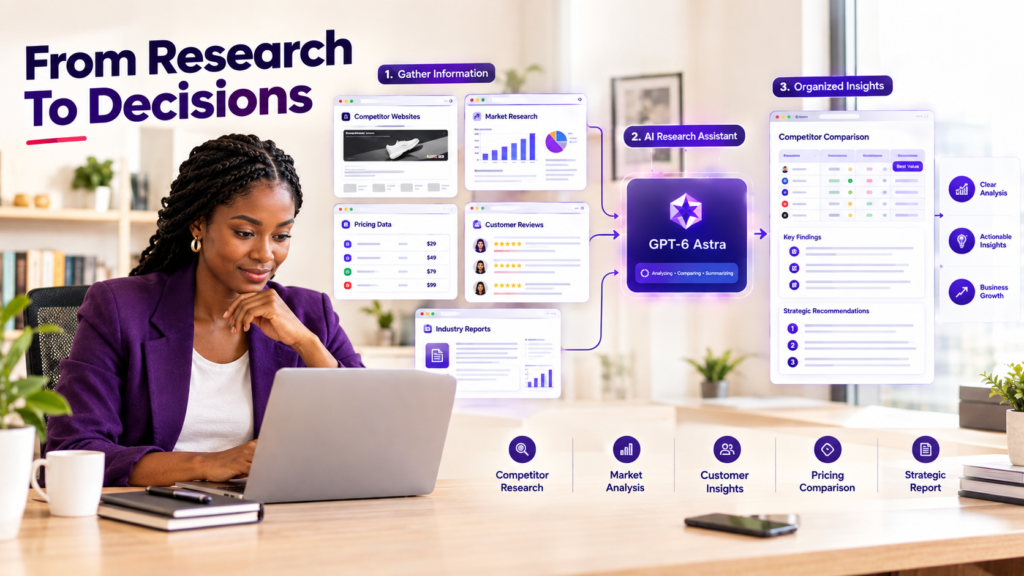
Astra is designed for complex research and professional work, including browsing and producing polished documents and analyses.
Imagine telling Astra:
“Research the top 30 competitors in the Nigerian logistics market. Compare their pricing, delivery areas, services, customer complaints, positioning and acquisition channels. Create a spreadsheet, identify five gaps in the market and prepare a two-page strategic recommendation.”
That is a much more valuable use of AI than asking:
“Give me 10 logistics business ideas.”
The first request connects research, analysis and a business decision.
The second simply produces text.
For founders, this distinction is important.
- Build sales prospecting systems
Sales teams spend enormous amounts of time researching prospects.
Read Also: Fable 5.1 vs GPT-6 Astra: Complete Comparison, Benchmarks, Pricing and Best Use Cases
Astra can potentially help reduce this workload.
For example, a B2B founder could give it a target customer profile:
“Find 100 Nigerian companies with between 20 and 200 employees that sell software to businesses. Identify their website, industry, decision-maker, LinkedIn presence, estimated company size and potential reason they might need workflow automation.”
The next step could be preparing personalized research for each prospect.
Astra could then help organize the information into a spreadsheet or CRM.
The founder can review the list before outreach.
This creates a workflow like:
Research → qualify → organize → personalize → review → outreach.
OpenAI says Astra can work across business applications and create documents, spreadsheets and presentations that follow company templates and standards.
The important point is that AI can increasingly participate in the operational part of sales, not simply write cold emails.
- Create and manage marketing campaigns
Marketing is another area where Astra can potentially handle an entire workflow instead of producing one isolated piece of content.
A founder could provide:
The product.
Target audience.
Brand guidelines.
Customer research.
Previous campaigns.
Competitor information.
Business objective.
Then ask Astra to develop a campaign.
OpenAI’s business examples specifically describe Astra taking one marketing brief and developing messaging and cohesive, on-brand assets across channels.
A practical workflow could look like:
Research competitors.
Identify customer pain points.
Develop campaign positioning.
Create the campaign brief.
Write landing-page copy.
Prepare email sequences.
Create social content.
Build campaign tracking spreadsheets.
Review the final assets against brand guidelines.
The founder still makes the strategic decisions.
Astra handles more of the execution.
- Build websites and internal business tools
This is particularly interesting for founders who do not have large engineering teams.
OpenAI says Astra can create websites, web applications and games through Sites in ChatGPT. It can also install and test software and troubleshoot problems displayed on screen.
That creates a different development workflow.
Instead of:
Idea → developer → specification → development → testing → revisions.
A founder could increasingly work through:
Idea → AI builds → AI tests → founder reviews → AI improves.
For example:
“Build a simple customer portal for my logistics company. Customers should be able to enter a tracking number, view shipment status, see estimated delivery dates and contact support. Use our existing brand guidelines. Test every page before presenting the final version.”
This does not mean every business should fire its developers.
Complex software still needs experienced engineering, security, architecture and human review.
But it can dramatically lower the cost of prototyping and building internal tools.
- Debug and improve software
For technology startups, GPT-6 Astra could become a much more capable engineering assistant.
OpenAI’s business examples describe a workflow where a reported bug can be traced, fixed and verified using Astra through Codex.
Canva has also reported testing GPT-6 on a codebase containing more than 80 million lines of code, alongside more than 1,000 queries against its data warehouse and information from more than 21 internal knowledge sources.
That is significant because it shows a move away from AI generating isolated code snippets.
The more interesting use case is AI working within an existing software environment.
For a startup, the workflow could be:
Customer reports a bug.
Astra investigates the issue.
It identifies the relevant code.
It proposes or implements a fix.
It runs tests.
It checks whether the fix introduced another problem.
It prepares a summary for the developer.
The human engineer still reviews important production changes.
But much of the investigation can potentially be delegated.
- Analyze business data and create management reports
Most businesses collect more data than their owners actually use.
Sales spreadsheets.
Customer records.
Inventory data.
Marketing metrics.
Financial reports.
Support tickets.
Website analytics.
The problem is turning those numbers into decisions.
Astra can analyze data, generate plots and create spreadsheets and professional documents.
A founder could give it a sales dataset and ask:
“Analyze the last 12 months of sales. Identify the fastest-growing products, declining products, customer segments with the highest retention, months with unusual performance and the top five factors associated with repeat purchases. Create charts and a management report.”
The useful part is not the chart.
It is the decision-making layer that comes afterward.
For example:
“Based on this analysis, which three changes should we make next quarter?”
That turns business data into an operating conversation.
Read Also: Anthropic Researcher Warns AI Has More Than a 10% Chance of Killing All Humans
- Prepare financial and investment research
Financial services are already becoming one of the first major enterprise use cases for GPT-6 Astra.
On September 10, 2026, OpenAI announced ChatGPT for Financial Services, built around workflows for investment banking and equity research. The system incorporates data from providers including LSEG, PitchBook and Daloopa and can help professionals conduct research, build financial models and prepare client materials.
This is an important example because it demonstrates something founders can learn from.
The value of advanced AI does not necessarily come from asking it generic financial questions.
The value comes from combining the model with relevant business data and giving it a real workflow.
A startup founder could use a similar approach for internal planning.
For example:
Analyze monthly revenue.
Compare actual revenue against targets.
Identify unusual expenses.
Model different pricing scenarios.
Analyze customer acquisition costs.
Prepare an investor update.
Create a financial planning spreadsheet.
Flag assumptions that need human review.
For regulated financial decisions, human oversight remains essential.
- Create presentations, proposals and business documents
Founders constantly create documents.
Investor decks.
Business proposals.
Sales presentations.
Strategy documents.
Product specifications.
Operations manuals.
Hiring documents.
Partnership proposals.
Astra is specifically trained to produce documents, presentations, spreadsheets and analyses while following existing templates and visual styles.
That means a founder can provide examples of existing company materials and ask Astra to follow the same structure.
For example:
“Using our existing investor presentation as the design reference, create a 12-slide presentation explaining our expansion into Ghana. Use the attached market research, include the financial assumptions, clearly distinguish facts from estimates and keep the presentation suitable for an investor meeting.”
This is much closer to having a junior business analyst or presentation specialist working alongside you than simply having an AI text generator.
- Operate software across multiple applications
This may ultimately be the biggest opportunity for small businesses.
Many companies have software that does not communicate with each other.
A CRM.
An accounting platform.
Email.
Google Sheets.
A project management system.
A website.
A payment platform.
An inventory system.
Traditionally, connecting these systems requires APIs, automation platforms or custom development.
Astra introduces another possibility.
It can interact with computer interfaces like a human user.
OpenAI says Astra can work across websites, desktop applications and internal tools without requiring APIs.
Consider an ecommerce business.
A customer places an order.
The AI could potentially:
Check the order.
Update the appropriate records.
Prepare fulfillment information.
Update inventory.
Create or update customer information.
Prepare a shipping record.
Draft a customer notification.
Flag unusual orders.
This is where AI agents become particularly interesting.
The AI is no longer simply generating information.
It is moving information through the business.
What people are already doing with GPT-6 Astra
The early Astra ecosystem is moving quickly.
Some examples are official company use cases. Others are creator demonstrations. These should not be treated as equivalent evidence.
One of the most interesting early examples comes from Canva. The company says GPT-6 was able to navigate its large codebase, analyze more than 1,000 data-warehouse queries and use more than 21 internal knowledge sources.
Epic Games has also reported using GPT-6 on C++ at the scale of Unreal Engine and testing it on complex problems across engineering and other teams.
Perplexity says combining Astra with its Search as Code architecture produced a 9% performance improvement on its hardest research benchmark while using roughly half the cost of its previous setup.
Outside formal company case studies, early creators have been experimenting with Astra’s ability to control creative software.
One documented launch-week index records demonstrations involving Blender, Unreal Engine, Final Cut Pro, Affinity Photo, Figma, Ableton and other applications.
One creator demonstrated Astra reconstructing a house from real-estate photographs as a 3D environment.
Another demonstrated Astra creating a house in Blender and moving the result into Unreal Engine.
Another turned a 2D train sketch into a Blender scene containing thousands of editable objects.
Another creator demonstrated Astra operating Final Cut Pro, Affinity Photo and Blender as part of a creative workflow.
These examples are particularly interesting because they reveal where Astra differs from a traditional chatbot.
The AI is operating the software.
It is not simply explaining which buttons you should press.
What founders should NOT automate blindly
GPT-6 Astra is powerful.
That does not mean you should give it unrestricted access to your entire company on day one.
OpenAI’s own safety documentation says Astra represents a major increase in cybersecurity capability and has reached its Critical threshold under the company’s Preparedness Framework.
Read Also: 20 New Ways to Make Money With AI as a Beginner in 2026: A Complete Guide
That should encourage founders to think about permissions.
Start with low-risk tasks.
Examples:
Research.
Drafting.
Data organization.
Internal reports.
Testing.
Non-sensitive administrative work.
Then gradually increase access.
For high-impact activities such as:
Bank transfers.
Payroll.
Legal decisions.
Production database changes.
Customer refunds.
Deleting records.
Publishing sensitive information.
Changing security settings.
Keep a human approval step.
The goal is not maximum autonomy.
The goal is useful autonomy with appropriate controls.
A simple GPT-6 Astra framework for founders
If you want to start using Astra inside your business, do not begin by asking:
“What can AI do?”
Start with your existing workflow.
Write down everything your team does during a normal week.
Then divide those tasks into four categories:
Category 1: Think
Research, analysis, planning and decision support.
Category 2: Create
Documents, presentations, marketing materials, code and reports.
Category 3: Operate
Clicking through software, updating records, moving information and completing forms.
Category 4: Verify
Testing, checking, comparing and identifying errors.
The most interesting Astra opportunities sit where several categories meet.
For example:
Research → analyze → create report → update CRM.
Or:
Bug report → investigate → modify code → run tests → report result.
Or:
Customer enquiry → research customer → update CRM → prepare response → schedule follow-up.
The biggest lesson for business owners
GPT-6 Astra is important because it moves AI closer to execution.
Previous generations made it easier to create content.
Then they became better at reasoning.
Then they became better at using tools.
Astra pushes further toward completing entire workflows.
That means the competitive advantage will increasingly come from knowing which business processes to delegate.
Two companies can have access to exactly the same AI model.
One uses it to write social media captions.
The other uses it to research prospects, update its CRM, analyze sales data, test its website, prepare reports and support product development.
They have the same technology.
They do not have the same operating model.
For founders, that is the real opportunity with GPT-6 Astra.
Do not ask how many prompts you can write.
Ask how many hours of repetitive work you can remove from your business without reducing quality or control.
Final thoughts
GPT-6 Astra does not eliminate the need for founders, employees, developers, marketers or operators.
It changes what those people can accomplish.
The most valuable use cases are likely to be the workflows that currently require people to repeatedly research, copy information, switch between applications, prepare documents, analyze data and verify routine work.
OpenAI’s early business examples from companies including Canva, Box, ClickUp, Epic Games and Perplexity suggest that organizations are already testing Astra on complex professional workflows.
Early independent demonstrations point in the same direction. People are increasingly asking Astra to operate software rather than simply explain software.
For a small business, you do not need to automate everything.
Find one repetitive workflow.
Measure how long it currently takes.
Give Astra a controlled version of the task.
Measure the result.
Then expand from there.
That is a much more practical way to turn GPT-6 Astra from an impressive AI model into a real business advantage.
Frequently Asked Questions About GPT-6 Astra for Business
What is GPT-6 Astra?
GPT-6 Astra is OpenAI’s latest advanced AI model, designed for complex reasoning, computer use, software engineering, research and professional work. It can interact with websites and applications, create business documents and complete multi-step workflows.
Can GPT-6 Astra automate business tasks?
Yes. Astra can perform computer-based tasks such as filling forms, updating CRM records, organizing calendars and working across applications. OpenAI says it can operate across websites, desktop applications and internal tools without requiring APIs for every workflow.
Can GPT-6 Astra build websites?
Yes. OpenAI says Astra can create and host websites, web applications and games through Sites in ChatGPT. It can also perform frontend QA and troubleshoot software.
Can GPT-6 Astra help with sales?
Yes. Founders can use it for prospect research, customer research, CRM updates, proposal preparation and other sales operations. Its ability to work directly with software makes it especially useful for multi-step sales workflows.
Can GPT-6 Astra analyze spreadsheets?
Yes. Astra can analyze data, generate plots and produce spreadsheets and other business documents.
Is GPT-6 Astra suitable for small businesses?
Yes. Small businesses may benefit particularly from workflows involving repetitive research, administrative work, CRM updates, reporting, marketing execution, software testing and document creation.
Can GPT-6 Astra replace employees?
That is not a useful assumption. Astra can automate parts of many jobs, but businesses still need people for judgment, accountability, relationships, strategy, creativity and decisions involving significant risk.
What is the best first GPT-6 Astra workflow for a founder?
Start with a repetitive, measurable and low-risk workflow. CRM data entry, competitor research, weekly reporting, document preparation and software testing are good candidates because you can compare the AI’s output with the existing process.
Sources
OpenAI, GPT-6 Astra: A new generation of intelligence.
OpenAI, GPT-6 Astra for Business.
OpenAI, Safety Overview: GPT-6 Astra.
OpenAI, GPT-6 Astra API documentation.
Reuters, OpenAI launches ChatGPT for financial services industry. September 10, 2026.
Built With GPT-6 Astra, independent index of early creator demonstrations.
Author
Written by Olasunkanmi Adeniyi
Olasunkanmi Adeniyi is a solo founder, product builder, no-code and low-code developer, SEO and content strategist focused on practical AI implementation. He builds websites, SaaS products, digital tools and content systems using AI and helps professionals and businesses use AI for productivity, automation, product development and online growth.
Explore more practical AI guides, tools, prompts and automation resources at AI Discoveries.



Leave a Reply