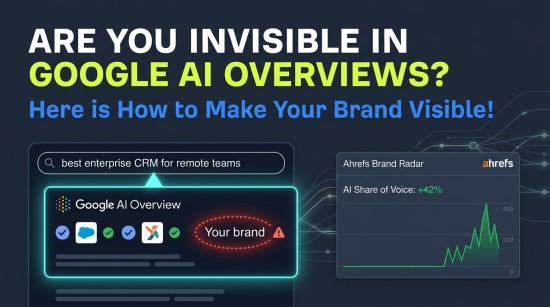
There is a quiet, structural migration happening right now within search engine results pages (SERPs). For the past two decades, Search Engine Optimization (SEO) was governed by a predictable blueprint: rank in the top blue links, secure the click, and convert the traffic on your domain. Today, that user journey is being short-circuited.
Read Also: How to Create Your Beautiful Excel Dashboard Using Claude AI in 2 Minutes
With the integration of Google AI Overviews (formerly SGE), the traditional organic click is being replaced by zero-click, LLM-generated summaries. When a buyer asks an informational or commercial query, Google’s premium AI container synthesizes the answer dynamically, citing specific brands while excluding others. If your product or service is missing from that dynamic summary, you are effectively invisible to the modern searcher.
To retain share of voice, marketing teams must shift from traditional rank tracking to AI retrieval intelligence. This guide provides an actionable, end-to-end framework to track brand visibility Google AI Overviews using the market’s leading enterprise tracking suite: Ahrefs Brand Radar.
1. The Invisible Metric: Why Traditional Rank Tracking is Failing You
Traditional SEO tracking software relies heavily on standard organic positions (1 through 100). If your page sits at position #2 for a high-value commercial query, your dashboard reports standard green arrows and healthy growth. However, this metric masks a structural threat: when Google triggers an AI Overview above the fold, the organic position #1 is pushed down by as much as 1,200 vertical pixels.
Even worse, the AI container does not merely aggregate the top three ranking sites. Studies show that a significant percentage of URLs cited inside Google AI Overviews do not even appear on the first page of standard organic search results. Instead, Google’s Retrieval-Augmented Generation (RAG) engine selects sources based on explicit informational entity mapping and programmatic vector alignment.
The LLM Citation Formula: The math governing visibility within an AI Overview is no longer dominated by simple PageRank ($PR$). Instead, it optimizes for context-aware informational density ($I_d$) and entity relevance ($E_r$):
$$V_{ai} = w_1(I_d) + w_2(E_r) + w_3(PR)$$
Where $V_{ai}$ represents the overall AI visibility vector score, and the weights ($w_1, w_2$) favor conversational alignment over domain authority.
If you rely solely on keyword positions, you are flying blind. You might hold position #1 organically while losing 100% of the conversational visibility within the AI container to a competitor who has optimized for LLM RAG variables. Tracking this conversational share of voice requires a programmatic approach built specifically for AI SERP architectures.
2. Setting Up Ahrefs Brand Radar for AI Search Engine Monitoring
Ahrefs Brand Radar provides the structural tools required to extract, isolate, and quantify your brand’s footprint inside generative search boxes. Follow this sequence to configure your tracking architecture specifically for AI Overviews.
Step 1: Isolate the AI Overview SERP Feature
Within your Ahrefs Rank Tracker project, navigate to the SERP Features filtering dashboard. You must build a dedicated segment to monitor AI interactions:
- Select your primary commercial and informational keyword buckets.
- Apply the SERP Feature filter and choose AI Overview (ensure “Triggered” is active).
- Save this view as your
AI Share of Voice (SoV) Baseline.
Step 2: Configure Entity Variants in Brand Radar
LLMs identify brands as semantic entities rather than simple keyword strings. To ensure Ahrefs captures every instance where your brand is mentioned or cited inside the generative box, you must input your full entity syntax list into the Brand Radar tracking profile. This includes:
JSON
{
  "primary_entity": "Acme Software",
  "alt_syntax_variants": ["Acme Inc", "Acme", "Acme platform", "acme.com"],
  "product_entities": ["Acme CRM", "Acme Analytics Pipeline"]
}
Step 3: Define Your AI Competitor Matrix
Do not simply paste your standard business competitors here. AI Overviews frequently cite informational hubs, niche review blogs, and academic papers alongside direct competitors. Review your top 50 informational queries and extract the top 5 domains consistently cited in the AI boxes. Enter these domains into your Brand Radar comparison matrix to calculate true conversational Share of Voice.
3. How to Identify When Competitors are Being Cited Over Your Brand
Once your configuration is live, your objective is to pinpoint high-value queries where your brand is absent, yet a competitor is actively winning the LLM citation. In Ahrefs Brand Radar, this is visible within the Citation Gap Matrix.
| Target Query / Prompt | Search Volume | AIO Triggered | Cited Entities | Your Status |
| best enterprise CRM for remote teams | 12,400 | Yes | Salesforce, Hubspot, Monday.com | Missing Citation (Red Alert) |
| how to scale multi-region data pipelines | 4,200 | Yes | Databricks, Snowflake | Missing Citation (Red Alert) |
| automated rider verification platform cost | 850 | Yes | YourBrand, Checkr | Cited (Secured) |
Analyze these “Missing Prompts” systematically. Filter your data matrix by high search volume combined with a “Missing” label for your own domain.
If a query like “best enterprise CRM for remote teams” generates an AI Overview that lists three competitors along with links to their landing pages—while your page sits silently at organic position #3 below the fold—you are facing a massive conversion leak. The AI container has already solved the searcher’s prompt; those users will rarely scroll down to click your organic link.
4. Reverse-Engineering the AI Overviews: Uncovering Content Gaps
When Google AI Overviews choose a competitor over your brand, it isn’t an arbitrary decision. It implies that your competitor’s semantic HTML architecture and informational density align more precisely with Google’s internal retrieval model. To get selected, you must isolate the content gaps.
I. Identify the Source Attribution Format
Look closely at how the competitor is cited in the AI summary. Is it a direct quotation, a summarized definition, or an explicit recommendation inside a bulleted list? Google chooses content formats that fit its UX requirements. If the AI overview presents a comparative pricing table, and your page only contains long-form wall-of-text paragraphs, you will be passed over.
II. Uncover Missing Micro-Concepts
LLM search engines break long articles down into independent passages and entities. Your page might cover the macro-topic thoroughly, but it may lack the specific micro-concepts your competitor has laid out. For example, for the query “how to scale multi-region data pipelines,” the AI summary might prioritize sites that explicitly outline “SOC2 latency compliance parameters”—a sub-topic your current content entirely ignores.
5. Action Plan: Turning Citation Gaps Into Content Outlines
Knowing you are missing from the generative summary is only half the battle. You must apply a rigorous, programmatic editorial fix to rewrite your target pages and force Google’s retrieval bot to include your brand. Use this three-step content adjustment framework:
Step 1: Deploy Direct Definition Sentences (NLU Optimization)
Google AI Overviews favor clear, declarative syntax for core thematic definitions. If your article uses playful, conversational jargon to explain a technical concept, rewrite it. Use the Natural Language Understanding (NLU) structural standard: [Target Concept] is [Functional Category] that performs [Core Value Action].
- Before (Weak RAG Alignment): “We like to think of our real-time tracking engine as a magic lens for your operations team to keep an eye on everything at once.”
- After (Strong RAG Alignment): “Real-time tracking is an operational logistics infrastructure that delivers continuous GPS telemetry updates across multi-tenant delivery networks.”
Read Also: How To Find High-Paying Foreign Clients With Claude AI (with 7 ready-to-use Claude prompts)
Step 2: Implement Semantic Structured Tables and Lists
AI containers are designed to give users rapid, scannable data. If a targeted “Missing Prompt” triggers a list or table in the AI Overview, structure that exact data format on your page. Ensure you wrap lists in clean <ul> and <li> tags, and tables in explicit, logically arranged semantic data layouts (<thead>, <tbody>, and clean <th> rows).
Step 3: Build an Actionable Content Optimization Outline
When updating your page to win the missing AI citation, construct your internal content outlines using this programmatic checklist:
- Intent Lock-in: Place a 150-word synthesis block at the absolute top of your page that answers the primary informational intent immediately.
- Entity Association: Co-locate your brand name explicitly alongside industry-standard terminology inside your
<h2>subheadings (e.g., “Configuring [Brand Name] for HIPAA Compliance”). - Structural Schema: Add highly detailed Product, FAQ, or Article Schema structured data markup to give the Google LLM spider unmistakable entity relationships.
By regularly auditing your performance using Ahrefs Brand Radar, identifying your “Missing Prompts,” and restructuring your content using semantic RAG principles, you can confidently protect and scale your brand visibility inside Google’s AI Overviews.
SEO Blueprint Summary Matrix
- Target Core Slug:
/track-brand-visibility-google-ai-overviews-ahrefs - Primary Keyword:
track brand visibility Google AI Overviews - LSI Keywords Included:
Ahrefs Brand Radar,AI Share of Voice,Missing Prompts,Retrieval-Augmented Generation,RAG Optimization,Entity Mapping.
Olasunkanmi Adeniyi is a professional Product Manager, AI Prompt Engineer, and Technical Writer specializing in digital growth strategy, automation frameworks, and AI search optimization architectures.



Leave a Reply