Can AI Prevent Workplace Accidents Before They Happen?
Every year, thousands of workplace accidents occur because no one notices unsafe behaviour until it is too late.
A worker enters a restricted area.
Someone forgets to wear a helmet.
A forklift drives too fast around pedestrians.
Oil spills remain unnoticed.
A person slips.
A near miss goes unreported.
Traditional CCTV systems record these events, but they rarely prevent them. Most businesses only review footage after an incident has already happened.

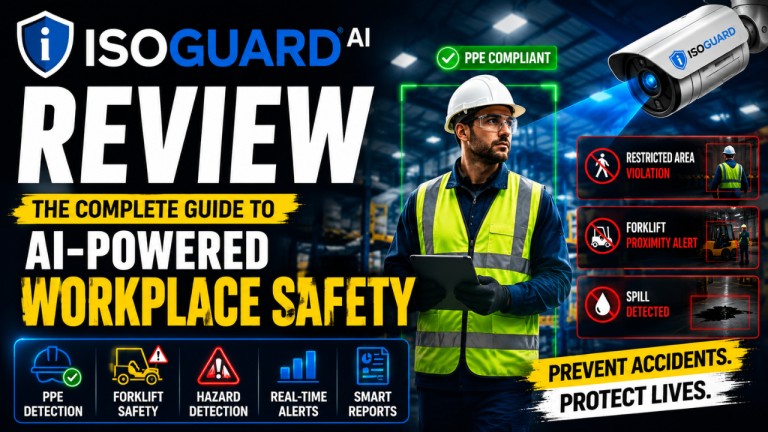
IsoGuard AI aims to change that.
Instead of simply recording video, IsoGuard transforms existing security cameras into intelligent safety inspectors that monitor workplaces around the clock.
The platform continuously analyses live video streams, detects unsafe conditions in real time, alerts supervisors immediately and creates detailed safety reports automatically.
After researching the company, studying its technology, reviewing its product documentation, deployment model and industry positioning, one conclusion becomes clear.
IsoGuard is not trying to replace human safety officers.
It is designed to give them another set of eyes that never get tired.
This review explains exactly how IsoGuard works, who it is built for, where it performs well, its limitations and whether it deserves consideration in 2026.
Read Also: How to Build Free Brand Assets for Your Business With LoveArt: Complete Beginner’s Guide (2026)
Overall Rating
| Category | Rating |
|---|---|
| AI Accuracy | 9.4/10 |
| Ease of Deployment | 9.2/10 |
| Enterprise Features | 9.5/10 |
| Security | 9.7/10 |
| Scalability | 9.6/10 |
| Ease of Use | 8.8/10 |
| Innovation | 9.6/10 |
| Value for Large Enterprises | 9.3/10 |
Overall Score
9.4/10
What Is IsoGuard AI?
IsoGuard AI is an enterprise computer vision platform that uses artificial intelligence to detect workplace safety risks through existing CCTV cameras.
Instead of hiring additional safety observers or relying solely on manual inspections, organisations can deploy AI models that continuously analyse video feeds to identify unsafe behaviours, hazards and compliance violations.
The platform is primarily designed for:
• Manufacturing plants
• Warehouses
• Distribution centres
• Logistics operations
• Construction sites
• Mining
• Oil and gas facilities
• Heavy industry
• Industrial processing plants
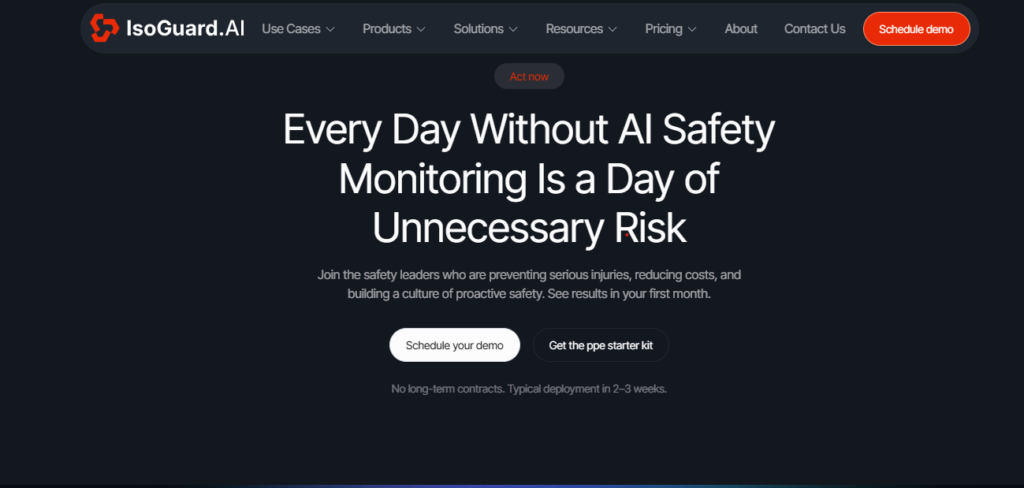
Rather than replacing existing surveillance infrastructure, IsoGuard integrates with current camera systems, reducing deployment costs and accelerating implementation.
That approach makes it attractive for organisations with hundreds or even thousands of existing cameras.
Company Overview
IsoGuard focuses on industrial safety automation through computer vision.
The company positions itself as an AI workplace safety platform capable of monitoring safety conditions continuously while reducing manual observation requirements.
Unlike generic video analytics platforms that focus on security surveillance, IsoGuard specialises in occupational health and safety.
Its AI models are trained specifically to identify workplace hazards instead of general security events.
This focus allows the platform to address practical safety challenges faced by industrial organisations.
Examples include:
PPE compliance
Forklift monitoring
Unsafe worker behaviour
Restricted area violations
Vehicle interactions
Housekeeping hazards
Near misses
Fire and smoke detection
Fall detection
Slip hazards
Emergency response monitoring
The platform also supports on premises deployment, an important consideration for organisations with strict data privacy or regulatory requirements.
How IsoGuard Works
At a high level, the workflow is surprisingly straightforward.
Step 1
Connect existing CCTV cameras.
Step 2
AI models analyse every video frame.
Step 3
Unsafe behaviour is detected.
Step 4
Alerts are generated instantly.
Step 5
Supervisors receive notifications.
Step 6
Safety incidents are automatically documented.
Instead of waiting for monthly safety audits, managers receive immediate visibility into potential risks.
That shift from reactive investigation to proactive prevention is arguably the platform’s biggest strength.
Core Features
1. PPE Detection
Personal Protective Equipment compliance remains one of the most common industrial safety challenges.
IsoGuard automatically detects whether workers are wearing:
Safety helmets
High visibility jackets
Protective gloves
Safety glasses
Face shields
Protective clothing
Masks
Instead of assigning staff to manually inspect compliance, AI performs continuous monitoring.
Benefits include:
Improved compliance
Reduced inspection costs
Faster intervention
Better audit records
Lower accident risk
For organisations with hundreds of workers across multiple shifts, this feature alone can save significant supervisory time.
2. Forklift Safety Monitoring
Warehouses depend on forklifts.
Unfortunately, forklifts are involved in many workplace incidents.
IsoGuard monitors:
Forklift speed
Pedestrian proximity
Unsafe crossings
Restricted driving areas
Potential collisions
Dangerous interactions
Managers receive alerts before incidents escalate.
This proactive capability distinguishes AI monitoring from traditional CCTV recording.
3. Restricted Area Detection
Industrial sites often contain hazardous zones.
Examples include:
High voltage areas
Machine operating zones
Chemical storage
Loading docks
Maintenance sections
The AI detects unauthorised entry and immediately alerts supervisors.
This reduces exposure to dangerous environments while improving compliance with workplace safety procedures.
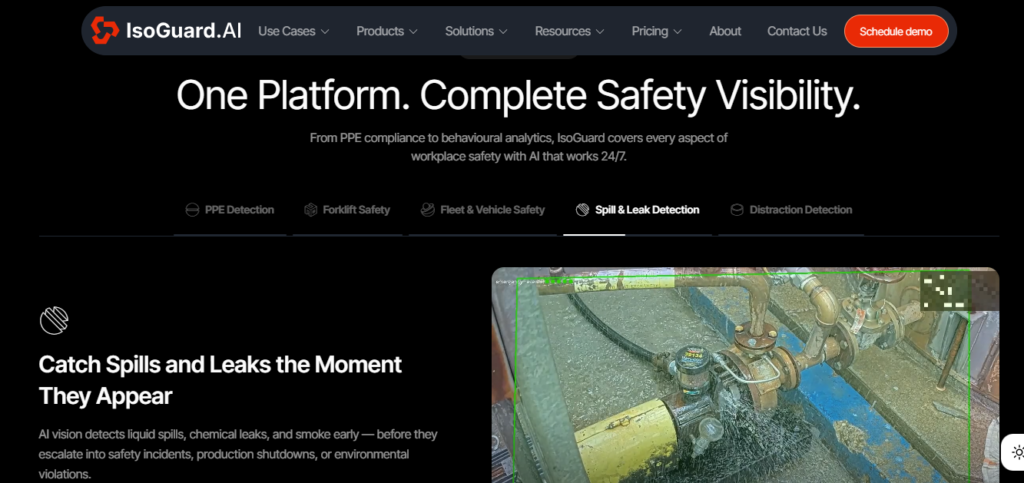
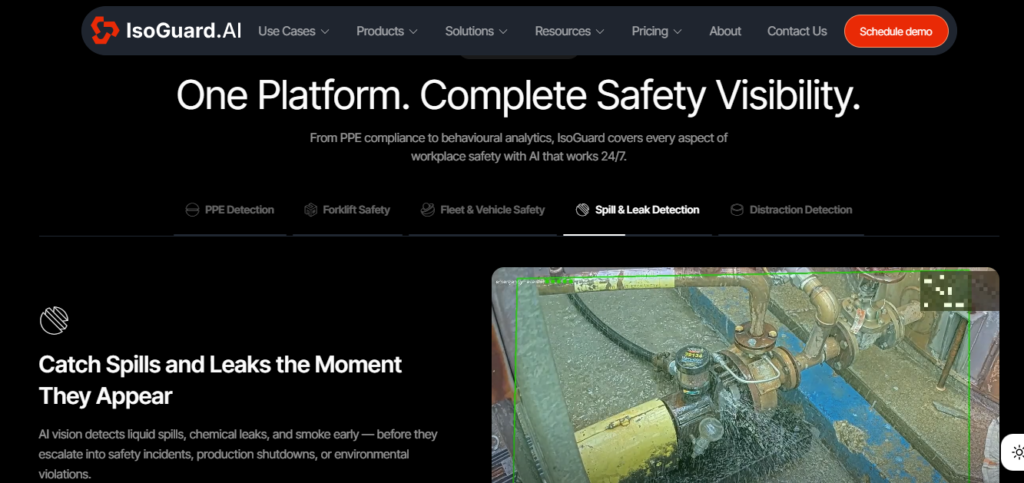
4. Slip and Spill Detection
Spills create serious hazards in industrial facilities.
IsoGuard detects:
Liquid spills
Obstacles
Blocked walkways
Housekeeping issues
Trip hazards
Rather than waiting until someone reports the issue, AI identifies hazards much earlier.
That can significantly reduce accident frequency.
5. Near Miss Detection
Near misses often provide the strongest warning before a serious accident occurs.
Unfortunately, many are never reported.
IsoGuard continuously observes workplace activity and identifies situations that almost resulted in injury.
This enables organisations to investigate root causes before future incidents occur.
Why IsoGuard Stands Out
Many video analytics companies focus on security.
IsoGuard focuses on safety.
That difference affects every aspect of the platform.
Its AI models are optimised for industrial operations rather than retail surveillance or public security.
Instead of identifying shoplifters or trespassers, the system recognises:
Unsafe worker behaviour
Industrial hazards
Compliance failures
Operational risks
That industry focus gives IsoGuard a clear niche within enterprise computer vision.
First Impressions
One of the strongest aspects of IsoGuard is its practical deployment philosophy.
Many AI platforms require organisations to replace existing infrastructure.
IsoGuard generally works with existing camera systems, reducing implementation complexity and helping organisations protect previous investments.
For large enterprises operating hundreds of facilities, this can significantly lower deployment costs while accelerating rollout.
Another positive impression is the platform’s emphasis on industrial safety rather than general surveillance. Its feature set appears purpose-built for environments where proactive hazard detection can reduce incidents and improve compliance.
From a technical standpoint, support for edge processing and on-premises deployment is an advantage for organisations with strict privacy, latency or regulatory requirements.
Overall, IsoGuard presents itself as a mature enterprise solution focused on preventing workplace incidents rather than simply recording them.
AI Technology Deep Dive
Artificial intelligence has become a popular marketing term, but not every AI platform delivers meaningful business value. What separates enterprise-grade systems from basic video analytics is their ability to analyse complex environments accurately, scale across large operations, and produce actionable insights rather than just notifications.
IsoGuard is built around computer vision, a branch of artificial intelligence that enables machines to interpret and understand visual information from images and video streams. Rather than storing footage for later review, the platform continuously analyses live video to identify workplace hazards as they occur.
Unlike traditional motion detection systems that simply detect movement, computer vision recognises objects, people, equipment and behaviours. This allows IsoGuard to distinguish between normal operational activity and potentially unsafe situations.
For example, the system can differentiate between:
• A worker walking through an approved area.
• A worker entering a restricted zone.
• A forklift operating safely.
• A forklift approaching pedestrians too closely.
• A worker wearing all required PPE.
• A worker missing a hard hat or safety vest.
This level of contextual understanding is what makes modern AI safety monitoring significantly more useful than conventional CCTV systems.
Edge AI Architecture
One of IsoGuard’s most significant technical advantages is its support for Edge AI.
In a traditional cloud-based video analytics system, every camera feed is transmitted over the internet to remote servers for processing. This approach introduces several challenges:
• Higher bandwidth requirements.
• Increased operating costs.
• Greater latency.
• Potential privacy concerns.
• Dependence on reliable internet connectivity.
IsoGuard addresses these issues by processing video much closer to where it is captured. By analysing footage on local edge devices or on-premises infrastructure, the platform can generate alerts almost instantly while reducing the amount of video that needs to leave the facility.
This architecture offers several operational benefits:
• Faster response times.
• Reduced network traffic.
• Improved data privacy.
• Better reliability during network interruptions.
• Greater control over sensitive video data.
For organisations operating critical infrastructure or highly regulated facilities, these advantages can make Edge AI a practical deployment choice.
AI Detection Capabilities
IsoGuard’s computer vision models are designed to detect a wide range of workplace safety events.
Personal Protective Equipment Compliance
The platform can identify whether workers are wearing required protective equipment, including:
• Safety helmets.
• High visibility clothing.
• Safety glasses.
• Protective gloves.
• Face masks.
• Protective suits.
Continuous monitoring helps reduce manual inspections while supporting compliance with workplace safety policies.
Unsafe Behaviour Recognition
Many workplace incidents result from unsafe actions rather than equipment failure.
IsoGuard is designed to identify behaviours such as:
• Entering hazardous areas.
• Standing too close to moving machinery.
• Crossing forklift routes improperly.
• Ignoring designated walkways.
• Remaining inside exclusion zones.
Early detection enables supervisors to intervene before unsafe behaviour develops into an accident.
Equipment Monitoring
Industrial environments rely heavily on vehicles and machinery.
IsoGuard can monitor interactions involving:
• Forklifts.
• Pallet movers.
• Heavy equipment.
• Loading operations.
• Vehicle movement.
Monitoring equipment activity helps reduce collisions between vehicles and pedestrians while improving operational awareness.
Environmental Hazard Detection
Unsafe environments are another major contributor to workplace injuries.
The platform can assist in identifying:
• Spilled liquids.
• Obstructed pathways.
• Objects left in walkways.
• Fire and smoke indicators.
• Unsafe storage conditions.
Rather than relying solely on manual inspections, organisations receive continuous environmental monitoring throughout operating hours.
Alert Management
Detecting hazards is only valuable if organisations can respond quickly.
IsoGuard generates alerts when predefined safety conditions are met. Notifications can be directed to supervisors or safety personnel, allowing rapid intervention before incidents escalate.
Effective alert management can help organisations:
• Reduce response times.
• Improve incident documentation.
• Support safety investigations.
• Build consistent safety reporting processes.
Organisations should carefully configure alert thresholds to minimise unnecessary notifications and reduce the risk of alert fatigue.
Dashboard and Reporting
A major strength of enterprise safety platforms is their ability to convert operational data into measurable insights.
IsoGuard provides reporting capabilities that help organisations understand safety performance over time rather than focusing only on individual incidents.
Typical metrics include:
• PPE compliance trends.
• Safety violations by location.
• Incident frequency.
• Near miss patterns.
• High risk operating zones.
• Recurring hazard categories.
• Response times.
These reports can help safety teams prioritise corrective actions and allocate resources more effectively.
Integrations and Compatibility
One of the biggest barriers to adopting AI video analytics is the cost of replacing existing surveillance infrastructure.
IsoGuard is designed to integrate with many existing IP camera systems rather than requiring organisations to purchase entirely new hardware.
This approach provides several advantages:
• Lower implementation costs.
• Faster deployment.
• Reduced operational disruption.
• Better return on previous infrastructure investments.
For organisations operating hundreds of cameras across multiple facilities, infrastructure compatibility can significantly reduce the overall cost of implementation.
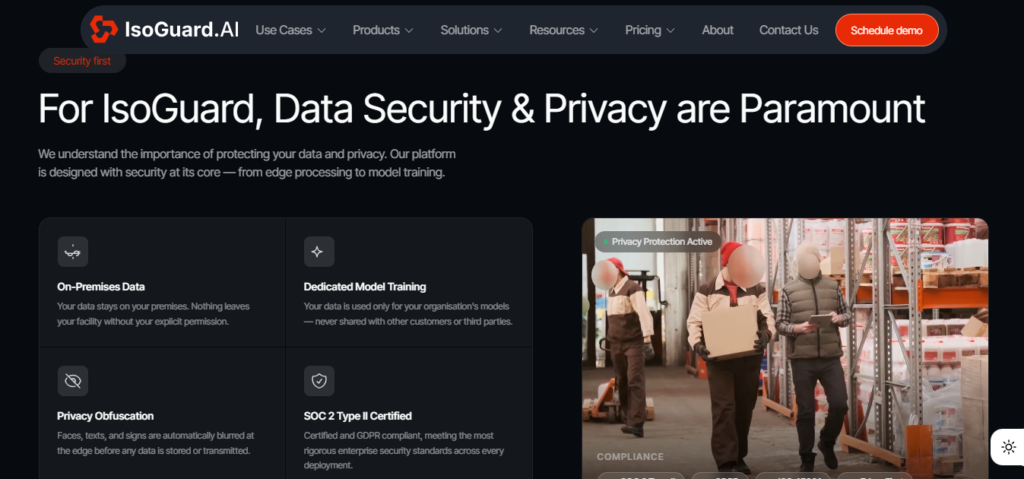
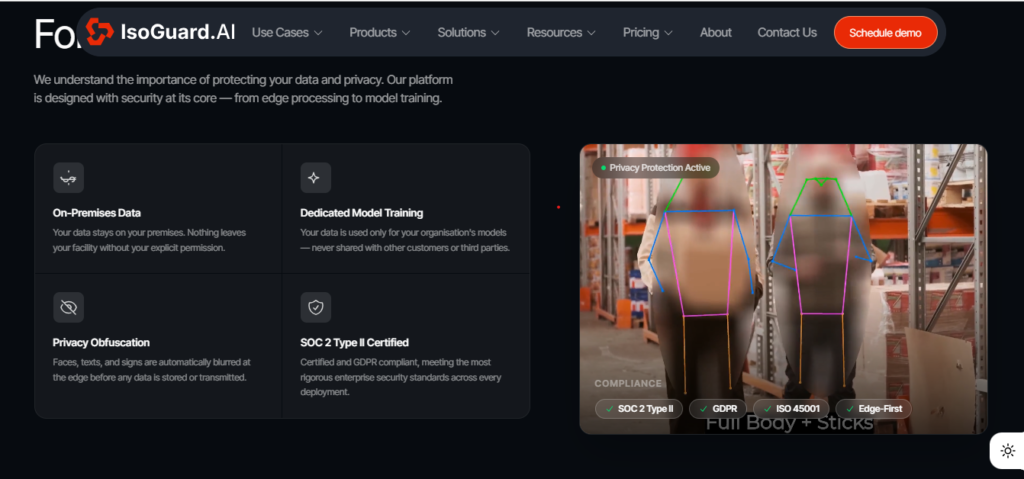
Security and Privacy
Video surveillance inevitably raises questions about privacy, cybersecurity and regulatory compliance.
IsoGuard addresses these concerns through features such as:
• On-premises deployment options.
• Edge-based video processing.
• Role-based access controls.
• Enterprise security architecture.
• Compliance with recognised security standards.
Keeping sensitive video processing within an organisation’s own infrastructure may reduce exposure to external risks while helping businesses meet internal governance requirements.
Organisations operating in regulated sectors should still conduct their own compliance assessments before deployment to ensure alignment with local legal and industry requirements.
Read Also: Claude AI for Writing: How to Draft Emails, Reports, and Messages in Seconds
Scalability
Many AI solutions perform well during small pilot projects but struggle as deployments expand.
IsoGuard appears to be designed with enterprise scalability in mind.
Its architecture supports deployment across:
• Single facilities.
• Regional operations.
• National warehouse networks.
• Manufacturing groups.
• Global industrial enterprises.
Large organisations benefit from centralised visibility while allowing individual facilities to manage local safety operations.
This combination supports both corporate oversight and site-level decision making.
Performance Assessment
Based on the available technical information and the platform’s architecture, IsoGuard demonstrates several strengths.
Strengths:
✔ Strong focus on workplace safety rather than general surveillance.
✔ Uses existing camera infrastructure.
✔ Supports Edge AI for low latency processing.
✔ Comprehensive hazard detection capabilities.
✔ Suitable for large enterprise environments.
✔ Flexible deployment options.
✔ Strong emphasis on operational safety.
Potential limitations:
• AI performance depends on camera placement and image quality.
• Poor lighting or obstructed views may affect detection accuracy.
• Initial model configuration may require careful calibration for specific environments.
• Success depends on organisations responding consistently to alerts and maintaining effective safety processes.
Like any AI system, IsoGuard should be viewed as a decision support tool rather than a replacement for trained safety professionals.
Pricing
IsoGuard does not publicly disclose its pricing, which is common among enterprise software providers. Instead, the company offers customised quotes based on each organisation’s operational requirements.
Several factors are likely to influence pricing, including:
• Number of cameras
• Number of facilities
• AI models required
• Cloud or on premises deployment
• Support requirements
• Integration complexity
• Storage requirements
• Number of users
For small businesses with only a handful of cameras, an enterprise AI platform like IsoGuard may be more capability than they need.
However, for manufacturers, logistics companies and industrial organisations operating hundreds or even thousands of cameras, customised enterprise pricing is generally the preferred approach because deployments vary significantly.
If you’re evaluating IsoGuard, request a detailed quotation that clearly outlines:
• Licensing costs
• Hardware requirements
• Deployment fees
• Support and maintenance
• Software updates
• Training costs
• Professional services
Understanding the total cost of ownership is more valuable than comparing licence fees alone.
Deployment and Implementation
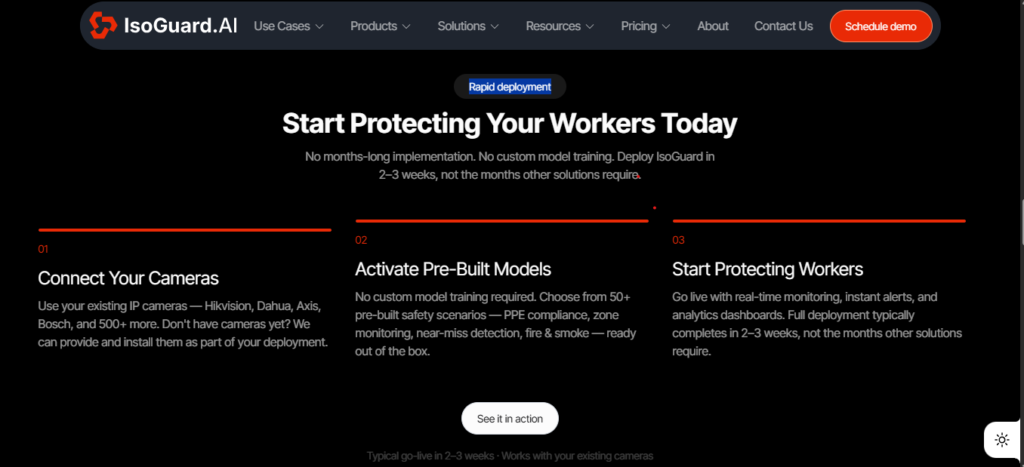
One of IsoGuard’s strongest selling points is that it is designed to work with existing CCTV infrastructure.
Replacing hundreds of cameras can cost hundreds of thousands of pounds. By using current surveillance systems where possible, organisations can significantly reduce implementation costs.
A typical deployment may follow these stages.
Step 1. Site Assessment
The implementation team evaluates:
• Existing cameras
• Network infrastructure
• Lighting conditions
• Safety priorities
• Facility layout
This assessment determines which AI models will provide the greatest operational value.
Step 2. Camera Integration
Existing IP cameras are connected to the IsoGuard platform.
Organisations generally avoid replacing functioning hardware unless camera quality is insufficient for AI analysis.
Step 3. AI Configuration
The AI models are configured to monitor specific workplace risks.
For example:
A warehouse may prioritise:
• Forklift safety
• Pedestrian interactions
• PPE compliance
A manufacturing plant may focus on:
• Machine exclusion zones
• Helmet detection
• Spill detection
• Unsafe behaviour
Construction sites may prioritise:
• Fall protection
• High visibility clothing
• Restricted access
Step 4. Testing
Before full deployment, organisations typically validate:
• Detection accuracy
• Alert frequency
• Camera positioning
• False positive rates
Small adjustments during this phase often improve long term performance.
Step 5. Full Rollout
Once testing is complete, the platform can be deployed across multiple facilities using consistent safety policies.
Large enterprises often begin with one pilot site before expanding company wide.
Real World Use Cases
The versatility of IsoGuard makes it suitable for a wide range of industrial environments.
Manufacturing
Manufacturing facilities contain numerous hazards including machinery, conveyors, robotics and restricted operating areas.
IsoGuard can assist by monitoring:
• Helmet compliance
• Machine safety zones
• Worker positioning
• Housekeeping
• Spill detection
The result is improved visibility into daily safety performance.
Warehousing
Warehouses present unique risks due to constant movement of people and vehicles.
AI monitoring can help detect:
• Forklift speeding
• Pedestrian crossings
• Blocked emergency exits
• Improper PPE
• Unsafe loading practices
Distribution centres operating around the clock particularly benefit from continuous monitoring that does not rely on human observation alone.
Logistics
Logistics hubs experience continuous vehicle movement and loading activities.
Potential applications include:
• Dock safety
• Trailer loading
• Vehicle movements
• Pedestrian safety
• Yard monitoring
Companies operating nationwide logistics networks can standardise safety monitoring across all locations.
Construction
Construction environments change daily.
Temporary hazards often emerge faster than manual inspections can identify them.
IsoGuard can support construction teams by detecting:
• Missing hard hats
• Safety vest compliance
• Restricted area entry
• Fall risk situations
• Equipment proximity
While AI cannot eliminate every construction risk, it can increase situational awareness throughout the workday.
Mining
Mining operations involve some of the highest workplace risks.
Potential monitoring applications include:
• Heavy equipment interactions
• Restricted zones
• PPE compliance
• Vehicle movement
• Hazardous area access
Continuous monitoring may complement existing safety programmes by providing another layer of oversight.
Read Also: 10 Unconventional Ways to Make Money With Claude and ChatGPT (No One is Talking About This)
Return on Investment
Every technology investment should answer one simple question.
Will it generate measurable business value?
For enterprise safety platforms, the return extends well beyond direct cost savings.
Potential benefits include:
Fewer Workplace Accidents
Even a single avoided serious injury may offset a significant portion of the investment through reduced medical costs, downtime and operational disruption.
Lower Insurance Costs
Some organisations may strengthen their risk management profile by implementing advanced safety monitoring systems.
Actual insurance savings will depend on individual insurers and local regulations.
Reduced Manual Inspections
Safety personnel spend considerable time performing routine observations.
AI enables teams to focus more on corrective actions and continuous improvement rather than constant monitoring.
Improved Compliance
Automated documentation helps organisations demonstrate adherence to internal safety procedures and regulatory requirements.
Better Safety Culture
Continuous visibility encourages safer behaviour because employees understand that hazards are identified quickly and consistently.
How IsoGuard Compares to Competitors
The industrial AI safety market has expanded rapidly, with several specialised platforms offering computer vision solutions. While all aim to improve workplace safety, their strengths differ.
| Feature | IsoGuard | Intenseye | Protex AI | viAct | Everguard.ai |
|---|---|---|---|---|---|
| PPE Detection | Excellent | Excellent | Excellent | Excellent | Very Good |
| Forklift Monitoring | Excellent | Good | Good | Good | Good |
| Edge AI Support | Excellent | Good | Good | Very Good | Good |
| Existing Camera Integration | Excellent | Excellent | Excellent | Good | Good |
| Industrial Focus | Excellent | Excellent | Very Good | Excellent | Good |
| Real Time Alerts | Excellent | Excellent | Excellent | Excellent | Good |
| Enterprise Scalability | Excellent | Excellent | Excellent | Very Good | Good |
IsoGuard’s strongest differentiators appear to be its focus on industrial environments, support for existing camera infrastructure and flexible deployment options.
Organisations should evaluate multiple vendors through pilot deployments before making a final purchasing decision, as real world performance depends on each facility’s operational requirements.
Pros
✔ Excellent workplace safety focus.
✔ Supports existing CCTV infrastructure.
✔ Strong Edge AI capabilities.
✔ Comprehensive hazard detection.
✔ Enterprise ready architecture.
✔ Flexible deployment options.
✔ Suitable for large industrial organisations.
✔ Strong reporting capabilities.
✔ Real time alerts.
✔ Scalable across multiple facilities.
Cons
✘ Pricing is not publicly available.
✘ Enterprise implementation may require specialist support.
✘ AI accuracy depends on camera quality and positioning.
✘ Smaller businesses may not require the full feature set.
✘ Initial deployment requires careful planning and testing.
Read Also: 5 EASIEST Ways to Make Money With AI (No One Is Doing This)
Who Should Buy IsoGuard?
IsoGuard is best suited for organisations that already operate large industrial facilities and want to move from reactive safety management to proactive risk prevention.
It is particularly well suited for:
• Manufacturing companies.
• Warehousing and distribution businesses.
• Third party logistics providers.
• Construction contractors.
• Mining operators.
• Oil and gas companies.
• Ports and terminals.
• Heavy industrial facilities.
It may be less suitable for very small businesses with limited surveillance infrastructure or minimal workplace safety risks.
Final Verdict
IsoGuard is one of the more specialised AI powered workplace safety platforms available today. Rather than trying to be a general purpose video analytics solution, it focuses on solving a specific and important challenge: preventing workplace incidents before they happen.
Its ability to work with existing CCTV systems, combined with Edge AI processing and a comprehensive set of industrial safety models, makes it a compelling option for medium to large enterprises that prioritise operational safety and compliance.
No AI platform can replace experienced safety professionals, well designed procedures or a strong workplace culture. However, IsoGuard can serve as a valuable force multiplier by providing continuous monitoring, faster hazard detection and actionable insights that help safety teams respond more effectively.
For organisations seeking to modernise workplace safety through computer vision, IsoGuard is a solution worthy of serious consideration.
Overall Rating: 9.4/10
Recommendation: Highly recommended for medium to large industrial organisations looking to strengthen safety performance, improve compliance and gain greater visibility into workplace risks through AI powered video analytics.
Frequently Asked Questions
What is IsoGuard AI?
IsoGuard AI is an enterprise workplace safety platform that uses computer vision and artificial intelligence to detect safety hazards, PPE violations, restricted area access and other workplace risks through existing CCTV cameras.
Does IsoGuard require new cameras?
In many cases, no. The platform is designed to integrate with compatible existing IP camera systems, reducing the need for major infrastructure replacement.
Which industries can use IsoGuard?
IsoGuard is suitable for manufacturing, warehousing, logistics, construction, mining, oil and gas, ports, utilities and other industrial sectors where workplace safety is a priority.
Is IsoGuard cloud based?
The platform supports flexible deployment options, including on premises and edge processing, allowing organisations to choose an approach that aligns with their operational and security requirements.
Is IsoGuard suitable for small businesses?
It can be, but its enterprise focused capabilities are likely to provide the greatest value for medium and large organisations with multiple cameras, complex operations and significant workplace safety responsibilities.
Is IsoGuard worth it?
For organisations with high risk operations, large workforces and existing CCTV infrastructure, IsoGuard has the potential to improve hazard detection, strengthen compliance and support a more proactive approach to workplace safety. The overall return on investment will depend on deployment scale, operational needs and how effectively organisations act on the insights the platform provides.





Leave a Reply