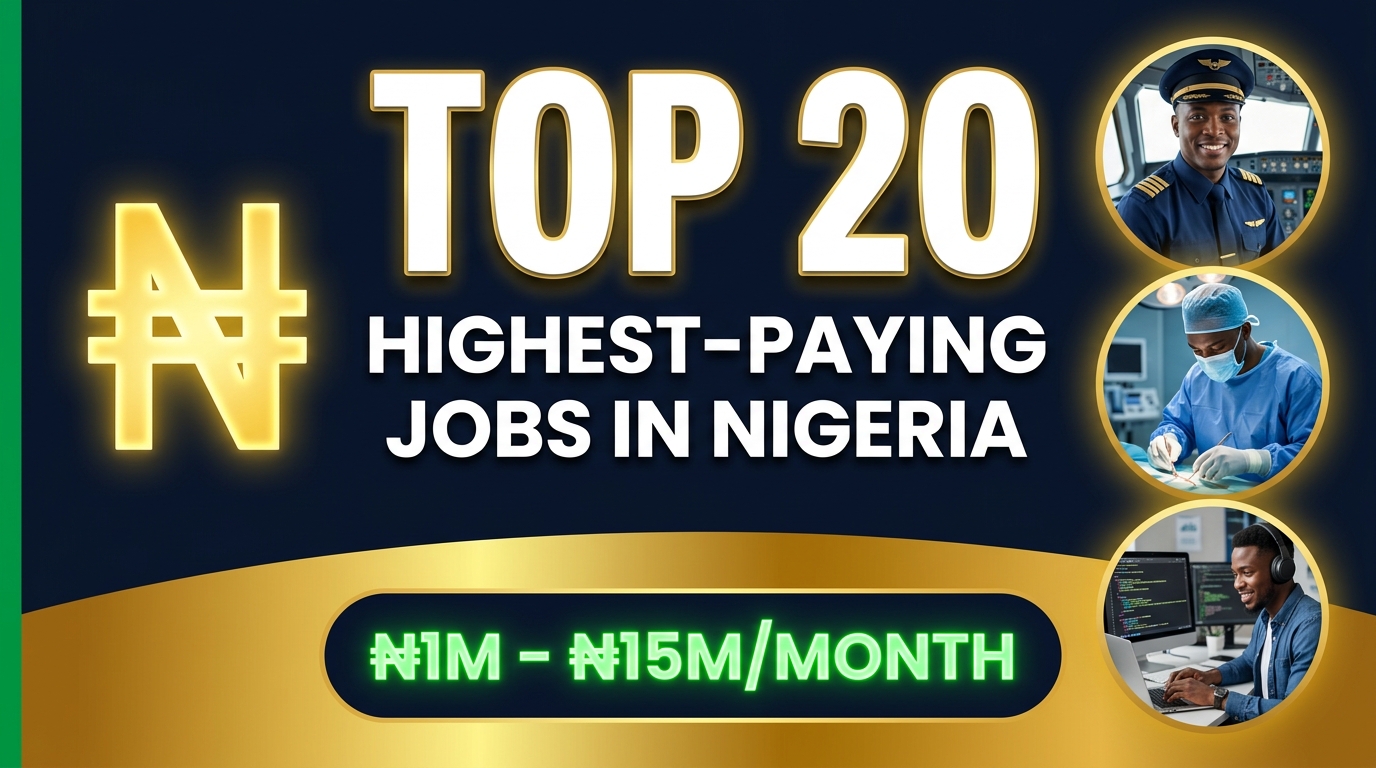
Looking for the most lucrative career paths in Nigeria? Whether you are a fresh graduate, a mid-career professional, or a parent advising a child, this comprehensive guide breaks down the top 20 highest-paying jobs in Nigeria, the exact salary ranges you can expect, the qualifications required, and the industries driving demand.
Nigeria’s economy, the largest in Africa is home to a rapidly growing professional workforce. From oil and gas to fintech, from aviation to medicine, high-paying careers are clustered in sectors where skills are scarce and stakes are high. This guide is built on current market data, industry salary surveys, and verified labour market intelligence.
Quick Answer: The highest-paying jobs in Nigeria in 2025 include Petroleum Engineers, Airline Pilots, Surgeons, Investment Bankers, and Software Engineers — with top earners taking home between ₦2 million and ₦15 million per month.
Table of Contents
- What Counts as a “High-Paying” Job in Nigeria?
- Top 20 Highest-Paying Jobs in Nigeria
- Salary Comparison Table
- Factors That Affect Salary in Nigeria
- How to Break Into High-Paying Careers in Nigeria
- FAQs

What Counts as a “High-Paying” Job in Nigeria?
Nigeria’s national minimum wage stands at ₦70,000 per month as of 2024. The median monthly salary across all formal-sector jobs is approximately ₦250,000–₦400,000. For the purposes of this guide, a “high-paying” job is any role where monthly gross earnings exceed ₦1,000,000 (₦1 million) — positioning the earner firmly in the top income bracket in the country.
High salaries in Nigeria are typically driven by:
- Scarcity of skills — roles requiring specialised training or certifications
- Industry revenue — sectors like oil and gas, finance, and aviation generate enormous revenues
- International exposure — roles tied to multinationals or global markets
- Regulatory requirements — professions requiring licensure (law, medicine, aviation)
Top 20 Highest-Paying Jobs in Nigeria
1. Petroleum Engineer
Average Monthly Salary: ₦800,000 – ₦5,000,000+
Nigeria is one of Africa’s top oil producers, and Petroleum Engineers sit at the commanding heights of this sector. These professionals design and develop methods for extracting oil and gas from deposits below the earth’s surface, working with companies like Shell, TotalEnergies, Chevron Nigeria, ExxonMobil, and the Nigerian National Petroleum Company Limited (NNPCL).
Why it pays so well: Oil and gas revenues account for a significant portion of Nigeria’s GDP and export earnings. Petroleum engineers with upstream experience — particularly in deepwater or subsalt environments — command globally competitive packages.
Qualifications required:
- B.Sc. or M.Sc. in Petroleum Engineering, Chemical Engineering, or Geosciences
- Professional membership with the Society of Petroleum Engineers (SPE)
- Nigerian Society of Engineers (NSE) registration
- 3–10 years of field experience significantly boosts earnings
Top employers: Shell SPDC, TotalEnergies EP Nigeria, Seplat Energy, Oando, NNPCL, Aiteo
2. Airline Pilot / Commercial Pilot
Average Monthly Salary: ₦1,200,000 – ₦7,000,000+
Commercial pilots in Nigeria are among the country’s highest-paid professionals, particularly captains on wide-body aircraft. Nigeria’s aviation sector is one of the fastest-growing in Africa, and the chronic shortage of locally trained pilots pushes compensation packages to extraordinary levels.
Why it pays so well: Pilot training takes several years and costs between $80,000 and $150,000. The combination of high training costs, strict regulatory requirements, and genuine scarcity creates extreme wage premiums.
Qualifications required:
- Airline Transport Pilot Licence (ATPL) issued by the Nigerian Civil Aviation Authority (NCAA)
- Minimum 1,500 flight hours (ATPL requirement)
- Class 1 Medical Certificate
- Type Rating on specific aircraft (Boeing 737, Airbus A320, etc.)
Top employers: Air Peace, Ibom Air, United Nigeria Airlines, Dana Air, Arik Air, international airlines hiring Nigerian pilots
3. Surgeon / Medical Specialist
Average Monthly Salary: ₦800,000 – ₦4,500,000+
Surgeons — particularly Cardiothoracic Surgeons, Neurosurgeons, Orthopaedic Surgeons, and Plastic Surgeons — rank among Nigeria’s most respected and highly compensated professionals. Those working in high-end private hospitals or running their own practices can earn significantly above the upper end of this range.
Why it pays so well: A surgeon typically spends 10–15 years in training before independent practice. The combination of extreme intellectual demand, physical skill, life-and-death responsibility, and rare expertise commands premium compensation.
Qualifications required:
- MBBS (Bachelor of Medicine and Bachelor of Surgery) from an accredited Nigerian or foreign university
- Fellowship of the West African College of Surgeons (FWACS) or National Postgraduate Medical College of Nigeria (NPMCN)
- Full registration with the Medical and Dental Council of Nigeria (MDCN)
Top employers: Lagos University Teaching Hospital (LUTH), UCH Ibadan, private hospitals (Eko Hospital, NISA Premier Hospital, St. Nicholas Hospital), personal practice
4. Investment Banker / Finance Executive
Average Monthly Salary: ₦1,000,000 – ₦8,000,000+
Nigeria’s capital markets — driven by the Nigerian Exchange Group (NGX), a growing private equity ecosystem, and an increasingly sophisticated banking sector — support some of the highest salaries in the professional services industry. Managing Directors, Executive Directors, and VPs at top-tier investment banks and asset management firms can earn exceptionally high all-in compensation (base salary + bonuses).
Why it pays so well: Investment banking deals — mergers and acquisitions, capital raises, IPOs — are high-stakes, high-value transactions. A single successful deal can generate millions in fees, which the bank shares with its top talent.
Qualifications required:
- B.Sc. in Finance, Economics, Accounting, or related field
- MBA (especially from a top school) is highly advantageous
- CFA (Chartered Financial Analyst) certification is the gold standard
- ACCA, ICAN, or CIMA adds significant value
Top employers: Stanbic IBTC, Coronation Merchant Bank, FCMB Capital Markets, Vetiva, Afreximbank, Renaissance Capital, Rand Merchant Bank
5. Software Engineer / Tech Lead
Average Monthly Salary: ₦600,000 – ₦5,000,000+ (local + remote)
Software engineering has become one of the most financially rewarding careers in Nigeria, especially for professionals working for international companies on remote contracts (paid in USD, GBP, or EUR). Senior engineers, engineering managers, and full-stack developers with expertise in high-demand technologies earn top-tier incomes.
Why it pays so well: Nigeria’s tech ecosystem — anchored by the “Silicon Savannah” of Lagos — includes unicorn startups (Flutterwave, Paystack, PiggyVest parent Piggytech), and thousands of Nigerian engineers work remotely for companies in the US, UK, and Europe, receiving international salaries.
Key skills that command premium pay:
- Blockchain and Web3 development
- Machine Learning / AI engineering
- Cloud architecture (AWS, GCP, Azure)
- Backend engineering in Go, Rust, or Python
- Mobile development (iOS/Android)
Top employers: Flutterwave, Paystack (Stripe), Kuda Bank, Interswitch, Microsoft Nigeria, Google Nigeria, remote US/EU companies
6. Chief Executive Officer (CEO) / C-Suite Executive
Average Monthly Salary: ₦2,000,000 – ₦15,000,000+
CEOs and C-suite executives (CFO, COO, CTO, CMO) at large Nigerian companies and multinationals receive the highest formal salaries in the country. Compensation at this level typically includes a base salary, performance bonuses, share options, housing allowances, and car benefits.
Why it pays so well: CEOs carry ultimate accountability for an organisation’s performance, strategy, culture, and governance. In publicly listed companies, their packages must attract and retain globally competitive talent.
Top-paying sectors for CEOs: Banking, oil and gas, telecommunications, fast-moving consumer goods (FMCGs), private equity
Examples of high-paying CEO roles:
- Bank CEOs (Tier 1 banks: Access, GTBank, Zenith, First Bank)
- Telecom CEOs (MTN Nigeria, Airtel Nigeria)
- Oil major CEOs and Country Directors
Read Also: How to Create Your Beautiful Excel Dashboard Using Claude AI in 2 Minutes
7. Lawyer / Senior Advocate of Nigeria (SAN)
Average Monthly Salary: ₦600,000 – ₦5,000,000+
Senior lawyers — particularly those with the prestigious Senior Advocate of Nigeria (SAN) rank, or partners at top-tier commercial law firms — earn exceptionally well. Corporate, finance, energy, and dispute resolution lawyers at elite firms command the highest fees.
Why it pays so well: Complex commercial transactions (oil licensing, M&A, bond issuances) and high-value litigation require expert legal counsel. Law firms bill by the hour, and senior partners can bill at rates that translate to enormous monthly earnings.
Qualifications required:
- LL.B. from an accredited Nigerian university
- B.L. (Barrister at Law) from the Nigerian Law School
- Call to Bar
- SAN designation requires at least 10 years of post-call experience and demonstrated legal excellence
Top employers / firms: Aluko & Oyebode, Templars, Udo Udoma & Belo-Osagie, AELEX, Banwo & Ighodalo
8. Medical Doctor (General Practice & Specialist)
Average Monthly Salary: ₦400,000 – ₦3,000,000+
While consultant specialists earn more (see Surgeons above), even general practitioners at private hospitals, oil company clinics, and international NGOs can command very competitive packages. The severe “Japa syndrome” (emigration of doctors abroad) has created a domestic talent scarcity that is pushing salaries higher.
Highest-paying sectors for doctors in Nigeria:
- Oil and gas company medical officers
- Private hospital consultants
- International NGO physicians (WHO, MSF, USAID-funded programmes)
- Telemedicine platforms
9. Data Scientist / Machine Learning Engineer
Average Monthly Salary: ₦500,000 – ₦4,000,000+ (local + remote)
Data science is rapidly becoming one of the hottest — and best-paid — professions in Nigeria. As Nigerian banks, telecoms, and fintechs sit on vast datasets, the ability to extract actionable intelligence from data is extraordinarily valuable.
Key skills:
- Python (Pandas, NumPy, Scikit-learn, TensorFlow, PyTorch)
- SQL and big data tools (Spark, Hadoop)
- Statistical modelling and machine learning
- Data visualisation (Power BI, Tableau)
- Natural Language Processing (NLP)
Top employers: Interswitch, MTN Nigeria, Access Bank, Konga, remote-first international companies
10. Telecommunications Engineer / Network Architect
Average Monthly Salary: ₦500,000 – ₦3,500,000+
With over 200 million mobile subscribers and accelerating 4G/5G rollout, Nigeria’s telecoms sector is a major employer of high-earning engineers. Network architects, RF engineers, and 5G infrastructure specialists are particularly well compensated.
Qualifications required:
- B.Sc. in Electrical/Electronics Engineering or Telecommunications
- Professional certifications: Cisco CCIE, CCNP; Ericsson/Huawei vendor certifications
Top employers: MTN Nigeria, Airtel Nigeria, Glo, 9mobile, IHS Towers, American Towers Corporation Nigeria
11. Chartered Accountant (FCA / ICAN Fellow)
Average Monthly Salary: ₦500,000 – ₦3,000,000+
Chartered accountants — particularly Fellows of the Institute of Chartered Accountants of Nigeria (ICAN) or ACCA members — at partner level in Big Four firms (Deloitte, PwC, KPMG, EY) or as CFOs of large corporations, are among Nigeria’s best-paid finance professionals.
Career progression that maximises earnings:
- ACA → FCA → Finance Manager → CFO
- ACA → Big Four senior manager → Partner (highest earning tier)
Top employers: Big Four firms (Deloitte Nigeria, PwC Nigeria, KPMG Nigeria, EY Nigeria), commercial banks, multinationals
12. Pharmacist (Hospital & Industrial)
Average Monthly Salary: ₦350,000 – ₦2,000,000+
Pharmacists, particularly those in industrial/pharmaceutical manufacturing, oil company dispensaries, or senior hospital pharmacy roles, earn well above average. The most lucrative path for pharmacists is in regulatory affairs, medical sales management, or owning a chain of community pharmacies.
Highest-paying pharma roles in Nigeria:
- Medical Sales Representatives (big pharma) with commissions
- Regulatory Affairs Manager
- Hospital Consultant Pharmacist
- Industrial/Manufacturing Quality Control Manager
Top employers: GlaxoSmithKline Nigeria, Emzor Pharmaceuticals, May & Baker, Sanofi Nigeria, Pfizer Nigeria
Read Also: How To Find High-Paying Foreign Clients With Claude AI (with 7 ready-to-use Claude prompts)
13. Geologist / Geophysicist
Average Monthly Salary: ₦700,000 – ₦4,000,000+
Geologists and Geophysicists working in Nigeria’s oil and gas sector — particularly those with seismic interpretation and subsurface modelling expertise — earn packages comparable to petroleum engineers. Those working offshore or on international assignments receive significant additional allowances.
Key specialisations in high demand:
- Seismic interpreter / Geophysical analyst
- Reservoir geologist
- Exploration geologist
Top employers: Shell, TotalEnergies, NNPCL, Seplat, Schlumberger (SLB), Halliburton, Baker Hughes
14. Actuary
Average Monthly Salary: ₦700,000 – ₦3,500,000+
Actuaries are among the most technically demanding and best-paid professionals in Nigeria’s financial services sector. They apply mathematical and statistical methods to assess financial risks in insurance, pension, and investment products.
Why actuaries earn so much: Nigeria has fewer than 200 qualified actuaries — a critical talent shortage that creates enormous wage premiums.
Qualifications required:
- B.Sc. in Actuarial Science, Statistics, or Mathematics
- Professional exams: Institute and Faculty of Actuaries (IFoA) or Society of Actuaries (SOA) — typically 7–10 exams over several years
Top employers: AIICO Insurance, AXA Mansard, NICON Insurance, Stanbic IBTC Insurance, NLPC Pension Fund Administrators
15. Project Manager (PMP-Certified, Oil & Gas / Construction)
Average Monthly Salary: ₦600,000 – ₦3,500,000+
Project Managers with PMP (Project Management Professional) certification, especially those working on infrastructure, construction, or oil and gas projects, command excellent salaries. Large-scale projects (LNG plants, highway construction, offshore platforms) require seasoned project managers capable of managing multi-billion naira budgets.
Qualifications required:
- PMP certification (Project Management Institute)
- PRINCE2 Practitioner certification
- B.Sc. in Engineering, Architecture, or related discipline
- 5–10 years of project management experience
Top employers: Julius Berger, Dangote Group, NNPCL, Lekoil, construction multinationals
16. University Professor / Academic (Top-Tier Institutions)
Average Monthly Salary: ₦400,000 – ₦2,500,000+
While government university professors often feel undercompensated, professors at private universities (Covenant, American University of Nigeria, Pan-Atlantic) and those who supplement with consulting, research grants, board memberships, and international speaking earn strong overall incomes. Those at the intersection of academia and industry (tech, medicine, law) fare best.
Qualifications required:
- Ph.D. in relevant discipline
- Substantial publication record (peer-reviewed journals)
- 10–20 years in academia for full professorship
17. Architect (Principal / Senior Partner)
Average Monthly Salary: ₦500,000 – ₦2,500,000+
Nigeria’s construction and real estate boom — driven by urbanisation, population growth, and a housing deficit of over 20 million units — has created strong demand for experienced architects. Senior partners at established architecture firms, or those running their own practices, earn very well.
Qualifications required:
- B.Arch or M.Arch from an accredited university
- Registration with Architects Registration Council of Nigeria (ARCON)
- Nigerian Institute of Architects (NIA) membership
Top employers / clients: Dangote Group, Julius Berger, government agencies, high-net-worth private clients, real estate developers
18. Dentist (Specialist / Implantologist)
Average Monthly Salary: ₦400,000 – ₦2,500,000+
Dental specialists — particularly Oral Surgeons, Implantologists, Orthodontists, and Prosthodontists — operating in high-end private practices in Lagos, Abuja, and Port Harcourt earn very impressive incomes. The cosmetic dentistry boom has been a particular driver of premium earnings.
Highest-earning dental specialisations:
- Oral and Maxillofacial Surgery
- Orthodontics (braces, Invisalign)
- Implantology
- Endodontics
19. Aviation Engineer / Aeronautical Engineer
Average Monthly Salary: ₦500,000 – ₦2,500,000+
Aviation engineers — responsible for maintaining, repairing, and certifying aircraft airworthiness — are among Nigeria’s more niche but well-compensated technical professionals. Those with EASA or FAA certifications earn significantly more.
Qualifications required:
- B.Sc. or B.Eng in Aeronautical/Mechanical/Electrical Engineering
- NCAA Aircraft Maintenance Engineer (AME) licence
- EASA Part-66 or FAA A&P certifications are internationally recognised and command premiums
Top employers: Air Peace, Nigerian College of Aviation Technology (NCAT), Nigerian MRO facilities, international airlines
20. Fintech Product Manager / Startup Executive
Average Monthly Salary: ₦600,000 – ₦4,000,000+ (+ equity)
Nigeria’s fintech ecosystem — home to unicorns like Flutterwave and Paystack, and dozens of high-growth startups — has created a booming market for experienced Product Managers, Growth Leads, and startup executives. Compensation often includes equity/stock options that can multiply in value significantly.
Why this role has skyrocketed: Nigeria has over 150 active fintech companies. Competition for experienced PMs who understand both technology and the African financial landscape is fierce.
Read Also: Younger Than Zuckerberg: The Mind-Blowing AI Founder Story of Surya Midha
Key skills required:
- Product strategy and roadmap development
- Agile / Scrum methodologies
- Understanding of Nigerian financial regulations (CBN, SEC)
- Data analytics and user research
- Strong business development skills
Top employers: Flutterwave, Paystack, Kuda Bank, Opay, PalmPay, Moniepoint, PiggyVest, Carbon
Salary Comparison Table
| Rank | Job Title | Min Monthly (₦) | Max Monthly (₦) | Key Sector |
|---|---|---|---|---|
| 1 | Petroleum Engineer | 800,000 | 5,000,000+ | Oil & Gas |
| 2 | Airline Pilot | 1,200,000 | 7,000,000+ | Aviation |
| 3 | Surgeon / Medical Specialist | 800,000 | 4,500,000+ | Healthcare |
| 4 | Investment Banker | 1,000,000 | 8,000,000+ | Finance |
| 5 | Software Engineer (Senior/Remote) | 600,000 | 5,000,000+ | Technology |
| 6 | CEO / C-Suite Executive | 2,000,000 | 15,000,000+ | All sectors |
| 7 | Lawyer (SAN / Senior Partner) | 600,000 | 5,000,000+ | Legal |
| 8 | Medical Doctor | 400,000 | 3,000,000+ | Healthcare |
| 9 | Data Scientist / ML Engineer | 500,000 | 4,000,000+ | Technology |
| 10 | Telecom Engineer / Network Architect | 500,000 | 3,500,000+ | Telecoms |
| 11 | Chartered Accountant (FCA) | 500,000 | 3,000,000+ | Finance |
| 12 | Pharmacist (Industrial/Senior) | 350,000 | 2,000,000+ | Healthcare |
| 13 | Geologist / Geophysicist | 700,000 | 4,000,000+ | Oil & Gas |
| 14 | Actuary | 700,000 | 3,500,000+ | Insurance |
| 15 | Project Manager (PMP) | 600,000 | 3,500,000+ | Construction/Energy |
| 16 | University Professor | 400,000 | 2,500,000+ | Education |
| 17 | Architect (Senior/Principal) | 500,000 | 2,500,000+ | Construction |
| 18 | Dentist (Specialist) | 400,000 | 2,500,000+ | Healthcare |
| 19 | Aviation Engineer | 500,000 | 2,500,000+ | Aviation |
| 20 | Fintech Product Manager | 600,000 | 4,000,000+ | Technology |
Factors That Affect Salary in Nigeria
Even within the same profession, salaries can vary enormously. Here are the key variables:
1. Sector (Private vs. Public vs. International)
Government salaries in Nigeria are significantly lower than private sector equivalents. A doctor at a federal teaching hospital may earn ₦400,000/month, while the same doctor at a private oil-company clinic earns ₦1,200,000+. International organisations (UN agencies, World Bank, USAID-funded NGOs) often pay USD-denominated salaries that dwarf local equivalents.
2. Location
Lagos and Abuja offer the highest salaries in virtually every profession — often 30–60% higher than equivalent roles in other states. Port Harcourt is competitive in oil and gas roles.
3. Years of Experience
Entry-level positions in even the highest-paying fields earn a fraction of senior-level compensation. A graduate petroleum engineer may earn ₦400,000/month; a Chief Petroleum Engineer with 15 years of deepwater experience may earn ₦5,000,000+.
4. International Certifications
Professionals who hold internationally recognised certifications (PMP, CFA, CCIE, ATPL, FWACS, ACCA) consistently earn more than uncertified peers. These credentials signal global competence.
5. Employer Size and Profitability
Tier 1 banks (GTBank, Access Bank, Zenith Bank) pay more than Tier 3 banks. Supermajor oil companies (Shell, TotalEnergies) pay more than marginal field operators. Always research your potential employer’s revenue base.
6. Negotiation Skills
A significant but underappreciated factor. Nigerian professionals who negotiate assertively at the offer stage — and who understand their market value — consistently earn more than passive peers.
How to Break Into High-Paying Careers in Nigeria
If you are currently in a lower-paying role and want to transition into one of these high-earning fields, here is a practical framework:
Step 1: Identify the highest-ROI credential for your target field. For finance: CFA or ACCA. For tech: AWS certifications, Google Cloud, or a strong GitHub portfolio. For oil and gas: a petroleum engineering postgrad or a discipline-specific professional certification.
Step 2: Build a strategic network. In Nigeria’s professional landscape, “who you know” remains enormously important. Join industry associations: NSE, ICAN, NIA, NBA, SPE. Attend sector-specific conferences. Use LinkedIn actively to connect with people in your target roles.
Step 3: Target multinationals and large private-sector employers first. These organisations have the most structured salary bands and are most likely to pay market rates. Build your experience there before moving to smaller firms or starting your own practice.
Step 4: Consider remote work as a salary multiplier. Nigerian tech professionals working remotely for US or European companies effectively earn USD salaries in a naira-cost environment — one of the most powerful wealth-building strategies available today.
Step 5: Invest in continuous professional development. Nigeria’s fastest-rising earners are those who add new, in-demand skills consistently. An accountant who adds data analytics skills, or a lawyer who develops expertise in tech and privacy law, commands a significant premium.
Read Also: How to Use ChatGPT for Business Growth: Step-by-Step Guide
Frequently Asked Questions
What is the highest-paying job in Nigeria in 2025?
The single highest-paying job category in Nigeria is Chief Executive Officer (CEO) of a major corporation, where total compensation can exceed ₦15 million per month. Among technical professionals, Airline Pilots and Investment Bankers are among the very highest earners, with monthly packages regularly exceeding ₦5–8 million for senior professionals.
Which sector pays the most in Nigeria?
Oil and gas remains Nigeria’s highest-paying sector overall, followed by aviation, financial services/banking, and technology (especially fintech and remote tech work). The technology sector is growing the fastest in terms of salary growth.
Is software engineering a good career in Nigeria?
Absolutely. Software engineering is one of the best career choices in Nigeria in 2025 — not only because of high local salaries, but because skilled Nigerian engineers can work remotely for international companies, earning USD-equivalent salaries. Senior software engineers consistently feature among Nigeria’s top 5% of earners.
What jobs are in demand in Nigeria right now?
The most in-demand jobs in Nigeria in 2025 include: Software Engineers, Data Scientists, Cybersecurity Analysts, Petroleum Engineers, Pharmacists, Nurses and Doctors, Fintech Product Managers, and Chartered Accountants. The “Japa” wave of emigration has created acute shortages in healthcare and technical professions.
Can a doctor become rich in Nigeria?
Yes — but it typically requires either specialist training (surgery, cardiology, neurology) combined with private practice, or working for oil companies, international NGOs, or building a strong personal brand as a medical professional. Government hospital salaries alone rarely generate significant wealth.
How does the Japa syndrome affect salaries in Nigeria?
The mass emigration of skilled Nigerian professionals — particularly doctors, nurses, engineers, and tech workers — to the UK, Canada, US, and other countries has created talent shortages in several key sectors. This scarcity is gradually pushing salaries upward, especially in healthcare, where some private hospitals now offer significantly improved packages to retain and attract talent.
Conclusion
Nigeria’s highest-paying jobs are clustered in sectors where skills are rare, stakes are high, and international demand exists for Nigerian talent. Whether your aspiration is the cockpit of a Boeing 737, the operating theatre of a top private hospital, the trading floor of a merchant bank, or a senior engineering role at a global tech company, the path is the same: invest in world-class credentials, target the right employers, and never stop building your professional value.
The salaries detailed in this guide are achievable — thousands of Nigerians earn them today. With the right strategy, the right qualifications, and relentless execution, you can join them.
Last updated: May 2026 | Data sources: Nigerian salary surveys, industry association reports, Jobberman Nigeria salary data, BudgIT Nigeria labour market analysis, and verified professional network intelligence.
Have a question about salaries or career paths in Nigeria? Drop it in the comments below.



Leave a Reply