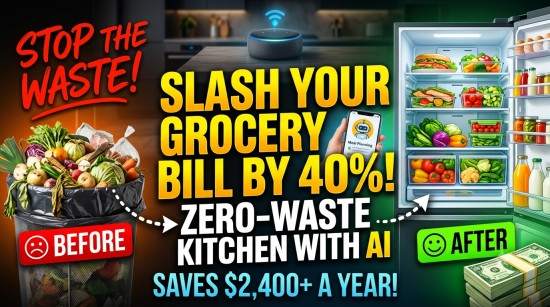
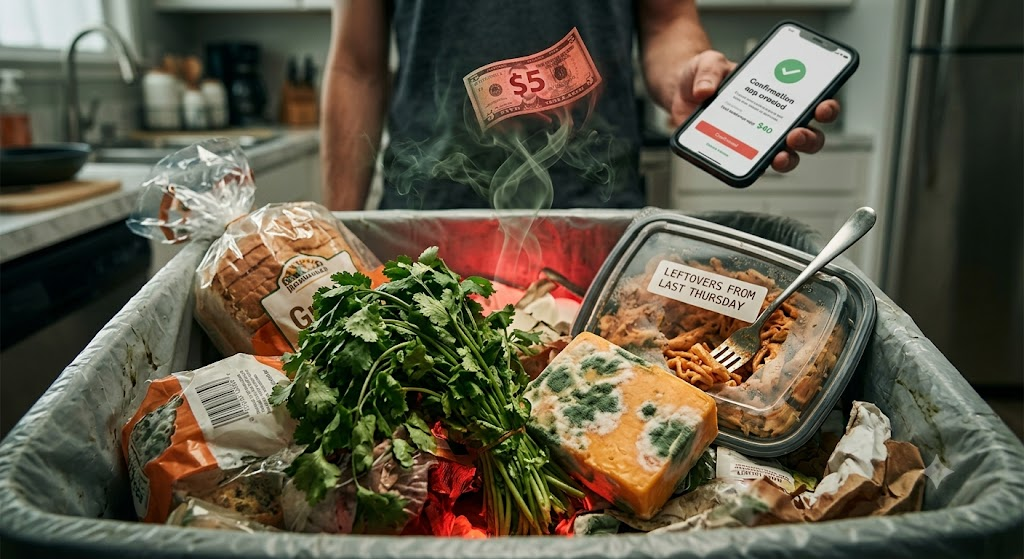
Imagine opening your refrigerator door right now. What do you see? If you are like most people, your gaze passes over a half-empty jar of marinara sauce, a bundle of cilantro turning into dark green slime in the crisper drawer, a container of takeout leftovers from last Thursday, and a block of cheddar cheese with edges just beginning to harden.
Read Also: Visual Prompting: How to Use AI Multimodal Vision to ID Raw Ingredients and Generate Instant Meals
In the past, this scenario followed a predictable, expensive script: you would feel a wave of decision fatigue, close the fridge door, open a food delivery app, spend $40 on a meal, and eventually throw those forgotten ingredients straight into the garbage bag.
This is the hidden tax of the modern kitchen. But a quiet revolution is taking place at the intersection of household economics, sustainability, and artificial intelligence. By transforming your home into an AI-powered Zero-Waste Kitchen, you can instantly halt this financial drain, eliminate food waste, and systematically slash your grocery bill by 40%.
This is not a collection of vague tips about eating your leftovers. This is a comprehensive, multi-layered blueprint designed to turn any standard kitchen into a hyper-efficient culinary ecosystem using consumer AI tools.
1. The Macro Economics of Your Trash Can
To understand why an AI-driven approach is so revolutionary, we have to look objectively at the scale of the problem. Human beings are notoriously poor at tracking their own waste. We suffer from optimism bias; we buy fresh produce on Sunday with every intention of cooking healthy meals all week, completely ignoring the reality of our late-night work meetings, energy crashes, and social invitations.
The Financial Anatomy of Household Food Waste
According to continuous economic studies on consumer habits, the average household discards roughly 30% to 40% of its edible food supply. Let us look at what that actually means for your bank account over time when broken down by typical household sizes:
| Household Size | Average Monthly Grocery Spend | Monthly Waste Value (35%) | Annual Financial Loss | 5-Year Cumulative Loss |
| Single Individual | $250 | $87.50 | $1,050 | $5,250 |
| Couple (2 People) | $450 | $157.50 | $1,890 | $9,450 |
| Family of 4 | $750 | $262.50 | $3,150 | $15,750 |
| Large Family (6 People) | $1,100 | $385.00 | $4,620 | $23,100 |
When you view food waste through this financial lens, it stops being a vague environmental issue and becomes a screaming hole in your household budget. Throwing away a wilted bag of spinach isn’t just an ecological pity; it is the literal equivalent of taking a five-dollar bill out of your wallet, setting it on fire, and flushing it down the toilet.
Why Traditional Systems Stagnate and Fail
For decades, the standard advice for curbing this waste has remained unchanged:
- Keep a handwritten inventory on a dry-erase board hung on your refrigerator.
- Spend your entire Sunday afternoon clipping coupons and drafting rigid meal calendars.
- Build massive, overly complex Excel spreadsheets to track expiration dates.
These systems almost always collapse within three weeks. Why? Because they demand too much cognitive friction. They require you to act like a professional inventory logistics manager after working an eight-hour day. They don’t account for human variables: if you get stuck in traffic on Tuesday, your pre-planned fish recipe is ruined because you don’t have the energy to spend an hour cooking it.
Traditional systems are static. Artificial intelligence, however, is dynamic. It thrives on chaos, adapts instantly to shifting schedules, and removes the mental burden of figuring out what to cook.
2. Understanding the AI Kitchen Toolkit
You do not need an expensive, internet-connected “smart refrigerator” with a built-in touch screen to run a zero-waste kitchen. All you need is a basic smartphone or computer and access to the free or low-cost AI tools already available.
To build your setup, you should understand the three core pillars of AI technology that apply directly to your kitchen:
Computer Vision (The Digital Eyes)
Computer vision is the branch of AI that allows software to analyze, identify, and categorize objects within visual images. When applied to your kitchen, it means you can take a picture of an unorganized shelf in your pantry or fridge, and the AI can instantaneously extract a text list of every single ingredient visible, assessing its quantity and condition.
Large Language Models (The Creative Chefs)
Large Language Models (LLMs) excel at combinatorial logic. Humans struggle to look at five unrelated ingredients—such as a can of black beans, half a jar of salsa, a handful of kale, an open carton of heavy cream, and a box of pasta—and immediately see a coherent, appetizing meal. An LLM can instantly analyze thousands of flavor compounds, culinary traditions, and structural techniques to generate a precise, step-by-step recipe tailored exactly to those items.
Read Also: How to Train a Custom ChatGPT/Gemini Agent to Act as Your Personal Sous Chef
Predictive Algorithmic Planners (The Resource Managers)
These are algorithms that calculate structural efficiencies. They are built into specialized meal-planning applications to ensure that when a meal plan is generated, ingredients are cross-utilized perfectly. If Recipe A requires half a cup of coconut milk, the algorithm scans its database to ensure that Recipe B or C later in the week uses the remaining portion, systematically preventing the open-carton expiration cycle.
3. The “Snap and Cook” Inventory Audit System
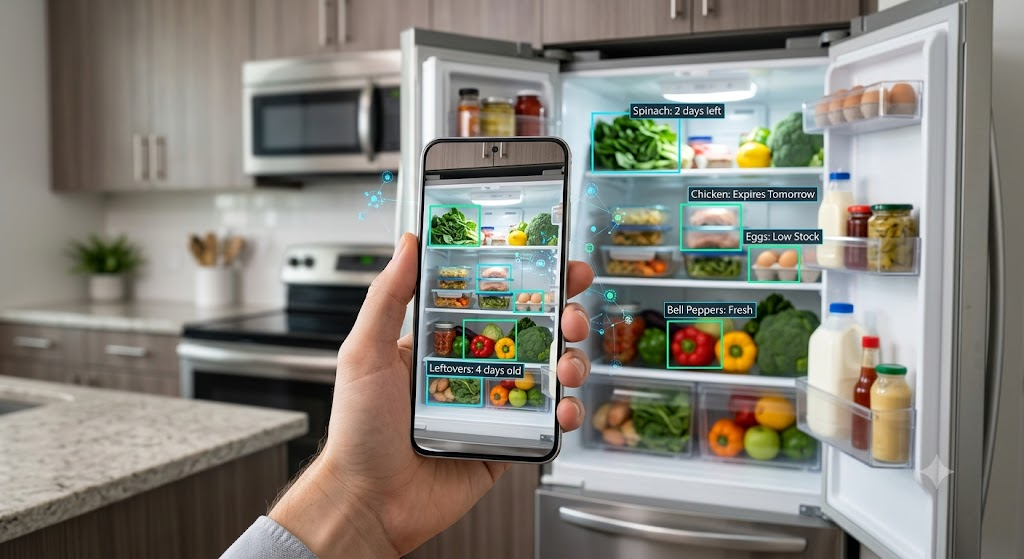
The foundation of saving 40% on your groceries is maintaining absolute awareness of what you already own before you spend a single additional dime. This is where the Snap and Cook system comes in.
+-------------------------------------------------------------+
|               THE SNAP AND COOK INVENTORY CYCLE            |
|                                                             |
|   1. VISUAL CAPTURE    -->   2. AI EXTRACTION   --> 3. TRIAGE  |
|   Take wide-angle           AI lists items,        Highlight   |
|   photos of fridge/pantry.  quantities & status.   at-risk items.|
+-------------------------------------------------------------+
Instead of manually typing out your grocery stock, use this systematic approach once or twice a week to allow AI to perform a rapid kitchen audit:
Step 1: Visual Capture
Open your refrigerator doors completely. Pull out any deep drawers so their contents are visible. Take two wide-angle photographs: one of the main shelves and one of the door compartments. Do the same for your dry-goods pantry or spice cabinet.
Step 2: AI Parsing and Extraction
Upload these images directly into an advanced AI model. Use a highly specific, structurally bounded prompt to force the AI to act as a rigorous data parser rather than a conversational partner.
The Master Inventory Extraction Prompt:
Prompt: “Analyze these images of my kitchen storage. Extract a clean, categorized markdown table of every identifiable food item. Divide the table into three columns: Ingredient Name, Estimated Quantity, and Perishability Status (High, Medium, Low). If an item is obscured or uncertain, list it with a question mark. Do not include conversational filler; output only the data table.”
Step 3: The At-Risk Triage
Once the AI returns your clean data table, you must immediately isolate the items marked as High Perishability. These are your primary financial liabilities. They represent money that will vanish within 48 to 72 hours if action is not taken.
By running this audit before you even think about going to the store, you construct a defensive barrier around your wallet. You force your future meal planning to solve for your existing surplus rather than creating new liabilities.
4. Master the Art of Reverse Recipe Generation
Standard cooking culture is built on a forward-facing framework: you browse social media or a cookbook, select an appealing picture of a dish, write down the long list of components required to create it, and head to the grocery store to buy them all fresh. This is the single biggest driver of kitchen inflation.
The Zero-Waste Kitchen operates entirely on Reverse Recipe Generation. You start with the supply, and let AI calculate the demand.
The Limits of Human Recipe Memory vs. AI Combinatorics
If you ask a skilled home cook what to make with leftover pulled pork, a zucchini, and a carton of sour cream, they might suggest a basic taco or a stuffed zucchini boat. Their brain relies on personal culinary history and memory.
An LLM, however, holds a multi-dimensional map of culinary chemistry. It knows that zucchini can be shredded, salted to extract moisture, and combined with flour and egg to create a savory fritter; it knows that sour cream can be stabilized with acid or spice to form a crema; it knows that pulled pork can be crisped in a skillet to mimic Mexican carnitas or dropped into a savory broth to create a quick pork ramen base.
To unlock this creative engine, you must feed the AI highly constraints-based prompts. If your prompts are too loose, the AI will default to generic internet recipes that secretly require you to run out and buy five more items.
The “No-Buy” Reverse Recipe Prompt Matrix
When you want to cook a meal without spending a single penny at the store, copy and paste this exact prompt template into your AI interface:
Act as an award-winning, zero-waste chef who specializes in high-efficiency budget cooking.

I am presenting you with a list of ingredients that MUST be used tonight to prevent waste:
- [Insert High-Risk Ingredient 1]
- [Insert High-Risk Ingredient 2]
- [Insert High-Risk Ingredient 3]

I also have access to these stable pantry elements and condiments:
- [Insert basic oils, spices, grains, or sauces you always keep stocked]

CRITICAL RULES:
1. You are forbidden from suggesting any recipe that requires ingredients outside of this list.
2. If a binding agent or liquid is required (like eggs, milk, or flour) and I have not listed it, you must find a creative culinary workaround using only what is provided.
3. Provide a clear recipe title, an active prep time estimation, and highly explicit step-by-step cooking instructions.
4. Explain the culinary logic of why these ingredients work together.
Case Study: Turning Kitchen Scraps into Gourmet Dinners
Let us look at a real-world transformation. A user had the following seemingly useless scraps remaining at the end of a week:
- One cup of stale, dried-out white rice.
- The green tops from two bunches of green onions (the white bottoms had been used).
- Half a can of unsweetened coconut milk.
- A single, wrinkled bell pepper.
- Two tablespoons of peanut butter left at the bottom of a plastic jar.
A standard internet search for recipes containing these items yielded zero functional results. However, when run through an LLM with a reverse-recipe prompt, the AI instantly generated a Crispy Coconut-Peanut Rice Skillet with Charred Scallion Glaze.
The AI instructed the user to microwave the stale rice with a splash of water to rehydrate it, whisk the hot coconut milk directly inside the peanut butter jar to dissolve the remaining solids into a rich, savory satay sauce, dice and sauté the wrinkled bell pepper over high heat to mask its soft texture through charring, and fry the rice in a dry pan until crispy before folding the whole mixture together.
The cost of this meal was effectively zero dollars, utilizing items that were hours away from a garbage bag.
5. Building a “Cascade Menu” Calendar
Most meal-planning software fails because it treats every day as an isolated island. Monday is Italian night; Tuesday is Mexican night; Wednesday is Thai night. This categorical jumping is a recipe for financial waste because the un-utilized fresh ingredients from Monday rarely cross over into the flavor profile of Wednesday.
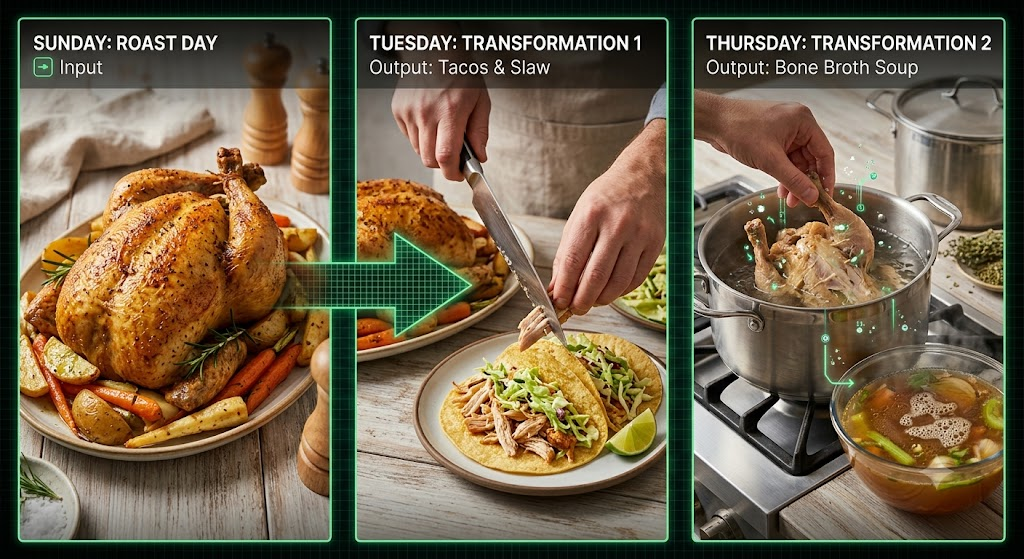
The solution is the Cascade Menu Plan. In a cascade menu, the structural output or surplus of Meal A explicitly becomes the functional input for Meal B.
+--------------------------------------------------------------+
|                    THE CASCADE MENU PIPELINE                 |
|                                                              |
|  SUNDAY: Whole Roasted Chicken & Root Vegetables             |
|    |                                                         |
|    +--> MONDAY LUNCH: Shredded Chicken & Herb Salad          |
|    |                                                         |
|    +--> TUESDAY DINNER: Chicken & Vegetable Enchiladas       |
|                                                              |
|  WEDNESDAY: Roasted Bone Broth Rice Bowl (Using Carcass)    |
+--------------------------------------------------------------+
The Geometry of Cross-Ingredient Efficiency
When you instruct an AI to build a cascade menu, you are asking it to treat your weekly food supply like a continuous pipeline. Let us look at a classic 4-day cascade sequence generated by an AI model optimized for structural ingredient reuse:
- Day 1 (Base Meal): Slow-Roasted Pork Shoulder with Cilantro-Lime Slaw.
- Intentional Surplus: The recipe instructs you to cook a cut of meat twice the size your family needs for a single dinner, and deliberately leaves half a head of cabbage un-shredded.
- Day 2 (Transformation Meal): Crispy Pork Carnitas Tacos with Lime Cabbage Fritters.
- Mechanics: The surplus pork is shredded and crisped under the broiler. The remaining raw cabbage is shredded, mixed with a basic flour-and-water batter, and fried into crisp pancakes, using up the lime juice from the previous night.
- Day 3 (Integration Meal): Pork and Cabbage Fried Rice.
- Mechanics: The tiny bits of remaining pork and cabbage are finely diced. They are tossed into a hot skillet with day-old cold rice (which fries better than fresh rice) and any remaining green onions or eggs.
- Day 4 (Consolidation Meal): Rich Pork Bone Broth Soup.
- Mechanics: The inner bone and trimmed fat caps from the original pork shoulder—which were stored in the freezer on Day 1—are simmered with vegetable scraps to create a rich ramen-style broth, stretching the final scraps of meat into a deeply filling soup.
By utilizing this cascade geometry, your cost-per-meal plummets. You are no longer buying unique sets of ingredients for every calendar day; you are buying versatile, whole-food building blocks that the AI continuously fits together into different shapes.
Read Also: DishGen vs. ChefGPT vs. FoodsGPT: Deep Dive Review of the Best AI Recipe Apps
The Cascade Menu Generation Prompt
To have an AI build this type of high-efficiency calendar for you, use the following prompt format:
Prompt: “Design a 5-day Cascade Menu for a family of [Insert Number]. I want the primary protein or vegetable base of each night’s dinner to deliberately create a structural surplus that forms the core framework for the next day’s meal. The flavor profiles must transition smoothly so that leftover components fit perfectly without clashing. Provide a complete, integrated grocery shopping list at the end that reflects this hyper-efficient cross-utilization. Focus heavily on low-cost, whole food items.”
6. Algorithmic Grocery Shopping: The Defensive Framework
The battle for a budget-friendly kitchen is ultimately won or lost in the grocery store aisles. Grocery store layouts are masterpieces of consumer psychology, meticulously engineered to bypass your rational brain and trigger impulse purchases. The sensory marketing, endcap displays, and loss-leaders are all designed to disrupt your plans.
To survive this, you need an algorithmic defensive framework provided by your AI. You must treat your grocery list not as a creative wishlist, but as a rigid executable script.
The 6-to-1 Shopping Blueprint
A popular framework used by modern culinary logicians is the 6-to-1 Shopping Method. When programmed into an AI grocery compiler, it keeps your shopping cart strictly balanced across nutritional categories while eliminating high-cost, hyper-processed convenience foods.
The rules of the 6-to-1 method dictate that your weekly basket must contain precisely:
- 6 Veggies: Highly versatile, whole vegetables (e.g., onions, carrots, bell peppers, spinach, cabbage, broccoli).
- 5 Fruits: Seasonal, nutrient-dense fruits (e.g., apples, bananas, lemons, berries, avocados).
- 4 Proteins: Lean, bulk-purchased proteins (e.g., whole chicken, eggs, black beans, ground turkey).
- 3 Starches: High-satiety, stable carbohydrates (e.g., brown rice, sweet potatoes, rolled oats).
- 2 Sauces/Spreads: Multi-use flavor maximizers (e.g., olive oil, Greek yogurt).
- 1 Fun Item: A single deliberate treat to prevent impulse fatigue.
When you pass this structural constraint to an AI, it forces the generated meal plan to conform to a highly stable, predictable financial envelope.
Generating Your Scripted Shopping List
Before you walk into the supermarket, execute this final step with your AI model to generate a clean, stress-free shopping script sorted by the actual physical layout of a standard grocery store:
Prompt: “Take the meal plan we have generated and compile a final, consolidated grocery shopping list. Organize the items into categories that match a standard supermarket floor plan (Produce, Meat/Counter, Dairy, Center-Aisle Grains/Canned, Baking/Oils). For every single item, list the exact quantity required—do not let it be vague. Next to each item, suggest a lower-cost alternative or substitution if the primary item is expensive or out of stock at my store.”
When shopping with this layout, you move linearly through the store like a laser. You drastically reduce your transit time, which directly correlates with a reduction in impulse purchases. If an item isn’t on the script, it does not enter the cart.
7. Advanced AI Upcycling: Turning Trash into Gold
To extract the final 10% of your 40% savings target, you must reprogram your definition of what constitutes culinary waste. Millions of tons of valuable nutritional matter are tossed into trash bins every day simply because home cooks lack the historical knowledge of how to process extracts, skins, stems, and bi-products.
AI bridges this gap instantly, acting as an encyclopedia of classical kitchen economy techniques.
The Freezer Stash System
To execute this, establish two distinct, high-quality silicone freezer bags in your kitchen:
+-------------------------------------------------------------+
|                     THE FREEZER STASH SYSTEM                |
|                                                             |
|   [ BAG 1: VEGETABLE SCRAPS ]    [ BAG 2: PROTEIN SCRAPS ]  |
|    - Onion skins & roots          - Chicken carcasses       |
|    - Carrot peels & tops          - Beef/Pork bones         |
|    - Celery leaves & ends         - Bacon fat drippings     |
|    - Mushroom stems               - Shrimp shells           |
+-------------------------------------------------------------+
Whenever you prep a meal, every skin, root, bone, and stem goes directly into these bags instead of the garbage disposal. Once a bag is full, you pass the contents to your AI to calculate an optimal extraction process.
Transforming Common Sub-Products
Here is a reference guide to the upcycling operations an AI can generate formulas for based on common items people routinely discard:
| Original Waste Item | Culinary Potential | The AI Upcycling Method |
| Broccoli Stalks | Creamy Slaw or Soup Base | AI calculates a shredding matrix that removes the woody outer skin, turning the sweet, tender inner core into a base for a nutrient-dense cream soup or crunchy salad. |
| Parmesan Rinds | Umami Broth Enhancer | AI calculates the exact immersion time to simmer hard cheese rinds inside a standard tomato sauce or pot of beans to extract deep flavor without burning the pot. |
| Aquafaba (Chickpea Liquid) | Vegan Egg Substitute | AI provides precise whipping times and stabilization ratios to turn the liquid drained from a can of garbanzo beans into light, fluffy meringues, mayo, or baking binders. |
| Stale Bread / Heels | Panzanella or Croutons | AI generates a custom moisture-evaporation and oil-absorption profile to transform rock-hard bread into gourmet garlic croutons or a classic Italian salad. |
| Sour / Separated Milk | Lactic Acid Baking Binder | AI adjusts the chemical leavening balance (baking soda to baking powder ratios) to use slightly soured milk as a perfect asset for making hyper-fluffy pancakes or biscuits. |
| Citrus Peels | Infused Vinegars or Oleo-Saccharum | AI walks you through drawing out the essential oils from lemon, lime, or orange skins using sugar or vinegar to create clean household sprays or gourmet syrups. |
8. Troubleshooting Your AI Kitchen Workflow
As you implement this system, you will occasionally hit points of friction. The key to long-term success is knowing how to handle variables when your real life disrupts the digital plan.
What to do when an AI recipe looks chemically incorrect
Large Language Models are excellent, but they can occasionally suffer from structural errors if your prompt constraints are too chaotic. If an AI suggests a cooking time or liquid ratio that looks suspicious to your common sense (e.g., simmering a delicate breast of chicken for four hours), do not blindly follow it.
Interrogate the model: “Are you certain that liquid ratio is correct for standard stovetop rice? It seems low. Recalculate the liquid absorption based on standard culinary physics.” The model will almost always correct its error instantly and provide a safer adjustment.
Handling unexpected schedule changes
If your AI-generated meal plan scheduled a complex scratch-cooked dinner for Thursday night, but you find yourself completely exhausted after a brutal day at work, do not abandon the system and buy fast food.
Open your AI app and execute a rapid pivot:
“I am scheduled to cook the Creamy Chicken and Rice tonight, but I am completely exhausted and have only 15 minutes of energy. Take the exact ingredients allocated for tonight’s meal and restructure them into a hyper-fast, low-effort execution that uses only one pan.”
The AI might respond by telling you to chop the chicken thin so it cooks in four minutes, toss it with the rice and a splash of soy sauce, and turn it into an effortless skillet scramble. You save your energy, you save your ingredients, and you keep your money in your bank account.
9. Comprehensive AI Prompts Cheat Sheet
To ensure you can run your zero-waste kitchen seamlessly, here is a collection of production-ready prompts that you can copy, paste, and customize.
The Weekly Budget Optimizer Prompt
Copy/Paste: “Act as a strict financial planner and automated meal prep expert. I have a firm weekly grocery budget of exactly [Insert Dollar Amount] for a household of [Insert Number] people. I want you to design a comprehensive 7-day meal plan that optimizes nutritional density while minimizing cost. Focus heavily on purchasing high-volume, low-cost whole ingredients in bulk (such as oats, eggs, beans, and seasonal produce) and cross-utilizing them extensively across the week. Provide the complete meal schedule followed by an itemized, cost-estimated grocery shopping list.”
The “Leftover Overhaul” Kid-Friendly Prompt
Copy/Paste: “I have a large amount of leftover [Insert Ingredient Name] that my family is tired of eating in its current form. Act as a creative food stylist and child-nutrition specialist. Transform this specific leftover into a completely disguised, exciting new meal that appeals to picky eaters. Focus on changing the physical texture, flavor profile, and visual presentation so it does not feel like eating the same meal again. Do not require expensive extra ingredients.”
The Ingredient Substitution Matrix Prompt
Copy/Paste: “I am currently in the middle of cooking a recipe that calls for [Insert Missing Ingredient]. I do not have this ingredient, and I refuse to go to the store. Review my pantry list: [Insert your basic pantry items]. Based on chemical composition, acidity, fat content, and structure, calculate the single best substitution combination from my available items to mimic the missing ingredient’s role in this dish.”
Conclusion: The Automated Future of Home Economics
The modern grocery store environment is designed to make you spend more money than you intend, buy more food than you can consume, and default to high-margin, ultra-processed convenience foods. Fighting back against this system using your unassisted willpower is an exhausting uphill battle.
By offloading the cognitive processing, inventory logistics, and creative problem-solving of your kitchen to artificial intelligence, you level the playing field. You stop guessing, you stop over-buying, and you stop throwing your hard-earned money directly into the garbage.
The Zero-Waste Kitchen isn’t about restriction, deprivation, or eating unappealing scraps. It is about absolute resource efficiency. It is a modern, high-tech return to the beautiful, thrifty culinary traditions of our grandparents—updated for the digital age.
Open your refrigerator, take your first photos, and let your new digital sous chef save you your first $50 this week.




Leave a Reply