
You do not need to spend thousands of dollars to start learning artificial intelligence.
Some of the world’s most respected universities and technology companies provide free AI learning resources online. You can learn artificial intelligence, machine learning, deep learning, generative AI, prompt engineering, and even the mathematics behind modern AI from Harvard, Stanford, MIT, and Google.
Read Also: How Much Does It Cost to Build an AI SaaS? Complete 2026 Pricing Guide
The bigger challenge is knowing where to start.
This guide gives you a practical roadmap for learning AI for free, including the best courses, who each course is for, what you will learn, and how to turn free learning resources into real-world skills.
Whether you are a student, professional, entrepreneur, developer, career changer, or complete beginner, you can start today.
Can You Really Learn AI for Free?
Yes.
Harvard provides free audit access to courses such as CS50’s Introduction to Artificial Intelligence with Python. MIT OpenCourseWare publishes complete course materials covering artificial intelligence, machine learning, and deep learning. Stanford makes selected engineering courses and learning resources available online, including machine learning material. Google also provides AI training designed for beginners and professionals. (Harvard Online)
However, there is an important distinction.
“Free course” does not always mean “free certificate.”
For example, Harvard’s CS50 AI course can be audited for free, while its verified certificate costs extra. (Harvard Online)
The same principle applies to many online university courses. You can often access the educational content without paying for a credential.
If your goal is to build AI skills, this is a huge advantage.
The Best Free AI Courses From Harvard, Stanford, MIT & Google
Here is the short version.
| Institution | Best free AI resource | Best for |
|---|---|---|
| Harvard | CS50’s Introduction to AI with Python | AI fundamentals and programming |
| Stanford | CS229 Machine Learning | Machine learning |
| Stanford | Probability for AI | AI mathematics |
| MIT | Introduction to Machine Learning | Machine learning foundations |
| MIT | Introduction to Deep Learning | Deep learning |
| Google AI training | Generative AI and workplace productivity |
Now let’s look at each one.
1. Harvard: CS50’s Introduction to Artificial Intelligence with Python
If you want to learn how AI actually works, Harvard’s CS50 AI is one of the strongest places to start.
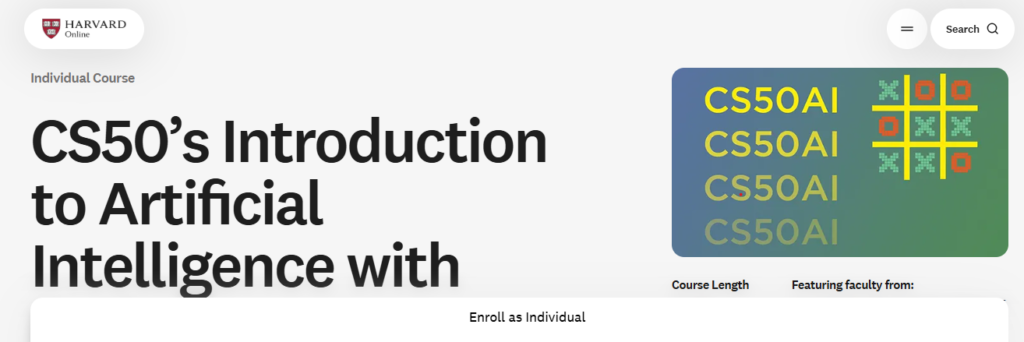
Harvard’s course covers the concepts and algorithms behind modern artificial intelligence. Topics include graph search, knowledge representation, uncertainty, optimization, machine learning, neural networks, and natural language processing. (Harvard Online)
You also build projects using Python.
That matters because watching AI lectures is different from actually building something.
The course expects some programming experience, particularly Python. Harvard recommends CS50x or prior Python programming experience as preparation. (Harvard Online)
You can audit the course for free. A verified certificate is a paid option. (Harvard Online)
Best for:
• Aspiring AI engineers
• Developers
• Computer science students
• Technical career changers
• People who want to understand AI beyond ChatGPT prompts
Start Harvard’s CS50 AI course
What you will learn
The course introduces areas such as:
• Search algorithms
• Knowledge representation
• Probability
• Machine learning
• Neural networks
• Natural language processing
• Optimization
• Reinforcement learning
Harvard’s current CS50 material also introduces generative AI, prompt engineering, large language models, deep learning, and transformer architecture. (edX)
2. Harvard: CS50 Introduction to Computer Science
If you are completely new to technology, consider starting with CS50 before jumping into advanced AI.
Harvard’s CS50 introduces computer science and programming through topics such as algorithms, abstraction, data structures, Python, SQL, web development, and problem solving. (edX)
You do not need previous computer science experience.
That makes it useful if you are coming from a non-technical background.
A simple learning sequence would be:
CS50 → Python → CS50 AI → Machine Learning → Deep Learning
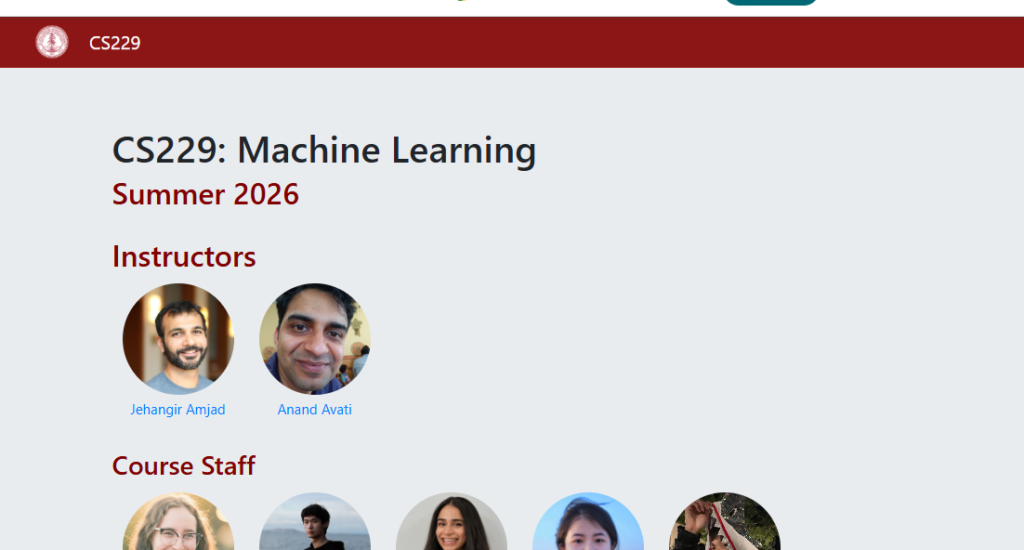
3. Stanford: CS229 Machine Learning
Stanford’s CS229 is a classic machine learning course.
It provides a broad introduction to machine learning and statistical pattern recognition. Topics include supervised learning, unsupervised learning, neural networks, support vector machines, clustering, dimensionality reduction, learning theory, reinforcement learning, and adaptive control. (see.stanford.edu)
This is considerably more technical than a beginner AI course.
You should have some programming knowledge and familiarity with probability and linear algebra before tackling it. (cs229.stanford.edu)
Best for:
• Developers
• Data scientists
• Engineers
• Advanced students
• People who want strong machine learning foundations
Explore Stanford CS229 Machine Learning
4. Stanford: Probability for Artificial Intelligence
One of the biggest mistakes people make when learning AI is ignoring mathematics.
Modern machine learning relies heavily on probability, statistics, linear algebra, and optimization.
Stanford’s Probability for Artificial Intelligence course is particularly interesting because its October 2026 class is offered online for free and focuses on the probability behind modern AI. Stanford says the course requires comfort with algebra and involves a few focused hours each week for six weeks. (pai.stanford.edu)
This is a strong option if you want to understand what is happening underneath machine learning models rather than simply learning how to call an AI API.
Best for:
• AI students
• Machine learning learners
• Technical professionals
• People strengthening their mathematics foundation
Explore Stanford Probability for AI
5. MIT: Introduction to Machine Learning
MIT OpenCourseWare is one of the best free educational resources on the internet.
MIT’s Introduction to Machine Learning course introduces the principles, algorithms, and applications of machine learning.
It covers learning problems, representation, overfitting, generalization, supervised learning, and reinforcement learning. (MIT OpenCourseWare)
The important part is that MIT says the Open Learning Library version is free to use. You can access the materials without paying for enrollment. (MIT OpenCourseWare)
Best for:
• Students
• Developers
• Data professionals
• Aspiring machine learning engineers
• Anyone who wants university-level machine learning education
Start MIT Introduction to Machine Learning
6. MIT: Introduction to Deep Learning
Once you understand the basics of machine learning, move into deep learning.
MIT’s Introduction to Deep Learning covers deep learning methods and applications including computer vision, natural language processing, and biology.
The course also gives learners practical experience building neural networks with TensorFlow. (MIT OpenCourseWare)
This is particularly useful if you want to understand the technology behind modern AI systems.
Best for:
• Machine learning learners
• Developers
• AI engineers
• Technical students
• Researchers
Explore MIT Introduction to Deep Learning
7. MIT: Artificial Intelligence
MIT also provides an Artificial Intelligence course through OpenCourseWare.
The course covers knowledge representation, problem solving, and learning methods used in AI. It is designed to help students understand how intelligent systems can be built to solve computational problems. (MIT OpenCourseWare)
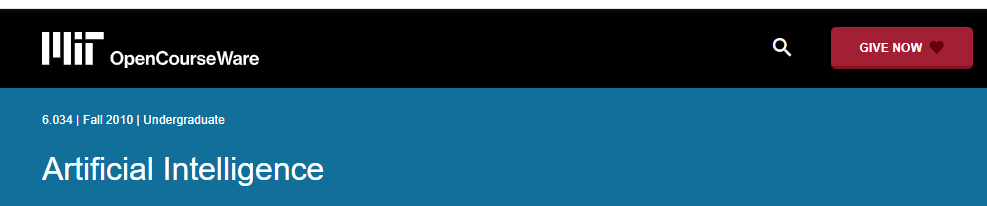
MIT OpenCourseWare also provides lecture videos, programming assignments, exams, problem-solving videos, and other learning materials for selected courses. (MIT OpenCourseWare)
Explore MIT Artificial Intelligence
8. Google: Free AI Training for Beginners
You do not need to become a machine learning engineer to benefit from AI.
Google has created AI training for people who want to use AI in everyday work and business.
Its AI training library includes courses covering AI fundamentals, prompting, job searching with AI, AI for small businesses, and generative AI. (Grow with Google US)
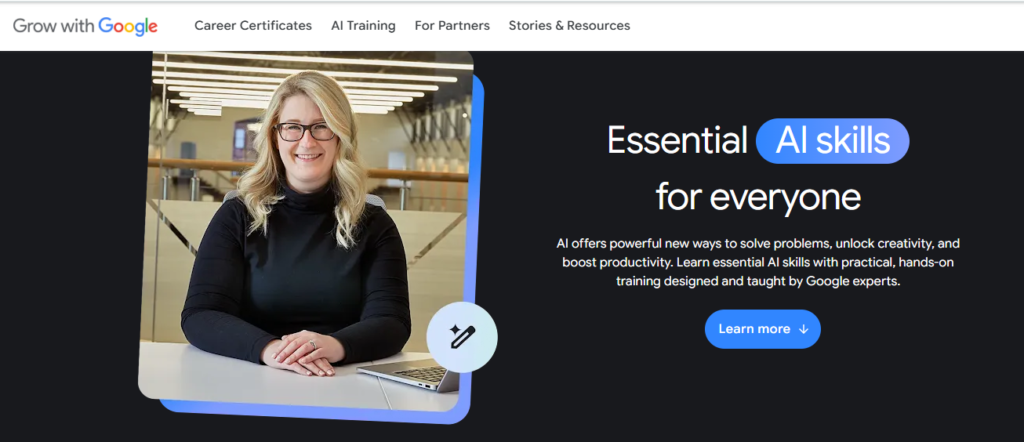
For beginners, Google’s AI Essentials is designed to teach the fundamentals of generative AI, prompting, responsible AI use, and practical workplace applications. Google says no previous experience is required. (Grow with Google US)
One important detail: Google AI Essentials is not universally free. Google currently lists it as a paid course in some markets, with pricing varying by country. (Grow with Google US)
So if your requirement is strictly zero cost, check the current enrollment price in your country before signing up.
Google also provides other no-cost AI learning resources, including generative AI training through Google Cloud. (Google Cloud)
The Best Free AI Learning Path for Beginners
You do not need to take every course listed above.
That is one of the biggest mistakes beginners make.
They collect courses instead of developing skills.
A better approach is to follow a sequence.
Stage 1: Learn AI fundamentals
Start with Google or Harvard CS50 material.
Learn:
• What artificial intelligence means
• Machine learning vs AI
• Generative AI
• Large language models
• Prompting
• AI limitations
• Responsible AI
Goal: Understand what AI can and cannot do.
Stage 2: Learn basic programming
If you want to build AI systems, learn Python.
Focus on:
• Variables
• Functions
• Loops
• Lists and dictionaries
• APIs
• Files
• Basic data manipulation
You do not need to become a Python expert before continuing.
Learn enough to build simple projects.
Stage 3: Learn machine learning
Move to MIT Introduction to Machine Learning or Stanford CS229.
Study:
• Supervised learning
• Unsupervised learning
• Regression
• Classification
• Clustering
• Model evaluation
• Overfitting
• Generalization
• Neural networks
Stage 4: Learn deep learning
Move to MIT’s Introduction to Deep Learning.
Learn:
• Neural networks
• Training
• Computer vision
• Natural language processing
• Deep learning frameworks
• Model architecture
Stage 5: Learn generative AI
Now study:
• Large language models
• Transformers
• Embeddings
• Prompt engineering
• Retrieval augmented generation
• AI agents
• Multimodal AI
• AI APIs
This is where you can start building useful AI applications.
Which Free AI Course Should You Take?
The answer depends on your goal.
If you are a complete beginner:
Start with Google AI resources and Harvard CS50.
If you want to become an AI developer:
Start with CS50, then CS50 AI, MIT machine learning, and MIT deep learning.
If you want to become a machine learning engineer:
Focus heavily on Stanford CS229 and MIT machine learning.
If you want to use AI in business:
Start with Google’s AI resources, then learn prompting, automation, AI workflows, data analysis, and AI implementation.
If you want to understand AI mathematics:
Study Stanford Probability for AI and the mathematical foundations of machine learning.
If you want to become an AI researcher:
Build a strong foundation in mathematics, algorithms, statistics, machine learning, deep learning, and research papers.
You Do Not Need a Computer Science Degree to Start
This deserves emphasis.
You can start learning AI without a computer science degree.
You can start without an expensive laptop.
You can start without attending an elite university.
And you can start without paying thousands of dollars for a bootcamp.
Your biggest advantage will be consistency.
The internet has already removed much of the information barrier.
Your job is to use the resources properly.
How to Learn AI for Free in 30 Days
Here is a simple 30-day plan.
Days 1 to 5: Understand AI
Learn:
• AI fundamentals
• Machine learning
• Generative AI
• LLMs
• Prompt engineering
Spend 60 to 90 minutes per day.
Days 6 to 12: Learn Python
Focus on the basics.
Write small programs every day.
Do not spend weeks watching tutorials without writing code.
Days 13 to 20: Learn Machine Learning
Study:
• Regression
• Classification
• Training data
• Testing data
• Overfitting
• Model evaluation
Build at least one small machine learning project.
Days 21 to 25: Learn Generative AI
Explore:
• LLMs
• Prompting
• Embeddings
• APIs
• RAG
• AI agents
Days 26 to 30: Build Something
This is the most important stage.
Build one useful project.
For example:
• AI resume analyzer
• AI customer support assistant
• AI invoice analyzer
• AI content assistant
• AI research assistant
• AI lead qualification tool
• AI document summarizer
• AI meeting notes assistant
Your project becomes evidence that you can apply what you learned.
How to Learn AI Without Getting Overwhelmed
There are thousands of AI courses online.
Read Also: Best 3 Text to Speech AI Tools That Are Actually Free in 2026
You do not need thousands.
You need a learning system.
Use this formula:
Learn → Practice → Build → Document → Repeat
For every concept you learn, create something with it.
If you learn prompting, create a prompt library.
If you learn Python, build a small program.
If you learn APIs, connect an AI model to an application.
If you learn machine learning, build a prediction model.
If you learn RAG, create a question-answering system over your own documents.
This turns passive learning into practical ability.
How to Build an AI Portfolio Without a Job
You can create an AI portfolio before getting your first AI job.
Start with three projects.
Project 1: Beginner AI application
Build a simple application using an AI API.
Project 2: Data or machine learning project
Use a public dataset and build a model.
Project 3: Real business problem
Build something that solves a problem for a real type of business.
For example, imagine building an AI assistant for a spare-parts business.
It could help staff:
• Search inventory
• Find compatible parts
• Answer customer questions
• Generate quotations
• Follow up with leads
• Summarize sales data
That is much more interesting to an employer or client than saying:
“I completed an AI course.”
Free AI Education vs Paid AI Courses
Free education is enough to build a strong foundation.
But paid education can provide additional benefits such as:
• Structured curriculum
• Instructor support
• Grading
• Certificates
• Career services
• Community
• Accountability
Do not pay for a course simply because it carries a famous university name.
First ask:
Does it teach what I need?
Can I access the material for free?
Does it include projects?
Will the skill help me achieve my goal?
Can I learn the same material elsewhere?
The value is in the skill, not the price tag.
Do Harvard, Stanford, MIT and Google Give Free AI Certificates?
Usually, you should separate three things:
Free learning.
Free access to course materials.
Free certificate.
They are not the same.
Read Also: ElevenLabs Review 2026: Is It the Best AI Voice Generator for Content Creators?
Harvard, for example, explicitly offers free audit learning for CS50 AI while charging for a verified certificate. (Harvard Online)
MIT OpenCourseWare focuses heavily on freely sharing educational materials rather than selling traditional university credentials. Its machine learning course states that the Open Learning Library is free to use. (MIT OpenCourseWare)
Stanford also makes selected courses and learning resources available online. (see.stanford.edu)
Google provides a mixture of free resources and paid certificate programs, so you should check the current terms for each course. (Grow with Google US)
If your primary goal is learning, do not let certificates stop you.
Build projects instead.
The Best Free AI Courses in One Place
Here is the recommended shortlist.
- Harvard CS50 Introduction to Computer Science
Best for: Complete beginners.
- Harvard CS50 Introduction to Artificial Intelligence with Python
Best for: AI fundamentals and Python.
- Stanford CS229 Machine Learning
Best for: Serious machine learning study.
- Stanford Probability for AI
Best for: Understanding the mathematics behind AI.
- MIT Introduction to Machine Learning
Best for: Machine learning foundations.
MIT Introduction to Machine Learning
- MIT Introduction to Deep Learning
Best for: Neural networks and deep learning.
MIT Introduction to Deep Learning
- Google AI Training
Best for: Generative AI and practical AI skills.
Frequently Asked Questions
Can I learn AI for free?
Yes. Harvard, Stanford, MIT, and Google all provide free AI learning resources, although access to certificates or some specific programs may require payment. (Harvard Online)
What is the best free AI course for beginners?
Google’s beginner-oriented AI resources and Harvard CS50 are strong starting points. Harvard CS50 is particularly useful if you also want to develop computer science and programming fundamentals. (Grow with Google US)
Can I learn AI without coding?
Yes.
You can learn how to use generative AI, prompting, AI productivity tools, automation, and AI-assisted workflows without becoming a programmer.
If you want to build machine learning models or AI applications, however, programming becomes increasingly important.
Can I learn AI without a degree?
Yes.
Many of these resources are available online without requiring admission to Harvard, Stanford, or MIT.
How long does it take to learn AI?
There is no single answer.
You can learn basic AI concepts in days or weeks. Developing professional-level machine learning skills can take months or years.
A better target is to define the specific AI skill you want to develop.
Is MIT OpenCourseWare really free?
Yes. MIT OpenCourseWare provides free access to a large collection of course materials. MIT’s Introduction to Machine Learning page specifically states that the Open Learning Library version is free to use. (MIT OpenCourseWare)
Is Harvard CS50 AI free?
You can audit CS50’s Introduction to Artificial Intelligence with Python for free. A verified certificate is a paid option. (Harvard Online)
Is Stanford CS229 free?
Stanford provides CS229 course materials online, and Stanford Engineering Everywhere also provides free course resources. Check the current course page for the specific materials and access available. (see.stanford.edu)
Is Google AI Essentials free?
Not everywhere. Google currently lists different pricing depending on location and enrollment platform. Some other Google AI learning resources are available at no cost. (Grow with Google US)
Your AI Learning Roadmap
If you want the simplest possible roadmap, use this:
Beginner:
Google AI → Harvard CS50 → Python
Intermediate:
Harvard CS50 AI → MIT Machine Learning
Advanced:
Stanford CS229 → MIT Deep Learning
Specialization:
Generative AI → LLMs → RAG → AI agents → AI applications
Portfolio:
Build 3 useful AI projects.
Career:
Publish your projects → document what you learned → connect with people in AI → apply for jobs, freelance projects, internships, or build your own AI product.
You do not need to complete every course.
You need to start.
Final Thoughts
The biggest opportunity in AI education is that world-class learning is increasingly accessible to anyone with an internet connection.
Harvard can teach you computer science and artificial intelligence.
Stanford can help you understand machine learning and the mathematics behind it.
MIT can take you deeper into machine learning and deep learning.
Google can help you develop practical generative AI and workplace skills.
You can combine these resources into a serious AI education without paying university tuition.
✍️ About the Author
Olasunkanmi Adeniyi is a solo founder, product builder, AI practitioner, no-code and low-code developer, and SEO/content strategist. He builds websites, SaaS products, digital tools, and content systems using AI and modern development tools.
Rather than writing about AI from theory alone, Olasunkanmi focuses on testing, building, experimenting, and documenting what actually works. His work explores AI-powered workflows, product development, automation, SEO, content strategy, online business, and the practical use of emerging technologies.
Through AI Discoveries, he publishes practical tutorials, in-depth guides, experiments, and real-world use cases designed to help entrepreneurs, professionals, creators, and businesses understand and apply AI more effectively.
His goal is simple: make AI practical, understandable, and actionable—so readers can move from learning about what AI can do to actually using it to build, work, and grow.
Learn more and explore his latest work at www.aidiscoveries.io.
But remember one thing.
Watching courses will not make you good at AI.
Building will.
Pick one course today.
Study for one hour.
Build something small.
Then do it again tomorrow.
That is how free AI education becomes a real skill.




Leave a Reply