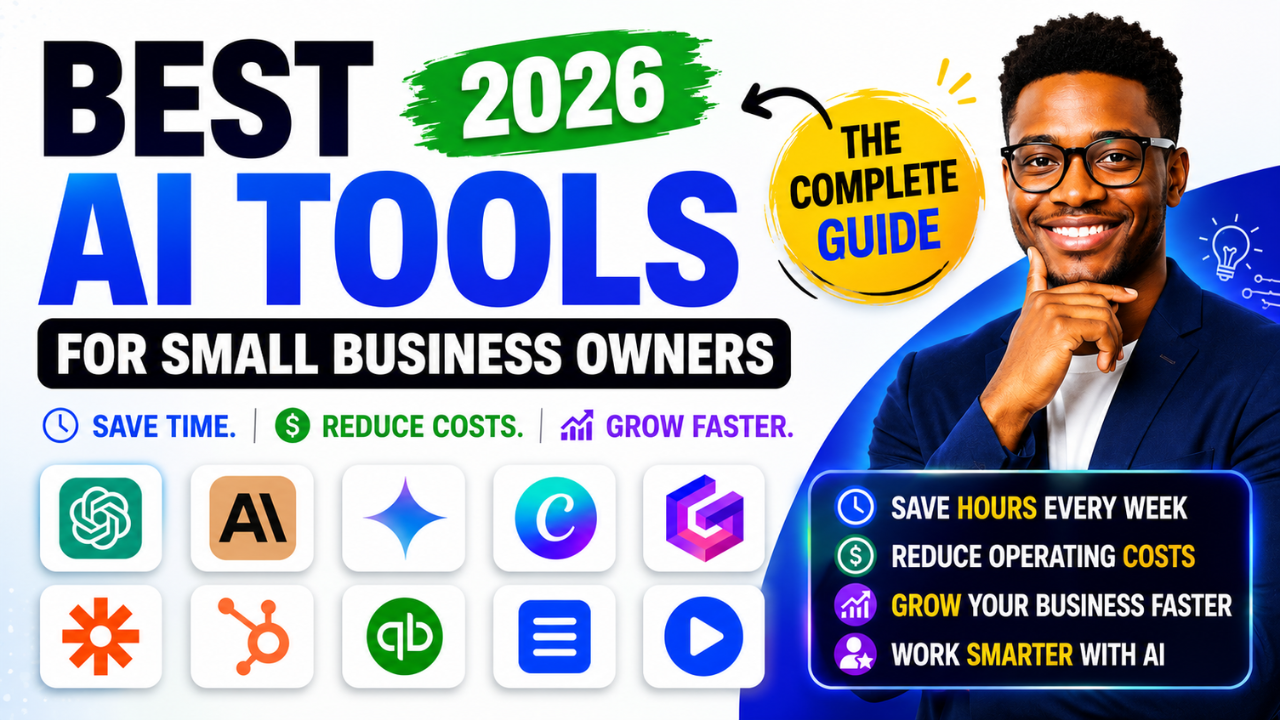
Artificial intelligence is no longer only for large companies.
Today, small business owners use AI to write content, answer customer questions, automate repetitive work, create marketing campaigns, manage finances, and increase sales without hiring additional staff.
Read Also: How to Use Gemini Step by Step (2026 Beginner’s Guide for Beginners)
The challenge is choosing the right tools.
This guide explains the best AI tools for small business owners based on real business use cases. It also answers the questions people ask on Google, ChatGPT, Claude, Gemini, and Perplexity, making it optimized for both search engines and AI-powered answer engines.
Quick Answer
If you only want the shortlist, these are the best AI tools for small businesses in 2026.
| Business Need | Best AI Tool |
|---|---|
| General AI Assistant | ChatGPT |
| Long-form Writing | Claude |
| Google Workspace AI | Gemini |
| Graphic Design | Canva AI |
| Video Creation | Synthesia |
| AI Presentations | Gamma |
| Customer Support | Intercom Fin |
| Automation | Zapier AI |
| Meeting Notes | Granola |
| Email Marketing | Beehiv |
| Social Media Scheduling | Buffer AI |
| Website Builder | Wix AI |
| Accounting | QuickBooks AI |
| CRM | HubSpot AI |
| Image Generation | Midjourney |
What Is an AI Tool?
An AI tool is software that uses machine learning and large language models to perform tasks that normally require human effort.
Examples include:
• Writing emails
• Creating marketing content
• Designing graphics
• Analyzing business data
• Managing customer support
• Automating repetitive tasks
Instead of replacing business owners, AI removes repetitive work so they can focus on growth.
Read Also: How I Automated Client Lead Generation Using Make.com and Claude (2026 Guide)
Why Small Businesses Should Use AI
Small businesses usually operate with limited budgets and small teams.
AI helps by:
• Reducing operating costs
• Saving hours every week
• Improving customer service
• Increasing productivity
• Creating marketing content faster
• Making better business decisions
Example:
Instead of hiring separate copywriters, designers, and virtual assistants, a business owner can combine ChatGPT, Canva AI, and Zapier AI to accomplish much of the same work in less time.
Best AI Tools by Business Category
1. ChatGPT
Best for: Everyday business tasks
ChatGPT is one of the most versatile AI assistants available.
Small business owners use it to:
• Write emails
• Create business proposals
• Brainstorm marketing ideas
• Generate product descriptions
• Answer customer questions
• Analyze spreadsheets
• Create business plans
Example:
A bakery owner can generate an entire month’s social media calendar in less than ten minutes.
Pros
• Easy to use
• Supports image generation
• Strong reasoning
• Great for brainstorming
Cons
• Requires good prompts for best results
Ideal for:
Nearly every small business.
Read Also: 25 ChatGPT Tasks Ideas Every Creator, Entrepreneur, and Marketer Should Try
2. Claude
Best for writing and document analysis
Claude excels at understanding long documents.
Business owners use Claude for:
• Contracts
• Reports
• Business plans
• SOP creation
• Research
• Long-form blog writing
Example:
Upload a 40-page business proposal and ask Claude to summarize key risks and opportunities.
3. Google Gemini
Best for Google Workspace users
Gemini integrates directly into Gmail, Docs, Sheets, and Meet.
Useful for:
• Writing emails
• Summarizing meetings
• Spreadsheet analysis
• Document creation
Businesses already using Google Workspace benefit the most.
Read Also: How to Build Free Brand Assets for Your Business With LoveArt: Complete Beginner’s Guide (2026) –
4. Canva AI
Best for marketing graphics
Canva AI helps create:
• Social media posts
• Presentations
• Flyers
• Logos
• Advertisements
• Product mockups
Example:
A restaurant owner can create an entire promotional campaign without hiring a graphic designer.
5. Zapier AI
Best for automation
Zapier connects thousands of business apps.
Common automations include:
Customer fills out a form.
↓
AI summarizes the request.
↓
Creates a CRM record.
↓
Sends confirmation email.
↓
Notifies your team.
Hours of manual work disappear.
Read Also:
6. HubSpot AI
Best CRM for growing businesses
HubSpot AI helps businesses:
• Track leads
• Generate emails
• Predict sales
• Summarize customer conversations
• Improve customer relationships
Excellent for B2B companies.
7. QuickBooks AI
Best for accounting
QuickBooks AI assists with:
• Expense categorization
• Financial reports
• Cash flow insights
• Invoice management
• Tax preparation support
8. Synthesia
Best for AI video creation
Instead of filming yourself, type your script.
Synthesia creates professional videos using AI avatars.
Useful for:
• Employee training
• Product demos
• Customer onboarding
• Marketing videos
9. Gamma
Best for presentations
Instead of spending hours designing PowerPoint slides, Gamma generates polished presentations from a simple prompt.
Great for:
• Sales pitches
• Investor decks
• Client proposals
10. Intercom Fin
Best AI customer support
Intercom Fin answers customer questions 24 hours a day.
It can:
• Resolve common issues
• Recommend products
• Escalate complex cases
This reduces support costs while improving response times.
How to Choose the Right AI Tool
Ask these five questions.
What problem are you solving?
Choose tools based on business problems, not popularity.
Does it integrate with existing software?
The best AI tools connect with software you already use.
Is it easy to learn?
Simple tools deliver faster results.
Does it improve productivity?
Measure time saved each week.
Does it provide a positive return on investment?
If a $30 monthly subscription saves ten hours every month, it usually pays for itself.
AI Tool Stack for Different Businesses
Retail Store
ChatGPT
Canva AI
QuickBooks AI
HubSpot
Marketing Agency
Claude
ChatGPT
Gamma
Zapier
Canva AI
Ecommerce Store
ChatGPT
Intercom Fin
HubSpot
QuickBooks
Zapier
Consultant
Claude
ChatGPT
Calendly
Gamma
Canva AI
Common Mistakes Small Businesses Make
Using too many AI tools.
Buying expensive software before identifying business needs.
Ignoring data privacy.
Not training employees.
Expecting AI to replace human judgment.
The best businesses combine AI with human expertise.
Frequently Asked Questions
What is the best AI tool for small businesses?
ChatGPT is the best all-around AI tool because it supports writing, research, planning, coding, analysis, and customer communication in one platform.
Which AI tool saves the most time?
Zapier AI typically saves the most time because it automates repetitive workflows across hundreds of business applications.
Can AI replace employees?
No.
AI works best as a productivity assistant. It handles repetitive work while people focus on strategy, creativity, customer relationships, and decision making.
Are AI tools expensive?
Many offer free plans.
Paid versions generally cost between $20 and $100 per month, depending on features.
Which AI tool is best for marketing?
Canva AI, ChatGPT, Claude, and Buffer AI form an excellent marketing stack for most small businesses.
Which AI tool is best for customer service?
Intercom Fin is among the strongest AI customer support platforms for growing businesses.
Is AI safe for small businesses?
Yes, when businesses use trusted providers, review AI-generated outputs, and avoid uploading confidential information without proper safeguards.
Example
Imagine a five-person digital marketing agency.
Before AI:
Content writing: 10 hours weekly
Design: 8 hours
Meeting notes: 5 hours
Proposal writing: 6 hours
Customer emails: 7 hours
Total: 36 hours
After adopting ChatGPT, Canva AI, Granola, and Zapier AI:
Content writing: 4 hours
Design: 2 hours
Meeting notes: 30 minutes
Proposal writing: 2 hours
Customer emails: 2 hours
Total: 10.5 hours
The agency saves over 25 hours every week, allowing the team to serve more clients without increasing headcount.
Final Thoughts
The best AI tool depends on your business goals.
If you need one place to start, begin with ChatGPT. Add Canva AI for design, Zapier AI for automation, and QuickBooks AI for finance as your business grows.
Focus on solving one business problem at a time. Measure the time you save, the quality of your work, and the return on your investment. The businesses that consistently benefit from AI are those that integrate it into everyday workflows instead of treating it as a one-time experiment.
Key Takeaways
• ChatGPT is the best overall AI assistant for most small businesses.
• Claude excels at long-form writing and document analysis.
• Canva AI simplifies graphic design.
• Zapier AI automates repetitive business workflows.
• HubSpot AI strengthens sales and customer relationship management.
• QuickBooks AI streamlines accounting.
• Synthesia creates professional AI videos.
• Choosing tools based on business problems delivers better results than following trends.
Frequently Asked Questions
What is the best AI tool for small businesses?
ChatGPT is the best all-around AI tool because it supports writing, research, planning, coding, analysis, and customer communication in one platform.
Which AI tool saves the most time?
Zapier AI typically saves the most time because it automates repetitive workflows across hundreds of business applications.
Can AI replace employees?
No.
Are AI tools expensive?
Many offer free plans.
Paid versions generally cost between $20 and $100 per month, depending on features.
Which AI tool is best for marketing?
Canva AI, ChatGPT, Claude, and Buffer AI form an excellent marketing stack for most small businesses.
Which AI tool is best for customer service?
Intercom Fin is among the strongest AI customer support platforms for growing businesses.
Is AI safe for small businesses?
Yes, when businesses use trusted providers, review AI-generated outputs, and avoid uploading confidential information without proper safeguards.




Leave a Reply