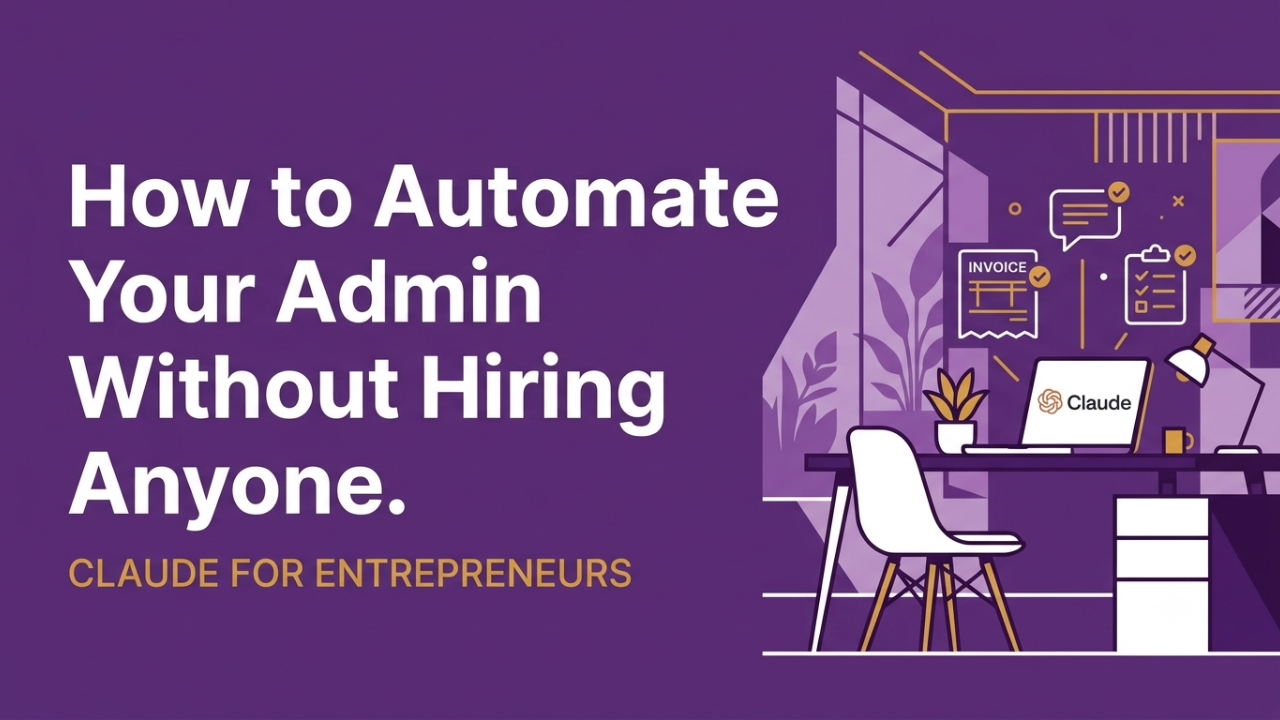
If you run a business alone — or with one or two people — admin work is the tax you pay every single day. Invoices. Follow-up emails. Content calendars. Customer replies. Reports nobody reads but everybody asks for.
Read Also: How to Use Claude AI as Your Free Personal Research Assistant (2026 Guide)
This is a practical guide to Claude business automation for solo founders and small teams: a real SME workflow, seven templates you can copy today, and no fake “AI hype” demos. Just what actually works when you’re the founder, the ops team, and the intern, all in one person.
If you’re searching for Claude for entrepreneurs or AI for small business Nigeria, this is built for you specifically — power, mobile money, unreliable internet, and all.
Why Solo Founders Are Turning to Claude Instead of Hiring
Hiring your first admin or virtual assistant sounds like the obvious move once you’re overwhelmed. But for most early-stage founders — especially across Nigeria, Ghana, Kenya, and South Africa — that hire comes with real costs before it ever saves you time:
- Salary and benefits, even for part-time help
- Training time (usually yours)
- Managing someone else’s schedule and mistakes
- Turnover, and starting the training over again
Claude doesn’t replace a great hire forever. But it replaces the reason you’re hiring right now — which is usually “I have too much repetitive admin and not enough hours.” A well-built Claude workflow can take on invoicing follow-ups, customer FAQs, content repurposing, and reporting today, for the cost of a subscription instead of a salary.
This is the solo-founder framing that matters: you’re not trying to replace a person. You’re trying to buy back your evenings.
Read Also: Claude AI for Writing: How to Draft Emails, Reports, and Messages in Seconds

A Real SME Workflow: One Founder’s Actual Day
Here’s what this looks like in practice, using a real small-business pattern (an online retailer / service business — the kind of setup common across Lagos, Accra, and Nairobi):
7:00 AM — Customer messages review Overnight WhatsApp and Instagram DMs get pasted into Claude with a prompt that categorizes them (order question, complaint, price inquiry) and drafts replies in the founder’s own tone.
9:00 AM — Invoicing and follow-ups Claude generates invoice text and drafts polite payment reminder messages for customers who are 3, 7, and 14 days late — pulled from a simple spreadsheet the founder pastes in.
11:00 AM — Content batch One voice note or bullet list about the week’s stock becomes a week of social captions, a newsletter draft, and three short-form video scripts.
2:00 PM — Supplier and admin emails Claude drafts supplier follow-ups, delivery confirmations, and internal notes-to-self, all matching the business’s existing tone of voice.
5:00 PM — End-of-day report A five-line summary of sales, issues, and tomorrow’s priorities, generated from the day’s notes in under two minutes.
None of this requires code. None of it requires a developer. It requires a founder who knows how to write good prompts and reuse them — which is exactly what the templates below give you.
Read Also: 10 Best CRM AI Automations for Small Businesses in 2026
7 Claude Automation Templates for Small Business Owners
Copy these directly. Replace the bracketed sections with your business details.
1. Customer Reply Drafting Template
You are replying to customers for [business name], a [type of business].
Tone: [friendly / formal / warm and local].
Here is the customer message: [paste message]
Draft a reply that answers their question, offers a next step, and stays under 80 words.
2. Invoice & Payment Reminder Template
Generate a polite payment reminder for a customer named [name] who owes
[amount] for [product/service], due on [date].
This is reminder attempt #[1/2/3]. Escalate firmness slightly with each attempt
but never sound aggressive.
3. Weekly Content Batch Template
Here are this week's updates for my business: [bullet points].
Turn this into: 5 social captions (Instagram + X), 1 short newsletter,
and 3 video hook lines. Keep my brand voice: [describe voice].
4. Supplier / Vendor Follow-Up Template
Draft a follow-up email to a supplier about [order/delivery/pricing issue].
Keep it professional, firm on timelines, but respectful of the relationship.
5. Daily/Weekly Business Report Template
Here are today's notes: [paste raw notes, sales figures, issues].
Summarize into: 3 wins, 2 problems, 1 priority for tomorrow.
Keep it under 100 words, no fluff.
6. FAQ & Objection-Handling Template
Here is a list of common customer questions/objections: [paste list].
Write short, confident answers I can copy-paste into chats, in a tone that is
[warm/professional/local and relatable].
7. Meeting/Voice Note to Action Items Template
Here is a transcript or voice note summary from a meeting: [paste text].
Extract: action items with owners, deadlines mentioned, and any decisions made.
Format as a short checklist.
Tip: Save each of these as a note on your phone. The real unlock isn’t Claude itself — it’s having the prompt ready before the task hits your inbox.
Why This Matters More for Nigerian and African SMEs
AI for small business Nigeria searches have grown because the constraints here are real: unreliable power, expensive data, and a smaller pool of affordable, trained admin staff in many cities. A workflow that runs from a phone browser, works on mobile data, and doesn’t require monthly payroll is a genuinely different value proposition than it is in markets with cheaper labor and more reliable infrastructure.
This is also why the “no-code, no-developer” angle matters so much. Most solo founders in this market are not going to build a custom app. They need something they can start using in the next ten minutes, with tools they already have.
Video / Script Direction: “A Day in My Business With Claude”
For creators and educators covering this topic, skip the studio demo. The version that ranks, gets shared, and gets cited is the real one:
- Open on the actual admin pile — the WhatsApp backlog, the unpaid invoices spreadsheet, the notes app full of half-finished ideas.
- Show one real customer message being turned into a reply, in real time, with the actual back-and-forth — not a scripted “perfect” example.
- Show a mistake or an edit. Claude’s first draft not quite matching your tone, and you correcting it, is more credible and more useful to viewers than a flawless take.
- End on the time saved, stated honestly — “this used to take me 40 minutes, now it takes 8” — not an inflated claim.
Real examples outperform demos because the audience for this content is comparing your workflow to their own reality, not to a highlight reel.
Getting Started This Week
You don’t need all seven templates on day one. Pick the admin task that eats the most time in your week — for most founders it’s customer replies or invoicing — and run that single template for five business days before adding a second one.
The goal isn’t to automate everything. It’s to stop being the bottleneck in your own business.
Written by Olasunkanmi Adeniyi O:
Olasunkanmi Adeniyi O is a Product Manager, AI Prompt Engineer, Technical Writer, and founder of AI Discoveries. He helps professionals and businesses leverage AI to improve productivity, automate workflows, and build scalable digital businesses. His work focuses on AI tools, prompt engineering, automation systems, and practical strategies for using artificial intelligence to save time and create new income opportunities online.



Leave a Reply