Everything you need to know about NVIDIA RTX Spark — specs, confirmed laptops, price leaks, benchmarks, and the honest truth about what this chip can and can’t do.
Read Also: HilltopAds Review 2026: Is It the Best Ad Network for Publishers?
⚡ Key Facts at a Glance
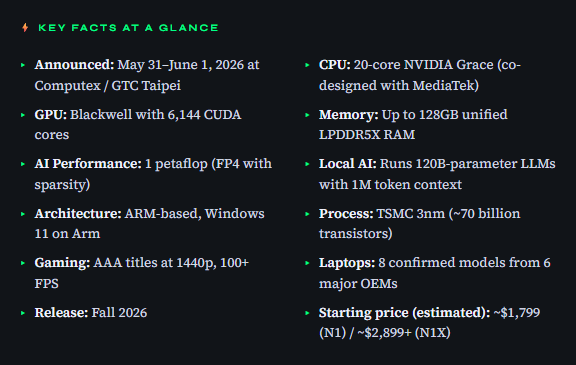
Release: Fall 2026
Starting price (estimated): ~$1,799 (N1) / ~$2,899+ (N1X)
Table of Contents
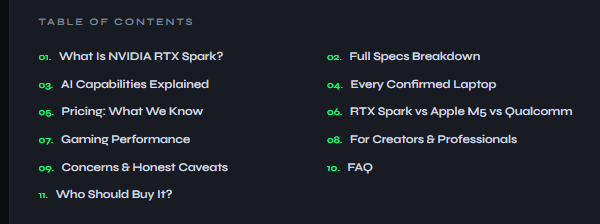
What Is NVIDIA RTX Spark?
NVIDIA RTX Spark is the company’s first-ever consumer system-on-chip for Windows PCs. Unveiled on May 31, 2026, at NVIDIA’s GTC Taipei keynote during Computex, it marks a seismic shift: for the first time in its 33-year history, NVIDIA is not just making the graphics card inside a laptop — it is building the entire brain of the computer.
“The PC is being reinvented. For forty years, you launched apps. Click. Type. With RTX Spark and Microsoft Windows, you ask — and the PC does the work.”
— Jensen Huang, CEO, NVIDIA
RTX Spark fuses a 20-core NVIDIA Grace CPU, a Blackwell RTX GPU, and memory controller onto a single package connected via NVLink-C2C — NVIDIA’s ultra-fast chip-to-chip interconnect. The result is a unified memory architecture similar to Apple Silicon, where CPU and GPU share the same physical RAM pool instead of shuttling data across a slow PCIe bus.
The chip’s CPU was co-designed with MediaTek, a leader in ARM-based SoC design. The GPU descends directly from NVIDIA’s Blackwell data center lineage — the same architecture powering billion-dollar AI clusters. On the software side, RTX Spark runs full Windows 11 on Arm, with CUDA, DLSS, TensorRT, OptiX, and G-SYNC all natively supported.
This is not an incremental product. It’s NVIDIA’s answer to Apple Silicon — but tuned for Windows, built for developers, and scaled for the era of local AI agents.
RTX Spark vs DGX Spark — Don’t Confuse Them
RTX Spark and DGX Spark are related but different. DGX Spark (formerly Project DIGITS, announced at CES 2025) is an AI workstation running DGX OS (Linux) aimed at developers and researchers. RTX Spark is the consumer/prosumer descendant, running Windows 11 on Arm, in thin laptops and compact desktops. Same silicon family; different markets.
Full Specs Breakdown
Here’s every confirmed technical specification for the NVIDIA RTX Spark platform. Note that not every laptop SKU will ship with all cores enabled — lower-end variants will have fewer CPU/GPU cores and less memory.
Read Also: How to Monitor Your Claude and ChatGPT Tokens as You Use Them
Specification Details
Product Name: NVIDIA RTX Spark (codename: N1X):
CPU Cores: Up to 20-core NVIDIA Grace (ARM v9 architecture, co-designed with MediaTek)
GPU: Blackwell RTX — 6,144 CUDA cores (same count as RTX 5070)
Tensor Cores: 5th-generation Tensor Cores, FP4 precision
AI Performance: 1 petaflop FP4 (with sparsity) / 500 TFLOPS dense
Unified Memory: Up to 128GB LPDDR5X (range: 16GB–128GB depending on SKU)
Memory Bandwidth ~300 GB/s
Interconnect: NVLink-C2C chip-to-chip
Process Node: TSMC 3nm
Transistors ~70 billion (vendor figure)
TDPUp to 80W (laptop); 100W sustained (Dev Box)
OS SupportWindows 11 on Arm
Software Stack: CUDA, DLSS 4.5, TensorRT, OptiX, Reflex, G-SYNC
Local AI Models: Up to 120B-parameter LLMs, 1 million token context
Display Tech: Mini-LED, tandem OLED, G-SYNC compatible
Expected Launch: Fall 2026 (laptops and compact desktops)
The CPU Architecture in Plain English
The 20 ARM v9 cores are split across performance and efficiency clusters — similar to how Apple divides P-cores and E-cores in its M-series chips. The CPU was co-designed with MediaTek, meaning NVIDIA didn’t simply license off-the-shelf Cortex cores. The result is a custom Grace CPU tuned for memory bandwidth and AI agent workloads.
The GPU Architecture
The embedded Blackwell GPU carries 6,144 CUDA cores — the same count as NVIDIA’s standalone RTX 5070 laptop GPU. However, because it runs within an 80W thermal envelope (versus a discrete laptop GPU that can run at 80–150W), real-world GPU clock speeds will be lower. Notebookcheck’s analysis suggests GPU performance should land between the RTX 5070 laptop GPU and the RTX 5070 Ti laptop GPU in sustained workloads.
Read Also: HOW TO USE CLAUDE AI FOR ACADEMIC WRITING AND RESEARCH: THE COMPLETE GUIDE (2026)
AI Capabilities: What RTX Spark Can Actually Do
This is where RTX Spark separates itself from every other laptop chip on the market. The 128GB of unified memory is the single most important number — not the petaflop figure.
Here’s why: a 120-billion-parameter model quantized to 4-bit (Q4) needs roughly 60–70GB just to hold its weights in memory. Every laptop on the market before RTX Spark — including high-end gaming laptops with discrete RTX 5090 GPUs (24GB VRAM) — can’t even load the model, let alone run inference. RTX Spark’s shared memory pool removes that wall entirely.
What Can Run Locally on RTX Spark?
Model ClassExample ModelsMemory RequiredFits in 128GB?
8B classLlama 3.1 8B, Gemma 2 9B~5–8GB at Q4✅ Easily
32B classQwen 2.5 32B, Mistral Large~18–22GB at Q4✅ Yes
70B classLlama 3.3 70B, Qwen 2.5 72B~38–45GB at Q4✅ Yes
120B classNVIDIA Nemotron 3 120B, Llama 4 Maverick~65–80GB at Q4✅ Yes (NVIDIA’s showcase claim)
MoE modelsLlama 4 Scout (109B total, 17B active)~50–60GB✅ Yes
⚠ Speed vs Capacity: An Important Distinction
RTX Spark can fit 120B-parameter models, but inference speed is limited by memory bandwidth (~300 GB/s). On a 70B Q4 model, expect roughly 3 tokens per second — compared to 20–25 tokens/s on an Apple Mac Studio M4 Max (546 GB/s bandwidth). For smaller 8B models, RTX Spark delivers 40–50 tokens/s — which is competitive. Know your workflow before choosing hardware.
Local AI Agents on Windows
NVIDIA’s most ambitious claim is that RTX Spark will power persistent local AI agents running natively on Windows — agents that can observe system state, reason across applications, search local files, generate media, write code, and execute multi-step tasks. Microsoft is deeply involved in this vision, building Windows-level APIs to expose these agent capabilities through an “OpenShell” interface that appears in the taskbar.
The CUDA software stack is the decisive advantage here. For 15+ years, every major AI framework — PyTorch, TensorFlow, JAX, llama.cpp (with CUDA backend) — has been built on CUDA. Qualcomm has no equivalent. Apple has Metal, which requires porting. RTX Spark brings CUDA natively to a Windows laptop, meaning the same code running on an H100 data center GPU can run on your laptop without modification.
Every Confirmed RTX Spark Laptop (Fall 2026)
NVIDIA announced that over 30 laptop models and 10+ compact desktop designs will eventually launch with RTX Spark. Here are the eight confirmed laptops unveiled at Computex 2026:
Microsoft
Surface Laptop Ultra
15-inch mini-LED PixelSense Ultra display, 2,000-nit peak HDR brightness, up to 128GB RAM. Largest trackpad Microsoft has shipped. Est. $3,000–$7,000.
ASUS
ProArt P16 (H7607)
Lumina Pro OLED display, up to 4K 120Hz VRR with G-SYNC. 13% thinner and 16% lighter than previous gen. 99.9Wh battery. Nano Black / Neo White finishes.
ASUS
ProArt P14 (H7407)
More portable creator option. Lumina Pro OLED, up to 3K display. Same RTX Spark superchip in a compact 14-inch form factor. Fall 2026, select regions.
Dell
XPS 16 Creator Edition
Updated XPS 16 chassis with tandem OLED screen. Michael Dell positioned it as a laptop “where creators shouldn’t have to choose between portability and performance.”
HP
OmniBook Ultra 16
Among the thinnest RTX Spark laptops at 15.73mm rear height. Supports up to four 4K displays simultaneously. Two Thunderbolt 4 ports.
HP
OmniBook X 14
HP’s 14-inch entry into RTX Spark — just 13.53mm thick. Targeting developers with agentic AI workloads. Pricing to come closer to launch.
Lenovo
Yoga Pro 9n
Lenovo’s flagship RTX Spark laptop. Creator and professional target market. Additional specs under wraps at time of announcement.
MSI
Prestige N16 Flip AI+
MSI’s convertible laptop entry. The “Flip” form factor targets creators who need touchscreen and stylus input alongside RTX Spark’s AI horsepower.
Also Coming: Compact Desktops
HP is building an RTX Spark mini-PC (compact desktop), and Microsoft announced the Surface RTX Spark Dev Box — a Surface-branded mini-PC running at sustained 100W for developers running long training jobs, agentic pipelines, and local model fine-tuning. Acer and GIGABYTE will follow with additional laptop and desktop designs after the initial fall 2026 wave.
RTX Spark Pricing: What the Leaks Say
No official retail prices have been announced as of June 2026. However, a Morgan Stanley report that circulated shortly after Computex gave the clearest pricing signal yet:
SKU TierChip VariantEstimated Starting Price
EntryN1 (lower core counts, less memory)~$1,799
PremiumN1X (full 20 cores, up to 128GB)~$2,899+
FlagshipSurface Laptop Ultra (128GB config)~$3,000–$7,000 (analyst estimate)
This places RTX Spark firmly in MacBook Pro territory — the 16-inch MacBook Pro M5 Max starts at $3,599. For a Windows platform to compete at this price bracket, it must deliver a significantly better experience for CUDA developers, AI researchers, and Windows power users who can’t or won’t switch ecosystems.
⚠ Pricing Is Not Final
All pricing above is analyst estimates and leaked figures — not confirmed MSRP. Actual retail pricing will vary by OEM, configuration, region, and promotional offers. Pre-orders are expected weeks before the official launch, with full pricing revealed at a later Microsoft event.
RTX Spark vs Apple M5 Max vs Qualcomm Snapdragon X2 Elite
This is the comparison everyone wants to see. RTX Spark’s primary competitive targets are Apple’s M5 Max and Qualcomm’s Snapdragon X2 Elite — two chips that have defined the “thin, powerful, all-day battery” laptop category in 2025–2026.
Spec
RTX Spark (N1X)
Apple M5 Max
Snapdragon X2 Elite Ext.
CPU Cores
20 (ARM v9)
16 (P+E)
18 (3rd-gen Oryon)
GPU Cores
6,144 CUDA + Blackwell
40-core GPU
Adreno X2-90
Max Unified Memory
128GB
128GB
48GB
Memory Bandwidth
~300 GB/s
546 GB/s
~170 GB/s
AI Compute
1 PFLOPS FP4
~800 TOPS
80 TOPS (NPU only)
Single-Core CPU
~30% behind M5 Max
Best in class
Competitive (~39% vs X Elite)
Multi-Core CPU
~30% behind M5 Max
Excellent
Strong
70B LLM Speed (Q4)
~3 tokens/s
~20–25 tokens/s
~1–2 tokens/s (48GB limit)
CUDA Support
Native
None (Metal)
None
Gaming (AAA)
1440p 100+ FPS (DLSS)
Limited ecosystem
1080p / limited titles
OS
Windows 11 on Arm
macOS
Windows 11 on Arm
Availability
Fall 2026
Available now
Early 2026
The Honest Verdict on Benchmarks
On raw CPU performance, RTX Spark trails. Notebookcheck’s analysis of the equivalent GB10 chip found single-core performance falls roughly 30% behind the Apple M5 Max and about 20% behind the Snapdragon X2 Elite. Multi-core scores show a similar pattern. For pure productivity workflows — document editing, coding, web browsing — Apple’s CPU advantage is real.
Where RTX Spark wins decisively is GPU and AI ecosystem depth. Its Blackwell GPU with 6,144 CUDA cores and the native CUDA stack give it an advantage no competitor can match. Qualcomm lacks a GPU ecosystem. Apple’s Metal requires porting from CUDA. If your work touches GPU-accelerated AI, rendering, or gaming, RTX Spark’s lead is structural — not just a spec sheet number.
Gaming on RTX Spark
NVIDIA claims RTX Spark can play AAA games at 1440p with over 100 FPS — a bold statement for an ARM-based chip. The key enabler is DLSS 4.5 (Deep Learning Super Sampling), NVIDIA’s AI-powered upscaling technology. Rather than rendering natively at 1440p, RTX Spark renders at a lower resolution and uses the Blackwell Tensor Cores to upscale the output in real time, delivering smooth, high-quality visuals.
The GPU performance ceiling should land between the RTX 5070 laptop GPU and RTX 5070 Ti laptop GPU in GPU-bound tasks — meaningful gaming performance in a thin, fanless-friendly form factor.
⚠ ARM Compatibility Is Still an Open Question
Running games on Windows on Arm requires either native ARM binaries or x86 emulation through Microsoft Prism. Not every game will run perfectly. Some titles may crash, exhibit graphical errors, or underperform through the emulation layer — a problem Qualcomm users have already encountered with Snapdragon X devices. NVIDIA’s CUDA ecosystem helps with native apps, but gaming compatibility is a broader Windows-on-Arm challenge that all OEMs must navigate.
For competitive gaming, RTX Reflex (latency reduction) and G-SYNC are also part of the RTX Spark software stack — features with no equivalent on Apple or Qualcomm platforms.
RTX Spark for Creators and Professionals
ASUS’s ProArt branding for its RTX Spark laptops signals the intended professional audience clearly. The chip’s capabilities for creative workflows are substantial:
Video Editing
NVIDIA claims RTX Spark can handle 12K 4:2:2 video editing — a workflow that would max out a professional workstation GPU at full resolution. Adobe is rearchitecting both Photoshop and Premiere from the ground up for RTX Spark, promising 2x faster AI and graphics performance compared to current alternatives.
3D Rendering
The 128GB unified memory pool enables rendering 3D scenes larger than 90GB — scenes that simply won’t fit in the VRAM of any discrete laptop GPU. For architecture visualization, VFX, and game asset creation, this is transformative: work that required a desktop workstation now fits in a 14mm-thick laptop.
AI-Assisted Creative Work
With 1 petaflop of AI compute, RTX Spark can run 4K AI video generation locally — using tools like ComfyUI — without cloud round-trips. This is the “agentic creative” workflow NVIDIA and Microsoft are betting on: describe what you want, let the local model generate it, iterate without a cloud subscription.
Concerns and Honest Caveats
No product this ambitious comes without legitimate questions. Here are the things worth scrutinizing before spending $3,000+ on an RTX Spark device:
- All Benchmarks Are Vendor-Stated (For Now)
As of June 2026, no independent third party has benchmarked a shipping RTX Spark device. Every performance figure — the 1 petaflop claim, the 120B model capability, the 100+ FPS gaming figures — comes from NVIDIA’s pre-production hardware demos. These numbers should be treated as targets, not guarantees, until reviews of retail units arrive in fall 2026.
- CPU Performance Trails the Competition
The benchmarks from NVIDIA’s DGX Spark (same silicon) show the Grace CPU trailing Apple’s M5 Max by roughly 30% in both single-core and multi-core tasks. For users whose primary workload is CPU-bound — heavy coding, complex document processing, browser-intensive work — this gap is meaningful.
- Memory Bandwidth Limits LLM Inference Speed
Fitting a 120B model in memory is not the same as running it fast. With ~300 GB/s of memory bandwidth versus Apple’s 546 GB/s on M4 Max, token generation rates on very large models will be slow — around 3 tokens per second on a 70B model. This is usable, but not fast.
- Windows on Arm App Compatibility
Despite years of progress, Windows on Arm still has compatibility gaps. Professional tools like AutoCAD have historically struggled under ARM emulation. NVIDIA’s CUDA native support helps the developer and AI community, but general software compatibility remains an ecosystem challenge.
- Release Timeline Uncertainty
Microsoft’s official messaging targets fall 2026. However, industry leaker Moore’s Law Is Dead has suggested that wide availability may slip to 2027 in some markets. Supply chain realities for a brand-new chip platform are always unpredictable.
The Right Posture
Track RTX Spark closely, wait for independent reviews of shipping hardware, and evaluate based on your specific workload. The architecture is genuinely differentiated — but extraordinary claims require extraordinary evidence, and that evidence arrives in fall 2026.
Frequently Asked Questions
What is NVIDIA RTX Spark?
NVIDIA RTX Spark is NVIDIA’s first consumer system-on-chip for Windows PCs and laptops. Announced at Computex 2026, it combines a 20-core ARM CPU, a Blackwell RTX GPU with 6,144 CUDA cores, and up to 128GB of unified LPDDR5X memory on a single package. It is designed to run local AI agents, large language models up to 120 billion parameters, AAA games at 1440p, and professional creative workloads in a thin laptop or compact desktop form factor.
When does RTX Spark release?
NVIDIA and its OEM partners (ASUS, Dell, HP, Lenovo, Microsoft, MSI) have all confirmed a fall 2026 release window. Exact dates have not been announced. Some analysts have raised the possibility of availability slipping into early 2027 for certain markets or configurations.
How much will RTX Spark laptops cost?
No official retail pricing has been announced. A Morgan Stanley report estimated entry-level N1 variants starting around $1,799 and the premium N1X chip (full 20 cores, up to 128GB) starting around $2,899. The flagship Microsoft Surface Laptop Ultra is estimated between $3,000–$7,000 by analysts, placing it in direct competition with the MacBook Pro M5 Max.
Can RTX Spark really run 120B parameter models locally?
Yes — in terms of memory capacity. A 120B-parameter model at 4-bit quantization requires roughly 60–70GB of memory, well within the 128GB unified pool. However, inference speed will be limited by RTX Spark’s ~300 GB/s memory bandwidth. Expect approximately 3 tokens per second on 70B models — usable for many tasks, but much slower than Apple’s M4 Max (which achieves 20–25 tokens/s). On smaller 8B models, RTX Spark delivers a faster 40–50 tokens per second.
How does RTX Spark compare to Apple Silicon?
It depends on the workload. Apple’s M5 Max leads in CPU performance (roughly 30% faster in multi-core) and in LLM inference speed (due to higher memory bandwidth at 546 GB/s vs RTX Spark’s ~300 GB/s). RTX Spark leads decisively in GPU compute, gaming (with DLSS), CUDA ecosystem depth, and maximum memory capacity parity. For developers whose tools are CUDA-dependent, RTX Spark fills a gap Apple simply cannot.
What is the difference between RTX Spark and DGX Spark?
Both share the same underlying Grace Blackwell silicon (the GB10 / N1X chip family). DGX Spark (announced at CES 2025) runs DGX OS (customized Ubuntu Linux) and is aimed at AI developers and researchers as a workstation device, priced around $3,999. RTX Spark runs Windows 11 on Arm and is designed for consumer and prosumer use in laptops and compact desktops — launching fall 2026 across multiple OEMs.
Does RTX Spark support CUDA?
Yes — NVIDIA has confirmed that CUDA runs natively on RTX Spark. This is arguably its biggest software advantage over Apple Silicon and Qualcomm Snapdragon. The full NVIDIA software stack (CUDA, TensorRT, cuDNN, Triton, DLSS) is natively supported on Windows on Arm.
What laptops will come with RTX Spark?
Eight laptops were confirmed at Computex 2026: Microsoft Surface Laptop Ultra, ASUS ProArt P16 and P14, Dell XPS 16 Creator Edition, HP OmniBook Ultra 16 and OmniBook X 14, Lenovo Yoga Pro 9n, and MSI Prestige N16 Flip AI+. NVIDIA has said over 30 laptop models will eventually launch with the chip, with Acer and GIGABYTE to follow the initial wave.
Is RTX Spark good for gaming?
NVIDIA claims RTX Spark can run AAA games at 1440p with over 100 FPS, enabled primarily by DLSS 4.5 AI upscaling. The embedded Blackwell GPU should outperform any integrated GPU from Intel, AMD, or Apple for gaming. However, Windows on Arm game compatibility remains a real concern — not all titles run natively, and some may require x86 emulation, which can cause crashes or performance penalties.
What did Intel and AMD say about RTX Spark?
Neither company issued an official response, but the stock market spoke: Intel dropped approximately 6% and AMD fell 5% on the RTX Spark announcement day, according to Yahoo Finance. Qualcomm fell even harder — roughly 10% in premarket trading, erasing over $10 billion in market cap within hours of the announcement.
Who Should (and Shouldn’t) Buy RTX Spark?
✅ Buy RTX Spark If You Are…
An AI developer who runs 70B+ models locally and lives in the CUDA ecosystem
A creator needing 3D scene rendering beyond 24GB GPU VRAM
A Windows power user who wants genuine Apple Silicon-class performance
A developer building local AI agents on Windows
A gamer who wants laptop gaming at 1440p with DLSS
A video professional needing 12K editing capability on-the-go
⏳ Wait or Look Elsewhere If You Are…
Primarily CPU-bound (coding, document work, web) — Apple M5 leads here
Focused on LLM inference speed, not just capacity — Apple wins on bandwidth
Needing a device right now — RTX Spark ships fall 2026
Budget-constrained — this is $2,899+ territory
Dependent on x86 apps with known ARM compatibility issues
Skeptical of first-generation hardware — wait for shipping unit reviews
The Big Picture
NVIDIA RTX Spark is the most consequential Windows PC chip announcement since Intel launched its Core architecture. It is NVIDIA’s declaration that the GPU company now wants to own the entire computing stack — from the data center to your laptop bag. The implications extend well beyond hardware specs.
If RTX Spark ships as described, it creates a new category: a Windows laptop that can replace a small AI workstation. The CUDA portability story — write code on your laptop, deploy to the data center without changes — is something no other consumer laptop platform can offer. That alone justifies the attention this chip has generated.
The critical unknowns — real-world benchmarks, thermal management in 14mm chassis, battery life, and software compatibility — will all resolve by the end of 2026. Watch for independent reviews from trusted hardware publications when retail units ship, and make your purchasing decision based on those, not on pre-production keynote claims.
RTX Spark is undeniably the most ambitious Windows-on-Arm project ever attempted. By the end of 2026, Qualcomm wins on availability. But Nvidia might just win on everything else.
— StackUmbrella, June 2026




Leave a Reply