
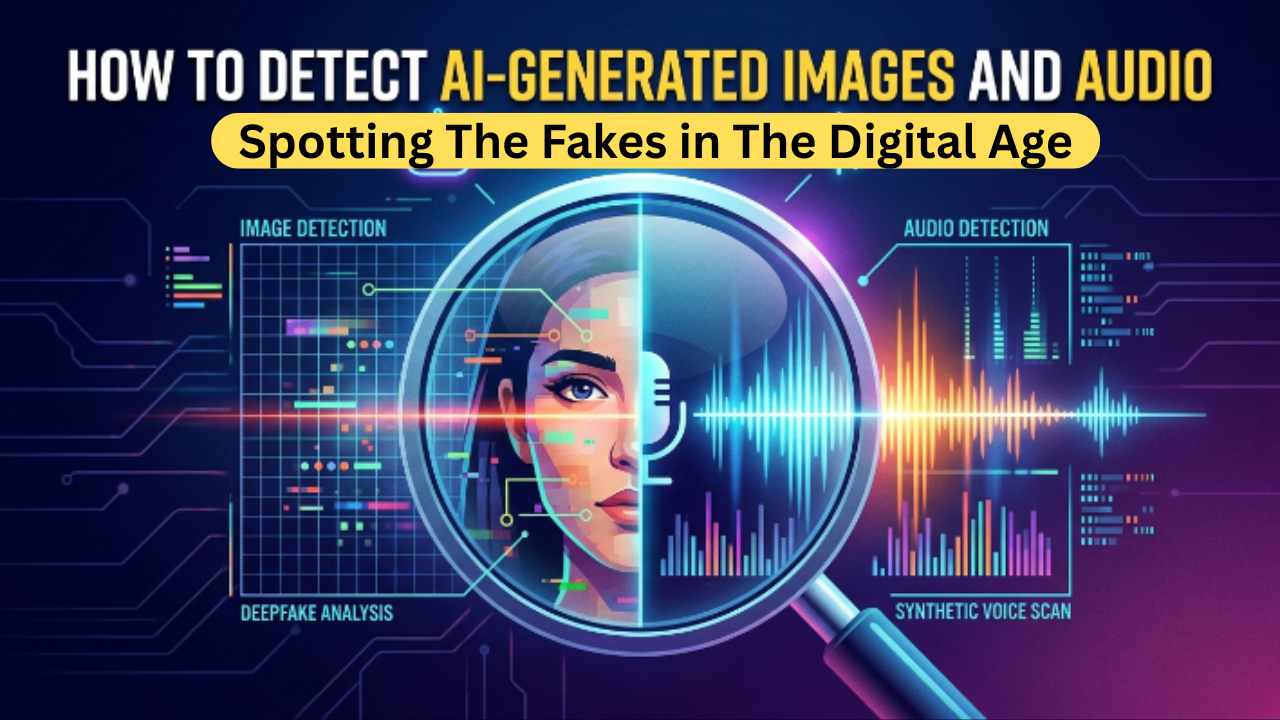
aidiscoveries · Technology & AI Ethics · Deep Dive
AI Ethics & Detection
As AI-generated media floods the internet, understanding how to identify synthetic content is no longer optional — it’s a civic responsibility.
Contents
- What Is Synthetic Content?
- Why Ethics Matter
- Detecting AI-Generated Images
- Detecting AI-Generated Audio
- Detection Tools & Resources
- The Legal Landscape
- What Comes Next
- FAQ
In 2026, the internet is saturated with synthetic media. AI models can generate photorealistic faces, clone voices in seconds, and produce audio indistinguishable from a real human speaker. The ethical implications are staggering and the need to detect AI-generated content has never been more urgent.
527% Rise in deepfake incidents since 2023
96% Of deepfakes target women without consent
$25B Estimated fraud losses linked to voice cloning by 2028

What Is Synthetic Content?
Synthetic content refers to any media image, audio, video, or text that is wholly or partially generated by an artificial intelligence model rather than directly captured or recorded from reality. It spans a broad spectrum: from AI-generated stock photos that never involved a real photographer, to voice clones designed to impersonate specific individuals, to deepfake videos placing real people into fabricated scenarios.
Definition
Synthetic content (also called AI-generated media or synthetic media) encompasses any digital artifact image, audio, video, or text produced by generative AI systems such as diffusion models, Generative Adversarial Networks (GANs), large language models (LLMs), or neural text-to-speech (TTS) engines, rather than by direct human capture of physical reality.
The key technologies driving this explosion include diffusion models (Stable Diffusion, Midjourney, DALL·E 3), GAN-based systems (StyleGAN, BigGAN), and neural TTS engines (ElevenLabs, Suno, Bark). Each leaves a distinct forensic signature the basis for detection.
The Spectrum of Synthetic Media
Not all synthetic content is created equal, and understanding the taxonomy helps frame the ethical debate:
- Benign synthetic media: AI-generated stock photos, synthetic training data, art and creative work no deception intended.
- Ambiguous synthetic media: AI-assisted journalism visuals, satire images the intent is interpretive.
- Manipulated media: Face-swaps, voice modifications, altered context may be deceptive depending on use.
- Malicious deepfakes: Non-consensual intimate imagery, election disinformation, fraud audio clearly harmful and increasingly illegal.
Why the Ethics of Synthetic Content Matter
The ethical dimensions of synthetic content are multifaceted. On one hand, generative AI democratizes creative production enabling individuals, small studios, and underserved communities to produce high-quality content without expensive equipment. On the other hand, the same technology enables unprecedented manipulation of perceived reality at scale.
“The question is no longer whether we can generate synthetic content indistinguishable from reality we already can. The question is what we owe each other in a world where we can.”
Informed Consent and Identity
One of the most ethically fraught applications of synthetic content is the unauthorized use of a real person’s likeness or voice. When a voice clone of a celebrity is used in a scam call, or a politician’s face is placed in fabricated footage, the victim’s identity is weaponized without consent. This raises profound questions about digital autonomy the right of individuals to control how their likeness, voice, and identity are represented in digital spaces.
Epistemic Harm and the Erosion of Trust
Beyond individual harm, synthetic media poses a collective threat: epistemic harm — the degradation of shared factual reality. When citizens can no longer trust images or audio at face value, public discourse suffers. This is sometimes called the liar’s dividend: even authentic footage can be dismissed as fake, allowing bad actors to discredit legitimate evidence.
Critical Risk
Researchers have documented the “liar’s dividend” effect in court proceedings, electoral contexts, and conflict zones, where AI-generated content has been used both to deceive and to cast doubt on authentic recordings. Detection tools are necessary but not sufficient — media literacy is equally critical.
The Asymmetry Problem
Perhaps the greatest ethical tension is the asymmetry between creation and detection. Generating a convincing synthetic image takes seconds and costs fractions of a cent. Detecting it with high confidence requires significant computational resources, specialized training, and critically access to detection models that are always playing catch-up with increasingly capable generators.
How to Detect AI-Generated Images
Detection of AI-generated images operates at multiple levels: visual inspection, metadata forensics, and algorithmic analysis. A robust verification workflow uses all three.
Visual and Perceptual Cues
Despite rapid improvements, current generative models leave characteristic artifacts that trained eyes — and detection algorithms can identify. The most reliable visual signals include:
| Signal | What to Look For | Reliability |
|---|---|---|
| Hand anatomy | Extra or missing fingers, malformed joints, unnatural knuckle structure | High |
| Text rendering | Garbled, pseudo-alphabetic, or inconsistent text on signs or labels | High |
| Symmetry artifacts | Subtle bilateral asymmetry in faces, ears, or jewellery | Medium |
| Background coherence | Objects that repeat, blend together, or violate perspective rules | Medium |
| Fabric and texture | Patterns that fail to continue across folds or edges | Medium |
| Lighting inconsistencies | Shadows or reflections that don’t correspond to apparent light sources | Lower |
Metadata and Provenance Analysis
Authentic photographs carry Exif metadata GPS coordinates, camera make and model, lens specifications, timestamps. AI-generated images typically lack this metadata entirely, or contain metadata injected post-generation that is internally inconsistent. Tools like ExifTool, Jeffrey’s Exif Viewer, or the C2PA (Coalition for Content Provenance and Authenticity) standard’s provenance chains can expose these inconsistencies.
The C2PA standard, now adopted by Adobe, Microsoft, Google, and the BBC, embeds tamper-evident provenance data directly into image files. When a C2PA-compliant camera captures an image, it signs that image with a cryptographic hash. Subsequent AI editing leaves a traceable record or breaks the chain entirely, which itself is a signal.
Read Also: 7-ways-to-make-money-with-ai-in-nigeria-in-2026-no-coding-required/
Algorithmic Detection: How AI Detects AI
At the pixel level, diffusion and GAN models leave frequency-domain artifacts invisible to the human eye but detectable via Fourier analysis. Diffusion models, in particular, tend to produce characteristic high-frequency noise patterns in their outputs. Forensic deep learning models trained on these patterns like those underlying Hive Moderation and Content at Scale’s AI Detector for images achieve accuracies above 90% on current-generation synthetic images, though these figures degrade as models improve.
Practical Tip
For high-stakes verification, use at least two independent detection methods. No single tool is definitive. Cross-reference algorithmic detection with metadata inspection and, where possible, reverse image search to find original sourcing.
How to Detect AI-Generated Audio and Voice Clones
AI-generated audio particularly neural text-to-speech and voice cloning presents a distinct detection challenge. Unlike images, audio is consumed in real time, doesn’t carry visual artifacts, and can be emotionally convincing even at low quality. Voice clone scams have already defrauded millions of dollars from individuals who believed they were hearing a family member in distress.
Acoustic Signatures of Synthetic Speech
Neural TTS systems produce audio with characteristic acoustic properties that differ from natural human speech:
- Prosodic flatness: Synthetic speech often lacks the micro-variations in pitch, rate, and emphasis that characterize emotionally authentic human speech.
- Formant transitions: Transitions between phonemes in synthetic speech may be slightly too smooth or statistically regular compared to natural coarticulation.
- Spectral artefacts: Neural vocoders leave distinctive patterns in the mel-frequency cepstral coefficients (MFCCs) detectable by trained models.
- Breathing and non-verbal sounds: Real speech contains breath sounds, lip smacks, and hesitation markers. Early TTS systems omit these entirely; newer models simulate them, but often imprecisely.
- Codec artifacts: Compressed and re-encoded audio from voice clones often shows unusual spectral gaps or aliasing near Nyquist frequencies.
Detection Models for AI Audio
The academic baseline for synthetic speech detection comes from the ASVspoof challenge series, which has produced a series of benchmark datasets and evaluation frameworks since 2015. Leading models include RawNet2, AASIST, and wav2vec 2.0-based detectors. Commercially, platforms like ElevenLabs’ AI Speech Classifier, Resemble AI Detector, and Microsoft Azure Content Safety offer API access to production-grade detection.
Key Term
A voice clone is a synthetic audio model trained on a relatively small sample (sometimes as few as 3–10 seconds) of a target speaker’s voice, capable of generating new utterances in that speaker’s voice given any text input. The fidelity of current voice clones — from systems like ElevenLabs, Resemble, and open-source models like Tortoise TTS — is sufficient to deceive both humans and legacy biometric voice authentication systems.
Read Also: How I Use “Patch” Prompt to Solve Everyday Problems – AI Discoveries
Red Flags in Real-Time Audio
When you cannot run a sample through a detection tool for example, during a live phone call these behavioural signals indicate possible voice cloning:
- Unusual latency before responses, or responses that don’t react fluidly to interruptions
- Inability to answer personal questions only the real person would know
- Requests for urgent financial transfers or sensitive information
- Audio quality that is unusually clean or free of environmental noise
- Flat emotional affect even when expressing distress or urgency
Detection Tools and Resources
The detection ecosystem is growing rapidly. Here is a curated overview of the most reliable tools available in 2026:
Image Detection
Hive Moderation
Enterprise-grade API for detecting AI-generated images. Supports GAN and diffusion outputs. Best-in-class accuracy on current models.
Image Detection
Content at Scale AI Detector
Free-tier image and text detection. Accessible to journalists and individuals. Useful for quick first-pass verification.
Audio Detection
ElevenLabs AI Speech Classifier
Specialized for detecting ElevenLabs-generated audio. Extends to other major TTS systems. Free for personal use.
Audio Detection
Resemble Detect
Real-time voice clone detection API. Integrates with telephony systems. Targets enterprise fraud prevention use cases.
Provenance / C2PA
Adobe Content Credentials
C2PA-compliant provenance viewer. Inspect cryptographic content credentials attached to images from compatible cameras and editors.
Metadata Forensics
ExifTool
Open-source command-line tool for reading, writing, and editing metadata in image, audio, and video files. Essential for provenance chains.
The Legal Landscape for Synthetic Content
Regulation of synthetic content has accelerated dramatically since 2024. Key developments include:
The EU AI Act (2024)
The European Union’s AI Act, which came into force in stages through 2025–2026, classifies certain synthetic content applications as high-risk and mandates transparency labeling. Systems that generate deepfakes must clearly disclose their synthetic nature. The AI Act also bans real-time remote biometric identification in public spaces — a category that encompasses voice clone detection.
United States: DEFIANCE Act and State Laws
The United States has taken a patchwork approach. At the federal level, the DEFIANCE Act (2024) created civil liability for individuals who produce or share non-consensual intimate deepfakes. Over 20 states now have laws specifically addressing deepfakes in electoral contexts. California’s AB 602 provides a right of action against non-consensual digital replicas.
Liability and Attribution Gaps
Despite legislative progress, significant gaps remain. Attribution — proving who generated a specific piece of synthetic content — is technically difficult. Model watermarking approaches (such as DeepMind’s SynthID) offer a partial solution, but are not yet universally adopted, and adversarial attacks can remove watermarks from some implementations.
Legal Note
This article does not constitute legal advice. The legal status of synthetic content varies significantly by jurisdiction, context, and intent. Consult a qualified attorney for guidance specific to your situation.
What Comes Next: The Arms Race and Its Limits
The trajectory of synthetic content detection is best understood as an adversarial arms race. As detection models improve, generative models are adversarially trained to evade them — a dynamic analogous to antivirus software vs. malware. This suggests that technological detection alone will never provide a permanent solution.
The most promising long-term approaches are provenance-first rather than detecting fakes after the fact, embedding cryptographic authentication at the point of capture. Initiatives like C2PA, SynthID, and hardware-level signing in cameras and microphones aim to make the provenance chain the primary layer of trust, with detection as a secondary fallback.
Equally important is media literacy. Populations that understand how synthetic content is produced, what its limitations are, and why healthy skepticism is warranted are more resistant to manipulation than those who rely solely on detection technology. Educational curricula, newsroom training programs, and public awareness campaigns are all critical investments.
“Detection technology buys us time. Provenance infrastructure builds resilience. Media literacy is the foundation.”
The ethics of synthetic content ultimately cannot be outsourced to an algorithm. They require active, ongoing negotiation between technologists, legislators, journalists, educators, and the public — grounded in a shared commitment to the value of authentic human communication.
Frequently Asked Questions
What is AI-generated synthetic content?
Synthetic content refers to any media images, audio, video, or text that is wholly or partially created by artificial intelligence systems rather than directly captured or recorded from reality. This includes deepfakes, AI-generated voices, GAN-produced images, and diffusion model outputs like those from Midjourney or Stable Diffusion.
How can you detect AI-generated images?
AI-generated images can be detected through multiple methods: inspecting pixel-level artifacts left by GAN or diffusion models, using dedicated AI detection tools like Hive Moderation or Content at Scale, analyzing EXIF metadata for inconsistencies, checking for C2PA provenance credentials, and looking for visual tells such as unnatural hands, asymmetric facial features, or incorrect text rendering.
What tools detect AI-generated audio and voice clones?
Tools that detect AI-generated audio include ElevenLabs’ AI Speech Classifier, Resemble AI’s Detector, Microsoft’s Azure AI Content Safety, and academic models like RawNet2 and AASIST. These analyze spectral patterns, prosody irregularities, and acoustic fingerprints to distinguish synthetic voices from real ones.
Is creating AI-generated synthetic content illegal?
The legality depends on jurisdiction, context, and intent. In many countries, non-consensual intimate deepfakes are explicitly illegal. The EU AI Act mandates transparency labeling for synthetic content in high-risk contexts. The US DEFIANCE Act creates civil liability for non-consensual intimate deepfakes. Creating synthetic content for creative, research, or clearly-labeled satire purposes is generally permitted, though always check local laws.
What is the C2PA standard and how does it help?
C2PA (Coalition for Content Provenance and Authenticity) is an open technical standard that embeds tamper-evident provenance metadata — including cryptographic signatures — directly into digital media files. Adopted by Adobe, Microsoft, Google, Sony, and the BBC, it allows any viewer to verify where an image was created, by what device or software, and whether it has been modified. AI-generated content created by C2PA-compliant tools carries a label indicating its synthetic origin.
Author: Olasunkanmi Adeniyi
AI Ethics Researcher & Technology Writer
Olasunkanmi Adeniyi writes about artificial intelligence, digital rights, and media integrity. His work has appeared in many publications, and blogs. He consult for media organizations on AI policy.
© 2026 AI Discoveries · All rights reserved · Privacy Policy · Contact