
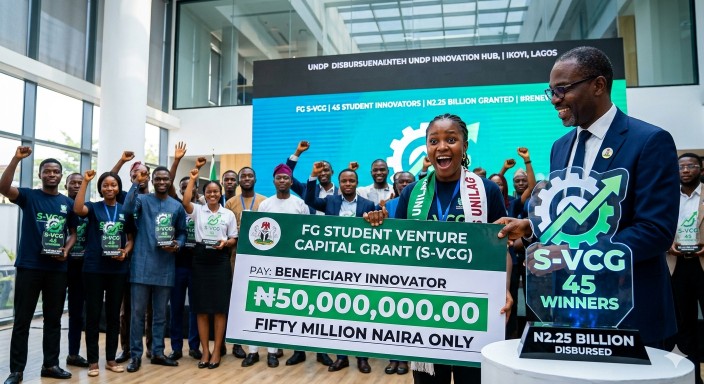
Nigeria’s journey toward becoming a global tech powerhouse just took a massive leap forward. In a landmark event that bridges the gap between academic research and commercial viability, the Federal Government has officially disbursed ₦50 million each to 45 exceptional student innovators.
Read Also: 7 Ways to Make Money With AI in Nigeria in 2026 (No Coding Required) – AI Discoveries
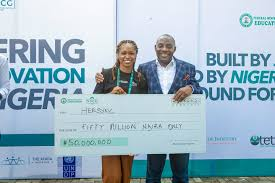
This initiative, known as the Student Venture Capital Grant (S-VCG), is more than just a financial handout—it is a strategic investment in the “Renewed Hope” agenda, designed to transform Nigerian students from job seekers into job creators.
Read Also: The Ethics of Synthetic Content: How to Detect AI-Generated Images and Audio – AI Discoveries
What is the Student Venture Capital Grant (S-VCG)?
The Student Venture Capital Grant (S-VCG) is a government-backed funding mechanism administered by the Federal Ministry of Education. It targets undergraduate and postgraduate students in both public and private tertiary institutions who are building high-impact solutions in STEMM (Science, Technology, Engineering, Mathematics, and Medical Sciences).
Key Highlights of the S-VCG Award:
- Total Funding Disbursed: ₦2.25 Billion (₦50m per student/team).
- Target Sectors: Agriculture, Healthcare, Logistics, Fintech, AI, and Renewable Energy.
- Selection Pool: 45 winners were selected from 65 finalists, narrowed down from over 30,000 applications across 404 institutions.
- Equity-Free: Unlike traditional venture capital, the government takes 0% equity, allowing students to retain full ownership of their startups.
Read Also: 50 ChatGPT Prompt Templates You Can Use Right Now (Free Download) – AI Discoveries
A Shift in Education Policy: Innovation Over Certification
Speaking at the UNDP Innovation Hub in Ikoyi, Lagos, the Minister of Education, Dr. Tunji Alausa, emphasized that this grant represents a “bold declaration.”
“Today, we are activating a new future and a new vision for Nigerian students. Great ideas should not die in classrooms but be nurtured into impactful solutions for our society.” — Dr. Tunji Alausa
The Minister noted that the S-VCG is part of a broader shift to reposition Nigerian universities and polytechnics. Instead of being mere “certification centers,” they are being retooled into hubs of entrepreneurship and industrial problem-solving.
The Role of Partners
The success of the 2026 cohort was bolstered by strategic partnerships with:
- UNDP: Providing the innovation ecosystem and hub infrastructure.
- Google: Offering digital tools and AI licenses (including Gemini Pro) to applicants.
- Bank of Industry (BOI): Assisting in the financial framework and sustainability of the ventures.
Read Also: The Complete Beginner’s Guide to Using AI in Nigeria (2026 Edition) – AI Discoveries
How the 45 Winners Were Chosen
The selection process was grueling, ensuring that only the most viable and scalable businesses received the ₦50 million boost.
| Stage | Process |
| 1. Application | Over 30,000 students submitted business plans and pitch videos. |
| 2. Review | Projects were vetted for market relevance and technical feasibility. |
| 3. Bootcamp | 65 finalists attended a 3-day intensive validation bootcamp in Lagos. |
| 4. Final Pitch | Finalists pitched before industry experts and venture capitalists. |
| 5. Disbursement | 45 winners were selected to receive milestone-based funding. |
UNILAG emerged as a top performer in this cycle, with eight of its students securing grants for projects ranging from AI-driven diagnostic tools to logistics optimization software.
Future Outlook: Building Nigeria’s Silicon Valley
The Minister of Communications and Digital Economy, Dr. Bosun Tijani, also lauded the initiative, noting that it aligns with the national goal of creating a “deep-tech” pipeline. By providing students with mentorship, incubation, and ₦50m in capital, the government is effectively de-risking the earliest stage of entrepreneurship.
The National Programme Coordinator, Mr. Adebayo Adebajo, revealed even loftier goals for the next cycle, aiming for 200,000 applications as the program scales.
Why This Matters for the Nigerian Economy:
- Job Creation: These 45 startups have the potential to employ thousands of youth within their first 2 years.
- Economic Diversification: Moving away from oil-dependency toward a knowledge-based economy.
- Solving Local Problems: Innovations are tailored to Nigerian challenges, such as post-harvest loss in agriculture and rural healthcare access.
Read Also: AI Tools for Nigerian Professionals & Businesses (2026 Complete Guide) – AI Discoveries
Conclusion
The ₦50 million S-VCG grant is a game-changer for student-led innovation. As these 45 beneficiaries move from ideation to commercialization, they carry the mantle of a new Nigeria—one where the laboratory and the marketplace are inextricably linked.
Are you a student innovator? Prepare your pitch, register your business with the CAC, and stay tuned to the official S-VCG portal for the next application window. The next ₦50 million could be yours.