★ The Definitive Parent’s Blueprint · 2026 Edition
By Olasunkanmi Adeniyi and AI Discoveries Editorial Team◆March 2026◆18 min read◆Evidence-based
“Every child alive today will live in a world shaped by artificial intelligence. The question is not whether AI will affect their future, it’s whether they will be its masters or its passengers.”— Dr. Fei-Fei Li, Co-Director, Stanford Human-Centered AI Institute
You are reading this because you sense the same thing millions of forward-thinking parents around the world are beginning to sense: something fundamental has shifted. The children who will thrive in 2035 and beyond won’t just be good at school. They will understand how intelligent systems work, how to collaborate with them, how to question them — and how to build with them.
This is not a fear-based argument. It is an opportunity-based one. And this blueprint will show you, step-by-step, exactly how to give your child that opportunity — regardless of your own technical background.
📋 What You’ll Learn In This Post
Why AI Literacy Is the New Literacy
The Numbers Every Parent Needs to See
The 5 Core AI Skills Every Child Needs
Age-by-Age Guide: From 3 to 18
Best Tools and Resources by Age Group
The Blueprint: 5 Phases of AI Parenting
5 Mistakes Parents Make (And How to Avoid Them)
Creating an AI-Ready Home Environment
Frequently Asked Questions
Why AI Literacy Is the New Literacy
In 1994, being able to use a computer was a competitive advantage. By 2004, it was a basic expectation. By 2024, the same transition had begun for AI fluency. Within the next decade, not understanding how AI systems work will be the equivalent of being functionally illiterate in a professional context.
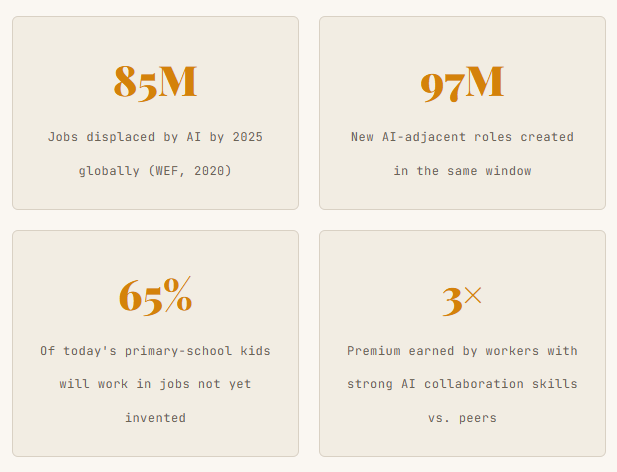
The World Economic Forum’s Future of Jobs Report projects that 65% of children entering primary school today will end up working in jobs that don’t yet exist. Many of those jobs will require AI collaboration as a core competency, not a bonus skill. But here’s the critical nuance most parents miss:
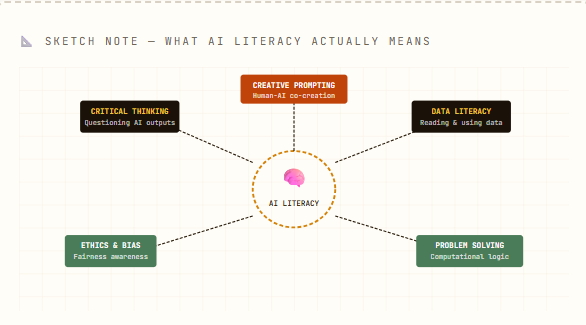
AI literacy is not about teaching your child to code (though that helps). It is about building a set of durable cognitive and ethical frameworks that allow them to engage with intelligent systems thoughtfully, creatively, and critically — for life.
📐 Sketch Note — What AI Literacy Actually Means 🧠 AI LITERACY CRITICAL THINKING Questioning AI outputs ETHICS & BIAS Fairness awareness CREATIVE PROMPTING Human-AI co-creation DATA LITERACY Reading & using data PROBLEM SOLVING Computational logic
The Numbers Every Parent Needs to See
Before we dive into the blueprint, let’s ground ourselves in the research. These figures come from major global reports published between 2023–2025:
85MJobs displaced by AI by 2025 globally (WEF, 2020)
97MNew AI-adjacent roles created in the same window
65%Of today’s primary-school kids will work in jobs not yet invented
3×Premium earned by workers with strong AI collaboration skills vs. peers
The takeaway is not panic — it’s preparation. The wave is already here. The children of parents who act now will ride it. Others will be swept under it.
The 5 Core AI Skills Every Child Needs
Through synthesis of curricula from MIT Media Lab, Stanford’s d.school, the UK Department of Education’s Computing framework, and UNESCO’s AI Competency Framework for Students (2023), five foundational skill clusters emerge. Teach these, and your child will be equipped to navigate any AI landscape — even one we can’t fully imagine yet.
Computational Thinking
The ability to break down complex problems into logical steps — sequencing, pattern recognition, abstraction, and algorithmic design. This is the foundation of all programming and AI work. It can be taught without a single computer through games, puzzles, and cooking recipes.
Prompt Literacy & Human–AI Collaboration
The emerging skill of communicating clearly and creatively with AI systems to achieve real-world goals. This includes knowing how to frame problems, evaluate AI outputs critically, iterate on results, and understand where AI excels versus where it falls short.
Data Literacy
Understanding that AI learns from data — and that data can be biased, incomplete, or misleading. Children who understand how training data shapes AI behaviour develop the critical eye needed to use these tools responsibly and ethically.
AI Ethics & Digital Citizenship
Teaching children to ask: Who does this affect? Is it fair? Could it be misused? As AI becomes embedded in healthcare, education, policing, and media, the next generation must be equipped to be informed moral agents — not just passive users.
Creative & Entrepreneurial Application
Using AI tools to build, make, and create. Whether that’s writing a story with a language model, training a simple image classifier, or building a chatbot for a school project — applied creativity turns passive understanding into active mastery.
Age-by-Age Guide: From 3 to 18
Different developmental stages call for radically different approaches. Handing a 6-year-old a Python tutorial is as misguided as refusing to let a 15-year-old build with real AI tools.
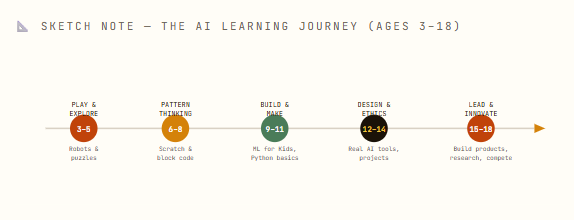
Here is the framework, mapped to developmental science:
📐 Sketch Note — The AI Learning Journey (Ages 3–18) 3–5 PLAY & EXPLORE Robots & puzzles 6–8 PATTERN THINKING Scratch & block code 9–11 BUILD & MAKE ML for Kids, Python basics 12–14 DESIGN & ETHICS Real AI tools, projects 15–18 LEAD & INNOVATE Build products, research, compete
Age Group
Core Focus
What to Teach
How to Teach It
Ages 3–5
Play & Curiosity
Cause-and-effect, sequencing, pattern recognition
Programmable toy robots (Bee-Bot), screen-free coding games, singing sorting games
Ages 6–8
Computational Thinking
Algorithms, loops, conditionals (without jargon)
Scratch Jr., Code.org “Hour of Code”, LEGO Spike Start
Ages 9–11
Building & Making
Block-based ML, data basics, real-world problem solving
ML for Kids, Scratch 3.0, Micro:bit, simple Python, AI art tools
Ages 12–14
Design & Ethics
How ML models are trained, bias in data, prompt engineering
Teachable Machine, ChatGPT for learning, AI project competitions
Ages 15–18
Leadership & Innovation
Applied AI, entrepreneurship, research methodology, ethics in depth
Python/TensorFlow basics, Kaggle, hackathons, school AI clubs, internships
Best Tools and Resources by Age Group
You do not need expensive subscriptions or specialist equipment.
The best AI education tools for children are largely free, browser-based, and joyful.
Here are the ones backed by real classroom results:
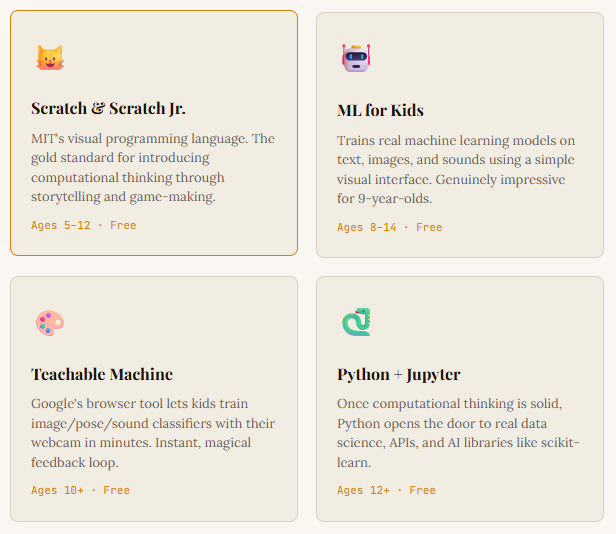
🐱
Scratch & Scratch Jr.
MIT’s visual programming language. The gold standard for introducing computational thinking through storytelling and game-making.Ages 5–12 · Free
🤖
ML for Kids
Trains real machine learning models on text, images, and sounds using a simple visual interface. Genuinely impressive for 9-year-olds.Ages 8–14 · Free
Teachable Machine
Google’s browser tool lets kids train image/pose/sound classifiers with their webcam in minutes. Instant, magical feedback loop.Ages 10+ · Free
🐍
Python + Jupyter
Once computational thinking is solid, Python opens the door to real data science, APIs, and AI libraries like scikit-learn.Ages 12+ · Free
💬
ChatGPT / Claude
Used with a parent present, these tools teach prompt literacy, critical evaluation, and AI collaboration in a real, consequential context.Ages 13+ · Supervised
🏆
Kaggle Learn
Free, structured courses in Python, ML, and AI ethics, plus real competitions with global datasets. Great for motivated teenagers.Ages 15+ · Free
The following framework is how you sequence the entire journey — from a toddler who plays with toy robots, all the way to a teenager who ships real AI-powered projects. Each phase builds on the last.
⚡ The Parent’s AI Blueprint at a Glance
Phase 1: SPARK — Build wonder and curiosity (ages 3–6)
Phase 5: LEAD — Apply, innovate, and share (ages 15–18)
These phases overlap. A gifted 9-year-old may hit Phase 3 early. That’s the point — the framework is a guide, not a cage.
Phase 1: SPARK — Ages 3–6
The goal here is not technical skill. It is wonder. Children at this stage should be allowed to notice that technology responds to them — that giving instructions to a robot or a game produces results. Bee-Bot, Cubetto, and LEGO Duplo coding sets are excellent physical tools. The key principle: no screens required at this phase. The body and hands learn before the eyes.
Phase 2: THINK — Ages 6–10
Now we introduce the core vocabulary of computational thinking — but through play and story, never lecture. Scratch is the canonical tool here. A child who has built even five simple Scratch animations has internalised loops, conditionals, and event-driven logic. Reinforce this offline with games like Robot Turtles (board game) and code.org’s unplugged activities.
Phase 3: BUILD — Ages 9–13
This is the phase most parents skip straight to — and then wonder why their child loses interest. By this stage, your child has the mental models to make real things. ML for Kids lets them build a spam classifier or an image recogniser. Micro:bit lets them create physical devices. They see that they can shape the world with code — and that is transformative.
Phase 4: QUESTION — Ages 12–16
The most underinvested phase. Technical competence without critical thinking produces dangerous practitioners. This is when you introduce structured conversations around AI ethics: Who trained this model? Whose data was used? Who benefits? Who is harmed? Use real examples: facial recognition errors, algorithmic loan bias, deepfakes. Make it personal and concrete.
Phase 5: LEAD — Ages 15–18
Your teenager is now ready to build things that matter to real people. Push them toward hackathons (MIT THINK, Science Olympiad AI events), toward open-source contributions on GitHub, toward internships at AI companies, toward starting a school AI club. The portfolio they build here will open university and career doors that simply did not exist five years ago.
📐 Sketch Note — The AI-Ready Home Environment 🔧 TINKERING CORNER Robots, Legos, Micro:bit, Pi electronics kits → Physical making 📚 THINKING WALL AI concepts map, question boards, ethics debates → Critical thinking 🖥️ CREATE STATION Dedicated screen, Scratch, ML tools, project portfolio → Digital making THE AI-READY HOME ( curiosity lives here )
5 Mistakes Parents Make (And How to Avoid Them)
In working with thousands of families navigating this terrain, the same errors come up again and again. Avoid these and you’ll stay years ahead of the curve.
Mistake 1: Confusing screen time with learning time. Passively watching YouTube or playing Roblox is not AI education. Structured, creative, and reflective engagement with technology is what builds lasting skills. The difference is agency: is your child making, or just consuming?
Mistake 2: Waiting until secondary school. The cognitive foundations — pattern recognition, causal reasoning, sequencing — are best laid between ages 5 and 10. By secondary school, you’re building on a foundation, not creating one. Start early, start playfully.
Mistake 3: Outsourcing everything to a coding class. An hour-long weekly coding class is a starting point, not a strategy. The deepest AI education happens at home, in conversation, in daily life — noticing where algorithms appear (Spotify recommendations, YouTube autoplay, navigation apps) and asking: How does this work? Is this fair?
Mistake 4: Skipping the ethics. A child who can build AI systems but cannot reason about their ethical implications is a liability, not an asset. Ethics is not a module — it is woven through every stage of the blueprint above.
Mistake 5: Thinking you need to be a tech expert. You do not. The most important thing you can model for your child is intellectual curiosity and a willingness to learn alongside them. Say “I don’t know — let’s figure it out together” more than any technical concept you could teach.
Creating an AI-Ready Home Environment
“Children don’t need perfect teachers. They need environments that make curiosity feel safe.”— Mitchel Resnick, LEGO Papert Professor, MIT Media Lab
Your home doesn’t need a server rack or a dedicated coding room. It needs the following five ingredients:
A designated making space. Even a corner of a desk with a Raspberry Pi, some LEGO, and a notebook signals to your child: this is a place where we build things.
A family “AI question of the week”. Pick something you encountered — a recommendation algorithm, a chatbot interaction, a news story about AI — and spend 10 minutes at dinner asking: how might this work? Who decided this? Is it fair?
A “failure is research” culture. The most important mindset in tech is the ability to debug, iterate, and persist. Praise effort and strategy, not just outcomes. When their code breaks (and it will), celebrate the debugging process.
Curated bookshelf and playlist. Books like Hello Ruby (ages 5–9), How to Be a Coder (ages 9–12), and The Alignment Problem (teens + parents) complement hands-on learning powerfully.
Community and peer learning. Connect your child to coding clubs, robotics teams, AI competitions, and online communities like Scratch’s global sharing platform. Children learn fastest from near-peers who are slightly more advanced.
Frequently Asked Questions
My child is 14 and has never done any coding. Is it too late?
Absolutely not. While early foundations help, motivated teenagers can move extremely fast. Start with Python (free on YouTube via CS50 or freeCodeCamp), then move to ML for Kids and Teachable Machine. Within 6–12 months of consistent effort, a 14-year-old can build real, portfolio-worthy projects.
Should I be worried about AI replacing my child’s career before they even start?
The research is nuanced here. Routine cognitive tasks face significant automation pressure. Roles requiring creativity, emotional intelligence, complex reasoning, and AI collaboration are growing. The goal of this blueprint is precisely to position your child in that second category — as someone who works with AI, not against it.
How much screen time is appropriate for AI education?
Quality beats quantity every time. One hour of focused, creative work with Scratch or ML for Kids provides more developmental value than four hours of passive consumption. The American Academy of Pediatrics recommends prioritising “educational, co-viewed, co-engaged” screen time — which is exactly what structured AI education provides.
What if my child is not interested in technology?
Meet them where their interests are. Love animals? Build an image classifier for dog breeds. Love music? Explore how Spotify’s recommendation system works. Love writing? Use AI writing tools to explore how language models work. AI touches every domain — find the door that fits your child’s enthusiasm.
Are AI skills only relevant for future engineers and coders?
No — and this is perhaps the most important point in this entire post. AI literacy is relevant for every future profession: medicine, law, journalism, design, education, business, policy, and the arts. The goal is not to produce programmers. It is to produce informed, capable, ethical citizens who can participate fully in an AI-shaped world.
The Takeaway: Start Today, Not Perfectly
The blueprint above can feel overwhelming when read all at once. But the most important thing you can do today is not pick the perfect curriculum or buy the most expensive robot kit. It is this: sit down with your child and ask a curious question about something intelligent-seeming in your daily environment.
Why does TikTok know what she’ll like? How does Google Maps decide which route to show? Why does the autocomplete on a phone sometimes seem to know exactly what we were about to type?
These are the questions that plant the seeds. The tools, the curricula, the competitions — they are the water and the light. But the seed is curiosity, and that is something every parent can give, starting right now.
The children who grow up asking these questions — and learning how to find the answers — will not just survive the age of AI. They will shape it.
🎯 Your Action Plan for This Week
Identify your child’s current age and find their phase in the blueprint above
Download one free tool from the tools section and try it together for 20 minutes
Start a “How does this AI work?” conversation at dinner this week
Add one AI/tech book to your home reading shelf
Find a local robotics club, coding workshop, or online AI camp for this term
Sources & Further Reading: World Economic Forum Future of Jobs Report 2023 · UNESCO AI Competency Framework for Students 2023 · MIT Media Lab Lifelong Kindergarten Research · Stanford HAI Policy Briefs · American Academy of Pediatrics Digital Media Guidelines · UK Department of Education Computing Curriculum Framework 2023
FutureReady Parenting · Evidence-based guides for raising future-ready children