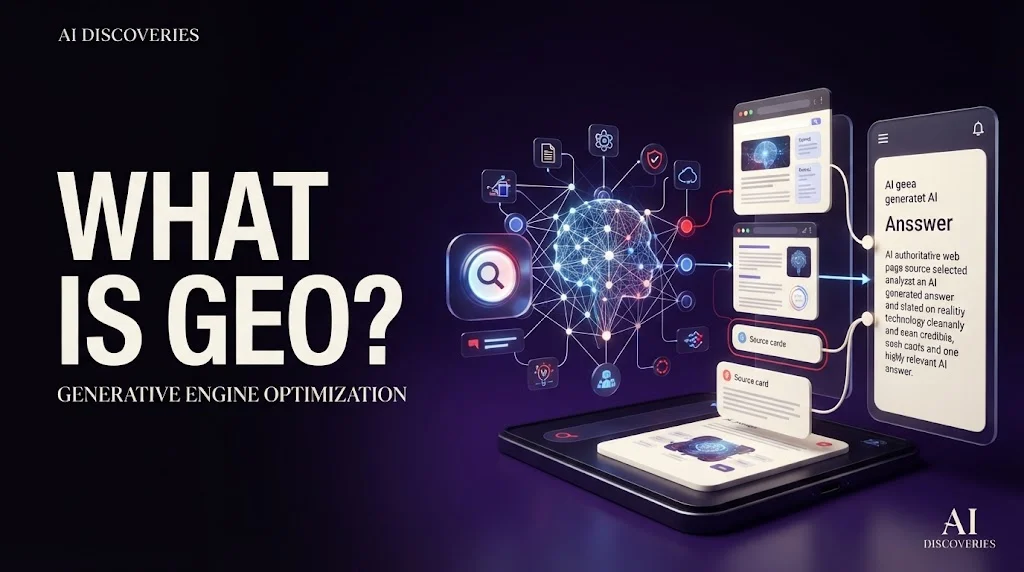
If you publish content online, there is a new question you should be asking:
When someone asks ChatGPT, Google AI, Perplexity, Gemini, or another AI search engine a question related to my business, will my website be mentioned?
That question is at the heart of GEO.
GEO stands for Generative Engine Optimization. It is the practice of creating and structuring content so AI-powered search and answer engines can understand it, trust it, retrieve it, summarize it, quote it, and potentially cite it in their responses.
Traditional SEO helps your website appear in search results.
GEO focuses on helping your content become part of the answer.
This distinction matters because search is changing.
AI systems can now search the web, retrieve information from multiple sources, synthesize that information, and provide users with a direct answer instead of simply displaying a list of links. OpenAI’s ChatGPT Search, Microsoft’s AI-powered search experiences, and other generative search systems are examples of this shift.
In 2026, GEO is becoming an important part of modern search visibility.
WHAT DOES GEO MEAN?
GEO means Generative Engine Optimization.
A simple definition is:
GEO is the process of optimizing online content so that generative AI systems are more likely to discover, understand, use, mention, quote, or cite that content when generating answers to users.
The term was formally introduced in research published by researchers associated with Princeton University and other institutions.
Their 2024 KDD paper, “GEO: Generative Engine Optimization,” examined how content creators could improve their visibility in generative engine responses. The researchers found that optimization strategies could increase visibility by up to 40% in their experimental setting, although results varied by domain and optimization technique.
GEO is therefore more than another marketing acronym.
It represents a change in the way brands think about online visibility.
SEO asks:
“Can I rank for this search?”
GEO asks:
“Can an AI system find, understand, trust, and use my content when answering this question?”
WHY GEO MATTERS NOW
For years, the basic search journey looked like this:
User searches Google → Google displays results → User clicks a website → User reads the content.
AI search changes that journey.
The new journey can look more like this:
User asks a question → AI retrieves information → AI evaluates multiple sources → AI generates an answer → AI cites selected sources.
Microsoft describes this shift as a move from traditional ranking toward systems that use web content to support AI-generated answers. Its Bing Webmaster Tools now includes AI Performance reporting that can show publishers which pages are cited in AI-generated answers across Microsoft Copilot, Bing AI experiences, and selected partner experiences.
That creates a new visibility opportunity.
Your website does not always need to be the first traditional search result to influence an AI-generated answer.
Your content needs to be useful, understandable, accessible, credible, and relevant enough to become a source.
SEO VS GEO: WHAT IS THE DIFFERENCE?
SEO and GEO are closely connected, but they optimize for different experiences.
SEO, or Search Engine Optimization, focuses primarily on improving a website’s visibility in traditional search results.
GEO, or Generative Engine Optimization, focuses on improving the likelihood that content will be retrieved, referenced, quoted, or cited by generative AI systems.
Think about the difference this way.
SEO:
“Which page should appear for this keyword?”
GEO:
“Which sources should help answer this question?”
SEO commonly focuses on:
Keywords
Search intent
Technical SEO
Backlinks
Internal linking
Page experience
Crawlability
Topical authority
Search rankings
GEO adds greater emphasis on:
Clear answers
Context
Entity relationships
Evidence
Statistics
Original research
Expertise
Source credibility
Structured information
Question-based content
Consistent information across the web
AI crawler accessibility
Citation potential
You should not choose between SEO and GEO.
A strong content strategy increasingly needs both.
HOW DOES GEO WORK?
Generative AI search systems do not simply look for pages containing an exact keyword.
They can interpret the user’s question, retrieve relevant information, evaluate sources, and synthesize an answer.
Microsoft describes modern AI search as a system where agents and AI experiences retrieve structured, verifiable, applicable content to help ground generated answers.
This means your content needs to work at several levels.
- SEARCHABILITY
AI systems need to be able to discover your content.
If important pages cannot be crawled or indexed, they have less opportunity to appear in AI-generated experiences.
For example, OpenAI states that public websites can appear in ChatGPT Search and advises publishers to avoid blocking OAI-SearchBot when they want their content to be discoverable and potentially cited.
Technical accessibility therefore remains important.
- RELEVANCE
Your content needs to answer a real question.
Instead of creating a page simply because a keyword has search volume, build content around the information your audience actually needs.
For example:
“What is GEO?”
is a basic informational query.
But a deeper content cluster could include:
What is GEO?
How does GEO work?
GEO vs SEO
How to optimize content for AI search
How to get cited by ChatGPT
How to optimize a website for AI Overviews
What are GEO strategies?
How to measure GEO performance
What is Answer Engine Optimization?
How does AI search choose sources?
This creates a clear topical ecosystem.
Read Also: How to Set Up and Use Guided Vision in Gemini Live (Step-by-Step Guide)
- CLARITY
AI systems need to understand what your page is about.
Clear headings, concise explanations, descriptive titles, logical sections, definitions, examples, and well-organized information make content easier to interpret.
Bing’s current guidance specifically recommends clear structure, descriptive headings, concise sections, tables, and FAQ-style content when creating content that can be understood and referenced in AI-generated answers.
- EVIDENCE
AI systems need reliable information to ground their answers.
That makes evidence increasingly important.
Instead of writing:
“AI search is changing everything.”
Write:
“Microsoft introduced AI Performance reporting in Bing Webmaster Tools in 2026 to show publishers how their pages are cited in AI-generated answers.”
The second statement is more useful because readers can verify it.
Use:
Statistics
Original research
Expert quotes
Named sources
Studies
Examples
Case studies
First-party data
Where appropriate, cite your sources.
- ORIGINALITY
AI systems have access to enormous amounts of similar content.
Publishing another generic article that repeats information already available across hundreds of websites gives your content little reason to stand out.
Original information gives your content more value.
Consider publishing:
Original surveys
Industry research
First-party data
Expert interviews
Case studies
Experiments
Benchmarks
Unique frameworks
Proprietary insights
Real-world examples
This can give AI systems and human readers a stronger reason to reference your work.
- AUTHORITY
Authority matters in GEO.
AI systems need to decide which information is useful and trustworthy.
Your website should clearly communicate:
Who created the content
What expertise they have
Who the organization is
Where claims came from
When information was updated
What sources support important claims
Build recognizable expertise around specific topics rather than publishing disconnected articles about everything.
Read Also: 30 Legitimate Ways to Make Money Online in 2026: A Beginner’s Opportunity Map
THE GEO CONTENT FORMULA
A practical GEO content framework looks like this:
Question
+
Direct answer
+
Context
+
Evidence
+
Examples
+
Expertise
+
Sources
+
Related questions
For example:
Question:
What is GEO?
Direct answer:
GEO stands for Generative Engine Optimization. It is the practice of optimizing content so AI-powered search and answer engines can discover, understand, retrieve, and potentially cite it in generated responses.
Context:
Explain why AI search is changing content discovery.
Evidence:
Reference credible research and official platform documentation.
Examples:
Show how a business could optimize a page.
Related questions:
Answer the next questions a reader is likely to ask.
This structure works well for humans and machines.
HOW TO OPTIMIZE YOUR WEBSITE FOR GEO
You can start improving your GEO visibility without rebuilding your entire website.
STEP 1: Identify questions your audience asks
Stop thinking only in keywords.
Think in questions.
For example, instead of targeting only:
“AI productivity tools”
build content around:
What are the best AI productivity tools?
How can AI save employees time?
Which AI tools can automate repetitive tasks?
How can small businesses use AI for productivity?
What AI tools are free?
AI search is heavily conversational, so question-driven content can give you more opportunities to address specific user intent.
STEP 2: Answer the main question early
Do not make readers or AI systems dig through 1,500 words before finding the answer.
Give a concise definition near the beginning.
Then expand.
For example:
“GEO stands for Generative Engine Optimization. It is the practice of optimizing content so AI-powered search engines can understand, retrieve, reference, and cite it when generating answers.”
Then explain the details.
STEP 3: Build topical depth
One article rarely establishes complete authority around a subject.
Create connected content.
For example, an AI Discoveries GEO content cluster could include:
What Is GEO?
GEO vs SEO
What Is AEO?
GEO Strategies for Beginners
How to Optimize Your Website for ChatGPT
How to Get Your Content Cited by AI
How AI Search Works
How to Measure AI Search Visibility
Best GEO Tools
GEO Case Studies
Link these pages together.
This helps users navigate your site and gives search systems clearer context about your expertise.
STEP 4: Add evidence
Back important claims with credible sources.
For example:
Research papers
Government sources
University research
Official company documentation
Industry reports
Original datasets
Bing’s AI Performance guidance recommends supporting claims with examples, data, and cited sources.
STEP 5: Make important information easy to extract
Use:
Short paragraphs
Descriptive headings
Definitions
Lists
Tables
FAQs
Step-by-step instructions
Examples
Clear conclusions
This does not mean writing for robots.
It means making useful information easy for both people and machines to understand.
STEP 6: Keep information current
AI search is increasingly connected to current web information.
Outdated information can become a liability.
Review important pages regularly.
Update:
Statistics
Product information
Company information
Pricing
Examples
Research
Links
Screenshots
Dates
Microsoft’s Bing Webmaster Tools specifically recommends keeping content fresh and accurate because updated content can help AI systems reference the current version of a page.
STEP 7: Make your brand consistent
Your website should not say one thing while your LinkedIn profile, YouTube channel, business directories, and other authoritative sources say something completely different.
Keep important information consistent.
This includes:
Brand name
Founder information
Products
Services
Locations
Descriptions
Expertise
Industry
Contact information
Bing also recommends consistency across formats so text, images, and video communicate the same entities, products, and concepts.
WHAT TYPES OF CONTENT WORK WELL FOR GEO?
Several content formats can be particularly useful because they answer specific questions or provide information that AI systems can reference.
How-to guides
Example:
“How to Automate Your Weekly Report With AI”
Definitions
Example:
“What Is Generative AI?”
Comparisons
Example:
“ChatGPT vs Gemini: Which Is Better for Research?”
Original research
Example:
“State of AI Adoption in Nigerian Businesses 2026”
Case studies
Example:
“How a Small Business Used AI to Reduce Customer Response Time”
Statistics-driven articles
Example:
“25 AI Adoption Statistics Businesses Should Know”
Expert interviews
Example:
“10 Nigerian Founders Explain How They Use AI”
FAQs
Example:
“50 Questions About AI Agents Answered”
These formats can produce useful passages that directly address user questions.
WHAT IS THE ROLE OF CITATIONS IN GEO?
Citations are becoming an important part of AI search visibility.
When an AI system generates an answer, it may provide links or references showing where information came from.
OpenAI’s ChatGPT Search, for example, was designed to provide answers with links to relevant web sources.
Microsoft’s AI Performance reporting also measures citation activity across supported AI experiences.
This changes the goal for publishers.
You are no longer optimizing only for:
“Will someone click my page from Google?”
You also need to consider:
“Will an AI system consider my page useful enough to cite?”
That creates a new measurement category for content teams.
GEO METRICS TO TRACK
Traditional SEO metrics still matter.
But GEO introduces additional questions.
Track:
AI citations
Pages cited by AI systems
AI-generated mentions
Citation frequency
Queries that trigger your content
Brand mentions in AI answers
Share of AI citations
AI referral traffic
Organic traffic
Conversions from AI-referred visitors
Bing’s AI Performance tools now expose metrics such as pages cited in AI answers, average cited pages, grounding queries, citation counts, and time-series citation data.
The important point is this:
GEO measurement is moving from theory toward actual visibility reporting.
GEO DOES NOT MEAN “TRICKING AI”
This is important.
GEO should not mean manipulating AI systems with hidden text, fake citations, keyword stuffing, fabricated statistics, or misleading claims.
The objective is to make genuinely useful information easier for AI systems to discover and understand.
The best GEO strategy is therefore closely connected to good publishing.
Create something useful.
Make it clear.
Support it with evidence.
Demonstrate expertise.
Keep it updated.
Make it accessible.
Build authority around the topic.
That is a much more sustainable approach than trying to exploit temporary weaknesses in an AI system.
COMMON GEO MISTAKES
- Writing only for keywords
A page can contain the right keywords and still fail to provide a useful answer.
Focus on the user’s actual information need.
- Publishing generic AI-generated articles
AI can help you research, outline, draft, and edit.
But publishing generic content at scale does not automatically create authority.
Add original insights, examples, evidence, experience, and useful information.
- Making unsupported claims
If you say something important, support it.
Especially when discussing statistics, market size, scientific findings, financial claims, or product capabilities.
- Ignoring technical SEO
GEO does not eliminate technical SEO.
Crawlability, indexability, site architecture, page performance, structured data, internal linking, and accessible content still matter.
- Forgetting the human reader
Do not turn every article into a machine-readable document.
Your primary job remains helping people.
- Chasing guaranteed AI citations
No legitimate GEO strategy can guarantee that ChatGPT, Google, Gemini, Perplexity, Copilot, or another AI system will cite a specific page for every query.
AI responses can change based on query wording, sources, freshness, location, context, model behavior, and other factors.
Treat GEO as an optimization and measurement discipline, not a guaranteed placement system.
GEO, AEO, AND SEO: ARE THEY THE SAME?
You may also encounter another term:
AEO.
AEO usually means Answer Engine Optimization.
The terms overlap significantly.
SEO focuses on traditional search visibility.
AEO focuses on appearing in direct answers and answer-focused search experiences.
GEO focuses specifically on visibility within generative AI experiences.
In practice, the boundaries are not always strict.
A modern search strategy can incorporate all three.
The important goal is understanding how people discover information and making your content useful across those discovery systems.
WHY GEO IS IMPORTANT FOR SMALL BUSINESSES
GEO is not only for large companies.
A small business can use GEO to build visibility around specific customer questions.
Imagine a Lagos-based accounting firm.
Instead of publishing generic articles such as:
“Why Accounting Is Important”
it could publish:
“How Much Does a Small Business in Nigeria Pay in Tax?”
“What Tax Records Should Nigerian SMEs Keep?”
“How Does VAT Work for Nigerian Businesses?”
“Best Accounting Software for Nigerian SMEs”
“Common Tax Mistakes Nigerian Businesses Make”
These pages answer specific questions.
They can also demonstrate expertise, include Nigerian examples, reference official sources, and connect related topics.
Over time, this creates a stronger topical footprint.
The same principle applies to:
Law firms
Consultants
Doctors
Recruiters
SaaS companies
Logistics companies
Real estate businesses
Financial services
Universities
Training companies
Technology companies
Creators
Professional services firms
GEO FOR CONTENT CREATORS
Creators can benefit too.
Imagine someone asks:
“Who are the best AI educators in Nigeria?”
If your website, social profiles, videos, interviews, articles, and other credible references consistently establish your expertise, you have more digital evidence supporting your entity and topic association.
This is why GEO should not be treated as a blog-only strategy.
Your website is one part of your digital presence.
Your:
LinkedIn
YouTube
X profile
Podcasts
Interviews
Guest articles
Research
Press coverage
Business profiles
Communities
can all contribute to how your expertise and brand are represented online.
THE FUTURE OF SEARCH IS MULTI-SURFACE
The biggest GEO mistake is thinking there will be one AI search engine that matters.
There won’t necessarily be.
People already use multiple discovery systems.
They search Google.
They ask ChatGPT.
They use Gemini.
They explore Perplexity.
They interact with Microsoft Copilot.
They search YouTube.
They ask social networks.
They use AI-powered applications and agents.
OpenAI says ChatGPT Search connects users with web sources and gives content owners opportunities to reach audiences through AI-driven discovery.
Microsoft is also building measurement capabilities around how websites appear as sources in AI-generated answers.
The implication is simple:
Your content strategy needs to prepare for multiple discovery surfaces.
A PRACTICAL GEO CHECKLIST
Before publishing your next article, ask:
Does this page answer a specific question?
Is the answer clear near the beginning?
Does the page demonstrate genuine expertise?
Are important claims supported by credible sources?
Does it include original information?
Does it use descriptive headings?
Are related questions answered?
Is the content easy to scan?
Can search engines crawl and index it?
Is the information current?
Are internal links relevant?
Is your brand information consistent across the web?
Could an AI system understand exactly what this page is about?
Could a reader confidently recommend this page as a source?
If the answer is yes to most of these questions, you are building content that is better prepared for AI-powered discovery.
FREQUENTLY ASKED QUESTIONS ABOUT GEO
What does GEO stand for?
GEO stands for Generative Engine Optimization. It refers to optimizing content so generative AI and answer engines can discover, understand, use, and potentially cite that content when generating answers.
What is GEO in SEO?
GEO is an emerging discipline related to SEO that focuses on visibility within AI-generated search and answer experiences. SEO primarily focuses on traditional search rankings, while GEO focuses more on how content appears as part of AI-generated answers.
Who created the concept of GEO?
The term Generative Engine Optimization was introduced in research titled “GEO: Generative Engine Optimization,” authored by Pranjal Aggarwal, Vishvak Murahari, Tanmay Rajpurohit, Ashwin Kalyan, Karthik Narasimhan, and Ameet Deshpande. The work was published at KDD 2024.
Does GEO replace SEO?
No. GEO does not replace SEO. Strong technical SEO, crawlability, indexing, content quality, authority, and search visibility remain important. GEO extends the optimization conversation to generative AI experiences.
How do I optimize my website for GEO?
Start by answering specific questions clearly, creating authoritative content, supporting claims with evidence, publishing original information, improving site accessibility, building topical depth, maintaining consistent brand information, and keeping content updated.
Can GEO guarantee ChatGPT citations?
No. GEO cannot guarantee citations. AI systems select and generate answers dynamically. Your goal is to increase the usefulness, relevance, accessibility, credibility, and citation potential of your content.
Does GEO only apply to ChatGPT?
No. GEO can apply broadly to generative AI search and answer experiences, including systems such as ChatGPT Search, Microsoft Copilot, Bing’s AI experiences, Google AI search experiences, Perplexity, and other emerging systems.
HOW AI DISCOVERIES THINKS ABOUT GEO
At AI Discoveries, we see GEO as part of a larger change in digital discovery.
For years, businesses competed to rank on search engines.
Now they also need to become useful sources for AI systems.
That means the question is evolving from:
“How do I rank?”
to:
“How do I become a trusted source?”
That requires more than publishing more articles.
It requires expertise.
It requires evidence.
It requires useful answers.
It requires strong digital entities.
It requires consistent information.
It requires content that people want to reference and AI systems can understand.
The brands that adapt early can build an advantage before AI search becomes even more deeply integrated into how people research products, companies, services, careers, and ideas.
FINAL TAKEAWAY
GEO stands for Generative Engine Optimization.
It is the practice of improving your content’s ability to be discovered, understood, retrieved, referenced, quoted, and cited by generative AI systems.
The rise of AI search does not make content irrelevant.
It changes what makes content valuable.
The winning approach is straightforward:
Answer real questions.
Create original insights.
Use credible evidence.
Build topical authority.
Make your content easy to understand.
Keep it current.
Make your website accessible to search and AI systems.
Build a consistent digital presence.
Measure where your content appears in AI-generated answers.
SEO helped websites compete for rankings.
GEO helps them compete for inclusion in the answers themselves.
And that shift is already underway.
SOURCES
Princeton University, “GEO: Generative Engine Optimization,” KDD 2024.
Microsoft Bing, “Elevating the Role of Grounding on the AI Web,” 2026.
Microsoft Bing Webmaster Tools, “AI Performance in Bing Webmaster Tools.”
Microsoft Bing Webmaster Blog, “Introducing AI Performance in Bing Webmaster Tools Public Preview.”
OpenAI, “Introducing ChatGPT Search.”
OpenAI Help Center, “Publishers and Developers FAQ.”
✍️ About the Author
Olasunkanmi Adeniyi is a product manager, AI prompt engineer, and the founder of AI Discoveries (aidiscoveries.io). With hands-on expertise in leading AI models, no-code automation, and digital strategy, he helps businesses and creators adopt practical artificial intelligence. He is the author of several business and tech guides, including ChatGPT Mastery Guide for Business Owners, AI-POWERED LINKEDIN GROWTH AUDIT
and SELL YOURSELF. All content is rooted in real-world testing, modern workflows, and a commitment to smart, actionable technology adoption.
Learn more and explore his latest work at www.aidiscoveries.io.




Leave a Reply